

Illustrative patient calmly discussing jaw movement with a dental clinician
Specialized Care

Jaw Clicking Assessment in Halton Hills

Waking up with a stiff jaw that pops over your first coffee? From anywhere in Halton Hills, our team can help work out what that means. A click without pain often needs no care, while morning soreness, catching, or reduced opening merits a closer look.

First thing in the morning

Stiff on waking, clicking by breakfast

Some people notice their jaw most in the early hours: a tight feeling as they wake, then a pop or two as they start to talk and eat. Often it eases as the day goes on. On its own, a joint sound is very common and frequently means nothing harmful. It does not confirm that the joint is worn or injured, and it is not a sign that your teeth have to be moved or reshaped.

The morning pattern is a useful clue, though, and so is everything around it. Is there soreness in the cheeks or temples? Has your partner heard grinding at night? Does the jaw ever catch or stop short of its usual opening, and has there been any injury? A history and examination in person sort those details out in a way a quick recording cannot.

From Georgetown, Acton, Glen Williams, or one of the smaller hamlets, start the visit by telling us what you notice and when. We will look at the jaw and teeth together, talk about whether keeping an eye on things is enough, and say if more care or a referral would help. Expect a practical plan for comfort and function, not a vow that the joint will never make a sound.

Book a visit about morning jaw symptoms
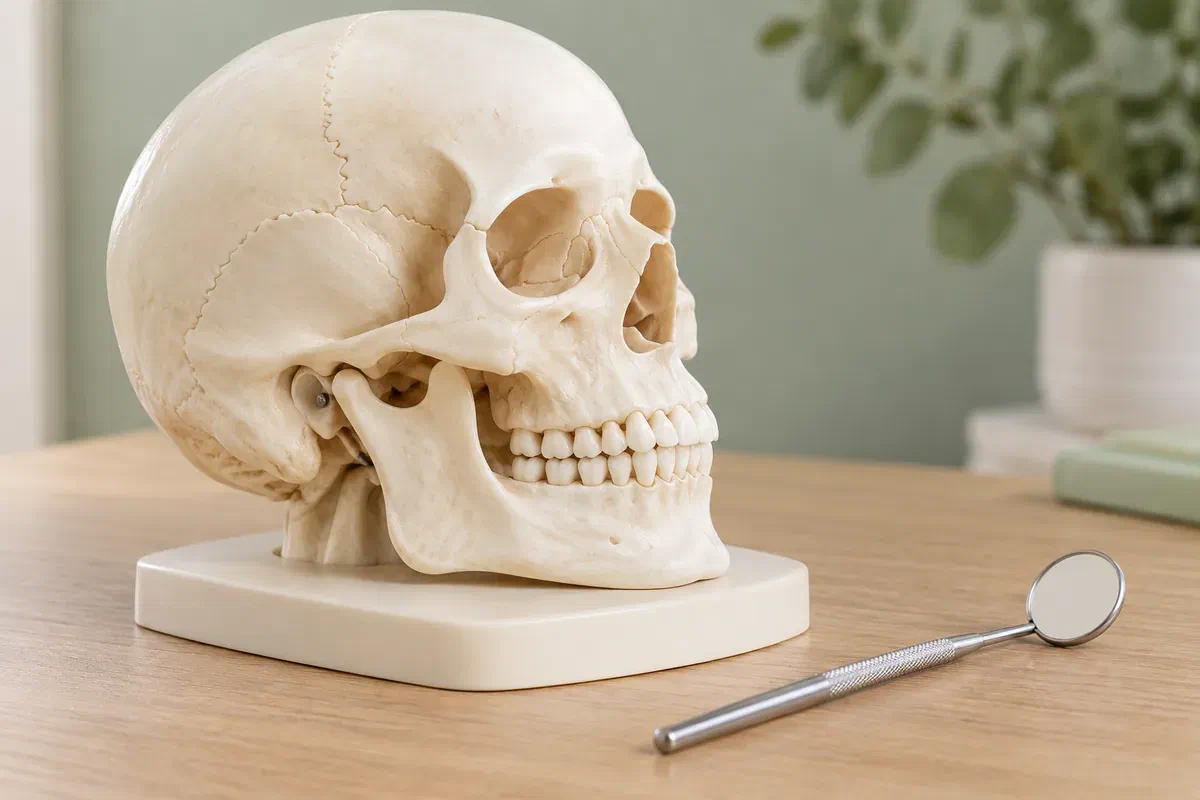
Illustrative anatomical skull model with an attached lower jaw and visible joint region
Morning, noon, and night

When the click happens tells part of the story

Keep a rough note of which side clicks, the time of day it is worst, and how long it has been going on. Testing it repeatedly before you come in is unnecessary. A plain account of a normal week is ideal.

A click that comes and goes, painlessly

If the sound has been with you for a while and never gets in the way of eating or opening, mention that clearly. Ask whether anything in the examination changes how much it matters. When nothing else turns up, explanation and observation are a reasonable response.

Morning ache or tired muscles

Say whether the soreness is by the joint, through the cheek muscles, at the temples, or elsewhere, and whether it fades through the day. Mention tenderness, fatigue, and any tooth sensitivity. That discomfort is looked at in its own right, since it may have a different source from the click.

A jaw that will not open fully

Explain whether it catches for a moment, gets stuck, or has a new limit on opening. Mention injuries and any difficulty eating or drinking. If the jaw is locked or badly restricted, call a clinician promptly, and resist forcing it or trying a repositioning method you saw online.

Prompt care is important when the jaw is stuck, after a significant injury, or if eating or drinking is impossible. Breathing or swallowing trouble, large swelling, or any severe symptom needs emergency medical attention.

What a consultation can tell you

Whether the morning stiffness and the click are even related

An assessment separates a harmless joint sound from a problem involving pain or limited movement, and sometimes it shows that the two are unrelated. Ask what the findings support and whether there is a confirmed diagnosis. A sound explanation can include some uncertainty instead of labelling every click the same way.

If care is suggested, the goal should be easy to state. Waking without soreness, or opening comfortably again, is a clear aim. Making a painless joint silent is a different matter. Ask how the plan relates to your reason for booking and how its effect will be reviewed.

Assessment built around your pattern

Your history, jaw movement, any tenderness, and the teeth are considered together, including signs of clenching or grinding where relevant. Ask which findings are significant and which are probably incidental. The click should not overshadow a morning ache that bothers you more.

Any scan or referral explained

Further tests are worthwhile when they can answer a question or change your care. Ask what they would show and what they cannot. There is no automatic scan for a clicking jaw, and a result must be read alongside the examination.

Reversible options considered first

If treatment is needed, discuss conservative approaches and a point at which progress will be reassessed. Ask what change to expect and how to respond if symptoms worsen. Nobody should assume that a clicking joint means your teeth need permanent work.

How the assessment works

Your routine, your jaw, and a plain-language summary

We open with your daily pattern, from waking to bedtime. If opening wide is uncomfortable, tell the clinician, and agree on how you will signal a pause.

  1. Describe your typical day

    Explain when the clicking started, whether it is one-sided or on both sides, and whether pain, stiffness, or catching is involved, especially in the morning. Mention past injuries, previous jaw treatment, any night guard, and health information that may be relevant.

  2. Gentle examination

    The clinician checks how you open and close, feels for tender areas in the joint and muscles, and looks at dental findings as appropriate. Sharp pain is not something to push through. Say whether the examination reproduces your usual feeling.

  3. What we found, and what is still unclear

    Ask whether the findings point toward observation, a jaw-related diagnosis, a separate dental concern such as wear from grinding, or further assessment. If imaging or referral is mentioned, ask what it would answer. The observed sound and a theory about its cause should be kept apart.

  4. A plan with a check-in date

    Confirm whether treatment is needed and which changes should prompt an earlier call. If care is proposed, ask about its purpose, costs, limitations, and follow-up. A clear plan lets you notice what matters without testing the click every morning.

In the days ahead

Notice the mornings. Ignore the pop.

Follow the guidance that fits your findings. A painless click and a sore, locking jaw are handled very differently, so a routine someone else swears by may not suit you.

Track how you wake up

If monitoring is advised, note any new stiffness, pain, catching, or trouble opening and eating. Clicking the jaw deliberately to check on it is unnecessary. Ask which details are worth recording and when the clinician wants to hear back.

Stay within the advice given

If exercises or temporary changes in activity are suggested, have them shown to you and ask where to stop. Never force a jaw that has locked, and do not use a painful movement to try to end a click. Contact us if the recommendation seems to aggravate things.

Bring your night guard along

If you already wear one, explain why it was made and whether symptoms improved, worsened, or stayed the same. Do not file it down or swap it for a store-bought version just to quiet the joint. If a prescribed guard hurts, stop and check with the provider who made it.

Options after the assessment

Three directions, depending on what we find

Which route makes sense depends on how the click, any morning ache, and your range of movement fit together. Good advice deals with the problem found on examination, and a silent joint is not the yardstick.

A painless click with normal movement

Explanation and watchful waiting

You may be told that the click itself needs no treatment. Ask what would be a reason to look again and whether it can be checked at routine visits. Observation should come with enough explanation that you know why no appliance or procedure is needed.

When morning pain or another jaw concern is confirmed

Conservative care for soreness

Reversible care may focus on habits such as clenching, comfortable jaw use, or other contributing factors. Ask what is being tried and how you will both judge the response. Treatment should follow the diagnosis and your needs, with realistic expectations and no promise that one method stops every sound.

When locking, injury, or ongoing difficulty is present

Further evaluation

A clinician experienced in jaw-joint or facial-pain care may be appropriate for complex problems or movement that stays limited. Ask what information will be shared and whether you need care while you wait. Urgent symptoms should be addressed promptly rather than left on a routine list.

Patient information: NIDCR — conservative TMD care and avoiding permanent bite changes

Halton Hills questions

Morning stiffness, night guards, and clicking

These answers can help you discuss a clicking jaw without assuming it must be fixed. When you call, mention any pain, locking, or change in how far the jaw opens.

(905) 876-4488
Will a night guard make my jaw stop clicking?
Not necessarily. A guard may be suggested for reasons such as protecting teeth from grinding, but it is not a guaranteed way to silence a joint. Ask what it would be for and how its usefulness would be judged.
Is a drugstore mouthguard a good idea while I wait to be seen?
Ask before buying one. An ill-fitting guard can feel uncomfortable, and buying a device only to quiet a click is not recommended. If you already use one, bring it to the appointment and mention how your jaw feels with it.
My partner says I grind my teeth at night. Is that connected to the click?
It might be relevant, which is why it is worth mentioning. Grinding or clenching can contribute to jaw muscle discomfort and tooth wear, but it does not explain every joint sound. The examination helps put it in context.
My jaw is stiff when I wake up but fine by lunch. Is that worth an appointment?
It is worth raising, particularly if it is new, getting worse, or comes with pain or catching. A painless click alone may only need observation, but a regular pattern of morning stiffness is useful history.
Do noisier clicks need more urgent attention?
Not on loudness alone. How audible a click is does not decide a diagnosis or whether treatment is needed. Pain, catching, and reduced movement matter more, and those are what to describe when you book.
Could straightening or reshaping my teeth fix a click that does not hurt?
That should not be assumed. Permanent bite changes are not a standard answer to painless joint sounds. Ask for the diagnosis, the reasoning, and alternatives first, and seek an independent opinion if the purpose is unclear.
Booking from Halton Hills

Mornings should not start with a sore jaw.

Get in touch with our Bronte Street practice about clicking with discomfort, catching, or restricted movement. If your jaw is locked, opening is severely limited, or eating and drinking have become hard, let us know when you call.

Clicking that does not hurt often needs no care. Any scan, treatment, or referral we suggest is based on your examination and history, and we cannot promise the jaw will go quiet.

Visit Milton Dental Clinic
Unit 1, 342 Bronte St. S, Milton, ON L9T 5B7
Get directions Clinic hours
Monday–Thursday
11am–7pm
Friday–Sunday
By appointment only

Areas we serve

  • Milton
  • Oakville
  • Mississauga
  • Georgetown
  • Halton Hills
  • Acton
  • Campbellville
  • Brampton
  • Burlington
  • Puslinch
  • Rockwood
  • Erin
  • Caledon
  • Etobicoke
  • Old Milton
  • Bronte Meadows
  • Timberlea
  • Dorset Park
  • Dempsey
  • Clarke
  • Beaty
  • Coates
  • Harrison
  • Scott
  • Willmott
  • Ford
  • Bowes
  • Cobden
  • Walker
  • Mountain View
  • Milton Heights
  • Hawthorne Village
  • Valley View
  • Fallingbrook
  • Nassagaweya
  • Trafalgar
  • Esquesing
  • Nelson
  • Brookville
  • Moffat
  • Glen Williams
  • Norval
  • Limehouse
  • Stewarttown
  • Ashgrove
  • Hornby
  • Silver Creek
  • Speyside
  • Scotch Block
  • North Oakville
  • River Oaks
  • Glen Abbey
  • West Oak Trails
  • Palermo
  • Bronte Creek
  • College Park
  • Joshua Creek
  • Uptown Core
  • Preserve
  • Iroquois Ridge
  • Lisgar
  • Meadowvale
  • Meadowvale Village
  • Churchill Meadows
  • Erin Mills
  • Central Erin Mills
  • Streetsville
  • East Credit
  • Creditview
  • Heartland
  • Sheridan
  • Mount Pleasant
  • Credit Valley
  • Huttonville
  • Churchville
  • Springbrook
  • Northwest Brampton
  • Bram West
  • Fletcher's Meadow
  • Fletcher's Creek South
  • Alton Village
  • Orchard
  • Millcroft
  • Headon Forest
  • Tansley
  • Brant Hills
  • Tyandaga
  • Kilbride
  • Lowville
  • Aberfoyle
  • Morriston
  • Arkell
  • Hillsburgh
  • Freelton
  • Carlisle
  • Waterdown
  • Flamborough
  • Mountsberg

How can we help?

Milton Dental Clinic

Have a question about your smile? Choose the option that works best for you.

For urgent dental concerns, please call.
Messages are reviewed during clinic hours.