

Illustrative patient calmly discussing jaw movement with a dental clinician
Specialized Care

Jaw Clicking Assessment in Milton

Not sure whether a clicking jaw is worth an appointment? Talk it through with our team in Milton. Many clicks are harmless and need nothing done, but pain, catching, or a jaw that opens less than before deserves a closer look.

Is the click worth a visit?

Most jaw sounds are simply sounds. The useful question is what else is going on.

Maybe you noticed it over dinner, or a family member heard it while you yawned. A pop just in front of the ear can be startling the first time, yet the joints there move whenever you talk, chew, or swallow, and they can make noise without anything being wrong. A sound on its own is not proof of damage, and it is not a sign that your bite has to be changed.

What shifts the picture is company. Pain, a jaw that catches or sticks, opening that feels shorter than it used to, or a change since a fall or knock are the details a clinician needs. Those come from talking with you and examining the jaw in person, which a phone clip or a search result cannot replace.

When you come to our Milton practice, start with what you have noticed and what concerns you about it. Together we can go over the jaw and dental findings, whether simply keeping an eye on it makes sense, and whether more care or a referral would help. You should leave with a plan you understand for comfort and function, not a pledge to make every click go away.

Ask about a jaw that clicks or catches
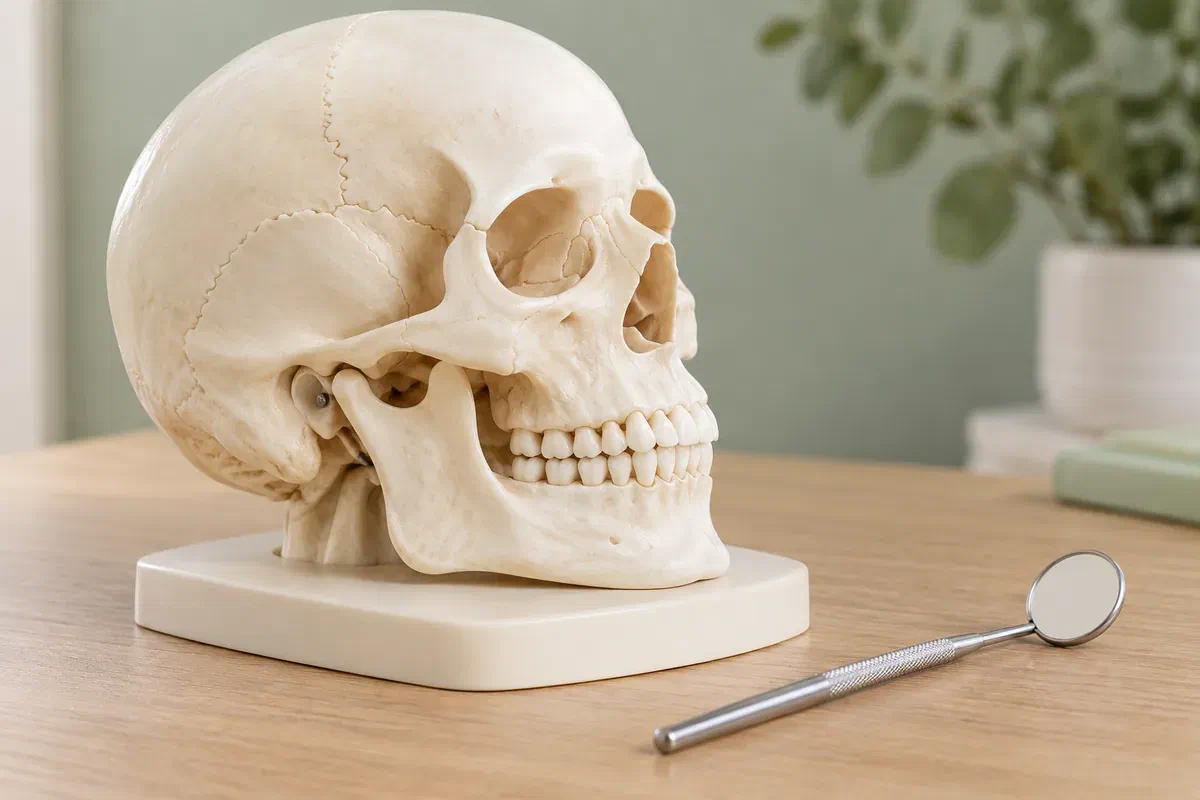
Illustrative anatomical skull model with an attached lower jaw and visible joint region
Sorting the sound from the symptoms

Three situations that can look alike at first

Let us know which side clicks, what sets it off, and whether it is new or has been around for years. There is no need to practise making the sound before your visit; a plain description of ordinary days is what helps most.

An old, quiet habit of the joint

If the click has been there a long while and never gets in the way of eating or opening, say so. Ask whether anything found during the examination makes that history more significant. When nothing else is wrong, an explanation and a plan to watch it may be all that is needed.

A click that now comes with soreness or tired chewing

Point to where it aches, whether at the joint, along the cheek muscles, or somewhere else, and name the foods or tasks that have become harder. Tenderness, fatigue, and any tooth symptoms are worth mentioning. Discomfort deserves its own look rather than being blamed on the most obvious noise.

Sticking, locking, or less room to open

Tell the clinician whether the jaw hitches for a moment, stays stuck, or simply opens less than normal. Mention any injury and any trouble eating or drinking. Call promptly if movement is badly limited or locked, and avoid forcing it or trying a repositioning trick seen online.

Get prompt professional care for a jaw that is stuck, a significant injury, or being unable to eat or drink. Trouble breathing or swallowing, major swelling, or other severe symptoms call for emergency medical care.

What a good assessment gives you

Clarity first, and treatment only if something actually needs it

The visit is meant to tell a harmless noise apart from a problem involving pain or limited movement. It is fair to ask what the findings actually support and whether a firm diagnosis has been reached. A good explanation is honest about uncertainty and does not give every click the same label.

When some form of care makes sense, its aim should be plain. Helping you chew comfortably or open more freely is a different goal from chasing silence in a joint that does not hurt. Ask how the suggestion connects to the reason you booked and how everyone will judge whether it is helping.

Findings tied to what you feel

Movement, tenderness, your history, and relevant dental findings are weighed together. Ask which observations carry weight and which are probably incidental. A click that is easy to hear should not crowd out a quieter complaint that matters more to your daily comfort.

A clear purpose behind any scan or referral

Extra tests are worth considering when they answer a real question or could change the plan. Ask what an image would show and where its limits lie. Joint sounds do not all lead to the same scan, and any result still has to be read alongside the examination.

Gentle, reversible steps when care is warranted

Talk about suitable reversible options and a date to review progress before anything permanent is considered. Ask what improvement to expect and what to do if symptoms get worse. Reshaping or moving teeth should not be assumed necessary just because a joint is noisy.

What happens at the appointment

From your story to an examination to a plain explanation

We begin with how the jaw behaves during everyday activities. If opening wide is uncomfortable, tell the clinician, and agree on a simple signal for a pause.

  1. Share the history

    Describe when the clicking started, which side or sides are involved, and whether there is pain or restriction. Mention any injuries, earlier jaw treatment, appliances, and health details that might matter. You can ask to concentrate on the change that bothers you most.

  2. A comfortable look at movement

    The clinician checks opening and closing, tender areas, and dental findings where relevant. Pushing through sharp pain to show the problem is not required. Say whether the examination brings on your usual symptom or feels different from what happens at home.

  3. Talk through what is known and what is not

    Ask whether the findings point toward observation, a jaw-related diagnosis, another dental issue, or a further assessment. If imaging or a referral comes up, find out what question it is meant to answer. Separating the sound that was observed from a guess about its cause makes the explanation more useful.

  4. Settle on a plan and a check-in

    Confirm whether anything needs treating and which changes should bring you back sooner. If care is proposed, ask about its purpose, cost, limits, and follow-up. A specific plan tells you what to report, so you are not testing the click all day.

In the weeks that follow

Watch for real change, not for the click

Follow the advice that fits your own findings. Guidance for a painless click can look nothing like guidance for pain or locking, so a friend's exercise routine is not a safe stand-in because their jaw clicks too.

Pay attention during ordinary use

When monitoring is the plan, notice any new pain, catching, or trouble with eating and opening. Making the sound over and over to see if it is still there is unnecessary. Ask which changes are worth writing down and when the clinician would like to hear about them.

Stick to movement advice meant for you

If exercises or short-term changes in activity are suggested, ask to see them demonstrated and to hear the limits. Never force a locked jaw or use a painful motion to try to stop a click. Get in touch if a recommended activity makes discomfort or restriction worse.

Bring any appliance you already use

Explain why it was made for you and whether symptoms changed while wearing it. Avoid adjusting it yourself or buying a new one only to quiet a click. If a prescribed device causes pain, stop wearing it and ask the provider who made it for advice.

Possible next steps

Watch, manage gently, or look further

Ask which path matches your mix of sound, pain, and function. The recommendation should respond to the problem that was assessed, not treat a silent joint as the only sign of success.

For a painless click with comfortable movement

Explanation and watchful waiting

You may hear that the sound itself needs no treatment. Ask what would prompt a fresh look and whether it can be checked at routine visits. Choosing to watch it should come with enough explanation that you know why an appliance or procedure is not needed.

For pain or another assessed jaw concern

Conservative care for discomfort

A reversible plan might address habits, comfortable movement, or other contributing factors. Ask what is being tried and how the response will be measured. Care should follow the diagnosis and your goals, with realistic expectations instead of a promise that one method fixes every sound.

When the history or findings call for more

A further opinion for locking, injury, or ongoing trouble

Someone with experience in jaw-joint or facial-pain care may be the right next step for complex problems or movement that stays limited. Ask what information will be passed along and whether you need care while you wait. Urgent symptoms should never sit on a routine waiting list.

Patient information: NIDCR — conservative TMD care and avoiding permanent bite changes

Common questions

Before you book, a few things people often ask

These answers can help you talk about clicking without assuming it needs fixing. When you call, mention pain, locking, or a change in how far your jaw opens.

(905) 876-4488
Is it fine to wait and mention the click at my next regular checkup?
Often, yes, if the sound is painless and your jaw opens and chews normally. Book sooner if pain, catching, or reduced opening appears. Raising it at a routine visit lets the clinician note a baseline and decide whether anything more is worthwhile.
My jaw clicks on both sides. Is that more worrying than one side?
Not by itself. Which side clicks is useful information, but the significance depends on pain, movement, and the examination. Describe each side separately, including which one, if either, feels sore or stiff during ordinary activities.
Does a noisy jaw mean my bite is off and needs adjusting?
No, that should not be assumed. Bite changes are not a routine answer to painless joint sounds. Ask what the examination shows, and request the reasons and alternatives before agreeing to any permanent change to your teeth.
Do I have to make the click happen in front of the clinician?
There is no need. Explain when it usually occurs and let the examination stay comfortable. If the sound does not appear that day, the description you give is still useful, along with any pain or locking you have had.
My jaw stopped clicking last week, but now it will not open as far. What should I do?
Contact a clinician promptly. A new limit on opening matters even when the noise has gone, and more so if eating or drinking is affected. Avoid forcing the jaw open, and do not read the silence as a sign of improvement.
Is a scan part of every jaw clicking assessment?
No. Imaging is used when it can answer a specific question and might change management. Ask what the history and examination suggest and what a test would add. Many people with a click never need one.
Book in Milton

Tell us what has changed, and leave with a plan that fits.

Reach our Bronte Street practice to talk about clicking with discomfort, catching, or trouble moving your jaw. Mention it when you call if the jaw is locked, opening is badly limited, or eating and drinking have become hard.

A painless click may need no treatment. Diagnosis, imaging, management, and referral depend on your history and examination, and silencing the click cannot be guaranteed.

Visit Milton Dental Clinic
Unit 1, 342 Bronte St. S, Milton, ON L9T 5B7
Get directions Clinic hours
Monday–Thursday
11am–7pm
Friday–Sunday
By appointment only

Areas we serve

  • Milton
  • Oakville
  • Mississauga
  • Georgetown
  • Halton Hills
  • Acton
  • Campbellville
  • Brampton
  • Burlington
  • Puslinch
  • Rockwood
  • Erin
  • Caledon
  • Etobicoke
  • Old Milton
  • Bronte Meadows
  • Timberlea
  • Dorset Park
  • Dempsey
  • Clarke
  • Beaty
  • Coates
  • Harrison
  • Scott
  • Willmott
  • Ford
  • Bowes
  • Cobden
  • Walker
  • Mountain View
  • Milton Heights
  • Hawthorne Village
  • Valley View
  • Fallingbrook
  • Nassagaweya
  • Trafalgar
  • Esquesing
  • Nelson
  • Brookville
  • Moffat
  • Glen Williams
  • Norval
  • Limehouse
  • Stewarttown
  • Ashgrove
  • Hornby
  • Silver Creek
  • Speyside
  • Scotch Block
  • North Oakville
  • River Oaks
  • Glen Abbey
  • West Oak Trails
  • Palermo
  • Bronte Creek
  • College Park
  • Joshua Creek
  • Uptown Core
  • Preserve
  • Iroquois Ridge
  • Lisgar
  • Meadowvale
  • Meadowvale Village
  • Churchill Meadows
  • Erin Mills
  • Central Erin Mills
  • Streetsville
  • East Credit
  • Creditview
  • Heartland
  • Sheridan
  • Mount Pleasant
  • Credit Valley
  • Huttonville
  • Churchville
  • Springbrook
  • Northwest Brampton
  • Bram West
  • Fletcher's Meadow
  • Fletcher's Creek South
  • Alton Village
  • Orchard
  • Millcroft
  • Headon Forest
  • Tansley
  • Brant Hills
  • Tyandaga
  • Kilbride
  • Lowville
  • Aberfoyle
  • Morriston
  • Arkell
  • Hillsburgh
  • Freelton
  • Carlisle
  • Waterdown
  • Flamborough
  • Mountsberg

How can we help?

Milton Dental Clinic

Have a question about your smile? Choose the option that works best for you.

For urgent dental concerns, please call.
Messages are reviewed during clinic hours.