

Illustrative patient discussing gum-treatment options with a clinician and a dental model
Specialized Care

Laser Gum Treatment in Burlington

Deciding between a standard gum plan and one with a laser added? From Burlington, you can sit down with us and weigh them properly: the diagnosis, what the laser contributes, the strength of the evidence, the fees and visits involved, and when specialist advice fits better.

Weighing it up from Burlington

Two plans on the table, and one of them mentions a laser

Comparing gum treatment options is easier once you know what each plan is solving. A laser can sound like the premium choice, yet the term covers a wide range of devices and techniques with different purposes. The real question is not which plan sounds newer, but which one answers the condition your examination found.

For periodontal disease, the reference point is cleaning below the gumline, then reassessing, then keeping up maintenance. Adding a laser does not automatically make that care more effective. Research results change with the device and the method, so a plan that includes one should state what it is expected to add and how you'd know.

When you visit from Burlington, bring both plans if you have them, along with X-rays or gum charts. Our team at the Bronte Street practice can walk through the diagnosis, explain the options, and discuss referral when it's warranted. Any laser procedure's suitability, technique, and provider must be confirmed for you; no particular device or branded protocol is promised.

Compare your gum treatment options with us
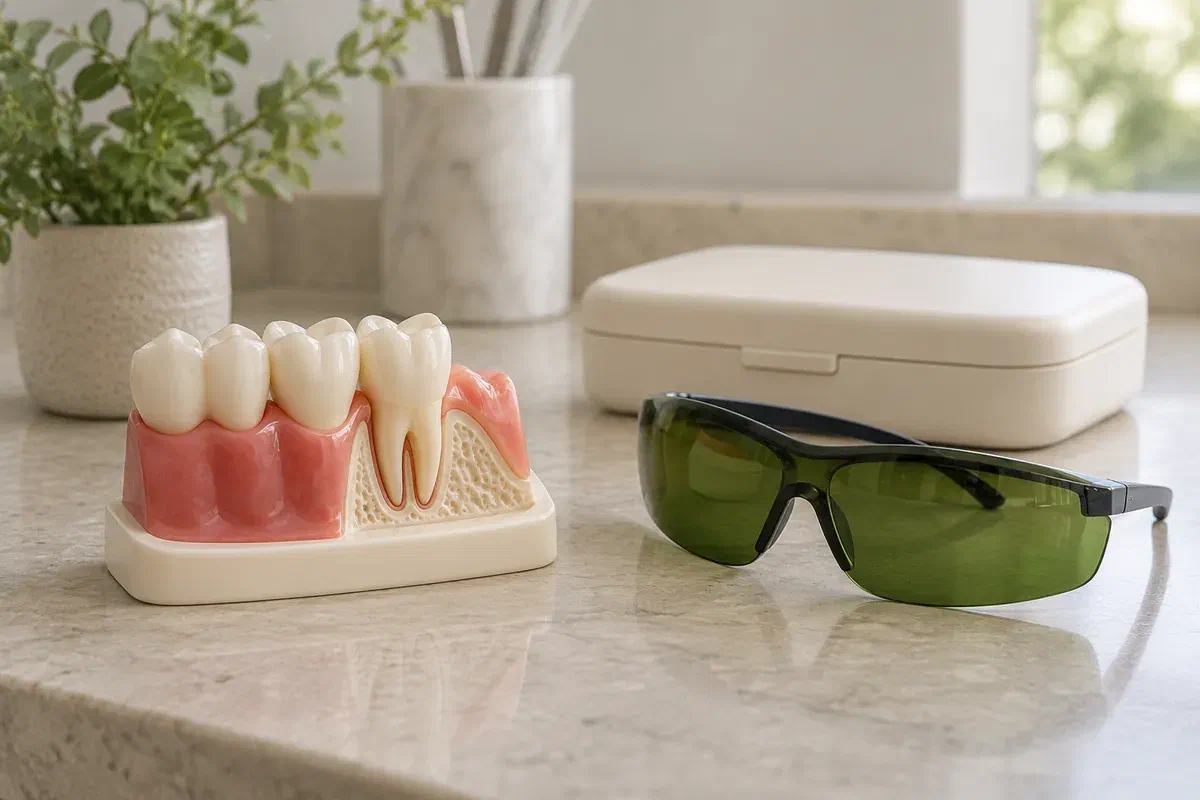
Illustrative gum model, protective eyewear, and a closed instrument case
Start with the reason

Which problem is each plan trying to solve?

Plans can differ simply because they address different things: gum disease, symptoms that came back, or one small area of tissue. Sorting that out first makes a comparison fair.

Periodontal pockets and a cleaning plan

List the teeth and sites involved in each plan and the findings behind them. If one plan adds a laser to the same cleaning, ask what that step offers and how its effect would be checked. Essential treatment should be easy to tell apart from an optional add-on.

Symptoms that outlasted earlier treatment

Note what was already done, what the review found, and which areas are hard to keep clean at home. Persistent bleeding is a reason to revisit the cause carefully. It isn't proof that a laser is needed, and it isn't a reason to repeat the same cleaning without a clearer rationale.

One area of tissue called a laser procedure

Ask the actual name of the procedure and what it does to the tissue. Removing or reshaping a small area is a different decision from treating gum disease, with its own reasons, alternatives, risks, and recovery to understand.

Brochures, branded device names, and the word advanced do not show that a procedure suits you. For each plan, ask how it follows from your examination and what would be recommended if the laser were left out.

Is the extra worth it?

Price the benefit, not the novelty.

Value is about what you get for the added cost, time, and recovery. That starts by separating what a device does to tissue in the chair from the long-term outcome you care about. A laser may perform its task well and still not show better periodontal results than sound conventional care. Ask what the evidence says for the exact procedure in your plan.

Put the practical details side by side: comfort, anaesthetic, healing, fees, number of visits, and the alternatives. Include maintenance, since that is part of either plan. A good choice is one where you understand the whole course of care and what each part is for.

Patient information: American Academy of Periodontology — laser evidence, conventional care, and tissue-safety considerations · European Federation of Periodontology S3 guideline — evidence for adjunctive lasers in periodontitis care

A rationale built on your readings

Ask which findings each plan addresses and why its method fits them. A general point about bacteria won't explain every gum problem. Each plan should also say what it can't be expected to fix.

Conventional care as the benchmark

Make sure standard periodontal instrumentation is part of the discussion, along with other reasonable options. Evidence does not support assuming every laser method is better, and current guidance does not recommend routine laser additions for periodontitis. Ask what justifies the extra step for you.

Risks, training, and arrangements

Lasers need appropriate training, equipment, and precautions. Discuss tissue injury, postoperative soreness, and other technique-specific risks alongside the possible gains. Check which provider would perform it, at what location, and if specialist input is advisable.

From two plans to one decision

Assess, line up the options, prepare, then review

Comparing plans may lead to conventional treatment, a different procedure, a period of monitoring, or a referral, not necessarily to a laser.

  1. Confirm the diagnosis both plans rely on

    We go over your symptoms, health, medications, and past gum care, and examine the tissues and supporting structures as needed. Ask what diagnosis is established and whether more records are needed before the plans can be compared fairly.

  2. Set the options next to each other

    For each plan, ask what the laser would do, if anything, and whether it's an addition or a replacement. Compare evidence, expected benefit, limitations, fees, visits, and any referral. A recognizable product name shouldn't settle the question.

  3. Prepare for the chosen procedure

    If an indicated procedure is selected and available, the provider explains preparation, anaesthetic, protective measures, and the order of the visit. Agree on how to ask for a pause. Safety requirements follow the specific device and technique rather than one universal routine.

  4. Measure the response afterward

    Aftercare should fit the treatment performed. Agree when healing and response will be reviewed and what findings will guide further care. With periodontal disease, maintenance and daily cleaning remain part of either plan.

Recovery, either way

Healing instructions belong to the procedure, whatever tool was used.

Whether a laser was involved doesn't decide how you clean, what you eat, or how long things take to settle. Those depend on the tissue treated, how much was done, and your health.

Get clear cleaning directions

Ask which areas can be cleaned normally and which need a temporary change. If a rinse or product is recommended, ask why and for how long. A treated area doesn't remain sterile, so steady plaque control is still your part of the plan.

Learn the warning signs

Ask what soreness, sensitivity, swelling, or bleeding is expected, and what isn't. Contact the treating provider for worsening symptoms, persistent bleeding, fever, or unexpected tissue changes. Being described as minimally invasive doesn't mean a procedure needs no follow-up.

Compare results at the review

Judge the outcome against the goal agreed at the start, not the look of the gums right afterward. Ask whether more treatment is expected and what maintenance interval suits you. Feeling better soon after is not the same as lasting control of gum disease.

The choices, side by side

Choose the plan whose reasoning holds up.

Ask which option your diagnosis supports and what evidence backs any added step. Weigh expected outcomes, uncertainty, cost, risks, and the care required afterward.

When established nonsurgical treatment meets the need

Standard periodontal care with reassessment

Appropriate instrumentation, support for daily cleaning, and a planned review may be what's recommended. Ask which areas will be treated and how the response will be judged. Picking conventional care is a sound decision that doesn't imply newer equipment was needed.

When a clear reason and realistic benefit are established

Laser-assisted treatment with a specific indication

Ask which technique is planned, how the evidence applies to you, and what other care is still needed. Confirm availability and fees before you commit. Broad claims of painless treatment, faster healing, regrown bone, or avoiding surgery shouldn't take the place of a personal explanation.

When the condition needs wider planning

A periodontist's assessment or another procedure

Some gum disease is too advanced or stubborn for routine care, and a periodontist may suggest another path. Find out what question the referral is meant to answer and who will keep the two offices in step. No laser should push back treatment that your diagnosis genuinely calls for.

Patient information: American Dental Association — nonsurgical periodontitis guideline and varying evidence for adjuncts

Comparing gum plans

Questions that help you choose

Use these to steer a technology-focused offer back to a treatment discussion. The answers depend on your diagnosis and the exact procedure, not the label.

(905) 876-4488
Why would one gum plan cost more than another for the same teeth?
Two estimates for the same mouth may include different things, such as added steps, extra visits, or different procedures. Ask for each line to be explained and connected to your findings. A higher fee alone tells you nothing about whether a step is needed or likely to help.
Can insurance coverage differ between laser and non-laser gum care?
It can, but coverage depends entirely on your plan and how the procedure is described. Ask the office for the procedure details and check with your insurer before treatment. We can’t predict coverage, so confirming it in advance avoids surprises.
Is the laser version of a deep cleaning always the better choice?
No. Studies point in different directions depending on the technique, and an added laser has not proven helpful in every situation. Find out what gain the office anticipates over a well-done conventional cleaning, and whether research on that particular procedure supports it.
Does either option mean I can skip future maintenance appointments?
No. When periodontal disease has been treated, daily care and professional reviews remain important regardless of the technique used. Ask what maintenance schedule is recommended and which sites will be monitored over time.
How many visits should I expect with each plan?
It depends on how many areas need care, whether treatment is split into sessions, and when reassessment is scheduled. Ask each office to outline the full sequence, including review visits. Comparing the whole course gives a fairer picture than the first appointment alone.
Can I start with conventional care and consider a laser later?
That is sometimes reasonable. Many plans begin with standard treatment and a reassessment, then decide on further steps based on the response. Ask whether that approach fits your findings and what result at review would lead to a different recommendation.
Burlington gum consultations

Line up the options with someone who will explain them.

Contact our Bronte Street practice to go over your gum findings or compare plans you've been given. Bring estimates, X-rays, and earlier periodontal records so we can review the indication, the alternatives, and whether referral is needed.

Laser equipment, protocols, availability, suitability, and expected benefit must be confirmed individually. We claim no advantage over conventional treatment and promise no particular outcome.

Visit Milton Dental Clinic
Unit 1, 342 Bronte St. S, Milton, ON L9T 5B7
Get directions Clinic hours
Monday–Thursday
11am–7pm
Friday–Sunday
By appointment only

Areas we serve

  • Milton
  • Oakville
  • Mississauga
  • Georgetown
  • Halton Hills
  • Acton
  • Campbellville
  • Brampton
  • Burlington
  • Puslinch
  • Rockwood
  • Erin
  • Caledon
  • Etobicoke
  • Old Milton
  • Bronte Meadows
  • Timberlea
  • Dorset Park
  • Dempsey
  • Clarke
  • Beaty
  • Coates
  • Harrison
  • Scott
  • Willmott
  • Ford
  • Bowes
  • Cobden
  • Walker
  • Mountain View
  • Milton Heights
  • Hawthorne Village
  • Valley View
  • Fallingbrook
  • Nassagaweya
  • Trafalgar
  • Esquesing
  • Nelson
  • Brookville
  • Moffat
  • Glen Williams
  • Norval
  • Limehouse
  • Stewarttown
  • Ashgrove
  • Hornby
  • Silver Creek
  • Speyside
  • Scotch Block
  • North Oakville
  • River Oaks
  • Glen Abbey
  • West Oak Trails
  • Palermo
  • Bronte Creek
  • College Park
  • Joshua Creek
  • Uptown Core
  • Preserve
  • Iroquois Ridge
  • Lisgar
  • Meadowvale
  • Meadowvale Village
  • Churchill Meadows
  • Erin Mills
  • Central Erin Mills
  • Streetsville
  • East Credit
  • Creditview
  • Heartland
  • Sheridan
  • Mount Pleasant
  • Credit Valley
  • Huttonville
  • Churchville
  • Springbrook
  • Northwest Brampton
  • Bram West
  • Fletcher's Meadow
  • Fletcher's Creek South
  • Alton Village
  • Orchard
  • Millcroft
  • Headon Forest
  • Tansley
  • Brant Hills
  • Tyandaga
  • Kilbride
  • Lowville
  • Aberfoyle
  • Morriston
  • Arkell
  • Hillsburgh
  • Freelton
  • Carlisle
  • Waterdown
  • Flamborough
  • Mountsberg

How can we help?

Milton Dental Clinic

Have a question about your smile? Choose the option that works best for you.

For urgent dental concerns, please call.
Messages are reviewed during clinic hours.