

Illustrative patient discussing gum-treatment options with a clinician and a dental model
Specialized Care

Laser Gum Treatment in Etobicoke

Travelling in from Etobicoke for gum care means every appointment counts. We help you understand your diagnosis, what a laser step would do, how it compares with standard periodontal treatment, how to group visits sensibly, and where to turn closer to home if healing goes off track.

Planned visits from Etobicoke

Make each trip answer a question.

When the clinic isn't around the corner, you want a first visit that settles the big questions: what's wrong with your gums, what the options are, and how many appointments the plan really needs. Laser treatment often comes up in that conversation, so it helps to know what the term does and doesn't mean.

It doesn't mean one procedure. Lasers come in different types and are used in different ways, some for gum disease and others for small soft-tissue jobs. For periodontitis, careful cleaning under the gumline with a follow-up check and steady maintenance remains the benchmark. Adding a laser isn't automatically an upgrade, and the evidence shifts from one method to another.

Before your first visit from Etobicoke, gather any X-rays, gum charts, or treatment plans and send what you can ahead. That lets our Bronte Street team use the appointment well: reviewing findings, discussing options, and raising referral if it fits. Laser suitability, technique, and provider availability have to be confirmed; we don't promise any particular device or protocol.

Plan an efficient gum consultation
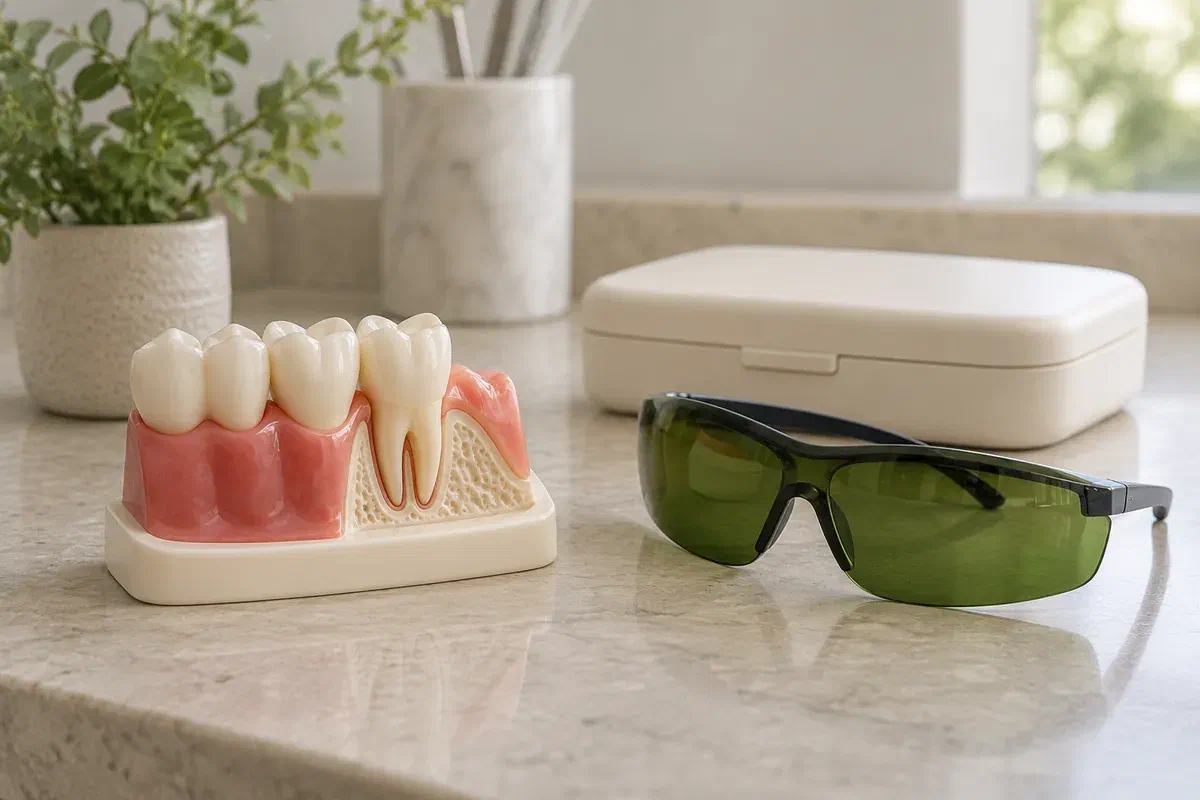
Illustrative gum model, protective eyewear, and a closed instrument case
Clarify it early

Knowing the reason up front saves a return trip.

Gum disease, symptoms that never cleared, and a single tissue concern each need different preparation. Telling us which applies helps us make the first appointment as complete as possible.

A deep cleaning has been recommended

Ask how many sites are involved and whether the work can be grouped into fewer, longer appointments. If a laser is suggested as part of it, find out what it would add and how that would be judged at review. Separate what's essential from what's optional.

Ongoing bleeding or tenderness after earlier care

Share what was done before and what follow-up showed, plus any areas that are hard to clean. Persistent symptoms call for a fresh look at the cause. They don't automatically mean a laser is needed, or that a repeat of the same cleaning will fix things.

One soft-tissue area described as laser work

Ask the procedure's proper name and whether it removes, reshapes, or otherwise treats tissue. That's a different matter from treating gum disease. Its reasons, alternatives, risks, and healing, including how soon a check is needed, deserve their own explanation.

Promises of high-tech care don't establish that a procedure is right for you. Ask how the plan connects to your examination and what would be recommended with no laser involved.

Worth the extra step?

Separate the device's task from the outcome you want.

A laser can perform a specific job during a visit. Whether that job leads to healthier gums over time is a separate question, and the answer isn't always yes compared with well-done conventional care. Ask which outcome matters most in your case and whether research supports the exact procedure being suggested.

For a longer trip, the practical side weighs more. Talk through comfort, freezing, the healing course, fees, total visits, and other routes. Knowing the full plan, maintenance included, lets you schedule realistically and avoid surprise appointments.

Patient information: American Academy of Periodontology — laser evidence, conventional care, and tissue-safety considerations · European Federation of Periodontology S3 guideline — evidence for adjunctive lasers in periodontitis care

Reasons you can see in your records

Your clinician should point to the readings or areas being treated and explain why the method fits them better than the alternatives. A general line about bacteria won't explain every gum problem. You should also hear, just as clearly, what the procedure can't resolve.

Standard care on the same footing

Conventional periodontal instrumentation and other options should be compared fairly. The evidence doesn't make every laser method superior, and guidance doesn't support routinely adding one for periodontitis. Ask what makes it worth it for you.

Safety, training, and who's treating you

Lasers require proper training, suitable devices, and precautions. Ask about tissue injury, soreness afterward, and technique-specific risks. Confirm who would perform the procedure, at what location, and whether specialist involvement makes sense.

A well-organised sequence

Fewer trips, clearer decisions

A laser consultation can end with conventional care, a different procedure, monitoring, or a referral. We aim to sort that out with as few visits as the diagnosis allows.

  1. Combine history and examination

    With records sent ahead, we can spend the visit on what matters: your symptoms, health, medications, and earlier gum care, followed by a look at the gums, bone levels, and how firm the teeth are. Ask whether any further images or readings are needed so they can be taken during the same appointment rather than on a second trip.

  2. Leave knowing the options

    Find out what the laser would do and whether it adds to or replaces another treatment. Review evidence, expected benefit, limits, fees, and referral before you go. A branded name shouldn't stand in for that explanation.

  3. Group treatment where it's sensible

    If an indicated procedure is chosen and offered, the provider explains preparation, freezing, protective measures, and the order of care, and whether areas can be treated together. Agree on a pause signal. Safety requirements follow the specific device and technique.

  4. Schedule the review before leaving

    Aftercare should fit what was performed. Book the reassessment in advance and ask which findings will shape next steps. With periodontal disease, maintenance and daily cleaning remain part of the plan.

Recovering at a distance

Know what's normal, and know who to call.

The word laser doesn't spell out your cleaning routine, diet, or healing time. Those depend on the treated tissue, the extent of care, and your health, and they matter more when the clinic is a longer trip away.

Leave with written cleaning instructions

Confirm which areas can be cleaned as usual and which need a gentler approach for a while. If a rinse is prescribed, note its purpose and duration. Treated tissue isn't sterilized for good, so daily plaque control still matters.

Call before you make the trip

Ask what soreness, swelling, sensitivity, or bleeding is expected. Phone the treating office first about worsening symptoms, persistent bleeding, fever, or unexpected tissue changes. If you have serious swelling, trouble breathing or swallowing, or bleeding that won't stop, seek urgent care closer to home.

Keep the reassessment

Judge the outcome against the goal set beforehand rather than the first few days' appearance. Ask whether more treatment is likely and how often maintenance should be scheduled. Feeling better early doesn't confirm that gum disease is under lasting control.

Choosing with the full picture

Weigh the plan, the evidence, and the visits it takes.

Ask which option your diagnosis supports and what justifies any added step. Include outcomes, uncertainty, cost, risk, total appointments, and the care that follows.

When standard nonsurgical treatment meets the need

Conventional periodontal care and reassessment

Thorough instrumentation, home-care coaching, and a scheduled review may be the advice. Know which sites are treated and how improvement will be gauged. Choosing this route is a sound decision, not a missed opportunity.

When a specific indication and reasonable gain exist

A laser-assisted procedure with a clear purpose

Ask about the technique, how evidence applies to your situation, and which other care remains necessary. Confirm availability and fees before booking. Promises of painless care, fast healing, bone regrowth, or no future surgery aren't a substitute for an individual explanation.

When the condition needs broader planning

Specialist assessment or another procedure

Advanced or persistent disease may call for a periodontist and a different approach, possibly one closer to where you live. Ask what the referral should clarify and how information will be shared. A laser shouldn't delay necessary care.

Patient information: American Dental Association — nonsurgical periodontitis guideline and varying evidence for adjuncts

Questions from Etobicoke

Practical answers for planning ahead

These answers keep attention on your treatment plan, not the equipment. Your situation turns on the diagnosis and the specific procedure.

(905) 876-4488
What should I send before my first gum appointment?
Recent X-rays, periodontal charts, treatment plans, and a list of medications and health conditions are all useful. Sending them ahead helps make the first visit more complete and may reduce the need for a return trip just to gather information.
If something feels wrong after treatment, should I drive in right away?
Call the treating office first so they can advise whether you need to be seen and how soon. For severe swelling, difficulty breathing or swallowing, high fever, or uncontrolled bleeding, go to urgent care or an emergency department near you.
Can several areas be treated in one appointment?
Sometimes. It depends on the diagnosis, how much treatment is needed, comfort, and the provider’s judgment. Ask whether grouping is reasonable for you and how it would affect freezing, recovery, and reassessment timing.
Is a laser treatment the same thing at every clinic?
No. Devices, techniques, and purposes vary. Ask for the procedure’s name, the condition it addresses, and whether it supplements or replaces standard cleaning. Those details are needed to compare benefits, risks, recovery, and cost.
Will laser-assisted care shorten my healing time?
That can’t be assumed. Healing depends on the procedure, how much tissue is treated, and your health. Ask what recovery to expect for your specific treatment and what would prompt a call. General claims of faster healing aren’t a reliable guide.
Do I still need maintenance visits if the laser treatment goes well?
Yes, when gum disease was treated. Daily care and professional reviews remain necessary regardless of technique. Ask how often maintenance is recommended and whether some visits could be coordinated with other dental appointments.
From Etobicoke to Bronte Street

One well-prepared visit is worth two rushed ones.

Contact our Bronte Street practice to discuss your gum findings or a proposed laser procedure. Send or bring earlier periodontal records and treatment plans so we can review the indication, alternatives, and any referral in one visit where possible.

We confirm for each person whether a laser procedure is suitable and available, which equipment and protocol would apply, and what benefit is realistic. Laser care is not claimed to outperform conventional treatment, and outcomes are not guaranteed.

Visit Milton Dental Clinic
Unit 1, 342 Bronte St. S, Milton, ON L9T 5B7
Get directions Clinic hours
Monday–Thursday
11am–7pm
Friday–Sunday
By appointment only

Areas we serve

  • Milton
  • Oakville
  • Mississauga
  • Georgetown
  • Halton Hills
  • Acton
  • Campbellville
  • Brampton
  • Burlington
  • Puslinch
  • Rockwood
  • Erin
  • Caledon
  • Etobicoke
  • Old Milton
  • Bronte Meadows
  • Timberlea
  • Dorset Park
  • Dempsey
  • Clarke
  • Beaty
  • Coates
  • Harrison
  • Scott
  • Willmott
  • Ford
  • Bowes
  • Cobden
  • Walker
  • Mountain View
  • Milton Heights
  • Hawthorne Village
  • Valley View
  • Fallingbrook
  • Nassagaweya
  • Trafalgar
  • Esquesing
  • Nelson
  • Brookville
  • Moffat
  • Glen Williams
  • Norval
  • Limehouse
  • Stewarttown
  • Ashgrove
  • Hornby
  • Silver Creek
  • Speyside
  • Scotch Block
  • North Oakville
  • River Oaks
  • Glen Abbey
  • West Oak Trails
  • Palermo
  • Bronte Creek
  • College Park
  • Joshua Creek
  • Uptown Core
  • Preserve
  • Iroquois Ridge
  • Lisgar
  • Meadowvale
  • Meadowvale Village
  • Churchill Meadows
  • Erin Mills
  • Central Erin Mills
  • Streetsville
  • East Credit
  • Creditview
  • Heartland
  • Sheridan
  • Mount Pleasant
  • Credit Valley
  • Huttonville
  • Churchville
  • Springbrook
  • Northwest Brampton
  • Bram West
  • Fletcher's Meadow
  • Fletcher's Creek South
  • Alton Village
  • Orchard
  • Millcroft
  • Headon Forest
  • Tansley
  • Brant Hills
  • Tyandaga
  • Kilbride
  • Lowville
  • Aberfoyle
  • Morriston
  • Arkell
  • Hillsburgh
  • Freelton
  • Carlisle
  • Waterdown
  • Flamborough
  • Mountsberg

How can we help?

Milton Dental Clinic

Have a question about your smile? Choose the option that works best for you.

For urgent dental concerns, please call.
Messages are reviewed during clinic hours.