

Illustrative patient discussing gum-treatment options with a clinician and a dental model
Specialized Care

Laser Gum Treatment in Georgetown

How will anyone know whether laser gum treatment worked? From Georgetown, start there. We explain the measurements behind a gum diagnosis, what a laser step is meant to change, how results are checked at reassessment, and when standard care or a periodontist is the stronger route.

Georgetown: measuring what matters

Decide how success will be measured before treatment begins.

Gum health is tracked with numbers as well as looks. Pocket depths, bleeding when the gums are gently probed, gum levels on each tooth, and bone seen on X-rays all tell part of the story. When a laser enters the plan, the most useful question is which of those numbers it is supposed to improve, and by when.

There isn't one laser gum treatment. Various devices and techniques exist, each suited to particular tissue tasks. For periodontitis, the established path is thorough cleaning below the gumline, followed by a reassessment of those same measurements and then ongoing maintenance. Research on adding a laser to that path gives mixed answers depending on method, so the expected improvement should be stated plainly.

Bring any earlier gum charts or X-rays when you visit from Georgetown, since a baseline makes later comparison meaningful. Our Bronte Street team can go over your findings, explain options, and suggest referral where it fits. Whether a laser procedure suits you, how it would be done, and who could provide it all need confirming; we promise no particular device or protocol.

Review your gum measurements with us
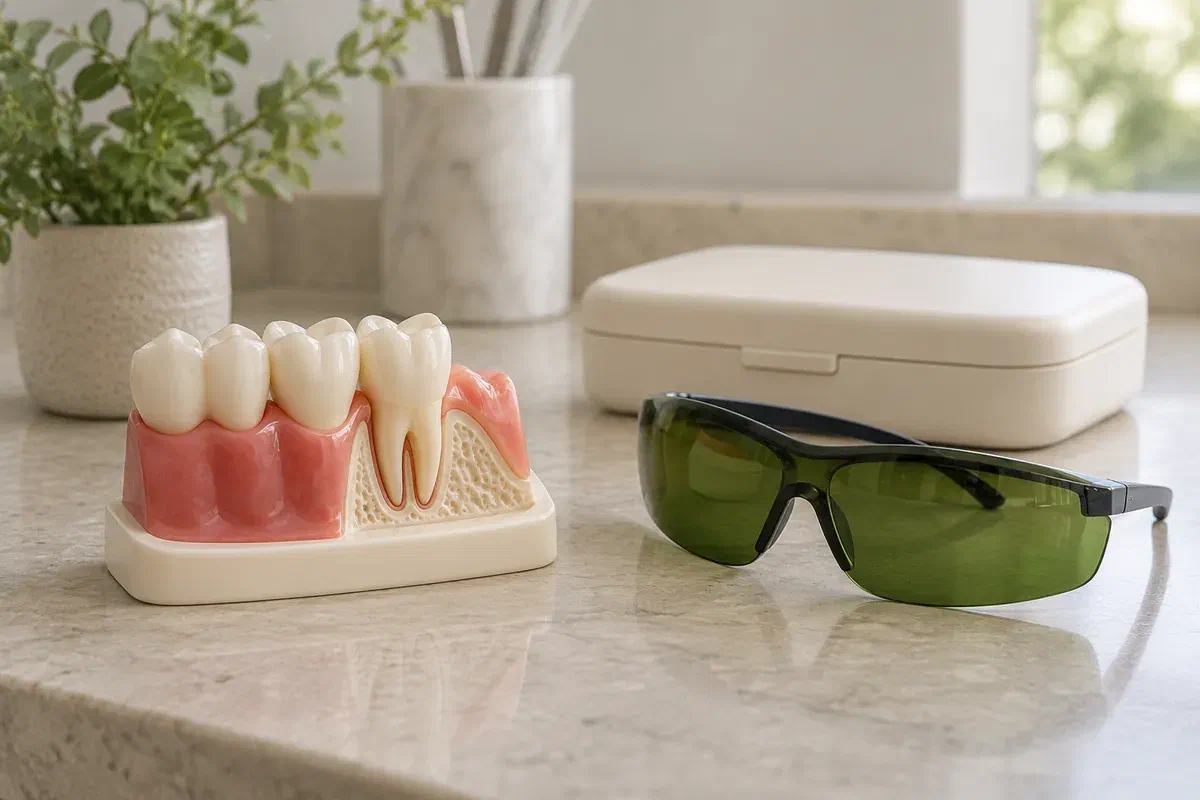
Illustrative gum model, protective eyewear, and a closed instrument case
What the numbers are telling you

Know which finding is being treated.

Deep pockets, bleeding that never quite stops, and a single area of overgrown or irregular tissue are measured and treated differently. Naming the finding first makes the plan easier to judge.

Deeper pocket readings at certain teeth

Ask for the depths at each affected site and how they compare with earlier charts. If a laser is offered with cleaning, find out which readings it's meant to change and by how much. You should be able to tell the essential treatment from any optional step.

Bleeding on probing after earlier care

Bleeding at review is one of the signals clinicians watch. Share what treatment you had and where cleaning is difficult. Persistent bleeding calls for a closer look at the cause, rather than an assumption that a laser is the fix or that the same cleaning should simply be repeated.

A localized tissue concern

Some procedures described as laser treatment address one small area, such as excess or irregular gum tissue. Get the procedure's proper name and its purpose. It is a separate question from periodontal disease, with its own alternatives, risks, and healing.

Before-and-after photos show appearance, not pocket depths or bone. Ask how the plan follows from your measured findings and what you'd be offered without any laser component.

Results you can check

What should be different at the recheck?

A device may do its job neatly on treatment day. Whether that translates into shallower pockets, less bleeding, and stable gum levels months later is the part that matters, and laser use has not consistently beaten careful conventional care on those measures. Ask what change is expected and whether studies of this specific procedure support it.

Factor in comfort, anaesthetic, healing, fees, visits, and alternatives as well. A realistic plan also names the maintenance schedule and the measurements that will be repeated over time, so you can follow your own progress.

Patient information: American Academy of Periodontology — laser evidence, conventional care, and tissue-safety considerations · European Federation of Periodontology S3 guideline — evidence for adjunctive lasers in periodontitis care

A target you can see on the chart

Ask which pocket depths or sites are the focus and what improvement would count as success. General talk about bacteria won't explain every gum problem. A good plan also states what the procedure is unlikely to change.

Conventional care as the comparison

Standard periodontal instrumentation is the reference treatment and should be discussed alongside any alternative. Evidence doesn't show every laser method doing better, and guidance doesn't support routine laser additions for periodontitis. Ask what makes the step worthwhile here.

Risk, training, and the treating provider

Safe laser use requires training, appropriate equipment, and precautions. Discuss tissue injury, soreness, and technique-specific risks along with the hoped-for gains. Find out who would perform the work, at which office, and whether a specialist should take part.

Baseline to reassessment

Measure, choose, treat, measure again

An enquiry about lasers can lead to conventional care, another procedure, careful monitoring, or a referral. Each route should end with the same measurements repeated.

  1. Record a baseline

    We review symptoms, health, medicines, and past gum care, then chart the gums and check supporting bone as appropriate. Ask for your readings to be explained and whether X-rays or other records are needed before methods are compared.

  2. Match the method to the findings

    Learn what the laser would actually be used for and whether it sits alongside another treatment or instead of it. Go over evidence, likely benefit, limitations, fees, and referral. A product name shouldn't stand in for that discussion.

  3. Prepare and consent

    If a suitable procedure is selected and available, the provider explains preparation, freezing, eye protection, and how the visit will proceed. Agree on a way to pause. Safety steps depend on the specific device and technique.

  4. Re-chart and compare

    Aftercare instructions should fit the treatment given. At an agreed interval, the same measurements are repeated and compared with the baseline to guide further care. With periodontal disease, maintenance and daily cleaning continue afterward.

Between treatment and re-charting

Healing time is when daily habits decide the numbers.

A laser doesn't determine how you should clean, what you can eat, or how long tissue takes to settle. That depends on the area treated, the amount of care, and your health.

Clean the treated sites as directed

Check which areas can be brushed and flossed normally and where to be gentle for a while. If a rinse is recommended, ask why and for how long. Bacteria return to treated sites, so your daily plaque control strongly influences the next set of readings.

Know when to phone

Find out how much soreness, sensitivity, swelling, or bleeding is normal. Call the treating office if things get worse instead of better, if bleeding won't settle, if you run a fever, or if the tissue changes unexpectedly. Even a small procedure can need a check.

Judge it at re-charting

Early comfort or pinker gums are encouraging, but the agreed measurements are the real test. The review shows whether more care is needed and sets your maintenance interval. A good first few weeks doesn't prove gum disease is controlled for the long term.

Comparing approaches

Choose the plan with the clearest path to measurable improvement.

Ask which option your findings support and what evidence backs any added step. Weigh expected changes, uncertainty, cost, risks, and the follow-up each requires.

When established nonsurgical care can meet the goal

Conventional periodontal treatment and re-charting

Careful instrumentation, home-care support, and a planned reassessment may be recommended. You'll know which sites are included and which readings will show progress. This is a well-supported choice and doesn't mean newer equipment was needed.

When an indication and a reasonable expected benefit are set out

Laser-assisted care with a measurable aim

Ask about the technique, how evidence relates to your findings, and what other care still applies. Confirm fees and availability first. Promises of no pain, quick healing, bone regrowth, or avoiding all future surgery shouldn't replace a specific, measurable explanation.

When readings or tissue concerns call for broader planning

Specialist review or another procedure

Persistent deep pockets or advanced disease may need a periodontist's assessment and a different approach. Find out what the specialist is being asked and how results will be shared back. A laser shouldn't become a reason to delay care your findings call for.

Patient information: American Dental Association — nonsurgical periodontitis guideline and varying evidence for adjuncts

Measurement questions

Understanding your gum numbers

These answers shift the focus from the technology to what can be measured. Your situation depends on your diagnosis and the procedure in question.

(905) 876-4488
What do periodontal pocket depths actually tell me?
They show how far a small probe slips between the gum and tooth at each site. Deeper readings, especially with bleeding, can signal gum disease. Your clinician interprets them along with gum levels, X-rays, and your history to reach a diagnosis.
How soon after treatment will my gums be re-measured?
It depends on the procedure and the plan. Reassessment is usually scheduled after the tissues have had time to heal. Ask when yours will be and which measurements will be repeated.
Can laser-assisted treatment make deep pockets shallower than cleaning alone?
Findings differ by method, and a laser hasn’t been shown to improve every case. Ask what added change is expected over well-done conventional care and whether research on that exact procedure supports it.
Will my X-rays show bone coming back after a laser procedure?
That shouldn’t be expected by default. Claims of regeneration need evidence for the specific condition and technique. Ask what tissue changes are realistic and how they’d be measured; early improvement in gum appearance doesn’t show restored bone.
Can I get a copy of my periodontal chart?
Yes, you can ask for your records. Having copies helps you follow changes over time and is useful if you seek a second opinion or see a specialist. Ask the team to walk you through the chart so the numbers and abbreviations make sense, and keep earlier copies together so trends are easy to spot.
Do the numbers still need watching after successful treatment?
Yes. Maintenance visits repeat key measurements so changes can be caught early. Ask how often you should be seen and which sites will be watched most closely.
Gum assessments for Georgetown

Start with a baseline you can compare against.

Reach our Bronte Street practice about gum concerns or a laser plan you'd like explained. Earlier periodontal charts, X-rays, or treatment plans let us compare findings and review the reasons for care, alternatives, and referral needs.

Suitability, equipment, protocol, availability, and realistic benefit of any laser procedure are confirmed person by person. We don't claim it outperforms conventional care, and results aren't guaranteed.

Visit Milton Dental Clinic
Unit 1, 342 Bronte St. S, Milton, ON L9T 5B7
Get directions Clinic hours
Monday–Thursday
11am–7pm
Friday–Sunday
By appointment only

Areas we serve

  • Milton
  • Oakville
  • Mississauga
  • Georgetown
  • Halton Hills
  • Acton
  • Campbellville
  • Brampton
  • Burlington
  • Puslinch
  • Rockwood
  • Erin
  • Caledon
  • Etobicoke
  • Old Milton
  • Bronte Meadows
  • Timberlea
  • Dorset Park
  • Dempsey
  • Clarke
  • Beaty
  • Coates
  • Harrison
  • Scott
  • Willmott
  • Ford
  • Bowes
  • Cobden
  • Walker
  • Mountain View
  • Milton Heights
  • Hawthorne Village
  • Valley View
  • Fallingbrook
  • Nassagaweya
  • Trafalgar
  • Esquesing
  • Nelson
  • Brookville
  • Moffat
  • Glen Williams
  • Norval
  • Limehouse
  • Stewarttown
  • Ashgrove
  • Hornby
  • Silver Creek
  • Speyside
  • Scotch Block
  • North Oakville
  • River Oaks
  • Glen Abbey
  • West Oak Trails
  • Palermo
  • Bronte Creek
  • College Park
  • Joshua Creek
  • Uptown Core
  • Preserve
  • Iroquois Ridge
  • Lisgar
  • Meadowvale
  • Meadowvale Village
  • Churchill Meadows
  • Erin Mills
  • Central Erin Mills
  • Streetsville
  • East Credit
  • Creditview
  • Heartland
  • Sheridan
  • Mount Pleasant
  • Credit Valley
  • Huttonville
  • Churchville
  • Springbrook
  • Northwest Brampton
  • Bram West
  • Fletcher's Meadow
  • Fletcher's Creek South
  • Alton Village
  • Orchard
  • Millcroft
  • Headon Forest
  • Tansley
  • Brant Hills
  • Tyandaga
  • Kilbride
  • Lowville
  • Aberfoyle
  • Morriston
  • Arkell
  • Hillsburgh
  • Freelton
  • Carlisle
  • Waterdown
  • Flamborough
  • Mountsberg

How can we help?

Milton Dental Clinic

Have a question about your smile? Choose the option that works best for you.

For urgent dental concerns, please call.
Messages are reviewed during clinic hours.