

Illustrative patient discussing gum-treatment options with a clinician and a dental model
Specialized Care

Laser Gum Treatment in Halton Hills

Managing diabetes, taking blood thinners, or juggling other health needs, and now gum treatment with a laser is on the table? From Halton Hills, talk it through with us: your diagnosis, your medical picture, what a laser would do, the evidence, and when a periodontist should help plan.

Halton Hills: health in the picture

Your medical history belongs in the gum conversation.

Gums don't exist in isolation. Blood sugar control, certain medicines, smoking, pregnancy, and other health factors can all affect how gum tissue behaves and how it heals. So before anyone weighs a laser against another approach, it makes sense to put your general health on the table alongside your dental findings.

The phrase laser gum treatment covers several devices and techniques used for different purposes. For periodontal disease, reliable care involves cleaning beneath the gumline, a planned reassessment, and maintenance that goes on afterward. A laser isn't inherently more effective than that, and studies vary by method. Any proposed addition should come with a reason that fits your health as well as your gums.

Households across Halton Hills, from Georgetown and Acton to the smaller hamlets, are welcome to bring medication lists, recent medical notes, and any periodontal records. We can discuss the assessment, the options, coordination with your physician when appropriate, and referral if needed. Laser suitability, technique, and availability must be confirmed; no specific device or protocol is promised.

Discuss gum care alongside your health
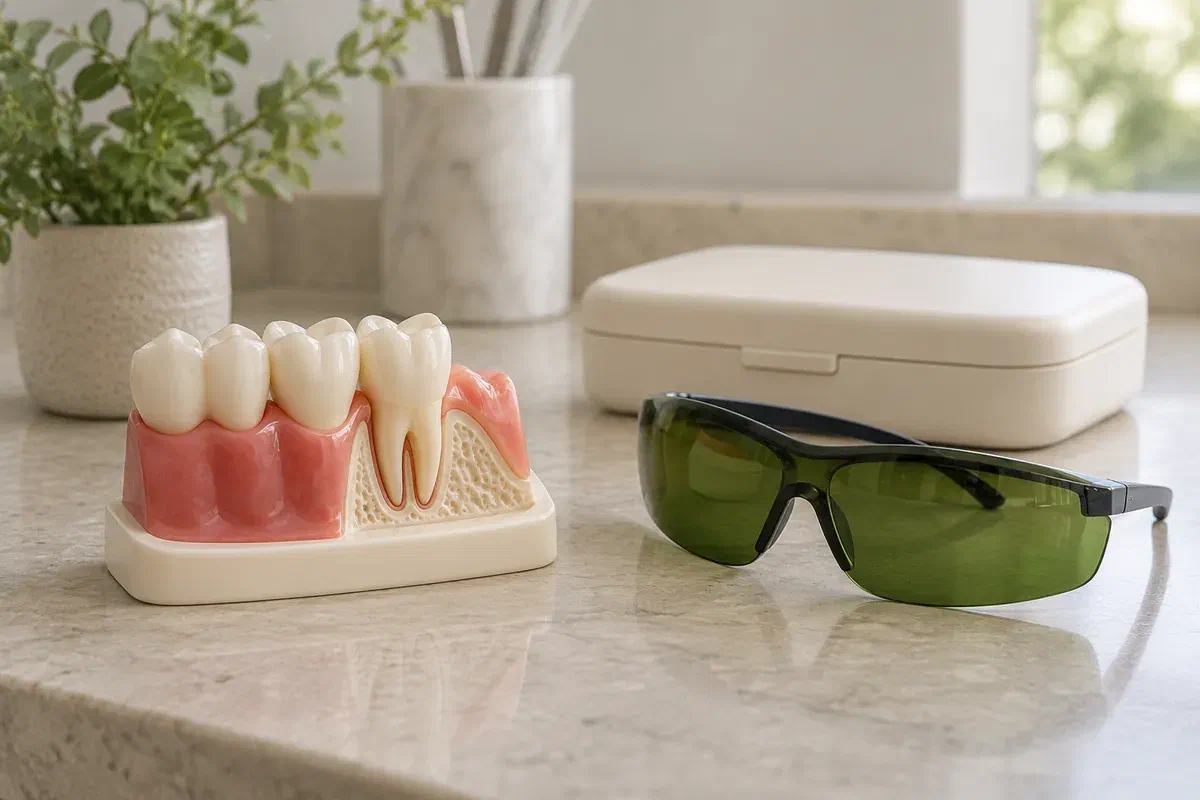
Illustrative gum model, protective eyewear, and a closed instrument case
Sorting out the starting point

Gum disease, lingering symptoms, or a tissue concern

Health conditions can complicate any of these. Let us know which describes your situation and what medical factors are involved, so the right questions come first.

A periodontal diagnosis with health factors involved

Find out which sites are affected and how your general health may be influencing them. If a laser is offered with cleaning, ask what it would add for someone with your history and how that would be checked. The core care should be clearly separated from anything optional.

Bleeding that continues despite treatment

Bring details of earlier care and follow-up results. Some medicines and conditions affect bleeding and healing, and those should be reviewed as possible contributors. Ongoing symptoms warrant a fresh look at causes, not an automatic assumption that a laser will help.

A local tissue procedure called laser treatment

Get the procedure's proper name and a description of what happens to the tissue during it. Trimming or contouring a small area is not the same as managing gum disease. Its purpose, alternatives, risks, and healing need separate discussion, including any precautions your health conditions require.

Advanced-sounding equipment doesn't show that a procedure suits your health or your gums. Ask how the recommendation follows from your examination and medical history, and what care you'd get without the laser.

Benefit, weighed against your health

Does the added step make sense for your body as well as your gums?

It's worth separating what a device does to tissue during treatment from what happens to gum health over time. A laser can do one task well without showing better periodontal outcomes than careful conventional care. When health conditions slow healing or raise risk, the question becomes sharper: what benefit is expected, and does the evidence for this exact procedure include people like you?

Practical points matter too: comfort, anaesthetic choices that suit your medical needs, healing, fees, visits, and alternatives. A full understanding includes the maintenance that follows, which can be especially important when health factors increase gum-disease risk.

Patient information: American Academy of Periodontology — laser evidence, conventional care, and tissue-safety considerations · European Federation of Periodontology S3 guideline — evidence for adjunctive lasers in periodontitis care

A plan tied to findings and history

Expect your clinician to connect specific pocket readings or sites to the chosen method, with your health factored in. A general claim about bacteria doesn't explain every case. Ask what the procedure won't resolve.

Fair comparison with conventional care

Conventional instrumentation below the gumline deserves equal billing with any newer approach. Not every laser method has proven better, and guidance doesn't back routine laser additions for periodontitis. Ask what justifies the step in your case.

Risks, precautions, and coordination

Lasers need trained providers, suitable equipment, and safety measures. Discuss tissue injury, soreness, and technique-specific risks, plus any precautions tied to your medications. Confirm who would treat you, where, and whether your physician or a periodontist should be consulted.

How planning works

Health review, gum exam, options, and a monitored recovery

A laser consultation doesn't commit you to laser care. Depending on your findings and health, the plan may be conventional treatment, another procedure, monitoring, or specialist advice.

  1. Review your health and your gums together

    We go over symptoms, conditions, every medication and supplement, and past gum treatment, then examine your gums and the bone around your teeth as appropriate. Ask whether information from your physician would help before treatment methods are compared.

  2. Explain the procedure and the alternatives

    You should come away knowing the laser's exact role, as a supplement or a substitute, and how the research, likely gain, limitations, fees, and any referral compare. A recognizable brand doesn't replace a clear explanation tailored to your health.

  3. Plan consent, comfort, and precautions

    Should a suitable procedure go ahead, the treating provider covers preparation, anaesthetic, protective eyewear, and the visit sequence, adjusting for medical needs where appropriate. Agree on a pause signal. Safety measures depend on the specific device and technique.

  4. Monitor healing and response

    Aftercare should fit the treatment and your health. Agree when healing will be reviewed and which findings guide further care. With periodontal disease, regular maintenance and daily cleaning remain essential, particularly when health factors raise risk.

Healing with health conditions

Recovery is personal. Plan it that way.

Knowing a laser was used won't tell you how to clean, what to eat, or how long healing takes. Those depend on the tissue treated, the extent of care, and health factors such as diabetes or medications.

Follow cleaning advice for treated sites

Confirm where normal brushing and flossing are fine and where a temporary change is needed. If a rinse or product is recommended, ask its purpose and how long to use it. Treated sites aren't permanently free of bacteria, so plaque control continues.

Know your warning signs

Find out how much tenderness, puffiness, or oozing is typical, keeping in mind that medicines like blood thinners can affect bleeding. Call the treating provider if pain builds, bleeding keeps going, a fever appears, or the tissue looks different than expected. Don't stop or change prescribed medicines without medical advice.

Attend reassessment

Results should be judged against the agreed goal, not how gums look in the first days. Health conditions can slow healing, so the review may also set a maintenance interval suited to your risk. Short-term comfort doesn't mean gum disease is permanently under control.

Options that fit your health

Compare plans by their fit with you.

Ask which option your diagnosis and health support, and what evidence backs any added step. Weigh expected outcomes, uncertainty, cost, risks, and later care.

When proven nonsurgical therapy is sufficient

Conventional periodontal care and review

Careful instrumentation, home-care support, and a scheduled recheck may be recommended. You'll be told which teeth are included and what improvement would look like at the recheck. Conventional care is a well-supported clinical choice and doesn't imply newer equipment was needed.

When a clear reason and realistic benefit are established

A laser-assisted procedure with an indication

Ask about the technique, how its evidence applies to your health and condition, and which other care remains essential. Confirm fees and availability first. General promises of painless care, quick healing, bone regrowth, or avoiding surgery shouldn't replace individual reasoning.

When disease or health complexity requires broader planning

Specialist assessment or a different procedure

Advanced disease, or significant medical factors, may call for a periodontist and coordinated planning with your physician. A good referral names the question the specialist should answer and explains how their advice will reach everyone involved. Interest in a laser should never hold up care your diagnosis requires.

Patient information: American Dental Association — nonsurgical periodontitis guideline and varying evidence for adjuncts

Health and gum-care questions

When your medical history matters

These answers turn a technology-led recommendation into a health-aware treatment discussion. What applies to you rests on your diagnosis, your health, and the specific procedure.

(905) 876-4488
Does diabetes affect gum treatment decisions?
It can. Diabetes is linked with gum disease and can affect healing. Let your clinician know about your diagnosis and how well it’s managed. They may adjust timing or follow-up and coordinate with your physician when appropriate.
I take a blood thinner. Can I still have gum treatment?
Often, yes, but tell your dental team before treatment. Don’t stop or change the medication on your own. The provider may consult your physician and plan the procedure with bleeding control in mind.
Does smoking change how gums respond to treatment?
Smoking is a known risk factor for gum disease and can affect healing and response to care. Let your clinician know if you smoke or vape. Support for quitting may be worth discussing as part of your overall plan.
Is laser gum treatment safe during pregnancy?
Tell your dental team if you’re pregnant or planning to be. Gum changes are common in pregnancy, and treatment timing and choices may be adjusted. Decisions should be made individually, sometimes with input from your prenatal care provider.
Will a laser produce better results than deep cleaning for someone with health conditions?
That shouldn’t be assumed. Evidence varies by method, and health factors may affect any treatment’s outcome. Ask what benefit is expected beyond appropriate conventional care and whether the research for that exact procedure applies to people with your conditions.
Should my physician know about my gum treatment?
It’s often helpful, especially if you have diabetes, heart conditions, or take medicines that affect bleeding or healing. Ask whether your dental team plans to coordinate with your physician and what information they’ll share.
Consultations for Halton Hills

Bring your medication list. We'll bring the questions.

Get in touch with our Bronte Street practice about gum symptoms or a laser plan you'd like explained. A current medication list, along with any periodontal records or treatment plans, helps us weigh the reasons for care, the alternatives, health considerations, and referral.

Suitability, the laser equipment and protocol, availability, and realistic benefit are confirmed for each patient. We don't present laser care as superior to conventional treatment and can't guarantee results.

Visit Milton Dental Clinic
Unit 1, 342 Bronte St. S, Milton, ON L9T 5B7
Get directions Clinic hours
Monday–Thursday
11am–7pm
Friday–Sunday
By appointment only

Areas we serve

  • Milton
  • Oakville
  • Mississauga
  • Georgetown
  • Halton Hills
  • Acton
  • Campbellville
  • Brampton
  • Burlington
  • Puslinch
  • Rockwood
  • Erin
  • Caledon
  • Etobicoke
  • Old Milton
  • Bronte Meadows
  • Timberlea
  • Dorset Park
  • Dempsey
  • Clarke
  • Beaty
  • Coates
  • Harrison
  • Scott
  • Willmott
  • Ford
  • Bowes
  • Cobden
  • Walker
  • Mountain View
  • Milton Heights
  • Hawthorne Village
  • Valley View
  • Fallingbrook
  • Nassagaweya
  • Trafalgar
  • Esquesing
  • Nelson
  • Brookville
  • Moffat
  • Glen Williams
  • Norval
  • Limehouse
  • Stewarttown
  • Ashgrove
  • Hornby
  • Silver Creek
  • Speyside
  • Scotch Block
  • North Oakville
  • River Oaks
  • Glen Abbey
  • West Oak Trails
  • Palermo
  • Bronte Creek
  • College Park
  • Joshua Creek
  • Uptown Core
  • Preserve
  • Iroquois Ridge
  • Lisgar
  • Meadowvale
  • Meadowvale Village
  • Churchill Meadows
  • Erin Mills
  • Central Erin Mills
  • Streetsville
  • East Credit
  • Creditview
  • Heartland
  • Sheridan
  • Mount Pleasant
  • Credit Valley
  • Huttonville
  • Churchville
  • Springbrook
  • Northwest Brampton
  • Bram West
  • Fletcher's Meadow
  • Fletcher's Creek South
  • Alton Village
  • Orchard
  • Millcroft
  • Headon Forest
  • Tansley
  • Brant Hills
  • Tyandaga
  • Kilbride
  • Lowville
  • Aberfoyle
  • Morriston
  • Arkell
  • Hillsburgh
  • Freelton
  • Carlisle
  • Waterdown
  • Flamborough
  • Mountsberg

How can we help?

Milton Dental Clinic

Have a question about your smile? Choose the option that works best for you.

For urgent dental concerns, please call.
Messages are reviewed during clinic hours.