

Illustrative patient discussing gum-treatment options with a clinician and a dental model
Specialized Care

Laser Gum Treatment in Rockwood

Not sure whether your gums need a general dentist, a periodontist, or a laser at all? From Rockwood, we help you sort out who should do what: the diagnosis, what any laser step would contribute, how the evidence compares, and how referral and shared care would actually work.

Rockwood: who treats what

General dentist, gum specialist, or both?

Plenty of gum problems are managed well in a general practice. Others benefit from a periodontist, a dentist with advanced training in gum and bone health. A laser can come up in either setting, which sometimes muddies the real decision: what level of care does your condition call for, and who is best placed to give it?

Laser gum treatment isn't one procedure. Devices and techniques vary and serve different purposes. For periodontitis, the cornerstone is cleaning beneath the gumline, then reassessment, then maintenance, whoever provides it. Research doesn't show a laser improving results in every case; outcomes depend on the method. Any added step should come with a clear rationale.

When you contact us from Rockwood, bring any referral letters, X-rays, or periodontal charts you already have. Our Bronte Street team can assess your gums, outline options, and explain whether a specialist referral makes sense and how care would be shared. Laser suitability, technique, and who could perform it need confirmation; no specific device or branded protocol is promised.

Find out what level of gum care you need
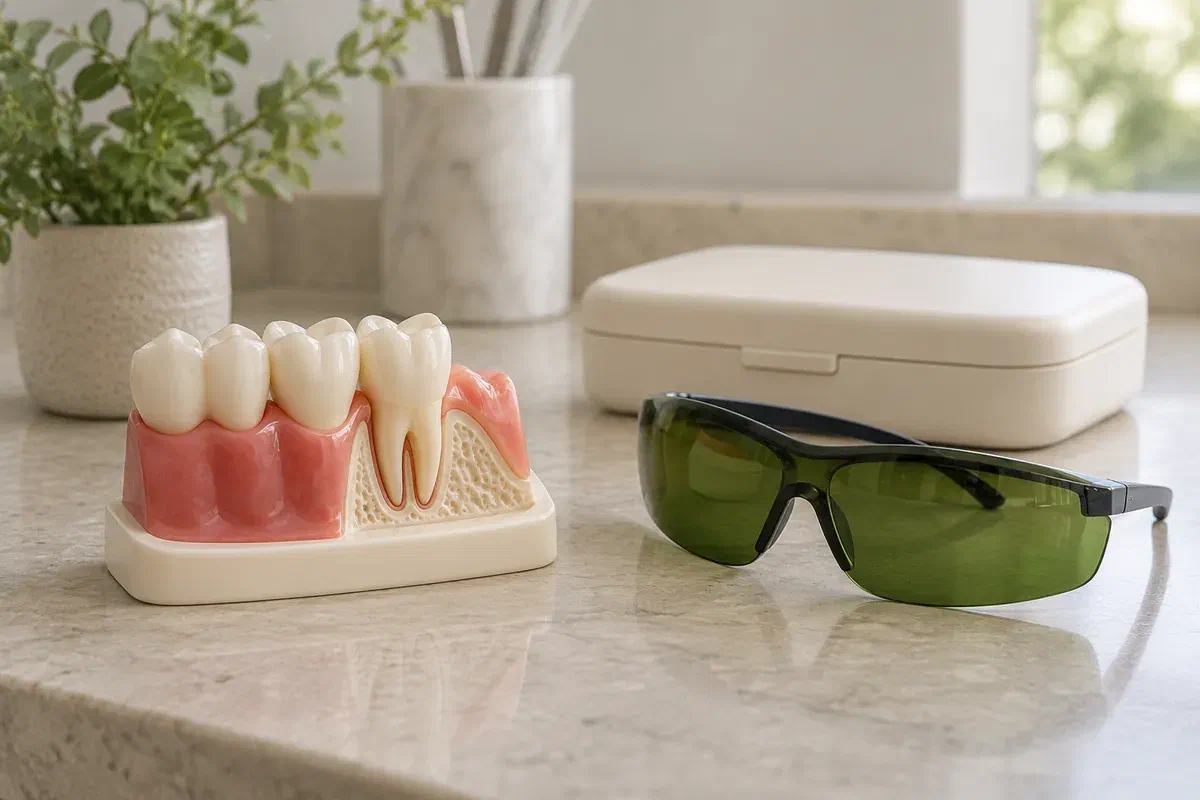
Illustrative gum model, protective eyewear, and a closed instrument case
Deciding where care belongs

The diagnosis decides the team.

Mild gum disease, symptoms that persisted after treatment, and a specific tissue concern can each point toward a different provider. Start by identifying which one fits.

Gum disease found at a check-up

Ask which teeth are affected and how severe the readings are. Many early to moderate cases are treated in general practice. If a laser is proposed, find out what it adds and how that would be checked. Separate the core treatment from optional steps.

Problems that didn't resolve with earlier care

Share what was done and what review found. When disease persists despite appropriate treatment, a specialist opinion is often worth discussing. Continuing symptoms don't automatically point to a laser; they point to a closer look at the cause.

A tissue procedure that might suit a specialist

Ask the procedure's correct name and what it involves. Some soft-tissue procedures are routinely done by general dentists, while others are often referred. Either way, it's distinct from treating periodontal disease and needs its own explanation of alternatives, risks, and healing.

A specialist title, a new machine, or a confident brochure cannot settle whether a procedure suits your mouth. The recommendation should trace back to your own examination, and you should be able to hear what the plan becomes if the laser is set aside.

Questions to put to any provider

Who adds what, and how do we know?

The same two-part question works in a general office and in a specialist's chair. First, what does the device physically do to the tissue during the appointment? Second, what does that change about the health of your gums a year from now? A laser can do the first convincingly without demonstrating an advantage on the second over careful conventional care. Ask which outcome is predicted for you and whether published studies looked at this exact procedure.

Beyond benefit, cover the practical side: how comfortable treatment is likely to be, freezing, the usual healing course, fees, the number of appointments, and other routes. When two offices share your care, it also helps to know who books what, including maintenance. A clear map of the whole course, with a name beside each part, keeps anything from slipping through the cracks between practices.

Patient information: American Academy of Periodontology — laser evidence, conventional care, and tissue-safety considerations · European Federation of Periodontology S3 guideline — evidence for adjunctive lasers in periodontitis care

Findings that justify the method

Any provider, specialist or not, should be able to point at the pockets or tissue in question and say why this approach suits them better than another. Talk of bacteria alone doesn't explain every gum problem. Ask, too, what the procedure isn't expected to change.

Conventional care in the comparison

Scaling and root planing remains the reference point, so it belongs in the conversation whichever office you're in. Research hasn't crowned every laser method the winner, and current guidance stops short of recommending a laser as a routine addition for periodontitis. The case for it has to be made for you specifically.

Safety and clear responsibilities

Lasers require training, suitable equipment, and precautions. Discuss tissue injury, discomfort afterward, and technique-specific risks. With a referral, confirm which office performs each procedure, which handles follow-up, and how records move between them.

How shared care can work

Assess here, refer if needed, coordinate throughout

A laser enquiry may end in conventional care with us, another procedure, a monitoring plan, or a referral to a periodontist. The goal is the right care from the right provider.

  1. Assess and gather records

    We review symptoms, health, medications, and earlier treatment, then examine your gums and supporting bone as appropriate. Ask what the diagnosis is and whether further X-rays or charting would help a specialist if referral is likely.

  2. Discuss options and referral

    If a laser is mentioned, you should hear its purpose in plain words and whether it adds to another treatment or stands in for one. Review evidence, likely benefit, limits, and fees. If referral is advised, ask what question the specialist will be answering.

  3. Prepare for the chosen treatment

    Whoever provides the procedure should explain preparation, freezing, protective eyewear, and the visit sequence, and how to signal a pause. Safety steps depend on the device and technique rather than one universal protocol.

  4. Coordinate follow-up and maintenance

    Aftercare should fit the treatment. Agree on when healing is reviewed and by whom. With gum disease, maintenance may alternate between offices; ask how the schedule will work and how findings will be shared.

After treatment, wherever it happens

One set of instructions, from the office that treated you.

The device used doesn't tell you how to clean, eat, or heal. Those instructions are shaped by which tissue was worked on, how much, and your general health, and they should come from whoever performed the procedure.

Follow the treating office's cleaning advice

Check which areas can be cleaned normally and which need gentler care for a while. If a rinse is recommended, ask why and for how long. Treated sites don't stay free of bacteria, so plaque control goes on.

Know who to call

Ask what discomfort, sensitivity, or swelling is typical. If symptoms worsen, bleeding continues, you have a fever, or the tissue looks unexpected, contact the office that performed the procedure first. Keep both offices' numbers handy if care is shared.

Wait for reassessment

Judge the result against the goal agreed beforehand, not early appearance. Ask whether more care is likely and how maintenance will be divided. Short-term comfort doesn't prove gum disease is controlled.

Comparing the paths

Match the care to the condition, and the provider to the care.

Each path should follow from your diagnosis, and anything extra needs evidence behind it. Weigh outcomes, uncertainty, cost, risks, and how follow-up will be organised.

When established nonsurgical treatment fits the need

Conventional periodontal care in general practice

Careful instrumentation, home-care support, and a planned review may be all that's needed, without leaving your usual practice. You should know the teeth involved and the signs that will count as improvement. Staying with conventional care is a reasoned decision, not a sign you were denied something newer.

When a specific indication and realistic benefit are established

Laser-assisted care for a defined reason

Find out the technique, why the research suggests it suits a case like yours, and which other treatment still has to happen. Check fees and whether the procedure is offered at all before planning around it. A sweeping pledge about no pain, rapid healing, regrown bone, or avoiding surgery is not a personal explanation.

When severity or complexity calls for specialist planning

Referral to a periodontist

Advanced, persistent, or complex disease often benefits from specialist assessment and, sometimes, surgical or other options a general office doesn't provide. Ask what the referral should clarify, how long it might take, and how both offices will coordinate. A laser shouldn't delay necessary care.

Patient information: American Dental Association — nonsurgical periodontitis guideline and varying evidence for adjuncts

Referral and specialist questions

Understanding who does what

These answers shift the focus from technology to the right care and the right provider. Your own path will be set by what the examination finds and which procedure, if any, is proposed.

(905) 876-4488
What's the difference between a general dentist and a periodontist?
A periodontist has additional training focused on gums and the bone supporting teeth. General dentists manage many gum conditions, while more advanced or complex cases are often referred to a periodontist.
Do I need a referral to see a periodontist?
Practices differ. Many periodontists accept referrals from general dentists, and some accept patients directly. A referral letter with your records usually helps the specialist start with a clearer picture.
Will my regular dentist still be involved after a referral?
Often, yes. Care is frequently shared, with check-ups and some maintenance at your general practice and specialist visits as needed. Ask how responsibilities and records will be divided.
Do periodontists always use lasers?
No. Specialists choose techniques based on diagnosis, evidence, and their training, and many treat gum disease without a laser at all. Ask any provider what method they recommend, why it suits your findings, and what the alternatives would involve in visits, recovery, and fees.
Is laser treatment more effective than conventional cleaning for advanced gum disease?
That can’t be assumed. Evidence varies by method, and advanced disease often needs broader planning. Ask what added benefit is expected and what research supports that particular procedure for your stage of disease.
Will I still need regular maintenance after specialist treatment?
Yes. Maintenance remains important after periodontal disease is treated, whoever provided the care. Some people alternate visits between their general dentist and the specialist for a while. Ask how often you’ll be seen, at which office, and what change in your readings would prompt an earlier appointment.
Gum assessments for Rockwood

Get a clear answer on where your care belongs.

Contact our Bronte Street practice to discuss gum concerns, a suggested laser procedure, or a possible referral. Bring earlier periodontal records or plans so we can review the indication, alternatives, and the best way to coordinate care.

The suitability, equipment, protocol, availability, and realistic benefit of any laser procedure are confirmed individually. We don't claim laser care beats conventional treatment, and no outcome is guaranteed.

Visit Milton Dental Clinic
Unit 1, 342 Bronte St. S, Milton, ON L9T 5B7
Get directions Clinic hours
Monday–Thursday
11am–7pm
Friday–Sunday
By appointment only

Areas we serve

  • Milton
  • Oakville
  • Mississauga
  • Georgetown
  • Halton Hills
  • Acton
  • Campbellville
  • Brampton
  • Burlington
  • Puslinch
  • Rockwood
  • Erin
  • Caledon
  • Etobicoke
  • Old Milton
  • Bronte Meadows
  • Timberlea
  • Dorset Park
  • Dempsey
  • Clarke
  • Beaty
  • Coates
  • Harrison
  • Scott
  • Willmott
  • Ford
  • Bowes
  • Cobden
  • Walker
  • Mountain View
  • Milton Heights
  • Hawthorne Village
  • Valley View
  • Fallingbrook
  • Nassagaweya
  • Trafalgar
  • Esquesing
  • Nelson
  • Brookville
  • Moffat
  • Glen Williams
  • Norval
  • Limehouse
  • Stewarttown
  • Ashgrove
  • Hornby
  • Silver Creek
  • Speyside
  • Scotch Block
  • North Oakville
  • River Oaks
  • Glen Abbey
  • West Oak Trails
  • Palermo
  • Bronte Creek
  • College Park
  • Joshua Creek
  • Uptown Core
  • Preserve
  • Iroquois Ridge
  • Lisgar
  • Meadowvale
  • Meadowvale Village
  • Churchill Meadows
  • Erin Mills
  • Central Erin Mills
  • Streetsville
  • East Credit
  • Creditview
  • Heartland
  • Sheridan
  • Mount Pleasant
  • Credit Valley
  • Huttonville
  • Churchville
  • Springbrook
  • Northwest Brampton
  • Bram West
  • Fletcher's Meadow
  • Fletcher's Creek South
  • Alton Village
  • Orchard
  • Millcroft
  • Headon Forest
  • Tansley
  • Brant Hills
  • Tyandaga
  • Kilbride
  • Lowville
  • Aberfoyle
  • Morriston
  • Arkell
  • Hillsburgh
  • Freelton
  • Carlisle
  • Waterdown
  • Flamborough
  • Mountsberg

How can we help?

Milton Dental Clinic

Have a question about your smile? Choose the option that works best for you.

For urgent dental concerns, please call.
Messages are reviewed during clinic hours.