

Illustrative patient describing a specific urgent dental concern to a clinician
Specialized Care

Limited Emergency Examinations in Mississauga

Your usual dentist is booked up, away, or closed, and a tooth will not wait. A limited emergency examination assesses the urgent problem, explains what was found, and helps you carry the results back to your regular care. Calling from Mississauga? Describe the symptom and we will talk about timing.

When your regular office is unavailable

Can another dentist look at just the one problem?

Yes, and that is exactly what this appointment is for. A limited emergency examination is centred on one complaint, such as a tooth that has flared up, a filling or crown that has broken, or a swollen area of gum. The dentist collects the history that matters for that complaint and examines the region to understand its cause and urgency, without replacing the full care your own dentist provides.

Since you may be new to us, the background questions carry extra weight. Your health conditions, medicines, any recent injury, and symptoms such as fever help determine what to check and whether a different setting is safer. You might leave with a likely diagnosis, or with a clear note of what still needs testing, records or a specialist's input.

From Mississauga, start with a phone call: explain the problem, ask what the visit covers, and mention who your regular dentist is. If you can bring recent X-rays or treatment notes, they help. The goal is an explanation and a plan; finishing every needed procedure that day is not guaranteed.

Ask about an urgent appointment
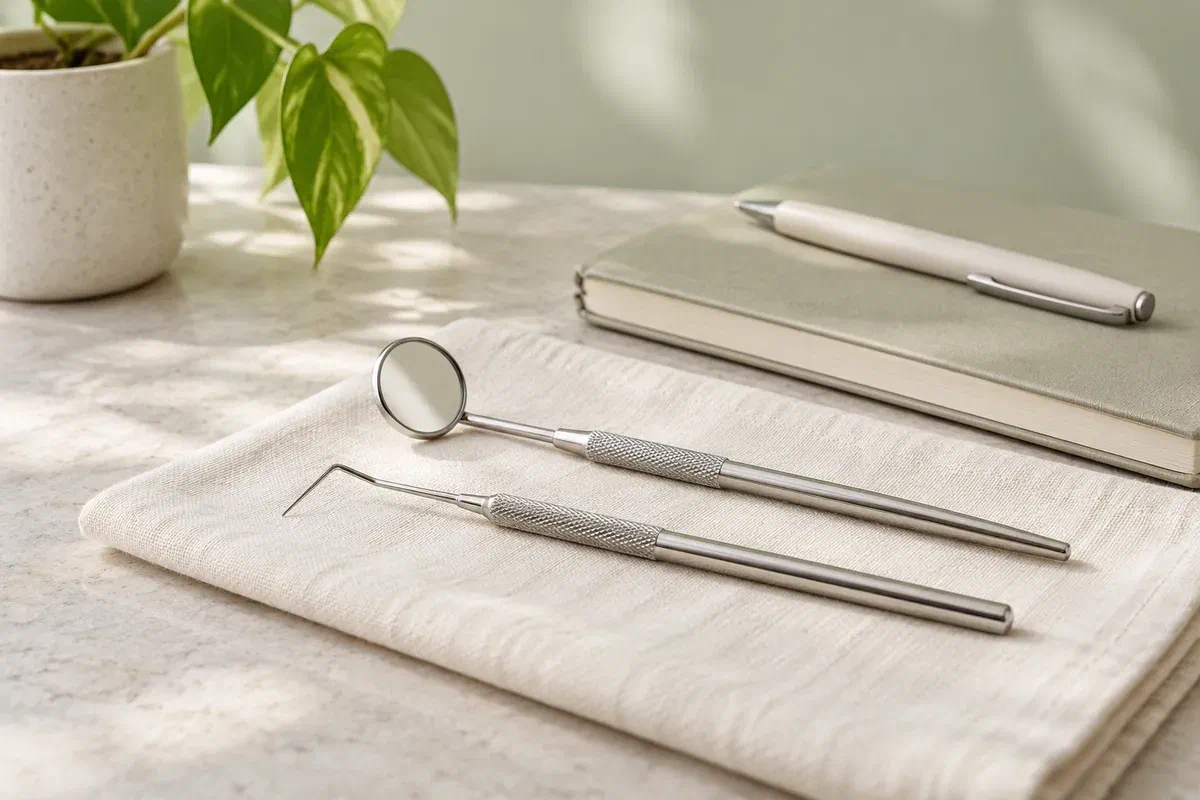
Illustrative dental examination instruments beside a closed notebook
When you call us

Three things to mention up front

Open with the main problem, then add anything that might make it more pressing. If you are dealing with more than one issue, point out which is newest or worsening so the right kind of visit can be arranged.

Pain: where, when, and what triggers it

Give a sense of the area, how long it has been going on, and whether chewing, hot or cold, or rest changes it. Mention sleep disruption or spreading pain. Being unsure of the exact tooth is normal and worth telling us.

Broken teeth or lost dental work

Explain what broke or fell out, whether an edge is sharp, and whether your bite feels different. If you have the piece or crown, bring it in a clean container. Avoid gluing or forcing it back while you wait to be assessed.

Swelling, injury, or general symptoms

Let us know if a swollen area is growing, if a fall or knock started things, and if you feel feverish or unwell. Include important medical history. If things worsen after booking, call back; the original time may no longer be suitable.

For breathing or swallowing difficulty, swelling that reaches the eye, facial swelling that spreads quickly or severely, bleeding that keeps going, or serious injury to the face, call 911 or go to an emergency department. Do not wait for a dental appointment or a reply online.

Information you can use

Findings that make sense to you and to your own dentist

Under stress, technical terms slip past easily. Ask for the main finding in plain language and how it explains your symptom. When the cause is not settled yet, the plan should name the further assessment required, not present uncertainty as though a diagnosis were complete.

Be clear on which care is for today and which belongs to a later visit, possibly with your regular dentist. Temporary measures serve a purpose but have limits and need review. Ask whether the next appointment will complete treatment, re-examine the problem, or be a broader checkup.

Patient information: American Dental Association — individualized selection of dental radiographs

Tests picked for the problem at hand

The dentist may examine nearby teeth and gums or use specific tests to narrow the cause. X-rays are taken when they add diagnostic value, and recent ones from your own office may help. Ask what each test is meant to clarify.

A conversation before any procedure

Go through the reasonable options, their purpose, risks and fees. Being in pain does not take away your consent, and no single treatment is automatic. Ask whether you need to decide now or whether waiting to consult your regular dentist is reasonable.

A handover that actually works

Confirm who will provide the next stage and what they will need. Ask how findings and images can be shared with your usual practice. An urgent visit is far more useful when the follow-up is understood rather than left for you to sort out.

What the appointment involves

A short history, a focused look, and a straight explanation

How much ground the visit covers depends on how severe things are. Nervous, or need a pause? Say so, and ask to have key decisions explained before treatment starts.

  1. Start with the complaint and your background

    Describe how the symptom developed, earlier treatment in that area, and any medication already taken. Your medical history, allergies and recent health changes are reviewed. Bring records from your usual dentist if available, but do not delay urgent care to collect them.

  2. Examine the area and run relevant tests

    The dentist checks the affected tooth or tissue, plus whatever nearby structures could explain it. Ask what each test is for and say whether it reproduces your usual symptom. Additional imaging or assessment may be recommended if something important remains unclear.

  3. Explain what was found and what can be done now

    Hear the likely diagnosis or the remaining uncertainty, how urgent it is, and what the dentist suggests. Ask if the suggested care is a stopgap or a final repair, and what else could be done. Time, complexity and your health influence whether care can happen at this visit.

  4. Confirm aftercare and who handles follow-up

    Before leaving, ask what to do in the meantime and which changes warrant earlier contact. Agree on whether follow-up is with us or your regular dentist, when it should be, and which records go with you.

Between visits

Relief now, follow-through later

What you should do next depends on the diagnosis and on whether anything was done in the chair. Hang on to any printed advice, and check with us if it is unclear instead of reusing tips from some other dental treatment.

Take care of temporary measures

If something temporary went in, find out how to look after it and whether we or your own dentist will review it, and when. If nothing was placed, ask what precautions apply until assessment continues. Feeling better does not mean the cause is fixed.

Follow medicine advice closely

Discuss suitable pain relief with the clinician or a pharmacist, particularly alongside other prescriptions or a health condition. Use any prescription as directed. Antibiotics are not routinely given after an urgent visit, and they never stand in for treating the dental source.

Speak up if things change

Phone if pain builds, a swelling appears, you run a temperature, your jaw will not open properly, or temporary work fails. Explain what is different since the visit. New information can change the urgency or plan, even with a follow-up booked.

Patient information: American Dental Association — dental treatment and antibiotic decisions for pain and swelling

After the assessment

Treat now, bridge the gap, or send you onward

Ask why the recommended route suits the findings. Urgent assessments end in different ways for different people, but each should leave you clear on the next step.

When the cause is known and treatment is suitable

Care for an established problem

A repair or another procedure aimed at the identified cause may be offered. Ask what it accomplishes and whether further care remains, perhaps with your regular dentist. Consent, time, resources and suitability still apply.

When comfort has to come before the full fix

A temporary step with a clear review

Interim care can keep you comfortable until the rest is organised. Ask how long it should serve, what it cannot do, and what would mean an earlier visit. Make sure the remaining work, and who will do it, is named.

When another setting or wider review is needed

Referral or a more complete visit

You might be pointed to a specialist, a different urgent clinic, or a full checkup. Ask what each referral is meant to answer and its timing. Serious medical warning signs need immediate attention rather than an ordinary dental waitlist.

Frequently asked

Seeing a new dentist for an urgent problem

These answers help you prepare and understand what follows. Urgent symptoms deserve a phone call, not an email or a web form.

(905) 876-4488
Do I need to become a regular patient to have an emergency examination?
Ask when you call. A limited emergency examination focuses on the urgent concern and can be arranged without assuming you will transfer your ongoing care. The team can explain availability and what the visit includes.
Can you use X-rays my regular dentist already took?
Recent, suitable images can sometimes help and may reduce the need for new ones. Ask your usual office to share them or mention when they were taken. The dentist decides on imaging based on your history and examination.
Will I get something in writing to take back to my own dentist?
Raise it before you leave. The team can explain how notes, X-rays and details of anything done today can be sent on, and you can agree who books the follow-up so your regular dentist has a clear picture.
Is the limited examination the same as a full new-patient exam?
No. It concentrates on the urgent complaint and directly related information. A complete examination covers much more and is booked separately. Ask what was outside today’s scope.
If my pain stops, should I still book the follow-up?
Check with the dentist who assessed you first. Symptoms can settle while the underlying problem remains. Ask whether the follow-up is needed to complete treatment, review temporary work or confirm the diagnosis.
I live in western Mississauga. When should I look for urgent care closer to home?
If we cannot offer a time soon enough for your symptoms, another emergency dental provider nearer to you may be the better choice. For breathing or swallowing problems or rapidly spreading swelling, go straight to emergency medical care.
Urgent visits for Mississauga patients

Start with a call and a short description.

Reach our Bronte Street office on (905) 876-4488 to describe what is wrong and ask about the next assessment time. If you need immediate care and we cannot see you, please contact another emergency dental provider.

Availability, tests, same-day treatment and referral vary with your circumstances. Online forms and email are meant for non-urgent enquiries.

Visit Milton Dental Clinic
Unit 1, 342 Bronte St. S, Milton, ON L9T 5B7
Get directions Clinic hours
Monday–Thursday
11am–7pm
Friday–Sunday
By appointment only

Areas we serve

  • Milton
  • Oakville
  • Mississauga
  • Georgetown
  • Halton Hills
  • Acton
  • Campbellville
  • Brampton
  • Burlington
  • Puslinch
  • Rockwood
  • Erin
  • Caledon
  • Etobicoke
  • Old Milton
  • Bronte Meadows
  • Timberlea
  • Dorset Park
  • Dempsey
  • Clarke
  • Beaty
  • Coates
  • Harrison
  • Scott
  • Willmott
  • Ford
  • Bowes
  • Cobden
  • Walker
  • Mountain View
  • Milton Heights
  • Hawthorne Village
  • Valley View
  • Fallingbrook
  • Nassagaweya
  • Trafalgar
  • Esquesing
  • Nelson
  • Brookville
  • Moffat
  • Glen Williams
  • Norval
  • Limehouse
  • Stewarttown
  • Ashgrove
  • Hornby
  • Silver Creek
  • Speyside
  • Scotch Block
  • North Oakville
  • River Oaks
  • Glen Abbey
  • West Oak Trails
  • Palermo
  • Bronte Creek
  • College Park
  • Joshua Creek
  • Uptown Core
  • Preserve
  • Iroquois Ridge
  • Lisgar
  • Meadowvale
  • Meadowvale Village
  • Churchill Meadows
  • Erin Mills
  • Central Erin Mills
  • Streetsville
  • East Credit
  • Creditview
  • Heartland
  • Sheridan
  • Mount Pleasant
  • Credit Valley
  • Huttonville
  • Churchville
  • Springbrook
  • Northwest Brampton
  • Bram West
  • Fletcher's Meadow
  • Fletcher's Creek South
  • Alton Village
  • Orchard
  • Millcroft
  • Headon Forest
  • Tansley
  • Brant Hills
  • Tyandaga
  • Kilbride
  • Lowville
  • Aberfoyle
  • Morriston
  • Arkell
  • Hillsburgh
  • Freelton
  • Carlisle
  • Waterdown
  • Flamborough
  • Mountsberg

How can we help?

Milton Dental Clinic

Have a question about your smile? Choose the option that works best for you.

For urgent dental concerns, please call.
Messages are reviewed during clinic hours.