

Illustrative patient discussing restricted jaw movement with a dental clinician
Specialized Care

Limited Jaw Opening Assessment in Caledon

Knowing what “better” should look like makes a restricted jaw easier to manage. For people travelling from Bolton or elsewhere in Caledon, our assessment identifies the likely cause, sets a baseline and agrees how and when progress will be reviewed.

Caledon · knowing where you stand

How will you know it’s getting better?

A jaw that won’t open fully often improves and slips back in small steps, so it’s hard to tell from day to day whether things are moving forward. Without a starting point, people tend to keep testing, which can aggravate soreness. An assessment gives you that reference: what your jaw does now, what is probably behind it and what change you should be watching for.

Restricted movement can come from tight or painful chewing muscles, a catching jaw joint, infection or inflammation near a tooth, an injury, or the later effects of treatment involving the throat or face. When it began, whether it arrived suddenly and whether pain or swelling came with it all help the dentist choose between dental care, conservative management or a wider assessment.

Coming down from Caledon, a call ahead helps us plan the visit and judge timing. You’ll never be pressed to open further than is comfortable. Tell us where your limit sits, what has shifted recently and whether meals, drinks or cleaning your teeth have become difficult.

Set a baseline for your jaw
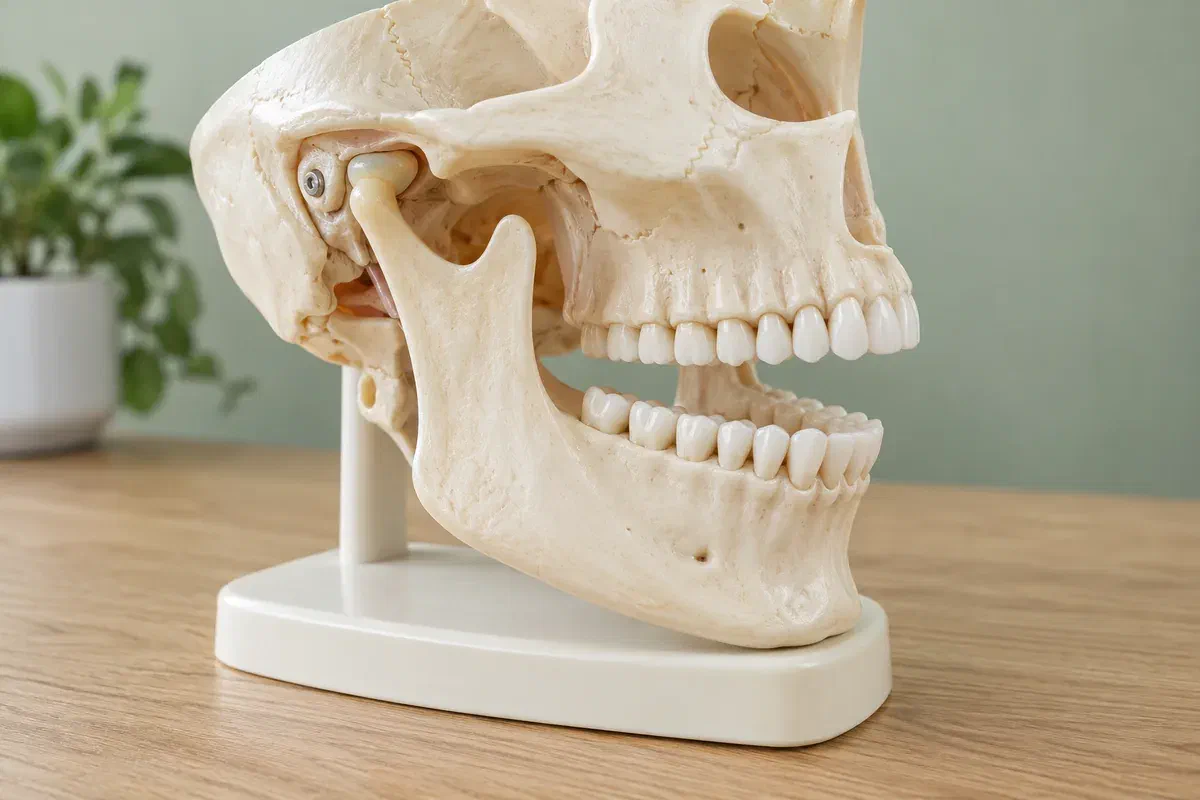
Illustrative physical teaching model showing the jaw and its supporting joint
What to describe first

Start with what has changed since it began.

These details help the team decide how soon you should be seen. Rapid worsening or new swelling belongs at the top of your call, not at a future routine appointment.

The character of the restriction

Describe whether movement halts suddenly, feels evenly stiff or varies from try to try, and whether it has ever stayed fixed in one position. Is it better, worse or the same as a week ago? Please avoid provoking a painful catch to check.

What you can and can’t manage

Explain which tasks are affected and whether you’re taking in enough food and fluid. If drinking or cleaning your mouth isn’t possible, ask for prompt advice. These examples also let the dentist plan an exam suited to your range.

Background that might be relevant

Tell us about recent dental treatment, any injury, swelling or earlier jaw problems. Previous operations or radiation therapy near the jaw or neck also matter. This history affects what we need to investigate and whether to involve another health professional.

If your jaw locks, opening suddenly becomes much more limited or you can’t eat or drink, you need urgent assessment. Swelling that spreads quickly or affects the eye, or problems breathing or swallowing, require emergency medical care; call 911 in an immediate emergency.

Why a baseline matters

Progress is easier to see when you know the starting line.

The dentist may record your opening as part of the visit. That reading becomes your reference, yet it means most when combined with your history and other findings. Ask how the pieces fit together and whether a probable cause is clear. If the cause is still uncertain, the plan should describe the information that would help resolve it.

We also discuss how to keep any dental treatment comfortable while your jaw is limited. Mention which positions are hard to hold and agree a pause signal. If the examination is partial today, ask what has been checked safely and how the remaining questions will be dealt with at review.

Patient information: NIDCR — assessment and management of temporomandibular disorders

A starting record, comfortably taken

The clinician observes how you open and listens to your account of tightness or pain. Say when you reach your comfortable limit. That limit is the useful reference; forcing beyond it would only make the baseline less reliable.

Causes beyond the jaw joint considered

Teeth, gums, muscles and nearby structures can be examined. Ask which findings support the explanation and whether more investigation would help. If every stiff jaw were treated as a joint problem, another condition might go unnoticed.

Review points agreed in advance

Decide together what improvement means for you, such as eating without cutting food small or brushing every tooth easily. Agree when to review, which signs warrant an earlier call and whether some updates can be made by phone.

The four parts of your visit

Talk, examine, explain, and set a review.

You can describe the restriction without repeating painful movements. If you can open only a little, mention it when booking so the team can prepare.

  1. Map the course so far

    We ask how the restriction began and how it has changed since, whether improving, worsening or fluctuating. Recent treatment, injuries, medicines and medical history are reviewed. Records or a contact for another treating clinician are welcome.

  2. Assess comfortable movement

    The dentist checks what your jaw can do comfortably and examines related areas for signs that fit your symptoms. Point to where you feel them. Breaks are fine, and anything that couldn’t be examined should be recorded so it can be revisited.

  3. Explain the probable cause and open questions

    You hear what seems likely and what is not yet known. Imaging or referral may be suggested when it would answer a particular question. Ask how it could change the plan and whether medical, dental or specialist assessment should come before management.

  4. Agree goals and a review date

    Confirm interim advice, the purpose of any treatment and the measures of progress you’ll both use. If exercises are recommended, ask for instructions that suit your diagnosis. Make sure you know whom to contact if symptoms worsen.

Between now and your review

Comfort first; let the review tell you how it’s going.

Home advice should follow from your assessment. A routine for recovery after a specific operation might not suit a new or unexplained restriction, even though both limit opening.

No self-directed stretching

Avoid levering your jaw open with objects, hard stretches or repeated painful movements. If you’re given a movement programme, confirm the technique, frequency and when to stop. If it worsens symptoms, call rather than doing extra.

Track a few markers, not every opening

Note real changes in how meals, drinks, brushing and comfort are going, and when symptoms occur. Bring those notes to your review. Repeatedly measuring your opening or provoking a lock isn’t necessary.

Raise problems before the review if needed

If you can’t clean an area or keep up with food and fluids, let us know without waiting. We can discuss adjustments or further assessment. Necessary care shouldn’t be put off on the assumption that your jaw has to improve first.

Patient information: Guy's and St Thomas' — jaw opening advice after relevant medical treatment

Choosing the approach

Care built on the cause, checked against your goals

For every proposed step, ask what result it is aiming for and when that will be reassessed. Limited opening by itself isn’t a reason for an appliance, a procedure or permanent bite adjustments.

If a tooth or nearby tissue is the cause

Addressing a dental source

A tooth or the gum around it may need treatment aimed at that source. Ask about urgency and whether it can be done in our clinic. Restoring movement alone wouldn’t clear an infection or resolve another untreated dental problem.

If muscles or the joint seem to be involved

Reversible care with review points

A plan selected for you may involve explanation and other reversible measures. Ask what to start with, what to avoid and when you’ll be reviewed. Progressing gradually allows your response to be judged without assuming an irreversible bite change.

If history or a persistent restriction needs wider input

Specialist assessment or shared rehabilitation

A specialist or your medical team may need to be involved, particularly following relevant surgery or radiotherapy. Find out who coordinates and what the referral will clarify. Rehabilitation should be tailored to you rather than borrowed from another plan.

Caledon questions about progress

Reviews, timelines and knowing what to expect

These answers help you prepare. A severe new restriction, or difficulty with food and fluids, calls for a phone conversation and prompt advice rather than an online request alone.

(905) 876-4488
What does a good review of my jaw look like?
It compares symptoms, movement and everyday function against your baseline. Easier meals or brushing are useful to report alongside the examination. Ask what the findings mean for the next stage.
How long before I should expect improvement?
It depends on the cause and the approach. Ask at your assessment what a reasonable timeframe is for your situation and what should prompt an earlier call.
If my opening isn’t improving, what happens next?
A persistent restriction may need further investigation, a change of approach or referral. The review is the time to discuss that, and worsening symptoms should be reported sooner.
Can I combine review visits with other dental appointments?
Often, if timing suits the plan. Ask when booking so enough time is allowed for both. Urgent changes should never wait for a combined visit.
Is one measurement at my first visit enough to judge progress?
It provides a reference, but progress is judged alongside symptoms, function and repeat examination. A single number can’t tell the whole story.
Should I stop following the plan if my jaw feels better?
Check with the clinician first. Some advice is meant to continue for a while, and the review can confirm whether it is safe to change your routine.
Jaw opening assessments for Caledon

Start with a baseline. Leave with a plan.

To arrange an assessment, call our Bronte Street practice on (905) 876-4488. Share any sudden locking, swelling, injury or trouble with meals and drinks so the team can understand the urgency and help plan your next steps.

Causes, the care required, any referral and the pace of recovery vary. Online requests suit non-urgent questions and are not a replacement for urgent assessment if symptoms are severe or get worse.

Visit Milton Dental Clinic
Unit 1, 342 Bronte St. S, Milton, ON L9T 5B7
Get directions Clinic hours
Monday–Thursday
11am–7pm
Friday–Sunday
By appointment only

Areas we serve

  • Milton
  • Oakville
  • Mississauga
  • Georgetown
  • Halton Hills
  • Acton
  • Campbellville
  • Brampton
  • Burlington
  • Puslinch
  • Rockwood
  • Erin
  • Caledon
  • Etobicoke
  • Old Milton
  • Bronte Meadows
  • Timberlea
  • Dorset Park
  • Dempsey
  • Clarke
  • Beaty
  • Coates
  • Harrison
  • Scott
  • Willmott
  • Ford
  • Bowes
  • Cobden
  • Walker
  • Mountain View
  • Milton Heights
  • Hawthorne Village
  • Valley View
  • Fallingbrook
  • Nassagaweya
  • Trafalgar
  • Esquesing
  • Nelson
  • Brookville
  • Moffat
  • Glen Williams
  • Norval
  • Limehouse
  • Stewarttown
  • Ashgrove
  • Hornby
  • Silver Creek
  • Speyside
  • Scotch Block
  • North Oakville
  • River Oaks
  • Glen Abbey
  • West Oak Trails
  • Palermo
  • Bronte Creek
  • College Park
  • Joshua Creek
  • Uptown Core
  • Preserve
  • Iroquois Ridge
  • Lisgar
  • Meadowvale
  • Meadowvale Village
  • Churchill Meadows
  • Erin Mills
  • Central Erin Mills
  • Streetsville
  • East Credit
  • Creditview
  • Heartland
  • Sheridan
  • Mount Pleasant
  • Credit Valley
  • Huttonville
  • Churchville
  • Springbrook
  • Northwest Brampton
  • Bram West
  • Fletcher's Meadow
  • Fletcher's Creek South
  • Alton Village
  • Orchard
  • Millcroft
  • Headon Forest
  • Tansley
  • Brant Hills
  • Tyandaga
  • Kilbride
  • Lowville
  • Aberfoyle
  • Morriston
  • Arkell
  • Hillsburgh
  • Freelton
  • Carlisle
  • Waterdown
  • Flamborough
  • Mountsberg

How can we help?

Milton Dental Clinic

Have a question about your smile? Choose the option that works best for you.

For urgent dental concerns, please call.
Messages are reviewed during clinic hours.