

Illustrative patient discussing restricted jaw movement with a dental clinician
Specialized Care

Limited Jaw Opening Assessment in Oakville

Is it your jaw joint, a sore muscle, or something going on with a tooth? For anyone coming from Oakville, our assessment sorts through the possible sources of restricted opening and explains which type of care suits the findings.

Oakville · sorting out the source

Not every stiff jaw is a joint problem.

The first thing many people search is “TMJ”, and sometimes that is the right lead. But restricted opening simply means your jaw is not moving as far as usual. A painful lower wisdom tooth, an infection near the back molars, tight muscles from clenching, a knock to the chin or the long-term effects of treatment to the head and neck can all produce that same limit.

That is why an assessment starts with your story rather than a label. Did the change arrive overnight or creep in over weeks? Is there pain, a catch, a bad taste or swelling? What happened just before it began? Each answer narrows the field and helps decide whether dental treatment, conservative care or another kind of assessment is the sensible route.

From North Oakville or further south, you can call ahead and describe what is going on before travelling in. You won’t be asked to force your mouth wide to show us. Explain where comfort ends, what has changed, and whether eating, sipping drinks or brushing has become difficult.

Arrange a jaw opening assessment
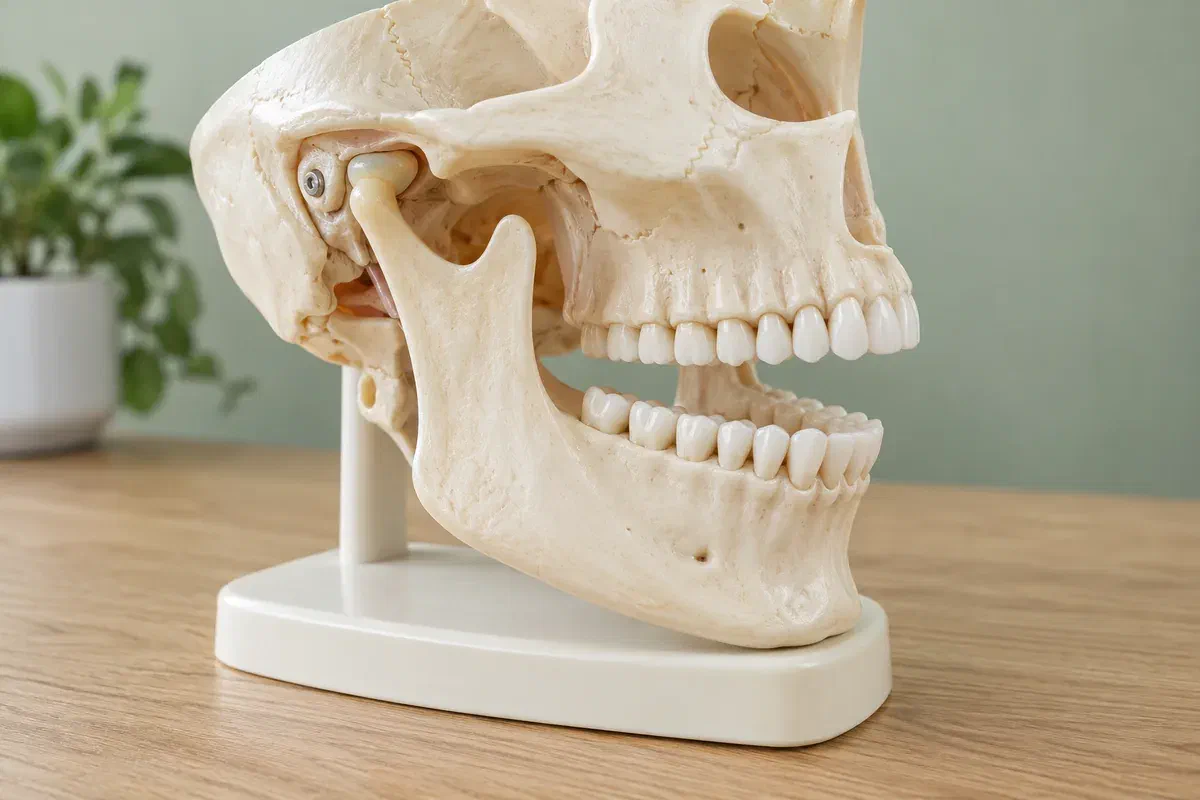
Illustrative physical teaching model showing the jaw and its supporting joint
Clues that point in different directions

Three kinds of detail help tell one cause from another.

Have a rough account ready when you phone. Swelling, or opening that is getting rapidly worse, should be mentioned at once instead of being left for a regular checkup.

How the movement stops

A sudden hard stop, a stiff feeling all the way through and movement that changes from try to try can suggest different things. Say whether the jaw has stuck open or closed and for how long. You don’t need to keep provoking a painful catch to describe it.

What it is stopping you from doing

Explain whether chewing, drinking or brushing is affected and whether you are keeping up with fluids and food. If you can’t drink or clean your teeth properly, ask for prompt advice. These examples also help the dentist tailor the exam to your present range.

Teeth, injuries and earlier treatment

Toothache, recent dental work, swelling or a blow to the face can all be relevant. Previous jaw trouble, and surgery or radiotherapy to the head and neck, matter too. They influence which questions need answers and whether another of your health providers should be involved.

Get urgent assessment for a jaw that is locked, a severe new restriction or being unable to eat or drink. Swelling spreading quickly or near the eye, or any difficulty breathing or swallowing, needs emergency medical care. For an immediate emergency, call 911.

The value of looking widely

One appointment, every likely source considered.

Your opening may be measured to document the visit, but that measurement can’t say why the jaw is limited. What matters is how it lines up with your history and what the examination finds. Ask whether a probable cause stands out. If the picture is still unclear, the plan should say which information would help, rather than resting on a number.

There is a practical side, too. Dental care still needs to happen while movement is reduced, so explain which positions are hard for you and agree how you will signal a pause. If the exam can only go part of the way today, find out what has been checked safely and how the gaps will be covered.

Patient information: NIDCR — assessment and management of temporomandibular disorders

Opening observed, never forced

The dentist watches your jaw move and listens to where you feel resistance or pain. Say when you reach your comfortable limit. Understanding how the jaw moves is the point; competing with a target or pushing through real discomfort is not.

Teeth and gums checked alongside the joint

The examination can take in teeth, gums, muscles and other relevant areas. Ask which findings back up the explanation you’re given and whether more investigation is warranted. Calling everything a joint problem could leave a different condition untreated.

Goals that reflect daily life

Agree on what progress would actually feel like, such as comfortable meals or brushing the back teeth without strain. Set a review point and decide which changes should prompt an earlier call. Knowing a plan’s purpose and limits from the start makes it easier to follow.

What happens at the visit

Four stages, each at a comfortable pace

Describing the problem is enough; you don’t have to repeat the movement that hurts. If opening for an exam is hard, tell the team when booking so they can plan around it.

  1. Your history, in your words

    We ask whether the restriction came on suddenly or gradually and whether it is improving, worsening or variable. Injuries, recent dental work, medicines and medical background are reviewed. Records or contact details for another treating team can help piece things together.

  2. A gentle look at movement and nearby areas

    The dentist checks what your jaw does comfortably and looks for signs linked to the complaint, including teeth and gums. Show where you feel symptoms and say if they match your experience. Pauses are expected; if part of the exam isn’t possible, that should be acknowledged.

  3. Likely cause, open questions and possible tests

    You hear what seems most probable and what remains unknown. X-rays or a referral are recommended only when they would answer a clear question. Ask what a test might change and whether medical, dental or specialist assessment should come before any management plan.

  4. A plan you can follow, with a review date

    Confirm interim advice, what treatment is aiming for and how you’ll both judge progress. If exercises are included, ask for instructions that fit your diagnosis. Make sure you know whom to contact if symptoms worsen or movement becomes more painful.

Between visits

Look after daily comfort while the cause is treated.

Home advice should be shaped by what the assessment found. A programme built for recovery after a particular operation may not suit an unexplained restriction, even though both limit opening.

No prying, no testing your limit

Avoid forcing the jaw with objects, vigorous stretching or repeating movements that hurt. If you are given a movement programme, check the technique, how often to do it and when to stop. Call if it makes symptoms worse rather than simply doing more.

Watch everyday function, lightly

Make a note when eating, drinking, brushing or comfort changes in a meaningful way, and when symptoms tend to appear. That record is useful at review. Measuring every opening or provoking a lock on purpose is unnecessary.

Tell us when routine care gets hard

Say so if an area can’t be cleaned or you are struggling with food and fluids. The team can suggest adjustments or arrange more assessment. Don’t quietly put off care on the assumption that opening has to improve before anyone can help.

Patient information: Guy's and St Thomas' — jaw opening advice after relevant medical treatment

Three possible routes

Different causes, different care.

Ask what each suggested approach is designed to change and how its effect will be checked. A reduced opening does not, by itself, call for an appliance, a procedure or permanently altering your bite.

If the exam finds a dental cause

Addressing a tooth or gum source

An infected tooth or inflamed tissue nearby may need treatment directed at that source. Talk about urgency and whether it can be done in our clinic. Loosening the jaw would not clear an infection or fix another dental problem that remains untreated.

If the findings suggest a muscle or joint origin

Reversible care for muscles or the joint

A plan suited to you may involve explanation and other reversible steps. Ask what to start with, what to avoid and when to come back. Moving gradually means the response can be reviewed without assuming an irreversible bite change is needed.

If your history or a lasting restriction needs more input

Specialist assessment or coordinated rehabilitation

A specialist or your medical team may need to be involved, especially after relevant surgery or radiotherapy. Ask who will coordinate and what the referral is meant to resolve. Rehabilitation advice should fit your case rather than repeat someone else’s plan.

Oakville questions about jaw restriction

Joint, muscle or tooth: your questions

These answers help you prepare. If restriction is severe and new, or you can’t keep up with food and fluids, phone for prompt advice instead of relying on an online request.

(905) 876-4488
Can a wisdom tooth make it hard to open my mouth?
It can. Inflammation or infection around a partly erupted lower wisdom tooth sometimes limits opening, often with soreness or swelling at the back of the mouth. Mention these signs when you call, as they affect how soon you should be seen.
How do you tell a muscle problem from a joint problem?
The history and examination together usually guide this. Where you feel symptoms, how movement stops and what triggers it all help. Sometimes uncertainty remains and imaging or referral is considered. Ask which findings support the explanation you’re given.
Is the measurement of my opening a diagnosis?
No. A measurement documents movement, but it has to be interpreted with your symptoms, the exam and your health history. One number can’t explain every reason a jaw is restricted.
Should I take something for the pain before my appointment?
Follow the directions on any over-the-counter product and your pharmacist’s or doctor’s advice about what suits you. Tell the dentist what you took and whether it helped, as that can be useful information.
Does sudden locking need a quicker appointment than clicking?
Usually, yes. A new lock or a real loss of movement should be reported promptly, especially if eating or drinking is affected. Clicking that is painless and doesn’t limit movement is a different presentation.
Can I call before travelling in from Oakville?
Please do. A phone description of when it started, how severe it is and whether there is swelling helps the team advise on timing. If symptoms are urgent, they may suggest seeking care sooner and closer to home.
Limited opening? Start with a call.

Let’s find out what is holding your jaw back.

Reach our Bronte Street practice at (905) 876-4488 to set up an assessment. Mention any sudden locking, swelling, injury or trouble eating and drinking, so the team understands how pressing the problem is and can plan your next step.

Every situation differs in its cause, the care it needs, whether referral is involved and how recovery goes. Online requests are for non-urgent enquiries and should not replace urgent assessment for severe or worsening symptoms.

Visit Milton Dental Clinic
Unit 1, 342 Bronte St. S, Milton, ON L9T 5B7
Get directions Clinic hours
Monday–Thursday
11am–7pm
Friday–Sunday
By appointment only

Areas we serve

  • Milton
  • Oakville
  • Mississauga
  • Georgetown
  • Halton Hills
  • Acton
  • Campbellville
  • Brampton
  • Burlington
  • Puslinch
  • Rockwood
  • Erin
  • Caledon
  • Etobicoke
  • Old Milton
  • Bronte Meadows
  • Timberlea
  • Dorset Park
  • Dempsey
  • Clarke
  • Beaty
  • Coates
  • Harrison
  • Scott
  • Willmott
  • Ford
  • Bowes
  • Cobden
  • Walker
  • Mountain View
  • Milton Heights
  • Hawthorne Village
  • Valley View
  • Fallingbrook
  • Nassagaweya
  • Trafalgar
  • Esquesing
  • Nelson
  • Brookville
  • Moffat
  • Glen Williams
  • Norval
  • Limehouse
  • Stewarttown
  • Ashgrove
  • Hornby
  • Silver Creek
  • Speyside
  • Scotch Block
  • North Oakville
  • River Oaks
  • Glen Abbey
  • West Oak Trails
  • Palermo
  • Bronte Creek
  • College Park
  • Joshua Creek
  • Uptown Core
  • Preserve
  • Iroquois Ridge
  • Lisgar
  • Meadowvale
  • Meadowvale Village
  • Churchill Meadows
  • Erin Mills
  • Central Erin Mills
  • Streetsville
  • East Credit
  • Creditview
  • Heartland
  • Sheridan
  • Mount Pleasant
  • Credit Valley
  • Huttonville
  • Churchville
  • Springbrook
  • Northwest Brampton
  • Bram West
  • Fletcher's Meadow
  • Fletcher's Creek South
  • Alton Village
  • Orchard
  • Millcroft
  • Headon Forest
  • Tansley
  • Brant Hills
  • Tyandaga
  • Kilbride
  • Lowville
  • Aberfoyle
  • Morriston
  • Arkell
  • Hillsburgh
  • Freelton
  • Carlisle
  • Waterdown
  • Flamborough
  • Mountsberg

How can we help?

Milton Dental Clinic

Have a question about your smile? Choose the option that works best for you.

For urgent dental concerns, please call.
Messages are reviewed during clinic hours.