

Illustrative patient discussing restricted jaw movement with a dental clinician
Specialized Care

Limited Jaw Opening Assessment in Rockwood

If you have had cancer treatment or an operation involving the head or neck, a tightening jaw needs care that links up with your medical team. For people coming from Rockwood, we assess the restriction and coordinate where it helps.

Rockwood · when medical history matters

Your earlier treatment is part of this conversation.

People who have been through radiotherapy or surgery near the mouth, throat or neck are sometimes told that jaw stiffness can follow, occasionally long after treatment has finished. So when opening starts to shrink, it is natural to assume that explains it. It might. But a dental infection, muscle tension or a joint problem can also be responsible, and each needs a different response.

That is why a careful history comes before conclusions. When did you first notice the change, and has it been steady or sudden? Is there pain, swelling, a catching sensation or a sore tooth? Which team treated you, and what did they advise about jaw movement? Bringing those details together helps decide whether dental care, coordinated rehabilitation or further assessment is the right step.

Travelling from Rockwood, it helps to call ahead so we know your background before you arrive. Nobody will push your jaw past what feels comfortable. Tell us what has changed, whether eating, drinking or cleaning your teeth is harder, and what advice you have already been given.

Discuss your history with our team
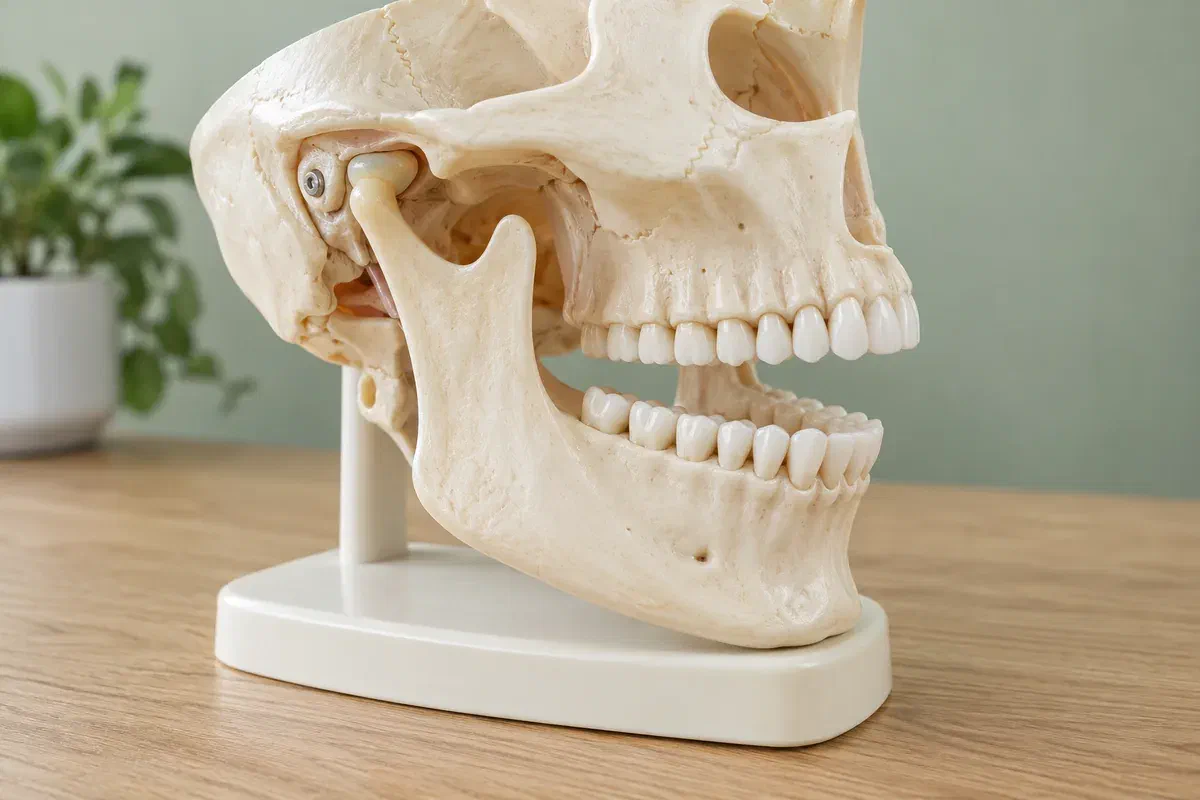
Illustrative physical teaching model showing the jaw and its supporting joint
What to share with us

Three areas we will ask about

Mention these when you phone. A sudden worsening or new swelling should be raised at once rather than waiting until a scheduled visit, especially given your history.

How the restriction is behaving

Explain whether movement stops abruptly, tightens gradually or varies, and whether it has ever held in an open or closed position. Has it been creeping in over months or arrived quickly? Please don’t test a painful limit over and over to describe it.

Daily care, eating and drinking

Describe which tasks are affected and whether you can manage enough fluids and food. A dry mouth or difficulty cleaning can make restriction harder still. If drinking or keeping your mouth clean has become difficult, ask for prompt advice.

Your treatment and care team

Tell us when and where you were treated, what was involved and who is following you now. Recent dental work, swelling or facial injury matters too. This history shapes the questions we need to answer and how closely we should work with your medical team.

A locked jaw, a sudden marked restriction or not being able to eat or drink needs urgent assessment. Swelling that spreads rapidly or reaches the eye, and any difficulty breathing or swallowing, need emergency medical care; call 911 in an immediate emergency.

What coordinated assessment offers

One clear baseline your whole care team can use

The dentist may record your opening, which can be shared with other clinicians as a reference. That figure is only one part of the assessment. Ask how it fits your history, what the examination shows and whether a dental cause has been found or ruled out. If something remains unclear, ask what further information would settle it.

We also look at how routine dental care can stay safe and manageable after your treatment, since some procedures need extra planning. Tell the clinician which positions are hard and agree a signal for pausing. If the exam is incomplete, ask what was assessed safely and how the rest will be approached.

Patient information: NIDCR — assessment and management of temporomandibular disorders

Movement assessed without strain

The clinician watches how your jaw opens and listens to where you feel tightness or pain. Say when you reach a comfortable limit. The aim is an accurate picture of how you move, not a target to reach through discomfort.

Dental causes checked, not assumed away

Teeth, gums, muscles and nearby tissues may all be examined. Ask which findings support the explanation and whether more investigation is warranted. Putting every change down to past treatment could mean missing an infection or another treatable problem.

Goals agreed with you and your team

Decide what improvement would mean for you, such as eating more comfortably or reaching back teeth to clean. Agree on review timing and which signs should prompt an earlier call. A plan that everyone understands is easier to follow.

Your appointment

History in depth, a gentle exam, and joined-up planning

Describing the restriction is enough; there is no need to repeat painful movements. If opening for an examination is difficult, tell us when you book so the visit can be prepared carefully.

  1. Review your treatment history

    We ask when the restriction appeared, whether it is improving, worsening or fluctuating, and about your previous treatment. Medicines, recent dental work and general health are discussed. Bring treatment summaries or contact details for your oncology or surgical team if you can.

  2. Examine movement and the mouth

    The dentist assesses your comfortable range and checks teeth, gums and related areas for signs connected to your symptoms. Show where you feel discomfort and whether it is new. Pauses are fine; anything that couldn’t be examined should be acknowledged.

  3. Talk through likely causes

    You’ll hear what seems probable and what isn’t yet known. Imaging or referral is suggested only if it would answer a particular question. Ask what a test could change and whether your medical team or a specialist should assess you before management begins.

  4. Coordinate the plan and the review

    Confirm interim advice, the aim of treatment and how progress will be judged. If exercises are recommended, ask whether they fit your diagnosis and match any guidance from your medical team. Know who to contact if symptoms worsen or movement becomes more painful.

Between appointments

Follow advice designed for you, not someone else.

What you do at home should come from your assessment and your treating teams. Rehabilitation routines written after one kind of operation may not suit a different situation, even though both involve limited opening.

Use only the exercises you’ve been given

Avoid forcing the jaw with objects or improvised stretches. If a programme is prescribed, keep to its technique, frequency and stopping rules. If it increases symptoms, contact whoever prescribed it rather than adding repetitions.

Keep simple notes on function

Record meaningful changes in eating, drinking, brushing and comfort, and when symptoms appear. These notes help both us and your medical team at review. There is no need to measure every opening or deliberately trigger a lock.

Tell us early if care becomes difficult

If you can’t clean an area, have a persistently dry or sore mouth, or are struggling with food and fluids, let us know. We can discuss adjustments or further assessment. Don’t put off necessary care thinking your jaw must improve first.

Patient information: Guy's and St Thomas' — jaw opening advice after relevant medical treatment

How care may proceed

The findings decide who leads the next step.

With any proposed approach, ask what it is expected to improve and how that will be measured. A restricted opening alone does not warrant an appliance, a procedure or permanent changes to your bite.

If a tooth or gum problem is identified

Dental treatment where a dental cause is found

A tooth or surrounding tissue may need treatment directed at that source, planned with your medical history in mind. Discuss urgency and whether care can be provided here or needs another setting. Better movement alone wouldn’t resolve an infection.

If muscles or the joint appear responsible

Conservative care with planned review

Your plan may include explanation, self-care and other reversible measures. Ask which to start with, what to avoid and when to return. A step-by-step approach lets your response be reviewed without assuming an irreversible bite change.

If past treatment or a persistent restriction needs wider expertise

Rehabilitation coordinated with your medical team

After relevant surgery or radiotherapy, the team that treated you or a specialist may need to guide rehabilitation. Ask who coordinates and what each referral is meant to answer. Instructions should be individual rather than copied from another patient’s plan.

Rockwood questions on jaw opening and past treatment

Medical history and your jaw

These answers help you prepare. If restriction is new and severe, or keeping up with food and drink is difficult, call for prompt advice rather than relying only on an online request.

(905) 876-4488
Can jaw stiffness appear years after radiotherapy?
It can sometimes develop or worsen well after treatment. Even so, other causes should be considered too, so describe when it started and any new symptoms such as pain or swelling.
Should my oncology team know I’m having a jaw assessment?
It is often helpful. Bring their contact details so findings can be shared where appropriate and your care stays coordinated.
Can I still have routine dental work after head and neck treatment?
Often yes, though some procedures need extra planning. Tell the team about your history before any appointment so they can discuss the safest approach and whether coordination with your medical team is needed.
Are the exercises my hospital gave me still right for me?
They may be, but if your restriction has changed, ask for a review. A routine that suited one stage of recovery may need adjusting, and new symptoms should be assessed first.
Does dry mouth affect how restricted opening is managed?
It can make cleaning and comfort harder. Mention it at your assessment so the plan for keeping your mouth healthy takes it into account.
If my opening is reduced, is radiotherapy always the reason?
No. Infection, muscle problems, joint issues or injury can also cause restriction. The assessment looks for these rather than assuming your past treatment explains everything.
Jaw assessments for Rockwood

Bring your history, and we’ll help join up your care.

Call (905) 876-4488 to arrange an assessment at our Bronte Street practice. Mention sudden locking, swelling, recent injury or problems eating and drinking, along with your treatment history, so the team understands the urgency and can plan carefully.

Causes, suitable care, referral and recovery vary for each person. Online requests are for non-urgent enquiries and cannot replace urgent or emergency care when symptoms are severe or worsening.

Visit Milton Dental Clinic
Unit 1, 342 Bronte St. S, Milton, ON L9T 5B7
Get directions Clinic hours
Monday–Thursday
11am–7pm
Friday–Sunday
By appointment only

Areas we serve

  • Milton
  • Oakville
  • Mississauga
  • Georgetown
  • Halton Hills
  • Acton
  • Campbellville
  • Brampton
  • Burlington
  • Puslinch
  • Rockwood
  • Erin
  • Caledon
  • Etobicoke
  • Old Milton
  • Bronte Meadows
  • Timberlea
  • Dorset Park
  • Dempsey
  • Clarke
  • Beaty
  • Coates
  • Harrison
  • Scott
  • Willmott
  • Ford
  • Bowes
  • Cobden
  • Walker
  • Mountain View
  • Milton Heights
  • Hawthorne Village
  • Valley View
  • Fallingbrook
  • Nassagaweya
  • Trafalgar
  • Esquesing
  • Nelson
  • Brookville
  • Moffat
  • Glen Williams
  • Norval
  • Limehouse
  • Stewarttown
  • Ashgrove
  • Hornby
  • Silver Creek
  • Speyside
  • Scotch Block
  • North Oakville
  • River Oaks
  • Glen Abbey
  • West Oak Trails
  • Palermo
  • Bronte Creek
  • College Park
  • Joshua Creek
  • Uptown Core
  • Preserve
  • Iroquois Ridge
  • Lisgar
  • Meadowvale
  • Meadowvale Village
  • Churchill Meadows
  • Erin Mills
  • Central Erin Mills
  • Streetsville
  • East Credit
  • Creditview
  • Heartland
  • Sheridan
  • Mount Pleasant
  • Credit Valley
  • Huttonville
  • Churchville
  • Springbrook
  • Northwest Brampton
  • Bram West
  • Fletcher's Meadow
  • Fletcher's Creek South
  • Alton Village
  • Orchard
  • Millcroft
  • Headon Forest
  • Tansley
  • Brant Hills
  • Tyandaga
  • Kilbride
  • Lowville
  • Aberfoyle
  • Morriston
  • Arkell
  • Hillsburgh
  • Freelton
  • Carlisle
  • Waterdown
  • Flamborough
  • Mountsberg

How can we help?

Milton Dental Clinic

Have a question about your smile? Choose the option that works best for you.

For urgent dental concerns, please call.
Messages are reviewed during clinic hours.