

Illustrative patient discussing tooth support with a clinician and a dental teaching model
Specialized Care

Loose Adult Tooth Treatment in Burlington

It doesn't hurt, so surely it can wait? Not necessarily. A permanent tooth that has started to move is worth having examined, pain or no pain. Adults from Burlington can see our dentist to check the tooth and its foundations, learn the likely cause, and hear their options.

The quiet kind of loose

Painless movement still tells you something.

Plenty of people put off calling because nothing aches. It's an understandable instinct, yet discomfort is an unreliable measure of how much a loose adult tooth needs attention. Support around a root can weaken gradually without much warning, and a tooth that moves quietly may have more going on beneath the gum than one that throbs.

What matters is the reason. An injury, even one you barely remember, can loosen a tooth. Gum and bone changes, other dental problems, or a crown coming free can do the same. Two of these may even be happening together. Sorting them out takes an examination, not guesswork.

So rather than waiting to see whether it gets worse, get in touch and describe it. Leave the tooth alone in the meantime. Useful details include roughly when you noticed it, anything that happened beforehand, and whether chewing or the way your teeth fit together has changed.

Have the loose tooth examined
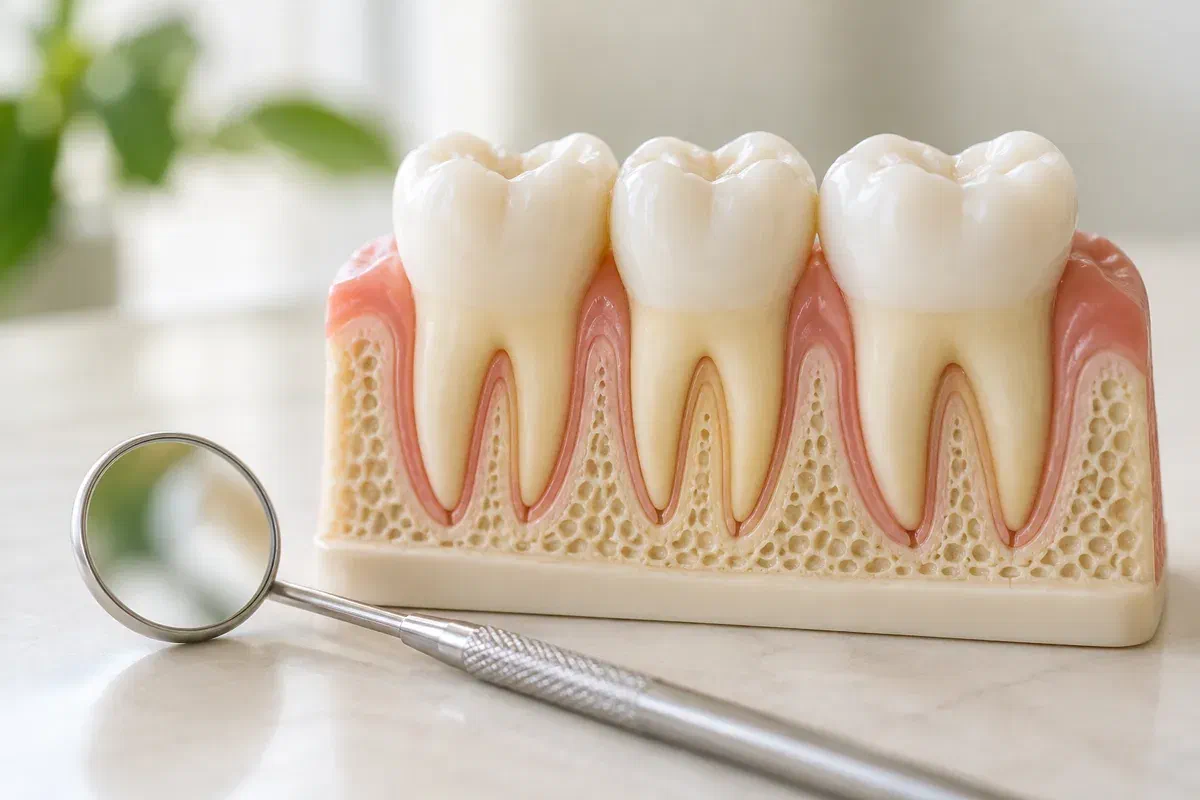
Illustrative cross-section teaching model showing teeth within gum and supporting bone
Signs to mention

Which story fits your tooth?

How the movement began guides the exam. An adult tooth knocked loose or out of line in an accident should be checked promptly, even if it seems comfortable right now.

It started after a bump or blow

Give the date, describe whether the tooth looks moved, and say whether your bite feels changed. Mention lip cuts, facial bruising or jaw ache. Adjacent teeth can absorb part of the same impact and are usually examined too.

It crept up gradually

Gradual loosening often comes with gum signs: bleeding on brushing, receding gums, widening gaps, or food trapping in new places. Mention any earlier gum therapy. These point the dentist toward the bone and tissue that anchor the root.

You suspect a crown or filling

Tell the team what dental work is in that spot. Describe the feeling without probing it repeatedly. If something comes off, store it in a clean container and phone us; avoid gluing it back, which can make later repair harder.

A loose or displaced permanent tooth after an injury calls for a prompt phone call. A tooth that has been knocked completely out is a separate emergency where minutes count. Call 911 for serious facial trauma, heavy bleeding you can't stop, or any difficulty breathing.

Leaving with clear answers

Learn the cause, the strength of the support, and your real options.

Whether a tooth is likely to last depends on far more than how loose it feels. The dentist assesses the root, gums and bone before giving a view. You're entitled to ask which findings drive that view and which remain uncertain. If more investigation or a specialist is recommended, ask what question it is meant to answer.

Expect the explanation to distinguish between easing symptoms now and treating what caused the movement. Steadying a tooth can be appropriate for some situations, but it won't restore lost support or resolve gum disease by itself. Ask what each step can sensibly achieve in your case.

Patient information: NIDCR — assessment and treatment of gum disease

A check of what anchors the tooth

Gums, supporting tissue and relevant images are reviewed along with the tooth. Your health history and any previous gum treatment help make sense of the results. Ask whether the issue is confined to one tooth or whether a broader gum check is sensible.

Natural tooth or dental work

Loose dental work and a mobile tooth are separate problems with separate solutions. Ask which you have and whether the tooth below a crown is still sound. That is why re-cementing may or may not be enough.

A candid prognosis

Review the benefits, limits, costs and follow-up attached to each choice. Keeping a tooth can involve ongoing care, and its future can't be guaranteed by how it looks. Ask what might change the plan once treatment begins.

Your assessment

Listen, examine, explain, then plan.

Mention any tenderness, and tell us if the idea of losing the tooth is weighing on you. Each finding is explained as we go, so the decision is one you share rather than one you have to guess at.

  1. Start with the timeline

    We ask when movement began and whether it followed an injury or dental work. We also cover earlier gum care, symptoms, medicines and medical conditions. Records from another dentist who treated the tooth can show how it has changed.

  2. Look at the tooth and its foundations

    The exam covers the loose tooth and the surrounding structures that may explain it. Tests and images are picked to suit the question. Ask what they reveal about the gum and bone, the root, or the nerve when those need investigating.

  3. Weigh immediate needs against later steps

    An injury might need prompt care, while gum-related causes are often managed in phases. If stabilization is offered, ask whether it's temporary and what follows. If extraction is raised, ask why keeping the tooth may not be advisable.

  4. Leave with a follow-up plan

    Confirm the reason for the next visit, its timing, and any referral. Ask how to brush and eat around the tooth until then, and which changes mean calling early. Monitoring makes sense when you know what's being tracked and why.

Care at home

Keep things calm until the next check.

Home advice differs depending on whether the cause is injury, gum disease, a restoration issue or something else. Rely on the instructions from your exam rather than general tips meant for other problems.

No more testing

Each push with a finger or tongue disturbs the area without telling you anything useful. Keep hard foods off that tooth while you wait for advice. Don't try to remove, glue, tie or brace it at home.

Ask for a cleaning demonstration

If a splint or new restoration is placed, have the team show you how to clean around it. Flag any spot that's hard to reach. Devices bring extra cleaning needs, and good advice covers both the device and the gums next to it.

Speak up about changes

Call if the tooth loosens more, your bite shifts, pain or swelling begins, or a splint loosens. Don't take a splint off on your own. After an injury, reviews stay important even when everything feels fine, because later checks guide what happens next.

Possible treatments

The right fix depends on the reason.

One procedure won't suit every loose tooth. Ask how the recommended approach answers your findings and whether its goal is short-term protection, disease control, repair, or planning a replacement.

When periodontal disease is found

Treating the gums and supporting tissue

Gum treatment and ongoing maintenance may be advised when periodontal disease is involved. Discuss how much support is gone and what's realistic to aim for. Care targets the disease and can't promise every loose tooth will firm up.

When the injury makes it appropriate

Stabilizing an injured tooth

A splint and planned reviews may be suggested for the right kind of injury. Ask what else is needed and how long the splint remains. Root canal treatment depends on what is found about the nerve, not simply on movement.

When the loose part or outlook shapes the choice

Repair, or removal and replacement

A loose crown or filling may be repaired if the tooth underneath is healthy enough. A tooth with a poor outlook may lead to a talk about removal and future replacement. Ask for the reasoning and alternatives before you decide.

Burlington questions, answered

What to know before you wait it out.

Your exam decides which options apply. Contact us soon about any new movement, especially after an injury, and mention whether the tooth or your bite has shifted.

(905) 876-4488
Why would a tooth loosen if nothing hurts?
Gum and bone support can change slowly without much discomfort, and injuries or dental work problems don’t always cause pain. A lack of pain doesn’t rule out a problem. An exam helps identify the cause and whether care is urgent.
Can a loose adult tooth tighten up again on its own?
Sometimes movement eases, for example after certain injuries settle, but that depends on the cause. Gum-related loosening usually needs treatment of the underlying disease. Rather than waiting, have it examined so you know what to expect.
Does smoking affect gum support around a loose tooth?
Smoking is a well-recognised risk factor for gum disease and can affect how gums respond to treatment. Tell the dentist if you smoke or vape. If you’re thinking of quitting, ask about support; it can be part of a gum care plan.
Is a splint the standard fix for loose teeth?
No. A splint is used only when the cause and findings suggest it would help. Ask what it would achieve and whether gum treatment or other care is also needed. It doesn’t cure the reason a tooth became mobile.
My gums bleed a little when I brush. Is that connected?
It could be. Bleeding gums can be a sign of gum inflammation, which may affect the support around teeth over time. Mention it at your visit. The dentist can check whether it relates to the loose tooth.
How long will the first appointment take?
It depends on what needs to be checked and whether images or tests are required. When you call, ask the team roughly how much time to allow. If treatment is needed, it may be planned for a separate visit.
Burlington adults with a loose tooth

Don't wait for pain to make the call.

A call to (905) 876-4488 puts you through to our Bronte Street practice; describe the movement, and the team will help arrange the right assessment. If an injury is involved, mention it first so they can advise on urgency before you set out from Burlington.

Retaining a tooth, the need for a splint or referral, and treatment response all depend on individual findings. Please use online forms for non-urgent enquiries only.

Visit Milton Dental Clinic
Unit 1, 342 Bronte St. S, Milton, ON L9T 5B7
Get directions Clinic hours
Monday–Thursday
11am–7pm
Friday–Sunday
By appointment only

Areas we serve

  • Milton
  • Oakville
  • Mississauga
  • Georgetown
  • Halton Hills
  • Acton
  • Campbellville
  • Brampton
  • Burlington
  • Puslinch
  • Rockwood
  • Erin
  • Caledon
  • Etobicoke
  • Old Milton
  • Bronte Meadows
  • Timberlea
  • Dorset Park
  • Dempsey
  • Clarke
  • Beaty
  • Coates
  • Harrison
  • Scott
  • Willmott
  • Ford
  • Bowes
  • Cobden
  • Walker
  • Mountain View
  • Milton Heights
  • Hawthorne Village
  • Valley View
  • Fallingbrook
  • Nassagaweya
  • Trafalgar
  • Esquesing
  • Nelson
  • Brookville
  • Moffat
  • Glen Williams
  • Norval
  • Limehouse
  • Stewarttown
  • Ashgrove
  • Hornby
  • Silver Creek
  • Speyside
  • Scotch Block
  • North Oakville
  • River Oaks
  • Glen Abbey
  • West Oak Trails
  • Palermo
  • Bronte Creek
  • College Park
  • Joshua Creek
  • Uptown Core
  • Preserve
  • Iroquois Ridge
  • Lisgar
  • Meadowvale
  • Meadowvale Village
  • Churchill Meadows
  • Erin Mills
  • Central Erin Mills
  • Streetsville
  • East Credit
  • Creditview
  • Heartland
  • Sheridan
  • Mount Pleasant
  • Credit Valley
  • Huttonville
  • Churchville
  • Springbrook
  • Northwest Brampton
  • Bram West
  • Fletcher's Meadow
  • Fletcher's Creek South
  • Alton Village
  • Orchard
  • Millcroft
  • Headon Forest
  • Tansley
  • Brant Hills
  • Tyandaga
  • Kilbride
  • Lowville
  • Aberfoyle
  • Morriston
  • Arkell
  • Hillsburgh
  • Freelton
  • Carlisle
  • Waterdown
  • Flamborough
  • Mountsberg

How can we help?

Milton Dental Clinic

Have a question about your smile? Choose the option that works best for you.

For urgent dental concerns, please call.
Messages are reviewed during clinic hours.