

Illustrative patient discussing tooth support with a clinician and a dental teaching model
Specialized Care

Loose Adult Tooth Treatment in Caledon

Maybe another dentist mentioned a gum specialist, or you've been told a tooth's future is uncertain. A clear second look can help. For adults from Bolton and the other villages of Caledon, we review earlier records, examine the moving tooth along with the gum and bone holding it, and lay out the options.

Records, referrals and second looks

Bring the history; we'll look at the tooth with fresh eyes.

A loose adult tooth often has a backstory: gum treatment years ago, an old sports injury, a crown placed at another office, or a suggestion that you see a periodontist. Pulling those threads together is part of working out why the tooth now moves. Earlier X-rays and notes can show whether the support around it has been changing, and how quickly.

The possible causes are the familiar ones. Injury can loosen a tooth abruptly. Gum disease gradually reduces the bone around a root. Other dental conditions can contribute, and a loose restoration can masquerade as a moving tooth. Pain says little about which is at work, so a comfortable tooth still warrants an exam.

For anyone arranging care from Caledon, it helps to ask a previous dentist to send records before your visit. Then call us, describe when you noticed the movement and whether anything happened first, and mention any change in your bite. Leave the tooth alone in the meantime.

Arrange a fresh look at a loose tooth
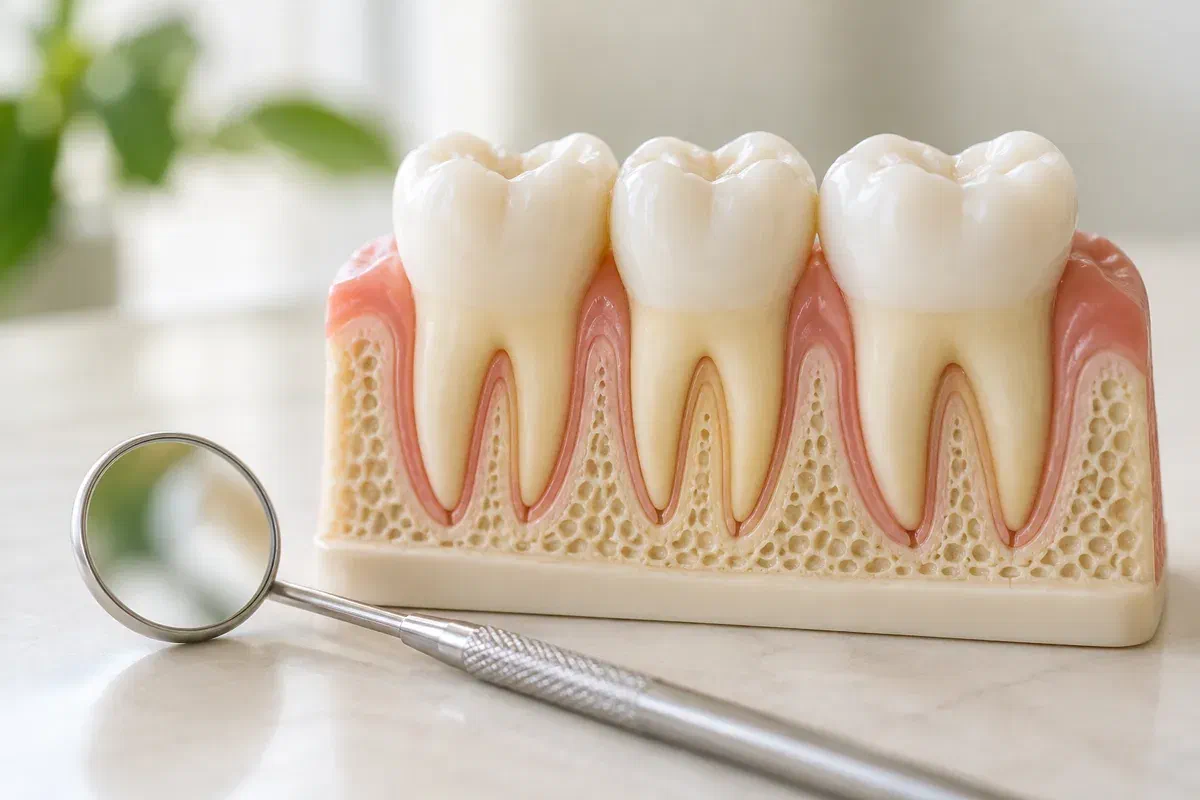
Illustrative cross-section teaching model showing teeth within gum and supporting bone
Pieces of the history

What came before helps explain what's happening now.

History matters, but a fresh injury comes first. A permanent tooth knocked loose or out of place in an accident should be assessed promptly, whatever its earlier treatment, and without waiting for pain.

An old or recent injury

Describe any injury to the tooth, however long ago, and whether it was treated. For a recent one, tell us when it happened, whether the tooth looks displaced, and whether your bite feels different. Mention facial or jaw injuries; neighbouring teeth are usually checked too.

Previous gum treatment

If you've had deep cleanings, gum surgery or maintenance elsewhere, tell us when and where. Report bleeding, recession, new gaps or food trapping. Earlier measurements and images can help show whether support has changed.

Dental work placed elsewhere

Let us know what restorations the tooth has and, if you can, when they were placed. Describe the sensation rather than probing it. If something comes off, keep it in a clean container and call; don't reattach it yourself.

Call promptly about an adult tooth that is loose or displaced after an injury. When the whole tooth has come out of its socket, that's a different emergency and needs attention immediately. Serious facial trauma, persistent heavy bleeding, or breathing difficulty requires emergency medical care: call 911.

What a second look can add

Clarity on cause, support and whether a referral would help.

A useful assessment pulls together your history and today's findings. The dentist considers the root, gums and bone around the tooth, and compares with earlier records where they exist. Ask which findings weigh most heavily in the outlook and what remains unclear. If a referral to a periodontist or other specialist is recommended, ask what that visit is meant to decide.

Understanding the difference between steadying a tooth and treating its cause is also important. A splint may protect a tooth after certain injuries, but it doesn't replace lost bone or treat gum disease. Ask what each proposed step can achieve, and how care would be shared if a specialist becomes involved.

Patient information: NIDCR — assessment and treatment of gum disease

Today's findings beside past records

Your gums, supporting tissue and suitable images may be examined along with the tooth, and compared with earlier results. Medical history and previous gum care help interpret them. Ask whether the problem appears localized or part of a wider gum condition.

Which part is moving

A crown from another office can loosen while the tooth under it stays sound, or the reverse. Find out which you have and how healthy the tooth beneath the restoration is, because that determines whether re-cementing would help.

An honest view, shared with your other providers

Go over what each option offers, its limits, its cost and the follow-up it needs, and how information will be shared with any specialist. Keeping a tooth may involve ongoing care, and the outcome can't be guaranteed. Ask what might change the plan.

How the visit runs

History, examination, discussion, coordination.

Tell us if the area is sore or if you're uneasy about advice you've had before. We explain each finding so you can weigh it alongside what other clinicians have told you.

  1. Review the records and your story

    We'll go through when the movement began, any injury or treatment beforehand, and your gum history, symptoms, medicines and health conditions. Records from other offices, if sent ahead, help show how the tooth has changed.

  2. Examine the tooth and its support

    With the history in hand, the dentist examines the moving tooth and whatever around it might be responsible. Tests are picked for the question being asked, and recent images from elsewhere are used where they're good enough. Have the dentist talk you through what the results say about the bone, root and nerve.

  3. Discuss what's needed and who provides it

    Damage from a recent blow can call for quick treatment, whereas gum problems are usually tackled over several visits, sometimes alongside a specialist. A proposed splint should come with an explanation of how temporary it is and what it leads into. Should removal be raised, find out what makes the tooth hard to save.

  4. Coordinate follow-up

    Confirm the reason and timing of each review and any referral, and how records will be shared. Ask how to clean and chew in the meantime and what changes mean calling early.

Between visits and referrals

Look after the tooth while the plan comes together.

Home care depends on whether the cause is injury, gum disease, a restoration problem or something else. If you're seeing more than one clinician, follow the instructions specific to your tooth and ask if they differ.

Don't test it

Pressing on the tooth with your finger or tongue can disturb it. Avoid hard foods with it while you wait for advice or treatment. Never attempt to pull, glue or secure it yourself.

Get cleaning advice for any new work

Anything bonded or fitted to the tooth, from a splint to a new crown, comes with its own cleaning challenge. Before you leave, have someone walk you through the brushing and between-teeth cleaning it needs, and say where you struggle. Healthy gums around the device matter as much as the device itself.

Report changes to whoever is treating you

Phone us if the tooth starts moving more, your teeth meet differently, it becomes sore or swollen, or a splint lifts. Leave splint removal to a clinician. If a specialist is involved, let both offices know about any change, and keep injury reviews even once the tooth feels settled.

Possible routes

Treatment, referral or both, depending on the findings.

Not every loose tooth needs the same care. Ask how the recommendation ties to your findings and whether it aims for protection now, control of disease, repair, or planning for replacement, and who would provide each part.

When periodontal disease is involved

Gum treatment, sometimes with a specialist

Gum therapy and maintenance may be recommended, and more complex cases may be referred to a periodontist. Ask to see where the bone sits now compared with any older images, and what treatment is aiming for. Its purpose is to bring disease under control, which is not the same as a promise that the tooth will firm up.

When the injury suits it

Stabilization after injury

A splint and planned reviews may suit certain injuries. Ask what other treatment might be needed and how long the splint stays. Root canal treatment depends on the nerve's condition, and in some cases an endodontist may be involved.

When the restoration or outlook decides

Repair, or removal and replacement

Where the restoration is the moving part and the tooth under it is sound, remaking it may be enough. Where the tooth's own prospects are poor, taking it out and planning a replacement may come into the conversation. Before deciding, ask for the reasons, the alternatives, and whether a second opinion would be useful.

Caledon referral and records questions

Making sense of past advice and next steps.

Past advice is useful context, but today's exam decides what applies now. Don't hold off on a call while records are being sent: new movement, and especially movement after a knock, should be reported straight away.

(905) 876-4488
How do I get my records sent from my previous dentist?
Ask your previous office to send your records and recent images; they may ask you to sign a release. Let our team know they’re coming so they can be reviewed before your visit.
What does a periodontist do for a loose tooth?
A periodontist specializes in the gums and supporting bone. They may assess and treat more advanced gum disease. Ask why a referral is suggested and what the specialist will evaluate.
I was told my tooth may need to come out. Can you give a second opinion?
Yes. We can examine the tooth, review records, and explain our findings. A second opinion may agree or offer different options; either way, you’ll have more information to decide.
Will I need new X-rays if I already have recent ones?
Recent images from another office may be usable, depending on what they show. The dentist will decide whether additional images are needed to answer the clinical question.
Is a painless loose tooth still worth a visit?
Yes. Pain isn’t a reliable sign of how much support remains. Describe when the movement began and any gum changes or injury.
If a specialist treats my gums, who looks after the rest of my dental care?
Care is often shared. A periodontist may handle gum treatment or certain maintenance visits while a general dentist continues with check-ups, fillings and crowns. Ask both offices to agree on who sees you for what, and how often, so nothing falls between the two.
From Caledon

Bring what you've been told, and we'll help you weigh it.

Call (905) 876-4488 to reach our Bronte Street team, describe the change, and arrange an assessment. If an injury caused the movement, say so straight away so they can advise on urgency; otherwise, ask about sending records before you come.

Keeping the tooth, any need for a splint or referral, and its response to treatment depend on individual findings. Online forms are for non-urgent enquiries.

Visit Milton Dental Clinic
Unit 1, 342 Bronte St. S, Milton, ON L9T 5B7
Get directions Clinic hours
Monday–Thursday
11am–7pm
Friday–Sunday
By appointment only

Areas we serve

  • Milton
  • Oakville
  • Mississauga
  • Georgetown
  • Halton Hills
  • Acton
  • Campbellville
  • Brampton
  • Burlington
  • Puslinch
  • Rockwood
  • Erin
  • Caledon
  • Etobicoke
  • Old Milton
  • Bronte Meadows
  • Timberlea
  • Dorset Park
  • Dempsey
  • Clarke
  • Beaty
  • Coates
  • Harrison
  • Scott
  • Willmott
  • Ford
  • Bowes
  • Cobden
  • Walker
  • Mountain View
  • Milton Heights
  • Hawthorne Village
  • Valley View
  • Fallingbrook
  • Nassagaweya
  • Trafalgar
  • Esquesing
  • Nelson
  • Brookville
  • Moffat
  • Glen Williams
  • Norval
  • Limehouse
  • Stewarttown
  • Ashgrove
  • Hornby
  • Silver Creek
  • Speyside
  • Scotch Block
  • North Oakville
  • River Oaks
  • Glen Abbey
  • West Oak Trails
  • Palermo
  • Bronte Creek
  • College Park
  • Joshua Creek
  • Uptown Core
  • Preserve
  • Iroquois Ridge
  • Lisgar
  • Meadowvale
  • Meadowvale Village
  • Churchill Meadows
  • Erin Mills
  • Central Erin Mills
  • Streetsville
  • East Credit
  • Creditview
  • Heartland
  • Sheridan
  • Mount Pleasant
  • Credit Valley
  • Huttonville
  • Churchville
  • Springbrook
  • Northwest Brampton
  • Bram West
  • Fletcher's Meadow
  • Fletcher's Creek South
  • Alton Village
  • Orchard
  • Millcroft
  • Headon Forest
  • Tansley
  • Brant Hills
  • Tyandaga
  • Kilbride
  • Lowville
  • Aberfoyle
  • Morriston
  • Arkell
  • Hillsburgh
  • Freelton
  • Carlisle
  • Waterdown
  • Flamborough
  • Mountsberg

How can we help?

Milton Dental Clinic

Have a question about your smile? Choose the option that works best for you.

For urgent dental concerns, please call.
Messages are reviewed during clinic hours.