

Illustrative patient discussing tooth support with a clinician and a dental teaching model
Specialized Care

Loose Adult Tooth Treatment in Georgetown

Many people expect a loose tooth to be wired or splinted straight away. Sometimes that helps; often the real work lies elsewhere. Adults coming from Georgetown can have the tooth and its gum and bone support examined, and hear which treatment actually addresses the cause.

Beyond “just splint it”

Holding a tooth still is not the same as fixing it.

It's a natural first thought: if a tooth wobbles, tie it to its neighbours. Splints do have a place, particularly after certain injuries. But steadying a permanent tooth leaves the bigger question untouched, which is why it became loose in the first place, and whether the bone and gum around its root can still do their job.

The answer varies from person to person. A knock can loosen a healthy tooth overnight. Gum disease tends to work more slowly, reducing the support around the root over time. Other dental problems may be involved, and a crown that has come unglued can mimic the whole thing. None of these reliably cause pain, so a comfortable tooth can still need attention.

For anyone in Georgetown, the starting point is the same: a call and an exam. You don't need to test how loose it is. Mention when you noticed it, whether anything hit the tooth, and whether your bite seems different. The dentist will then explain whether a splint, gum care, repair or something else fits.

Book an assessment before choosing treatment
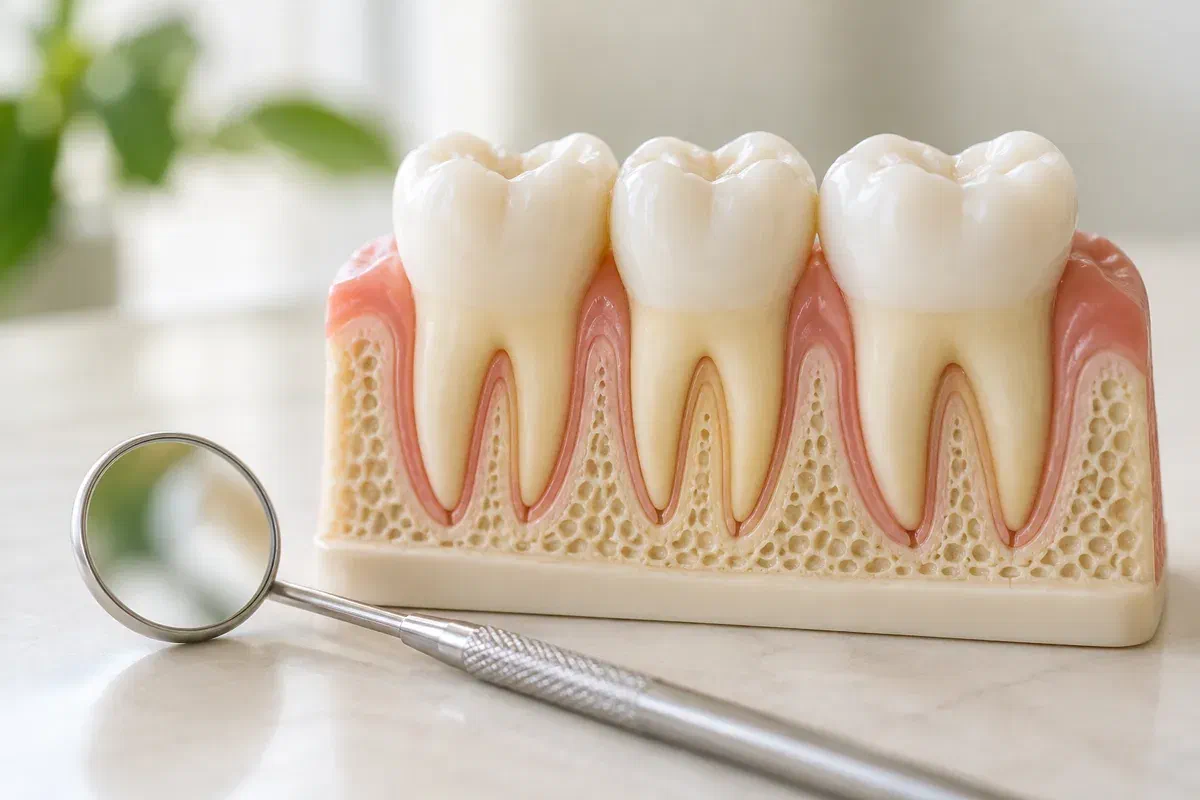
Illustrative cross-section teaching model showing teeth within gum and supporting bone
Details that change the plan

What caused it decides what fixes it.

One situation can't wait. A permanent tooth that was knocked loose or out of position in an accident should be assessed promptly, even if it isn't painful yet. Other causes allow a little more time, though not indefinite delay.

Injury

This is where splinting is most often considered. Tell the team when the injury happened, whether the tooth sits differently, and whether your teeth come together in a new way. Mention lip, face or jaw injuries. Surrounding teeth are checked too, since they can be hurt without looking it.

Gum and bone changes

Here, a splint alone rarely tackles the cause. Let us know about gum bleeding, recession, new gaps, or food packing in odd places, and any past gum therapy. These signs direct attention to the support around the root.

A restoration that may be loose

If the tooth has a crown, filling or bridge, say so. Describe what you feel without rocking it. Should a piece detach, keep it in a clean container and phone us; home glue tends to make a professional repair more difficult.

Call promptly if an adult tooth is loose or displaced after an injury. A tooth knocked completely out is its own emergency and every minute matters. For serious injury to the face, heavy bleeding that won't stop or any trouble breathing, get emergency medical help by calling 911.

What a careful assessment gives you

A reason, a measure of support, and options with honest limits.

No dentist can predict a tooth's future from its movement alone. The condition of the root and the amount of gum and bone around it carry most of the weight. You can ask which of these findings matter most in your case, and which are still uncertain. If a specialist or further imaging is suggested, ask what decision it will help make.

This is also the moment to separate stabilizing from treating. A splint can make a tooth feel firmer and protect it during healing in selected situations. It does not replace bone that has been lost, and it does not treat gum disease. Ask what any proposed step is designed to do, and what it leaves for later.

Patient information: NIDCR — assessment and treatment of gum disease

An examination of the foundations

Gums, supporting tissue and suitable images are reviewed alongside the tooth. Your medical history and any gum treatment you've had help interpret the results. Ask if the problem is confined to one tooth or whether your gums deserve a broader review.

Clarity on what is loose

Sometimes the tooth is firm and only its crown is moving; sometimes the opposite. Each calls for different care. Ask which you have and whether the tooth below any restoration is healthy enough to support a repair.

An outlook without promises

Talk through the benefits, drawbacks, costs and follow-up attached to each choice, including a splint. Saving a tooth may involve ongoing maintenance, and its future can't be guaranteed. Ask what would make the dentist change course.

How the decision is made

Understanding comes first; the splint question comes later.

Tell the dentist if the tooth is tender or if you're worried about losing it. Findings are explained in everyday language so that, whatever is recommended, you know why.

  1. Your account of what happened

    We'll ask when the movement began and whether an injury, dental procedure or nothing in particular came before it. So are any earlier gum treatment, other symptoms, your medications and your overall health. If another office has worked on the tooth, their records may help.

  2. A look at tooth, gum, bone and nerve

    The dentist examines the moving tooth and the structures that could explain it, using tests and images chosen for the question. Ask what the results say about the bone level, the root, and the nerve inside the tooth.

  3. A discussion of short-term and long-term care

    After an injury, prompt treatment, possibly including a splint, may be needed. With gum disease, a staged plan is more typical. Ask what any splint protects, how long it would stay, and what follows. If extraction comes up, ask what makes the tooth unlikely to be saved.

  4. An agreed schedule of reviews

    Confirm the reason for each review, its timing, and any referral. Ask how to clean around the area or splint, and what changes mean calling before the next visit. Reviews are useful when you know what's being measured.

Living with a splint, or without one

Protect the area and keep your follow-up.

Care at home depends on whether the cause is an injury, gum disease, a restoration issue or something else, and on whether a splint was placed. Use the instructions from your own visit.

Hands off the tooth

Testing it with a finger or tongue disturbs healing and tells you little. Avoid biting hard foods with that tooth or splint. Don't try to pull, glue, wire or secure anything at home.

Learn to clean around the splint

If a splint or restoration is placed, ask the team to demonstrate how to brush and clean around it. Mention any part that's difficult to reach. Splints can trap plaque, so cleaning advice should cover both the device and the gums beside it.

Report problems and return as planned

Call about increased movement, a change in bite, new pain or swelling, or a splint that feels loose or broken. Don't remove it yourself. After an injury, reviews remain important even once the tooth feels stable, since later findings may shape further treatment.

Where a splint fits, and where it doesn't

Three directions, chosen by the findings.

Treatment for a loose tooth isn't one-size-fits-all. Ask how the recommendation answers your findings and whether it aims to protect the tooth now, control disease, repair dental work, or plan a replacement.

When periodontal disease is the cause

Treating the gums

Gum therapy and ongoing maintenance may be recommended if periodontal disease is found. Ask how much bone and gum support remains and what the treatment can reasonably achieve. It manages the disease; it cannot guarantee that every loose tooth will firm up.

When the injury and tooth make it worthwhile

A splint and injury follow-up

For an appropriate injury, a dentist may place a splint and set review dates. Ask what other treatment is involved and when the splint will come off. A root canal is considered only if the nerve shows signs of damage, not because the tooth moved.

When the restoration or outlook guides the choice

Repair, or removal and replacement

A loose crown can often be re-cemented or remade if the tooth beneath is healthy. If the tooth's outlook is poor, the discussion may turn to removal and later replacement. Ask for the reasoning behind each path and the alternatives.

Splint and loose tooth questions

What Georgetown adults ask most.

Your exam decides which options apply. Call soon about new movement, especially after an injury, and mention any change in the tooth's position or your bite.

(905) 876-4488
How long does a splint usually stay on?
It depends on the injury and findings. Splints placed after an injury are typically kept for a set period and then reviewed. Ask your dentist how long they expect yours to stay and what will be checked before removal.
Will a splint make my teeth look different?
A splint is often bonded to the surfaces of the injured tooth and its neighbours, and it may be visible depending on where it sits. Ask the dentist where it will be placed and how it might look or feel.
Can I eat normally with a splint?
You’ll likely be advised to choose softer foods and avoid biting into hard items with the splinted teeth. Follow the instructions you’re given, and call if the splint loosens or breaks.
Does a splint treat gum disease?
No. A splint can steady teeth in certain situations, but gum disease needs its own treatment and maintenance. Ask whether gum care is part of your plan alongside or instead of a splint.
Is root canal treatment needed for every tooth that moves?
No. Whether it’s needed depends on the condition of the nerve and other findings, including the type of injury. Ask what evidence supports any treatment suggested inside the tooth.
Can a tooth feel solid after the splint is removed but still need monitoring?
Yes. Feeling stable doesn’t replace the recommended reviews, particularly after an injury. Ask how long follow-up will continue and what the dentist is checking for.
Loose tooth care from Georgetown

Find out what the tooth really needs.

Give our Bronte Street practice a call on (905) 876-4488 to describe the change and arrange an assessment. If an injury caused the movement, mention it at once so the team can talk about urgency and what to do before you arrive.

Saving the tooth, the role of any splint or referral, and the response to treatment all depend on your examination. Use online forms only for non-urgent questions.

Visit Milton Dental Clinic
Unit 1, 342 Bronte St. S, Milton, ON L9T 5B7
Get directions Clinic hours
Monday–Thursday
11am–7pm
Friday–Sunday
By appointment only

Areas we serve

  • Milton
  • Oakville
  • Mississauga
  • Georgetown
  • Halton Hills
  • Acton
  • Campbellville
  • Brampton
  • Burlington
  • Puslinch
  • Rockwood
  • Erin
  • Caledon
  • Etobicoke
  • Old Milton
  • Bronte Meadows
  • Timberlea
  • Dorset Park
  • Dempsey
  • Clarke
  • Beaty
  • Coates
  • Harrison
  • Scott
  • Willmott
  • Ford
  • Bowes
  • Cobden
  • Walker
  • Mountain View
  • Milton Heights
  • Hawthorne Village
  • Valley View
  • Fallingbrook
  • Nassagaweya
  • Trafalgar
  • Esquesing
  • Nelson
  • Brookville
  • Moffat
  • Glen Williams
  • Norval
  • Limehouse
  • Stewarttown
  • Ashgrove
  • Hornby
  • Silver Creek
  • Speyside
  • Scotch Block
  • North Oakville
  • River Oaks
  • Glen Abbey
  • West Oak Trails
  • Palermo
  • Bronte Creek
  • College Park
  • Joshua Creek
  • Uptown Core
  • Preserve
  • Iroquois Ridge
  • Lisgar
  • Meadowvale
  • Meadowvale Village
  • Churchill Meadows
  • Erin Mills
  • Central Erin Mills
  • Streetsville
  • East Credit
  • Creditview
  • Heartland
  • Sheridan
  • Mount Pleasant
  • Credit Valley
  • Huttonville
  • Churchville
  • Springbrook
  • Northwest Brampton
  • Bram West
  • Fletcher's Meadow
  • Fletcher's Creek South
  • Alton Village
  • Orchard
  • Millcroft
  • Headon Forest
  • Tansley
  • Brant Hills
  • Tyandaga
  • Kilbride
  • Lowville
  • Aberfoyle
  • Morriston
  • Arkell
  • Hillsburgh
  • Freelton
  • Carlisle
  • Waterdown
  • Flamborough
  • Mountsberg

How can we help?

Milton Dental Clinic

Have a question about your smile? Choose the option that works best for you.

For urgent dental concerns, please call.
Messages are reviewed during clinic hours.