

Illustrative patient discussing tooth support with a clinician and a dental teaching model
Specialized Care

Loose Adult Tooth Treatment in Milton

Noticed a permanent tooth shifting under your toothbrush or when you bite? That change is worth a professional look, with or without pain. Our team close to home in Milton examines the tooth and the tissues holding it, talks through likely causes, and explains how to protect it.

When a tooth moves under the brush

A small wobble is a signal, not a diagnosis.

Most people first notice it during something ordinary: brushing before bed, biting into an apple, or running a tongue along the back of the front teeth. An adult tooth is not meant to loosen the way a child's baby tooth does, so any new movement raises a fair question about why it has happened and how well the tooth is still held.

There are several possible explanations. A knock to the mouth can loosen a tooth quickly. Changes in the gums and the bone around a root tend to develop more slowly, and other dental problems can play a part too. Sometimes the tooth is fine and a crown or filling on top of it is what has come loose. An examination sorts these apart before anyone suggests treatment.

Because you are already in Milton, an assessment can usually fit around work or school runs without much planning. There is no need to measure the movement yourself first. When you get in touch, mention roughly when you noticed it, whether anything happened just before, and whether your bite or the tooth's position feels different now.

Book a loose tooth assessment
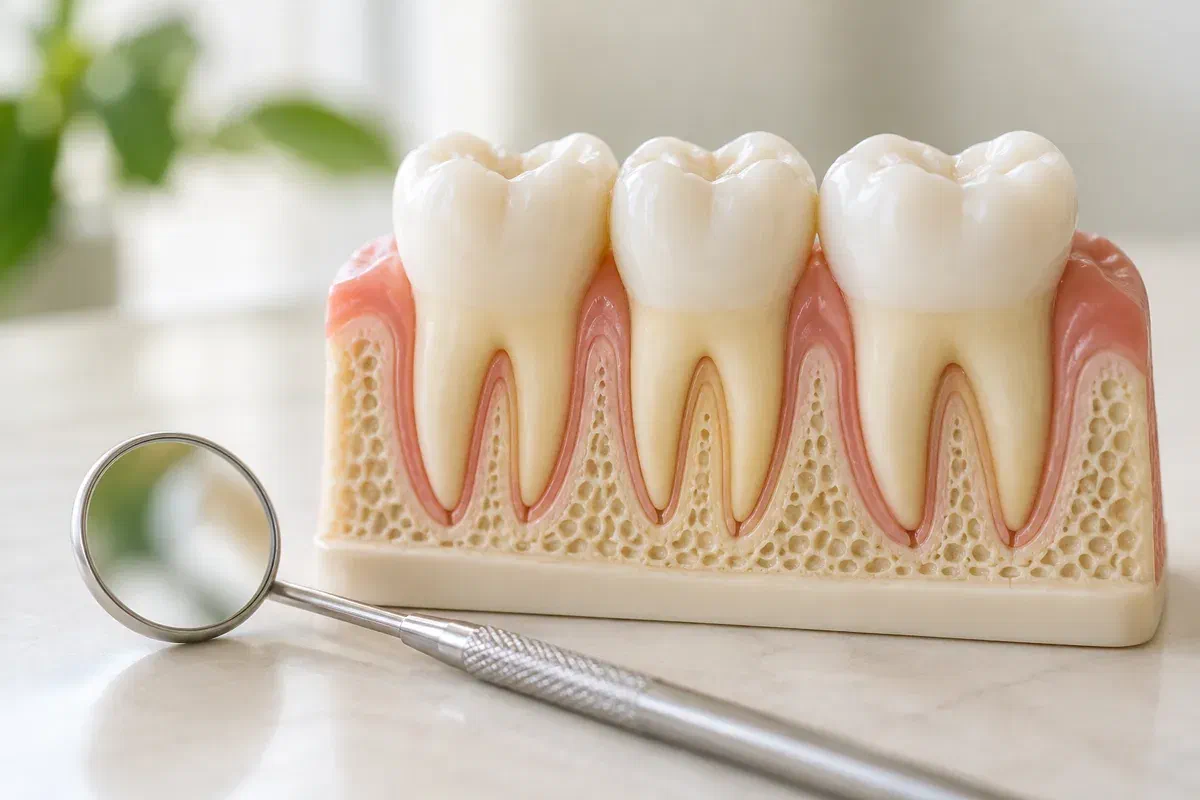
Illustrative cross-section teaching model showing teeth within gum and supporting bone
Helpful details for your call

Sudden looseness and slow change point in different directions.

The timing tells the team a lot. A permanent tooth that is knocked loose or pushed out of place in an accident should be examined promptly; don't wait to find out whether it starts to ache.

A recent knock or fall

Say when it happened, whether the tooth looks shifted, and whether your teeth now meet differently. Mention cuts to the lip, bruising on the face, or a sore jaw. Teeth beside the obvious one may have been affected too, so they are usually checked as well.

Gums that bleed or teeth that seem to drift

Let the dentist know about bleeding when you brush, gums that look like they have pulled back, new gaps, or food catching in places it never used to. Past gum treatment matters here. These clues direct attention to the support around the root, not just the part of the tooth you can see.

Not sure which part is moving

Tell the team if the tooth has a crown, a large filling, or other dental work. Try to describe the feeling rather than pressing on it again and again. If a piece comes away, keep it somewhere safe and call; please don't try to glue it back on.

Phone promptly if an adult tooth is loose or out of position after an injury. A tooth knocked completely out of its socket is its own urgent emergency. For a serious facial injury, bleeding you cannot control, or trouble breathing, get emergency medical help and call 911.

What you should leave knowing

Why it moved, what is holding it, and which options are real.

Describing the movement is only a starting point. To advise whether a tooth is likely to be kept over the long run, the dentist has to look at the support around it. It is reasonable to ask which findings shape that outlook and which questions are still open. If more tests or a specialist's view are suggested, ask what they are meant to answer.

A good explanation keeps two things apart: making the tooth more comfortable or protected for now, and dealing with whatever caused the looseness. Steadying a tooth can be useful in some cases, yet it does not rebuild lost support or cure gum disease on its own. Talk through what each step can realistically do for this particular tooth.

Patient information: NIDCR — assessment and treatment of gum disease

A look at the gums and bone, not only the tooth

Expect the dentist to check the gums, the supporting tissues, and any images that are relevant, along with the tooth. Your medical history and any earlier gum care help put the findings in context. Ask whether the problem seems limited to one spot or calls for a broader gum assessment.

Clarity on tooth versus dental work

A crown that has worked loose and a natural tooth that moves are not treated the same way. Ask which one is moving and whether the tooth underneath is still healthy. That answer explains why re-cementing a crown may or may not solve the real problem.

A frank view of the outlook

Go over the likely benefits, limits, costs, and follow-up each option involves. Keeping a tooth can mean continuing care, and nobody can promise the result from how it looks today. Ask what you might learn along the way that would change the plan.

How the visit unfolds

Context first, then a decision you understand.

Let the clinician know if the area is sore or if you are anxious about losing the tooth. When each part of the exam and its results is explained, you can share in the decision instead of trying to work out the diagnosis on your own.

  1. Talk through when it started and your history

    Share when you first felt the movement and whether it came after an accident or a dental appointment. Mention past gum treatment, any symptoms, medications, and health conditions. If another office has treated the tooth, their records can help show how it has changed over time.

  2. Examine the tooth and what surrounds it

    The dentist checks the loose area plus any nearby structures that might explain it. Tests and images are chosen to answer the specific question at hand. Ask what they reveal about the gums and bone, the root, or the nerve inside the tooth when those need a closer look.

  3. Separate what is urgent from what can be planned

    An injury may need attention right away, while a slower cause might be handled in stages. Ask whether any splinting is temporary, what it is protecting, and what treatment would follow. If removing the tooth comes up, ask why keeping it may not be sensible.

  4. Agree on follow-up and who does what

    Confirm why and when you will be seen again, including any referral. Ask how to clean and chew around the area until then, and which changes mean calling sooner. Monitoring is worthwhile when you know what will be checked and how the answer could change your care.

Between appointments

Leave the tooth in peace and keep the review date.

What to do at home depends on the cause, whether that is an injury, gum disease, a restoration issue, or something else. Use the advice given after your own exam rather than tips meant for a different problem.

Stop checking how loose it is

Resist pushing the tooth with a fingertip or your tongue to see if it has firmed up. Keep hard foods away from it while you wait for professional advice. Don't try to pull it, glue it, tie it, or fix it in place yourself.

Learn how to clean around any splint or repair

If a splint or other restoration is placed, ask the team to show you how to keep it clean. Point out any spot you find awkward to reach. A splint can add new cleaning challenges, so the advice should take both the device and the health of the nearby gums into account.

Call about changes and keep your reviews

Get in touch if the tooth gets looser, your bite shifts, or new pain, swelling, or a loose splint appears. Don't take a splint off yourself. After an injury, follow-up visits can still matter once the tooth feels settled, since later findings may shape what happens next.

Matching care to the cause

Address what loosened the tooth and think about its future.

There is no one procedure for every loose tooth. Ask how the suggested treatment fits your findings and whether it aims to protect the tooth now, control disease, repair dental work, or plan for a replacement.

When gum findings lead the plan

Care for the gums and supporting tissues

If periodontal disease is involved, gum treatment and regular maintenance may be advised. Talk about how much support has been lost and what goals are realistic. This care targets the disease; it cannot guarantee that every loose tooth will tighten again.

When the injury and the tooth warrant it

Splinting or treatment after an injury

For a suitable injury, the dentist may suggest a splint with a set review schedule. Ask what else will be needed and how long the splint should stay. Root canal treatment depends on findings about the nerve, not on movement alone.

When the loose part or outlook changes things

Repairing dental work or removing the tooth

A loose crown or filling may be fixable if the tooth beneath allows it. When a tooth's outlook is poor, removal and later replacement may be discussed instead. Ask about the reasoning, the alternatives, and what each path means before you decide.

Questions we hear in Milton

Straight answers before you start guessing.

Your exam decides which of these apply to you. Call soon about any new movement, particularly after a knock, and tell us if the tooth or your bite seems to have moved.

(905) 876-4488
I only notice the movement when I brush. Is that enough reason to book?
Yes. Movement you can feel during ordinary brushing is a change worth reporting, even without pain. Let the team know how long you have noticed it and whether your gums bleed. The exam helps show whether it needs attention soon or can be planned.
Can grinding or clenching my teeth make one feel loose?
Heavy forces from grinding or clenching can be one factor the dentist considers, often alongside gum health. Mention any jaw soreness, worn edges, or a partner hearing you grind at night. The exam looks at how your bite and the tooth’s support fit together.
Is it safe to eat normally while I wait for my appointment?
Favour softer foods and chew on the other side where you can. Avoid biting hard or sticky foods with the loose tooth. If eating becomes difficult or the tooth seems to be moving more, call the team rather than waiting for the booked visit.
Could my dental crown be what's moving instead of the tooth?
It can be. A crown that has lost its seal can feel just like a loose tooth. Mention any dental work in the area and avoid rocking it. The dentist can check both the crown and the tooth beneath before suggesting repair or another option.
Will the dentist need X-rays of a loose tooth?
Images are often helpful because they show the root and surrounding bone, which can’t be seen directly. Which images are taken depends on the clinical question. Ask what the dentist is looking for and what the pictures show once they are reviewed.
If the tooth settles after a fall, can I skip the follow-up visit?
It is best not to. A tooth can feel calm while changes continue that only a review can pick up. Ask what will be checked and for how long. Later findings may change the plan even after the first symptoms have eased.
Loose adult tooth care in Milton

Close to home, with time to explain what we find.

Call our Bronte Street practice at (905) 876-4488 to describe what you've noticed and arrange the right assessment. If an injury loosened the tooth, mention it right away so the team can talk about how urgent it is and what to do next.

Whether a tooth can be kept, whether a splint or referral is needed, and how it responds all depend on your individual findings. Use online forms for non-urgent questions only.

Visit Milton Dental Clinic
Unit 1, 342 Bronte St. S, Milton, ON L9T 5B7
Get directions Clinic hours
Monday–Thursday
11am–7pm
Friday–Sunday
By appointment only

Areas we serve

  • Milton
  • Oakville
  • Mississauga
  • Georgetown
  • Halton Hills
  • Acton
  • Campbellville
  • Brampton
  • Burlington
  • Puslinch
  • Rockwood
  • Erin
  • Caledon
  • Etobicoke
  • Old Milton
  • Bronte Meadows
  • Timberlea
  • Dorset Park
  • Dempsey
  • Clarke
  • Beaty
  • Coates
  • Harrison
  • Scott
  • Willmott
  • Ford
  • Bowes
  • Cobden
  • Walker
  • Mountain View
  • Milton Heights
  • Hawthorne Village
  • Valley View
  • Fallingbrook
  • Nassagaweya
  • Trafalgar
  • Esquesing
  • Nelson
  • Brookville
  • Moffat
  • Glen Williams
  • Norval
  • Limehouse
  • Stewarttown
  • Ashgrove
  • Hornby
  • Silver Creek
  • Speyside
  • Scotch Block
  • North Oakville
  • River Oaks
  • Glen Abbey
  • West Oak Trails
  • Palermo
  • Bronte Creek
  • College Park
  • Joshua Creek
  • Uptown Core
  • Preserve
  • Iroquois Ridge
  • Lisgar
  • Meadowvale
  • Meadowvale Village
  • Churchill Meadows
  • Erin Mills
  • Central Erin Mills
  • Streetsville
  • East Credit
  • Creditview
  • Heartland
  • Sheridan
  • Mount Pleasant
  • Credit Valley
  • Huttonville
  • Churchville
  • Springbrook
  • Northwest Brampton
  • Bram West
  • Fletcher's Meadow
  • Fletcher's Creek South
  • Alton Village
  • Orchard
  • Millcroft
  • Headon Forest
  • Tansley
  • Brant Hills
  • Tyandaga
  • Kilbride
  • Lowville
  • Aberfoyle
  • Morriston
  • Arkell
  • Hillsburgh
  • Freelton
  • Carlisle
  • Waterdown
  • Flamborough
  • Mountsberg

How can we help?

Milton Dental Clinic

Have a question about your smile? Choose the option that works best for you.

For urgent dental concerns, please call.
Messages are reviewed during clinic hours.