

Illustrative patient discussing bite contacts with a clinician beside a dental cast
Specialized Care

Occlusal Adjustment in Burlington

Someone has mentioned “adjusting your bite,” and you want to understand what that really means before agreeing. For people travelling from Burlington, our team explains what an occlusal assessment looks for, when a limited change is reasonable and when another cause should come first.

Burlington: weighing a bite adjustment

A permanent change deserves a clear reason.

Hearing that your bite might need adjusting can sound vague, so start with the definitions. Occlusion is how the upper and lower teeth touch. An occlusal adjustment removes a small amount from a chosen contacting surface, frequently on a filling or crown, because the examination has identified a particular reason. It is not shorthand for reshaping any bite that feels uncomfortable, and every change to a surface has consequences.

The most straightforward case is a recent restoration that meets before its neighbours. Even then, a sore bite might trace back to a crack, the nerve, the gum or the jaw. That is why the dentist looks at the tooth and its contacts before deciding that taking material away would help.

You can and should ask what the examination found and what the procedure would consist of. Is it restoration material or your own enamel that would be altered? Make sure the purpose, limits and alternatives are clear to you before you agree to any irreversible step.

Talk to us about your bite
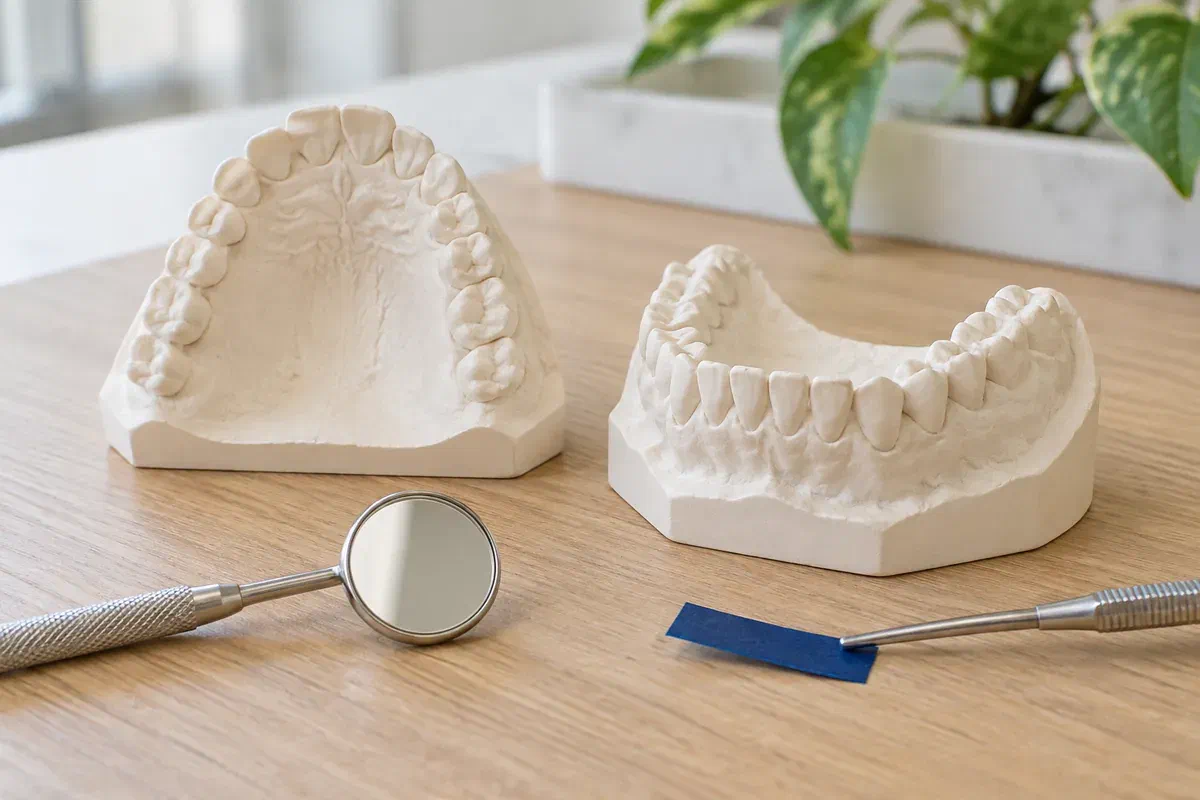
Illustrative dental casts beside a mirror and articulating-paper holder
What brought you in

Your description is the best starting point.

Think back to the first day it felt different. Had you just had a filling, a crown or a root canal? That sequence is often the quickest way for the dentist to tell one awkward contact apart from a sore tooth or a jaw that is generally uncomfortable.

Recent dental work that touches too soon

Name the tooth and the date it was treated, then say when you first felt it land early. Does it bump on a plain close, or only when your jaw slides forward or to the side? Get in touch with whoever placed the restoration; chewing hard on it in the hope it will flatten is not a dependable plan.

Discomfort on pressure or on release

Point to where it aches, and mention any twinges with cold drinks or throbbing when you are not eating. A tender bite has several possible explanations besides a tall filling. Fractures, an irritated nerve and other conditions sometimes need checking before a contact is touched at all.

A general sense that the bite has changed

Along with the bite itself, tell us about a sore or locking jaw, a recent knock to the face, and any guard or retainer that is new or has been altered. Is the feeling steady or does it come and go? A wide complaint calls for a wide look, rather than reshaping as a first resort.

Any bite that feels different after treatment is worth having checked. Pain that keeps climbing, facial swelling, a fever or being unable to open comfortably needs advice quickly, and the answer may be something other than smoothing a filling.

Before you agree

Three things the recommendation should make clear

A trustworthy recommendation is specific about the surface, the finding and the benefit. It should connect directly to the complaint you raised. If what the contacts show does not fully explain the symptoms, investigating further is generally wiser than removing material a little at a time until something feels better.

Scale matters too. Touching up one filling is a modest, local decision. Reshaping many natural teeth is a far bigger one, with lasting implications. Ask how extensive the plan is, why it is necessary and what else could be done if no clear target has been identified.

The exact contact concern

The dentist will usually combine a hands-on examination with thin marking paper or film to see where your teeth meet. Ask what all of it adds up to. Coloured marks show contact, not cause, so a dark spot is a clue to interpret rather than a reason to grind down everything the paper touches.

What material would be altered, and the risks

Confirm whether a filling, a crown or natural tooth is involved. Ask about risks, including the chance of needing more restorative care later. Removed tooth structure does not grow back, so understand the reason and amount first.

What happens if it does not help

Find out how long to wait before calling about discomfort that stays, and what a second appointment would cover. Symptoms that linger may mean part of the picture was missed. A good follow-up goes back over the evidence instead of reaching straight for another round of polishing.

Step by step

Diagnosis, discussion, a careful change, a recheck.

The dentist should explain each stage so you can ask questions along the way. If it is uncertain whether natural tooth would be changed, settle that before agreeing.

  1. History and examination

    Start by telling the dentist which treatment came first, the moment the bite felt different and whether pain or sensitivity has come with it. The tooth and its restoration are then examined. If your symptoms raise questions a bite check cannot settle, other tests may be suggested.

  2. Contacts in context

    You will be asked to close and move your jaw while the dentist watches, sometimes with marking film between your teeth. Speak up if one movement brings back the familiar feeling. Whatever shows up is weighed against what you have described, never used on its own to decide what to remove.

  3. Only the agreed change

    Before anything is done, you should know which surface is the target and what improvement to expect. Raise alternatives and risks at this point. The dentist can describe how the area is smoothed, polished and checked, which varies with the material involved.

  4. Recheck and follow-up

    Tell the dentist how gentle, everyday closing feels, without repeatedly biting hard. Ask what to monitor and when to call. If a separate tooth or restoration issue remains, confirm the care it needs.

Looking after the tooth

Normal use, no testing, and a call if it persists

What you are told depends on what was looked at or changed. Earlier instructions for the filling, crown or root canal still hold, together with anything new from the bite review.

No stress tests

It is tempting to keep grinding or tapping to see whether the spot has moved, but that tends to keep the area irritated. Eat as you normally would and close gently. If chewing still hurts, phone for advice rather than trying to make the tooth adapt.

The original plan still counts

Polishing one contact is seldom the last step of a crown or root canal course. Check whether a temporary is still waiting to be replaced and whether another visit is booked. A bite that feels better is no reason to quietly skip an essential final restoration.

Precise reporting

When something still bothers you, try to say whether it is the old symptom, a new kind of sensitivity, or a contact that now feels off in a different place. Swelling or pain that starts on its own should be reported straight away. Detail like this lets the clinician reassess properly.

Options after assessment

Several responses are possible, and removing material is only one.

Depending on the findings, you may hear about a minor correction, further tests, or treatment aimed at a different source. Ask which one applies to you and what new information would change the advice.

When a clear finding supports it

A limited correction to a confirmed restoration contact

The dentist may suggest smoothing a small, defined patch on a filling or crown. Ask whether that restoration will still be in good shape afterward and what you should notice. The decision is about one tooth that was examined; it does not justify reshaping other teeth as a routine.

When another dental cause needs attention

More investigation or different restorative care

Sometimes the tooth needs further assessment or a new restoration because polishing a contact would leave the real problem in place. Ask what each test is expected to show. Pain that keeps going, or damage to the tooth, should be investigated rather than covered over by a bite change.

When muscles or joints are involved

Conservative management of jaw symptoms

Sore jaw muscles or a troublesome joint need an assessment in their own right. The evidence does not back permanent bite alteration as standard care for temporomandibular disorders, and it may aggravate them. Ask about reversible approaches or a specialist referral.

Patient information: NIDCR — evidence and cautions concerning occlusal treatments for TMD

Before you decide

Questions worth asking

These answers help separate a focused review of one restoration from broader permanent changes. What you feel and what the dentist finds should shape the advice you get.

(905) 876-4488
Another dentist suggested equilibrating my whole bite. Should I get a second opinion?
It is reasonable to ask for one when extensive permanent reshaping is proposed. Ask what specific findings support it, what problem it is meant to solve and what conservative alternatives exist. A second assessment can help you weigh those answers.
What is the difference between adjusting a filling and adjusting my bite?
Adjusting a filling usually means refining one identified spot on a restoration. Adjusting a bite more broadly can mean changing several natural teeth. The second is a much larger, irreversible decision and needs a clear reason.
Can headaches be fixed by changing how my teeth meet?
Headaches have many causes, and permanent bite changes are not a routine treatment for them or for TMD pain. Ask about a proper assessment of the jaw and conservative options, and consider medical advice for persistent headaches.
Is the change reversible if I do not like how it feels?
Removing natural tooth cannot be undone. A restoration can sometimes be repaired or replaced, but that is further treatment. Ask exactly what would be altered before agreeing.
Should I keep biting on a high crown so it settles?
No. Book a check with the dentist who placed it and explain how it feels when you close and eat normally. Clamping down is not a controlled way to adjust anything, and you should never file the crown yourself.
How can I make one visit from Burlington cover as much as possible?
Bring details of the recent treatment, any appliances you wear and a short note of your symptoms. Mention these when booking so the time can be used well. Some situations still need a follow-up check.
From Burlington to our clinic

Bring your questions, and we will start there.

Phone (905) 876-4488 to book a bite assessment at our Bronte Street practice. A quick rundown of recent dental work, such as a new filling or crown, root canal treatment or a changed guard, helps us plan the visit around your tooth.

Coming in for an assessment does not commit you to an adjustment. Whether one is suitable, how much, which material and what response to expect all depend on your own findings and informed consent.

Visit Milton Dental Clinic
Unit 1, 342 Bronte St. S, Milton, ON L9T 5B7
Get directions Clinic hours
Monday–Thursday
11am–7pm
Friday–Sunday
By appointment only

Areas we serve

  • Milton
  • Oakville
  • Mississauga
  • Georgetown
  • Halton Hills
  • Acton
  • Campbellville
  • Brampton
  • Burlington
  • Puslinch
  • Rockwood
  • Erin
  • Caledon
  • Etobicoke
  • Old Milton
  • Bronte Meadows
  • Timberlea
  • Dorset Park
  • Dempsey
  • Clarke
  • Beaty
  • Coates
  • Harrison
  • Scott
  • Willmott
  • Ford
  • Bowes
  • Cobden
  • Walker
  • Mountain View
  • Milton Heights
  • Hawthorne Village
  • Valley View
  • Fallingbrook
  • Nassagaweya
  • Trafalgar
  • Esquesing
  • Nelson
  • Brookville
  • Moffat
  • Glen Williams
  • Norval
  • Limehouse
  • Stewarttown
  • Ashgrove
  • Hornby
  • Silver Creek
  • Speyside
  • Scotch Block
  • North Oakville
  • River Oaks
  • Glen Abbey
  • West Oak Trails
  • Palermo
  • Bronte Creek
  • College Park
  • Joshua Creek
  • Uptown Core
  • Preserve
  • Iroquois Ridge
  • Lisgar
  • Meadowvale
  • Meadowvale Village
  • Churchill Meadows
  • Erin Mills
  • Central Erin Mills
  • Streetsville
  • East Credit
  • Creditview
  • Heartland
  • Sheridan
  • Mount Pleasant
  • Credit Valley
  • Huttonville
  • Churchville
  • Springbrook
  • Northwest Brampton
  • Bram West
  • Fletcher's Meadow
  • Fletcher's Creek South
  • Alton Village
  • Orchard
  • Millcroft
  • Headon Forest
  • Tansley
  • Brant Hills
  • Tyandaga
  • Kilbride
  • Lowville
  • Aberfoyle
  • Morriston
  • Arkell
  • Hillsburgh
  • Freelton
  • Carlisle
  • Waterdown
  • Flamborough
  • Mountsberg

How can we help?

Milton Dental Clinic

Have a question about your smile? Choose the option that works best for you.

For urgent dental concerns, please call.
Messages are reviewed during clinic hours.