

Illustrative patient discussing bite contacts with a clinician beside a dental cast
Specialized Care

Occlusal Adjustment in Campbellville

When a crown catches and the workshop has a file in it, the shortcut can look tempting. Please leave it. From Campbellville, a bite assessment lets the dentist find the actual contact, check the tooth underneath and explain whether a precise, limited adjustment is warranted.

Campbellville bite care

Put down the nail file.

A rough edge or a high spot can be maddening, and people who are handy around the house sometimes reach for a file. The trouble is that the spot you can feel with your tongue is often not the spot that meets first. Dentists describe the way your teeth come together as occlusion. An occlusal adjustment is a measured change to one chosen surface, frequently a restoration, made because an examination found a definite reason.

Even with professional tools, the dentist does not start by removing material. Tenderness on biting can come from a crack, from the nerve inside the tooth, from gum inflammation or from the jaw, and none of those improve with filing. So the first job is to examine the tooth and work out which contact, if any, is actually responsible.

Once you know what was found, ask what the change would involve and whether it affects restoration material or natural enamel. Ask what else could be done instead. Removing tooth surface is not reversible, so the purpose and limits should be settled before you agree.

Let a dentist find the spot
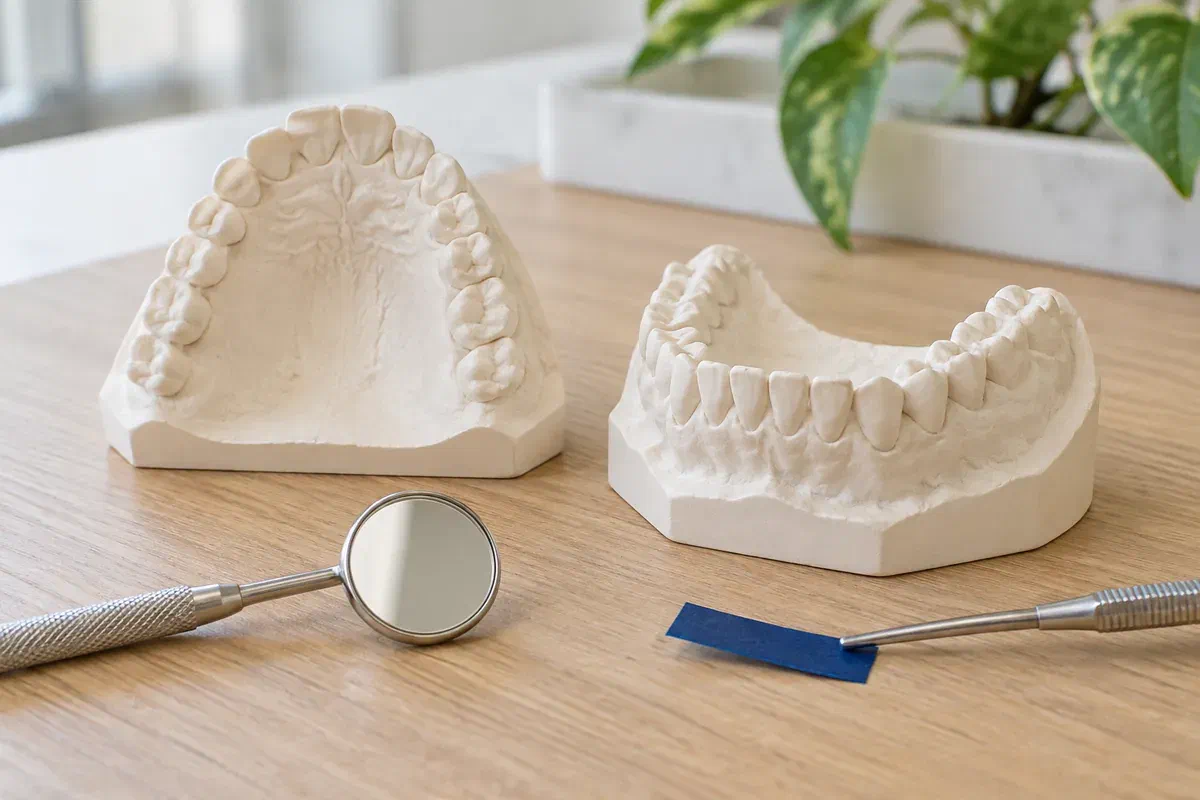
Illustrative dental casts beside a mirror and articulating-paper holder
What sends people to us

Feel it, note it, call. Leave the testing to us.

The details you notice at home are useful. When did it start, and what work had you just had? That history helps the dentist separate a single contact from a tooth problem or a broader jaw complaint.

New work catching on one side

Note the tooth, the treatment and the date. Does it catch every time you close, or only when you chew sideways? Call the dentist who placed it. Chewing hard on it, or smoothing it yourself, is not a controlled way to correct it.

A sore tooth when chewing or easing off

Describe the spot and what sets it off, including cold, sweets or nothing at all. Painful chewing is not always about height. Cracks and nerve problems need to be ruled out, and they would be made no better by filing.

A bite that feels wrong in general

Mention jaw aching or locking, a knock or fall, and any change to a guard or denture. Is the feeling steady or does it come and go? A wide complaint needs a wide look, not reshaping as a first move.

If the bite changed after treatment, have it reviewed. Swelling, fever, trouble opening, or pain that keeps getting worse needs prompt advice and may need a very different response from adjusting a restoration.

Why the clinic does it differently

Locate first. Then, only if needed, refine.

Precision is the whole point of a clinical adjustment. The dentist should be able to tell you the surface, the finding and the expected improvement, and show how they connect to your complaint. When the contacts do not explain your symptoms, the right move is further investigation, not taking a little more off each time something still feels off.

Scale is part of the decision as well. Smoothing a single filling is a small, contained step. Reshaping many natural teeth is a far bigger change that cannot be undone. Ask how much is planned, why it is needed and what the options are if no clear target has been found.

Finding the contact that matters

Thin marking film and a careful examination reveal where your teeth meet. Ask what the overall picture suggests. A coloured spot is a clue; by itself it does not explain discomfort or call for every marked point to be ground.

Knowing which material is involved

Is the change to a filling, to a crown, or to your own tooth? Talk through the risks, including whether further restorative treatment might follow. Enamel does not regrow, so the reason and the amount should be clear first.

Having a fallback if it doesn’t settle

Ask how long to wait before calling and what a recheck would cover. Ongoing symptoms can mean a second issue is involved. A good follow-up revisits the evidence rather than defaulting to more removal.

In the chair

Four careful steps, with your agreement before the third.

Each stage should be explained so you can ask about it. If you are unsure whether natural tooth would be reshaped, raise it before agreeing.

  1. Story and examination

    Tell the dentist what treatment came first, when the catching started and whether there is pain or sensitivity. The tooth and its restoration are examined, with further tests if the symptoms suggest a question a bite check cannot answer.

  2. Contact mapping

    You close and glide your jaw on marking film while the dentist watches. Speak up when the familiar feeling returns. What the film shows is interpreted with your history, not treated as a set of instructions.

  3. The agreed refinement

    If adjusting is appropriate, the target surface and expected benefit are confirmed, along with alternatives and risks. The area is then smoothed and polished in a way that suits the material.

  4. Recheck and plan

    Close gently and say how it feels, without clamping down repeatedly. Before you head home, find out which signs would justify a phone call and how soon. If the original treatment or another tooth still needs care, make sure that appointment is arranged too, so a rural round trip covers what it can.

Back home

Use it normally and keep the tools in the toolbox.

Advice depends on what was checked or changed. Instructions from the original filling, crown or root canal still apply alongside anything from the bite review.

No testing bites

Repeated clenching, tapping or biting on something hard to see if the spot has moved can keep the tooth tender. Notice how ordinary meals feel. If chewing is uncomfortable, phone for advice.

Remaining treatment still matters

An adjusted contact is not the end of a crown or root canal plan. Check whether a temporary needs replacing or another visit is booked. Being comfortable now is no reason to put off a necessary final restoration without advice.

Clear reports if anything persists

Say whether it is the old feeling, a new twinge or a contact that has moved to a different spot. Let us know promptly about swelling or pain that arrives on its own.

Possible outcomes

The answer may not involve removing anything.

Depending on the examination, you may be offered a small correction, more tests, or care aimed at a different source. It is fair to ask why one route was chosen over the others, and what new information would make the dentist think again.

When the culprit is clearly identified

A precise touch-up on a confirmed contact

The dentist may smooth one defined area of restoration material. Ask if the filling or crown will remain sound and what you should feel afterward. It concerns the tooth examined, and it is not a reason to reshape the rest of your bite.

When the tooth itself is in question

Further testing or new restorative work

A tooth may need more assessment or a different restoration if smoothing would not solve the problem. Ask what any test is designed to show. Ongoing pain or damage should be investigated, not hidden behind a contact change.

When muscles or joints are behind it

Conservative care for a jaw complaint

Jaw symptoms need their own assessment. Permanently changing natural teeth is not an evidence-based routine treatment for temporomandibular disorders and can make matters worse. Reversible care or specialist advice is the safer route.

Patient information: NIDCR — evidence and cautions concerning occlusal treatments for TMD

Practical questions

Things people ask about DIY fixes and bite checks

Most of these come from people tempted to sort the problem out at home. The answers explain why a clinical check is safer, and why one high filling and a full bite change are very different decisions.

(905) 876-4488
Can I smooth a rough or high spot on my filling with a nail file?
Please don’t. You may remove the wrong area, damage the restoration or scratch the surface so it collects more plaque. Call the clinic and describe what you feel instead.
What if I already tried filing it myself?
Let the dentist know when you book, and describe what tool you used and roughly where. They can examine the restoration and the tooth, check for chips, rough patches or thinning, and discuss whether a repair or replacement is needed. There is no need to feel embarrassed about telling us; it simply helps the examination.
Why does the spot my tongue feels not match the spot the dentist adjusts?
Your tongue picks up edges and texture, but the contact that matters is where teeth meet when you close or move. Marking film and examination show that more reliably.
Would an adjustment ever reduce my own enamel?
It can, depending on the plan, so ask. The dentist should identify the surface and explain why, how much, the risks and the alternatives. Enamel removal is permanent.
Can reshaping teeth relieve TMD symptoms?
Permanent changes to teeth are not routine treatment for TMD or jaw pain. Ask about a jaw assessment and conservative options, and seek another opinion if extensive irreversible work is suggested.
Is it worth calling before I head in from Campbellville?
Yes. A quick call lets you describe the problem and check that the appointment time suits. If there is swelling or severe pain, the team can advise how urgently you should be seen.
From Campbellville

Bring the problem, not a home repair.

Ring our Bronte Street team on (905) 876-4488 to arrange a bite assessment. Tell us about recent dental work, including any crown, filling, root canal or guard, and mention it if you have already tried to adjust it yourself.

Not every assessment ends in an adjustment. Whether one is advised, how much is changed and on what material depends on what the dentist finds and what you consent to.

Visit Milton Dental Clinic
Unit 1, 342 Bronte St. S, Milton, ON L9T 5B7
Get directions Clinic hours
Monday–Thursday
11am–7pm
Friday–Sunday
By appointment only

Areas we serve

  • Milton
  • Oakville
  • Mississauga
  • Georgetown
  • Halton Hills
  • Acton
  • Campbellville
  • Brampton
  • Burlington
  • Puslinch
  • Rockwood
  • Erin
  • Caledon
  • Etobicoke
  • Old Milton
  • Bronte Meadows
  • Timberlea
  • Dorset Park
  • Dempsey
  • Clarke
  • Beaty
  • Coates
  • Harrison
  • Scott
  • Willmott
  • Ford
  • Bowes
  • Cobden
  • Walker
  • Mountain View
  • Milton Heights
  • Hawthorne Village
  • Valley View
  • Fallingbrook
  • Nassagaweya
  • Trafalgar
  • Esquesing
  • Nelson
  • Brookville
  • Moffat
  • Glen Williams
  • Norval
  • Limehouse
  • Stewarttown
  • Ashgrove
  • Hornby
  • Silver Creek
  • Speyside
  • Scotch Block
  • North Oakville
  • River Oaks
  • Glen Abbey
  • West Oak Trails
  • Palermo
  • Bronte Creek
  • College Park
  • Joshua Creek
  • Uptown Core
  • Preserve
  • Iroquois Ridge
  • Lisgar
  • Meadowvale
  • Meadowvale Village
  • Churchill Meadows
  • Erin Mills
  • Central Erin Mills
  • Streetsville
  • East Credit
  • Creditview
  • Heartland
  • Sheridan
  • Mount Pleasant
  • Credit Valley
  • Huttonville
  • Churchville
  • Springbrook
  • Northwest Brampton
  • Bram West
  • Fletcher's Meadow
  • Fletcher's Creek South
  • Alton Village
  • Orchard
  • Millcroft
  • Headon Forest
  • Tansley
  • Brant Hills
  • Tyandaga
  • Kilbride
  • Lowville
  • Aberfoyle
  • Morriston
  • Arkell
  • Hillsburgh
  • Freelton
  • Carlisle
  • Waterdown
  • Flamborough
  • Mountsberg

How can we help?

Milton Dental Clinic

Have a question about your smile? Choose the option that works best for you.

For urgent dental concerns, please call.
Messages are reviewed during clinic hours.