

Illustrative patient discussing bite contacts with a clinician beside a dental cast
Specialized Care

Occlusal Adjustment in Halton Hills

Those coloured marks from bite paper are a clue, not a verdict. For households across Halton Hills, our team reads them alongside an examination of the tooth and your history, then explains whether a small, defined adjustment makes sense or whether the real cause lies somewhere else.

Halton Hills: reading the bite

What does that blue mark actually tell the dentist?

Thin coloured paper or film placed between your teeth leaves marks wherever they touch. Those marks map your occlusion, the pattern of contact between upper and lower teeth. An occlusal adjustment uses that information, along with an examination, to reshape one selected surface, often on a restoration, for a specific reason. A mark on its own does not mean reshaping is needed, and any change to a surface carries consequences.

Picture a crown placed last week that seems to strike early. The paper might show a heavy spot there, which supports the suspicion. Yet pain on chewing can also arise from a crack, the nerve or the jaw, and those do not show up on bite paper. That is why the dentist examines the tooth properly before deciding anything should be removed.

Ask what the marks and the examination show together, and what an adjustment would physically change. Would it affect restoration material, or your own enamel? You deserve to understand the purpose, limits and alternatives before agreeing to anything permanent.

Ask for a bite assessment
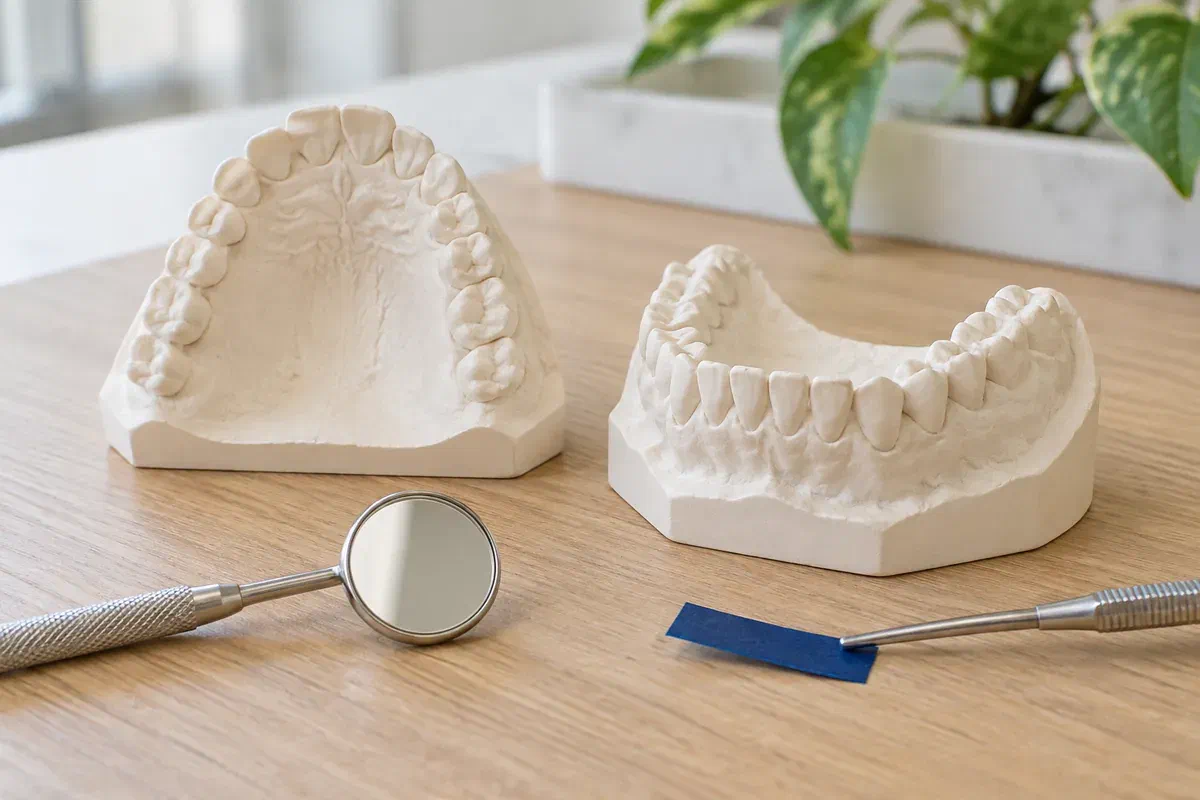
Illustrative dental casts beside a mirror and articulating-paper holder
What you might be noticing

Feelings first, marks second

Your account of when it started and what came before helps the dentist decide what the contact marks mean. It also separates a single high spot from another tooth problem or a broader jaw complaint.

One restoration striking before the others

Tell the team which tooth was treated and on what date the early contact appeared. Is it there on a simple close, or when your jaw glides? Have it reviewed by the dentist who placed it, rather than relying on firm chewing to wear it in.

Soreness when pressing or releasing

Describe the location and pattern, including sensitivity at other times. A tender tooth is not proof of a high contact. A crack or an issue inside the tooth may need assessment first, and bite paper will not reveal those.

A bite that feels off in many places

Mention jaw aching, locking, a recent injury or a changed appliance. Say whether it is constant or variable. Lots of marks across many teeth are normal, and they are no reason by themselves for a broad reshaping plan.

Any change in your bite after treatment is worth reviewing. Worsening pain, swelling, fever or trouble opening should prompt a call for advice, and the answer may be quite different from adjusting a restoration.

Interpreting, not just marking

Connect the evidence to the symptom before anything changes.

A sound recommendation joins three things: the surface, the finding and the expected benefit. Ask how the marks and the examination explain what you feel. When they do not clearly account for your symptoms, investigating further is wiser than taking away a little more material each time something still feels wrong.

There is also a big difference in scale. Polishing one filling is a contained decision. Reshaping several healthy teeth is a lasting one with broader effects. Ask how much is planned, why, and what the alternatives are if no clear target has emerged.

A meaningful reading of the contacts

Marking paper and film show where teeth meet, and the dentist interprets those marks with what they see and what you report. Ask what the overall picture suggests. Dark, heavy or numerous marks still need clinical judgment before they become a reason to reshape.

Consent that names the material

Find out whether a filling, crown or natural tooth would be altered. Discuss risks, including whether further restorative work might follow. Removed enamel does not return, so reason and extent come first.

A way forward if discomfort lingers

Ask when to report continued symptoms and what reassessment would include. Lingering discomfort may mean the first explanation was partial. A recheck should look again at the evidence rather than simply remove more.

From marks to decision

Examine, mark, interpret, then decide together.

Expect the dentist to explain the findings in plain language. If it is unclear whether natural tooth would be reshaped, ask before agreeing.

  1. Hear the history and examine the tooth

    Explain what treatment came before, when the feeling began and any pain or sensitivity. The tooth and restoration are examined. Other tests may help if the symptoms raise a question that contact marks cannot answer.

  2. Mark the contacts in different movements

    You close and slide your jaw on marking film while the dentist watches. Say whether a movement recreates the familiar sensation. The marks are interpreted with your story, never treated as an automatic instruction.

  3. Change only the agreed spot

    If adjusting is appropriate, confirm the exact surface and the intended result, as well as alternatives and risks. You will hear how the area is smoothed and checked, depending on the material.

  4. Mark again and plan follow-up

    A final check shows how the contact looks after the change. Describe how gentle closing feels rather than biting hard repeatedly. Agree on what to watch for, when to call and any separate care still needed.

Over the following days

Ordinary meals are the best guide.

Advice depends on what was examined or treated. Instructions from your original filling, crown or other procedure still apply, along with those from the bite review.

Hold off on self-checks

Repeated clenching, tapping or crunching hard foods to test the contact tends to keep the area irritated. Notice how normal chewing feels. If biting is uncomfortable, phone us instead of trying to make the tooth adapt.

Remember what else is planned

Adjusting one contact rarely completes a restorative or root canal course. Ask whether a temporary still needs replacing or another visit is due. Relief should not lead to postponing an essential final restoration without advice.

Notice what has changed, and say so

If discomfort continues, describe whether it is the original symptom, new sensitivity or a different contact feeling, and which side or tooth it seems to involve. Let us know quickly about swelling or an ache that appears with no obvious trigger. Specific detail helps the dentist reassess instead of assuming the first diagnosis still fits.

Making sense of the findings

A heavy mark can lead in more than one direction.

Depending on the full picture, the answer could be a limited correction, more investigation, or care aimed at another source. Ask which fits and what would change the advice.

When marks and symptoms agree

Refining one confirmed restoration contact

The dentist may suggest smoothing a small, defined area of restoration. Check whether it will remain sound and what you should feel afterward. The decision applies to that tooth only, not to every marked surface in your mouth.

When the marks don’t explain the pain

Looking further at the tooth

A tooth may need more tests or a new restoration if adjusting would leave the real problem untouched. Ask what each test is for. Ongoing pain or structural damage should be investigated rather than masked by a contact change.

When muscles or joints are the source

Gentle, reversible jaw care

Jaw symptoms need their own assessment. Research does not support permanently altering teeth as a standard answer to temporomandibular disorders, and it can worsen matters. Ask about conservative care or specialist advice.

Patient information: NIDCR — evidence and cautions concerning occlusal treatments for TMD

About bite marks and adjustments

The questions behind the coloured paper

These answers distinguish a focused restoration check from broader permanent changes. Your own findings and symptoms should guide any recommendation.

(905) 876-4488
Why do I have marks on so many teeth if only one feels wrong?
Healthy bites touch on many teeth, so marks are expected in lots of places. The dentist looks for a contact that stands out and matches your symptoms. Many marks alone are not a reason to adjust.
Does a dark mark on my new filling prove it is too high?
Not by itself. A heavy mark is a clue that needs to be read with the examination and your description. Ask how the findings support any recommendation, and whether another tooth issue has been ruled out.
Could an adjustment take away natural enamel as well as filling?
It depends on the proposed change, so ask before you agree. You should be told which surface is the target, why it was chosen, roughly how much would come off, what could go wrong and what else could be tried. Enamel removal is permanent, while restoration material can sometimes be repaired or replaced later.
Is it worth trying to chew the high spot down?
No. Heavy biting is not a controlled adjustment, and it can make the tooth sorer or damage new work. Arrange a review with the treating dentist and describe how normal closing feels at meals. In the meantime, softer foods on the other side may feel more comfortable.
Can bite reshaping help my jaw pain?
Permanent changes to teeth are not routine treatment for jaw pain or TMD. The jaw muscles and joints should be assessed in their own right, and reversible measures are usually the place to begin. If someone proposes grinding many teeth to treat an unexplained jaw complaint, it is reasonable to seek another dentist’s view first.
Can several people in a Halton Hills household book around the same time?
You can ask about grouping visits when you call. Mention who needs what, so the team can suggest appointment times that suit the household and give each person the time their concern needs.
Visiting from Halton Hills

Tell us how it feels; we will check how it meets.

To book a bite assessment, ring (905) 876-4488 and our Bronte Street team can help. Let us know what has been done lately, from a new crown or filling to a root canal or a different night guard, and whether you are coming from Georgetown, Acton or a smaller hamlet, so the visit can be planned around the history that matters.

An assessment does not mean an adjustment will follow. Suitability, extent, material involved and expected response depend on your individual findings and informed consent.

Visit Milton Dental Clinic
Unit 1, 342 Bronte St. S, Milton, ON L9T 5B7
Get directions Clinic hours
Monday–Thursday
11am–7pm
Friday–Sunday
By appointment only

Areas we serve

  • Milton
  • Oakville
  • Mississauga
  • Georgetown
  • Halton Hills
  • Acton
  • Campbellville
  • Brampton
  • Burlington
  • Puslinch
  • Rockwood
  • Erin
  • Caledon
  • Etobicoke
  • Old Milton
  • Bronte Meadows
  • Timberlea
  • Dorset Park
  • Dempsey
  • Clarke
  • Beaty
  • Coates
  • Harrison
  • Scott
  • Willmott
  • Ford
  • Bowes
  • Cobden
  • Walker
  • Mountain View
  • Milton Heights
  • Hawthorne Village
  • Valley View
  • Fallingbrook
  • Nassagaweya
  • Trafalgar
  • Esquesing
  • Nelson
  • Brookville
  • Moffat
  • Glen Williams
  • Norval
  • Limehouse
  • Stewarttown
  • Ashgrove
  • Hornby
  • Silver Creek
  • Speyside
  • Scotch Block
  • North Oakville
  • River Oaks
  • Glen Abbey
  • West Oak Trails
  • Palermo
  • Bronte Creek
  • College Park
  • Joshua Creek
  • Uptown Core
  • Preserve
  • Iroquois Ridge
  • Lisgar
  • Meadowvale
  • Meadowvale Village
  • Churchill Meadows
  • Erin Mills
  • Central Erin Mills
  • Streetsville
  • East Credit
  • Creditview
  • Heartland
  • Sheridan
  • Mount Pleasant
  • Credit Valley
  • Huttonville
  • Churchville
  • Springbrook
  • Northwest Brampton
  • Bram West
  • Fletcher's Meadow
  • Fletcher's Creek South
  • Alton Village
  • Orchard
  • Millcroft
  • Headon Forest
  • Tansley
  • Brant Hills
  • Tyandaga
  • Kilbride
  • Lowville
  • Aberfoyle
  • Morriston
  • Arkell
  • Hillsburgh
  • Freelton
  • Carlisle
  • Waterdown
  • Flamborough
  • Mountsberg

How can we help?

Milton Dental Clinic

Have a question about your smile? Choose the option that works best for you.

For urgent dental concerns, please call.
Messages are reviewed during clinic hours.