

Illustrative patient discussing bite contacts with a clinician beside a dental cast
Specialized Care

Occlusal Adjustment in Mississauga

A crown or filling went in recently, maybe at another office, and now one side meets a fraction too early. From Mississauga, you can arrange a bite assessment with our team to check the contact, look at the tooth and talk through whether a limited adjustment or another step makes more sense.

Bite reviews for Mississauga

When new dental work doesn’t sit quite right

Fillings and crowns are shaped to fit into an existing pattern of contacts, called occlusion. Now and then a new piece ends up meeting a little sooner than its neighbours. An occlusal adjustment is the precise reshaping of a selected surface, often on that restoration, once an examination has shown why it is needed. It is not a blanket fix for every strange-feeling bite, and taking material off any surface has consequences.

Where the work was done makes no difference to the sensation, but it does matter for planning. The dentist who placed it knows the materials and the details, so contacting them is often the first step. If you come to us instead, we start by examining the tooth and its contacts, because tenderness on biting is not always the restoration’s fault.

In either setting, ask what the examination revealed and what an adjustment would actually remove. Is the change confined to filling or crown material, or would natural tooth be involved? You should understand why, how far and what else is possible before you consent to anything irreversible.

Book a bite contact check
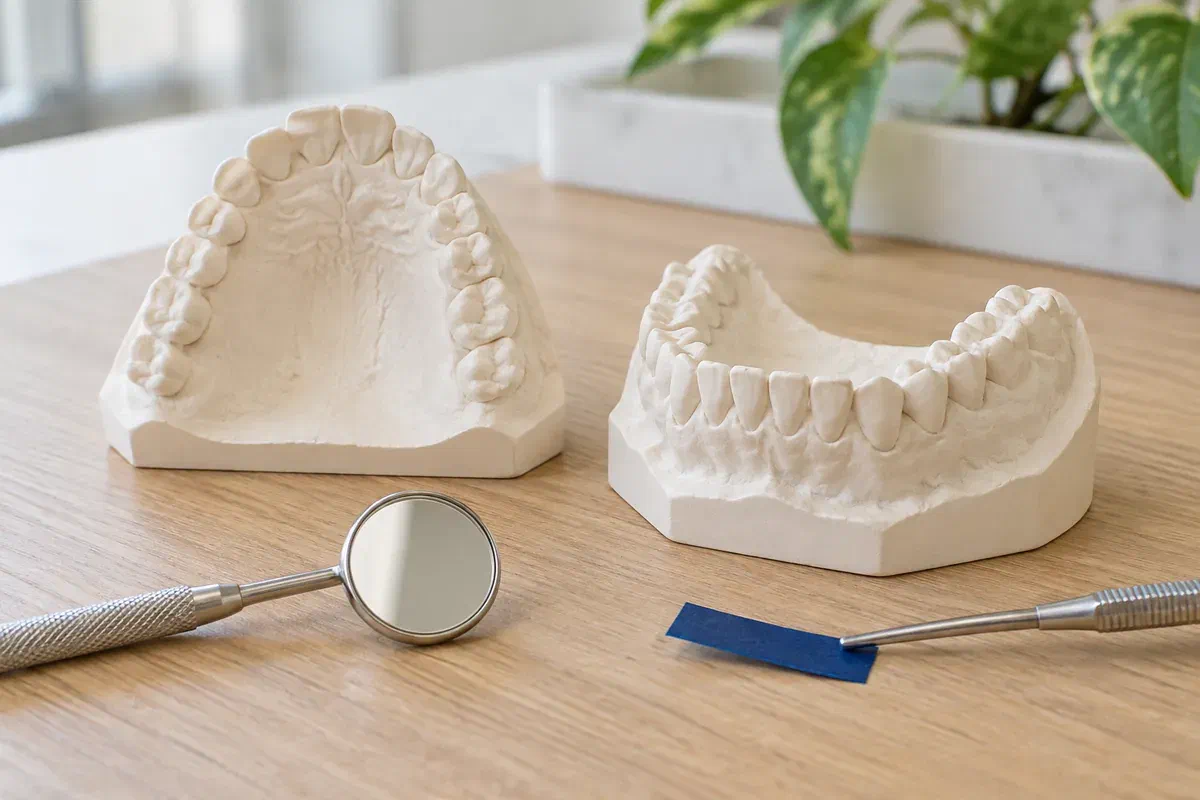
Illustrative dental casts beside a mirror and articulating-paper holder
How it tends to show up

Notice the moment; skip the experiments.

Was the change there from the day of treatment, or did it creep in later? Telling us helps separate a single contact from a different tooth problem or a wider shift in how your jaw feels.

A restoration that seems taller than the rest

Tell us the tooth, the date of the work and who placed it if it was elsewhere. Describe whether the bump happens each time you close or only in one sideways or forward glide. Have it reviewed rather than relying on hard chewing to flatten it.

Aching when you chew or unclench

Explain where the ache sits and whether hot, cold or rest makes a difference. Painful biting can come from a crack, an inflamed nerve or a gum problem, not only from a high spot. Those possibilities may need checking before anyone changes a contact.

A bite that feels unfamiliar overall

Let us know about jaw tightness, clicking or locking, any recent injury and changes to a night guard or aligners. Say whether the feeling is constant or fluctuating. The examination should take this in, not jump to wide-scale reshaping.

An uneven bite following treatment deserves a check. Pain that is getting worse, swelling, fever or trouble opening calls for prompt advice and may mean something other than a restoration adjustment is needed.

What you should come away with

Specific answers instead of a vague “we’ll even it out”

The recommendation ought to name the surface, describe the finding and state what should improve. Ask how it lines up with the problem you described. If the contact evidence leaves your symptoms unexplained, more investigation is usually sounder than removing material bit by bit in search of comfort.

Refining one restoration is a narrow, local decision. Reshaping a number of natural teeth is a broader commitment with lasting effects. Ask how much is proposed, why it is needed and what alternatives exist if no clear target has turned up.

A precise account of the contact

Marking paper or film, together with a clinical examination, shows the dentist where and how your teeth touch. Ask for the interpretation, not just the picture. A coloured mark is evidence of contact, and it alone does not explain pain or justify reshaping each marked point.

Informed consent that names the surface

Know whether the filling, the crown or natural tooth would change. Discuss risks, including whether more restorative work might later be needed. Enamel does not regenerate, so be clear on the reason and extent beforehand.

A plan if things don’t settle

Ask how long to wait before reporting continued discomfort and what a reassessment would look at. Persistent symptoms can point to a second issue. Follow-up should revisit the evidence rather than assume more polishing is the answer.

During the visit

A short procedure still begins with a careful diagnosis.

You should hear the plan explained in terms you can question. If you are unsure whether natural tooth would be reshaped, raise it before giving consent.

  1. Gather the history

    Tell the dentist what was done, when and by whom, and when the bite started to feel different. Mention pain or sensitivity. The tooth and restoration are examined, and other tests may be suggested if the symptoms point beyond a contact problem.

  2. Study the contacts

    You will close and move your jaw while the dentist observes, sometimes with marking material in place. Say if a particular movement recreates the feeling. The marks are read alongside your history rather than used as an automatic guide.

  3. Agree, then adjust

    If an adjustment fits the findings, confirm which surface will change and what should improve. Ask about other options and risks. The dentist can explain how the surface is smoothed and polished, which depends on the material.

  4. Recheck before you leave

    Describe how a relaxed, ordinary close feels without biting down hard repeatedly. Ask what to watch for and when to get in touch. If the original treatment or another tooth still needs care, make sure that is arranged.

The next few days

Use the tooth normally and keep track of anything that lingers.

Guidance depends on what was examined or changed. Instructions from the original filling, crown or root canal continue to apply, along with what you hear at the bite review.

Leave the testing to the clinic

Grinding, tapping or biting on something hard to check the spot tends to keep it irritated. Notice how regular meals and light closing feel. If you cannot chew comfortably, phone for guidance.

Finish what was started

An adjusted contact does not mean a temporary crown or an unfinished root canal is complete. Check what appointments remain. Relief from a high spot should not lead to putting off an essential final restoration without speaking to the dentist.

Report changes clearly

If you are still uncomfortable, describe whether it is the same problem, new sensitivity or a contact that feels wrong elsewhere. Let us know quickly about swelling or pain that appears without a trigger.

What the findings might point to

Sometimes the restoration is the fix. Sometimes it is not.

Depending on the examination, you might be offered a limited correction, further testing, or care focused elsewhere. Ask which fits and what would alter the advice.

When the contact is clearly identified

Smoothing a confirmed high point on the restoration

The dentist may recommend refining a small area of filling or crown material. Ask whether the restoration stays in good condition and what you should feel. It is a decision about that tooth, not a reason to routinely work on others.

When the tooth needs closer attention

Further tests or a new restoration

If adjusting would not solve the problem, the tooth may need more assessment or different restorative work. Ask what each test is meant to show. A bite change should not stand in for investigating ongoing pain or damage.

When muscles or joints are the source

Reversible care for the jaw

Jaw symptoms call for their own evaluation. Evidence does not support permanent bite changes as routine care for temporomandibular disorders, and they can worsen the problem. Conservative options or specialist advice come first.

Patient information: NIDCR — evidence and cautions concerning occlusal treatments for TMD

Your questions

Six things people want to know first

These answers distinguish a focused check of one restoration from broader permanent treatment. Your own findings and symptoms should guide any recommendation.

(905) 876-4488
My crown was placed at another clinic. Should I go back there or come to you?
Contacting the treating dentist is often the best first step, since they know the materials and details. You can still request an assessment with us. Bring what you know about the crown and its timing.
Can a restoration be adjusted without being replaced?
Often a small high spot can be refined and polished. Sometimes the restoration itself has a problem and needs repair or replacement. The examination determines which, and the dentist should explain the reasoning.
Why does the bite only feel wrong when I slide my jaw sideways?
Teeth contact in different ways during side-to-side and forward movements, so a restoration can feel fine on closing but bump during those glides. Describe the movement, and the dentist can check contacts in that position.
Would an adjustment remove any of my natural enamel?
That depends on the plan, so ask. The dentist should identify which surface and explain the reason, extent, risks and alternatives. Enamel removal cannot be undone, and consent should make that distinction clear.
Is reshaping teeth a treatment for clenching or TMD?
Not routinely. Permanent changes to teeth are not supported as standard care for those symptoms. Ask about a jaw assessment, conservative options and a second opinion if extensive irreversible work is suggested.
What should I do if the high feeling starts while I am at work in Mississauga?
Avoid chewing hard on that side and call to describe it. If there is swelling, fever or rapidly worsening pain, seek prompt care, which may mean a closer clinic or urgent service depending on the situation.
Coming from Mississauga

Tell us what changed after your dental work.

To arrange a bite assessment, call our Bronte Street practice on (905) 876-4488. Share what work you had recently, whether fillings, a crown, root canal treatment or a new appliance, so the appointment can centre on your tooth.

Being assessed does not mean you will be adjusted. Suitability, extent, the material involved and the response you can expect all depend on your own findings and informed consent.

Visit Milton Dental Clinic
Unit 1, 342 Bronte St. S, Milton, ON L9T 5B7
Get directions Clinic hours
Monday–Thursday
11am–7pm
Friday–Sunday
By appointment only

Areas we serve

  • Milton
  • Oakville
  • Mississauga
  • Georgetown
  • Halton Hills
  • Acton
  • Campbellville
  • Brampton
  • Burlington
  • Puslinch
  • Rockwood
  • Erin
  • Caledon
  • Etobicoke
  • Old Milton
  • Bronte Meadows
  • Timberlea
  • Dorset Park
  • Dempsey
  • Clarke
  • Beaty
  • Coates
  • Harrison
  • Scott
  • Willmott
  • Ford
  • Bowes
  • Cobden
  • Walker
  • Mountain View
  • Milton Heights
  • Hawthorne Village
  • Valley View
  • Fallingbrook
  • Nassagaweya
  • Trafalgar
  • Esquesing
  • Nelson
  • Brookville
  • Moffat
  • Glen Williams
  • Norval
  • Limehouse
  • Stewarttown
  • Ashgrove
  • Hornby
  • Silver Creek
  • Speyside
  • Scotch Block
  • North Oakville
  • River Oaks
  • Glen Abbey
  • West Oak Trails
  • Palermo
  • Bronte Creek
  • College Park
  • Joshua Creek
  • Uptown Core
  • Preserve
  • Iroquois Ridge
  • Lisgar
  • Meadowvale
  • Meadowvale Village
  • Churchill Meadows
  • Erin Mills
  • Central Erin Mills
  • Streetsville
  • East Credit
  • Creditview
  • Heartland
  • Sheridan
  • Mount Pleasant
  • Credit Valley
  • Huttonville
  • Churchville
  • Springbrook
  • Northwest Brampton
  • Bram West
  • Fletcher's Meadow
  • Fletcher's Creek South
  • Alton Village
  • Orchard
  • Millcroft
  • Headon Forest
  • Tansley
  • Brant Hills
  • Tyandaga
  • Kilbride
  • Lowville
  • Aberfoyle
  • Morriston
  • Arkell
  • Hillsburgh
  • Freelton
  • Carlisle
  • Waterdown
  • Flamborough
  • Mountsberg

How can we help?

Milton Dental Clinic

Have a question about your smile? Choose the option that works best for you.

For urgent dental concerns, please call.
Messages are reviewed during clinic hours.