

Illustrative patient discussing an oral tissue assessment with a dental clinician
Specialized Care

Oral Biopsy in Campbellville

Out in the countryside, a trip into town tends to get combined with groceries, errands and a few other stops. For households in Campbellville, we can explain why a biopsy or specialist referral may be recommended, how to plan the visits sensibly, and what recovery at home looks like.

Rural life, careful plans

One trip for the exam, a clear plan for everything after.

Living in a rural part of Milton often means waiting until there are several reasons to head into town. A mouth sore that hasn't healed should be one of those reasons on its own. When an exam cannot explain a tissue change, a dentist may recommend an oral biopsy: a small sample of tissue is removed and examined by a laboratory. That recommendation is about investigating. It is not a verdict that something serious has been found.

Sampling takes different forms. Some biopsies take only a section of the area, and some remove a small lesion entirely where that is suitable. Where the spot is, its size, the exam and the diagnostic question all influence the decision. It is fine to ask which type is planned and whether a specialist rather than a general office is the right place for it.

Coming in from Campbellville, you can use the first appointment to cover as much as possible. We examine the area, read any reports you bring and discuss how quickly things should move. You should also leave with practical answers: who will carry out the procedure, who will share the results and which conversations might happen by phone.

Arrange a mouth lesion exam
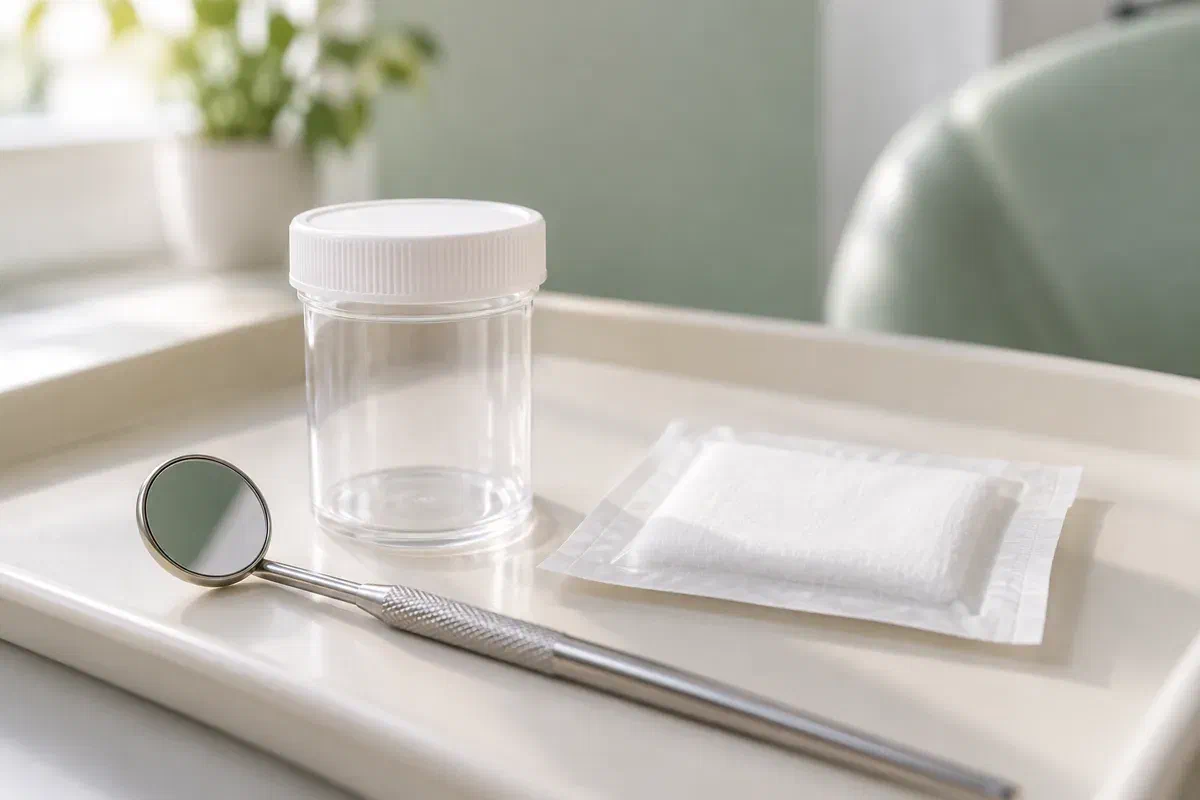
Illustrative empty closed specimen container beside packaged gauze and a dental mirror
Worth a trip into town

Changes that justify an appointment of their own

A photo or online search cannot tell you what a lesion is. Before you come in, note when it started, whether it's still there, how it feels and anything that has already been done.

A sore that hasn't healed on schedule

Estimate how many weeks it has been present and whether its appearance has changed. A broken tooth, chewing habit or appliance may be irritating it, and that's worth mentioning. Still, a likely cause doesn't mean the spot can go unexamined if it isn't clearing up.

Something new you can see or feel

Describe the location and any change in size, colour, texture or sensation, and mention bleeding or numbness. Many lesions needing investigation are painless. Waiting until it hurts is not a good rule for deciding when to book.

A biopsy you were told about but haven't scheduled

If a clinician already suggested a biopsy, bring the referral and ask about the intended timeframe. Check whether your booking is an assessment, the procedure or a results review, since each needs different planning.

Please don't hold off on a recommended biopsy or specialist visit until you have other errands in town, or because the area feels comfortable. Phone the team handling it if the area changes. Severe bleeding or any trouble breathing or swallowing needs emergency medical care without delay.

Answers you can plan around

Fewer unknowns, fewer unnecessary trips.

An exam tells the clinician how a lesion looks and feels. Some questions need a microscope and a laboratory. Ask what the biopsy is meant to answer and how possible results would change the plan. Having that explained can make the recommendation easier to accept, although no one can predict the outcome.

Agree on the results process at the same time as the procedure. Ask how the report comes back, who will be in touch, whether the call can be by phone and when to follow up if you hear nothing. Taking tissue is one task. Explaining the diagnosis is another, and both need to be finished.

A sampling approach with a reason

The exam guides whether part of the area or the whole lesion is taken. Ask which and why. The size of the sample isn't a hint about the answer; it reflects the clinician's plan for a useful report.

Results connected to your exam

Ask the treating clinician to explain the report plainly and link it to the spot that was sampled. If questions remain, a further review or sample might be needed, ideally planned to save you an extra trip.

A next step that's organised

The diagnosis may lead to monitoring, treatment or a referral. Ask who coordinates it and when. Even if a small lesion was removed completely, find out whether you'll need return checks.

Four visits or fewer

What each stage involves

Say so if a biopsy, or any procedure in your mouth, makes you anxious. Questions about the reason, comfort, travel and results can all be raised before you consent.

  1. First exam and history

    Describe the timeline and bring photos or older reports. The clinician goes over your medicines, allergies, any bleeding history and relevant conditions, then tells you whether further assessment or a specialist is needed and on what timeline.

  2. The plan, explained

    You'll hear where the sample would come from, which biopsy type is intended, how the area would be frozen and the risks for that site. Ask about stitches and whether you'll want someone to drive. Confirm the provider and location; a same-day procedure is not assumed.

  3. Procedure day

    Freezing with local anaesthetic is used in many cases, though it depends on your situation. The tissue is sent to the laboratory and the site is cared for. Ask for written aftercare to take home, and ask about anything unclear before you leave.

  4. Result and next step

    Keep the agreed call or visit. Ask what the diagnosis means, whether treatment is recommended and what monitoring the area will need. If extra tests come up, find out what they are for and who books them.

Back home after the biopsy

Recovery when the clinic isn't around the corner

Your instructions depend on the biopsy site, how much tissue was taken and your health. Follow those rather than advice for an extraction or someone else's procedure, and keep them somewhere easy to find.

Numbness on the drive home

A frozen lip, cheek or tongue is easy to bite, so wait to eat until feeling returns. Follow the guidance on food, drink and activity. Ask how sore the site may become and which pain relievers fit your medicines and health.

Looking after the site

Ask how to brush near the area and whether rinses or stitch care are part of the plan. Leave the wound alone between cleanings. If something looks unexpected, phone first rather than trying to remove it.

When to call, and when to go to emergency

Call our team about worsening pain, considerable swelling, a fever or bleeding that persists despite your instructions. For heavy bleeding that won't stop, or difficulty breathing or swallowing, get emergency medical help right away rather than waiting or driving to the dental office.

Choosing the route

Recheck, biopsy, or specialist referral?

Ask why a particular option suits your exam. Observation, sampling and specialist assessment each have their own purpose. None should become a way to quietly leave a concern unresolved.

When reassessment is sensible

A review on a fixed date

An area may be reviewed after an irritant is fixed. Ask for a specific return date and the changes that would justify coming sooner. Observation should have a reason and a deadline; a suspicious lesion shouldn't stay on watch just because it's painless.

When tissue needs a closer look

A partial or complete biopsy

Incisional biopsies sample a portion of the area; excisional biopsies remove a suitable small lesion in full. The clinician decides from the findings. Removing what you can see doesn't automatically end the need for follow-up.

When another provider is a better fit

Specialist assessment

An oral surgeon, oral medicine specialist or another suitable clinician may be recommended. Ask what the referral should establish, the expected timeframe and who will follow the outcome so nothing is lost between offices.

Questions from rural households

Planning a biopsy when you live outside town

These may help as you prepare for the consultation and results discussion. Your clinician can explain your lesion, the procedure and the follow-up after examining you.

(905) 876-4488
Can I combine my biopsy consultation with a regular checkup?
Ask when you book. It may be possible to cover both, but the biopsy assessment should follow the timeline your clinician recommends rather than wait for a routine visit.
What should I keep at home for recovery after an oral biopsy?
Request a short list tailored to your procedure before you leave. It might include your written instructions, whatever pain reliever was recommended for you and the kinds of food you were advised to choose for the first meals. Picking these up on the way home saves a second outing while the area is tender, and keeps you from improvising with whatever is in the cupboard.
Is it okay to go back to farm or outdoor work the next day?
Ask about activity limits for your specific procedure. The answer depends on the site, the type of biopsy and how you feel. Follow the advice you are given.
What happens if I can't easily get back for a recheck?
Tell the clinician. They can explain how important the timing is and whether any part of the follow-up can be handled by phone. Don’t simply skip a recommended review.
If I live in Campbellville, will a specialist referral mean a longer drive?
It may, depending on the type of specialist needed and availability. Ask about options and timelines, while keeping the recommended urgency in mind.
Can the lab report be sent to my family doctor as well?
Reports are handled by whoever performs the biopsy, so raise it with them. Sending a copy to your physician can help with coordination, with your consent, and it gives your doctor the same information if you see them first for an unrelated reason.
From Campbellville to Bronte Street

Make the first trip a productive one.

Call our Bronte Street practice at (905) 876-4488 to book a mouth lesion exam or to go over a biopsy recommendation you've already received. Tell us about any urgent timeframe so we can help you get the right appointment or referral.

Each biopsy plan is different: who does it, where, how tissue is sampled, how recovery goes and how long the lab takes. Confirm results and follow-up with whoever performs your procedure.

Visit Milton Dental Clinic
Unit 1, 342 Bronte St. S, Milton, ON L9T 5B7
Get directions Clinic hours
Monday–Thursday
11am–7pm
Friday–Sunday
By appointment only

Areas we serve

  • Milton
  • Oakville
  • Mississauga
  • Georgetown
  • Halton Hills
  • Acton
  • Campbellville
  • Brampton
  • Burlington
  • Puslinch
  • Rockwood
  • Erin
  • Caledon
  • Etobicoke
  • Old Milton
  • Bronte Meadows
  • Timberlea
  • Dorset Park
  • Dempsey
  • Clarke
  • Beaty
  • Coates
  • Harrison
  • Scott
  • Willmott
  • Ford
  • Bowes
  • Cobden
  • Walker
  • Mountain View
  • Milton Heights
  • Hawthorne Village
  • Valley View
  • Fallingbrook
  • Nassagaweya
  • Trafalgar
  • Esquesing
  • Nelson
  • Brookville
  • Moffat
  • Glen Williams
  • Norval
  • Limehouse
  • Stewarttown
  • Ashgrove
  • Hornby
  • Silver Creek
  • Speyside
  • Scotch Block
  • North Oakville
  • River Oaks
  • Glen Abbey
  • West Oak Trails
  • Palermo
  • Bronte Creek
  • College Park
  • Joshua Creek
  • Uptown Core
  • Preserve
  • Iroquois Ridge
  • Lisgar
  • Meadowvale
  • Meadowvale Village
  • Churchill Meadows
  • Erin Mills
  • Central Erin Mills
  • Streetsville
  • East Credit
  • Creditview
  • Heartland
  • Sheridan
  • Mount Pleasant
  • Credit Valley
  • Huttonville
  • Churchville
  • Springbrook
  • Northwest Brampton
  • Bram West
  • Fletcher's Meadow
  • Fletcher's Creek South
  • Alton Village
  • Orchard
  • Millcroft
  • Headon Forest
  • Tansley
  • Brant Hills
  • Tyandaga
  • Kilbride
  • Lowville
  • Aberfoyle
  • Morriston
  • Arkell
  • Hillsburgh
  • Freelton
  • Carlisle
  • Waterdown
  • Flamborough
  • Mountsberg

How can we help?

Milton Dental Clinic

Have a question about your smile? Choose the option that works best for you.

For urgent dental concerns, please call.
Messages are reviewed during clinic hours.