

Illustrative patient discussing an oral tissue assessment with a dental clinician
Specialized Care

Oral Biopsy in Halton Hills

Not every mouth change needs a biopsy straight away, and not every one can safely be watched. From Halton Hills, you can sit down with us to understand which applies to you, why a tissue sample or specialist visit might be advised, and how a result would be followed up.

Watch, or test?

Why some spots are rechecked and others are sampled

People are often surprised that two similar-looking sores can be handled differently. One gets a follow-up date in a couple of weeks; another is sent for a biopsy. The difference comes down to what the exam shows and what remains unknown. A biopsy, meaning a small tissue sample studied by a laboratory, is chosen when looking and feeling won't give the answer needed. Choosing to sample is about getting information. It does not mean the clinician has decided you have cancer.

If sampling is the route, it can be partial or complete. A section of the area may be taken, or a small lesion may be removed in one piece where that is appropriate. The location, size and findings, along with the specific diagnostic question, guide the choice. You can also ask whether a specialist is better suited to carry out the procedure.

Across Halton Hills, from Georgetown and Acton to Glen Williams and the smaller hamlets, people come to us with a mix of new concerns and old referrals. At the first appointment we look at the area, review whatever history you bring and talk about how quickly the next step should happen. You should finish knowing who would do any sampling and who would talk you through the findings.

Ask whether watching or sampling fits
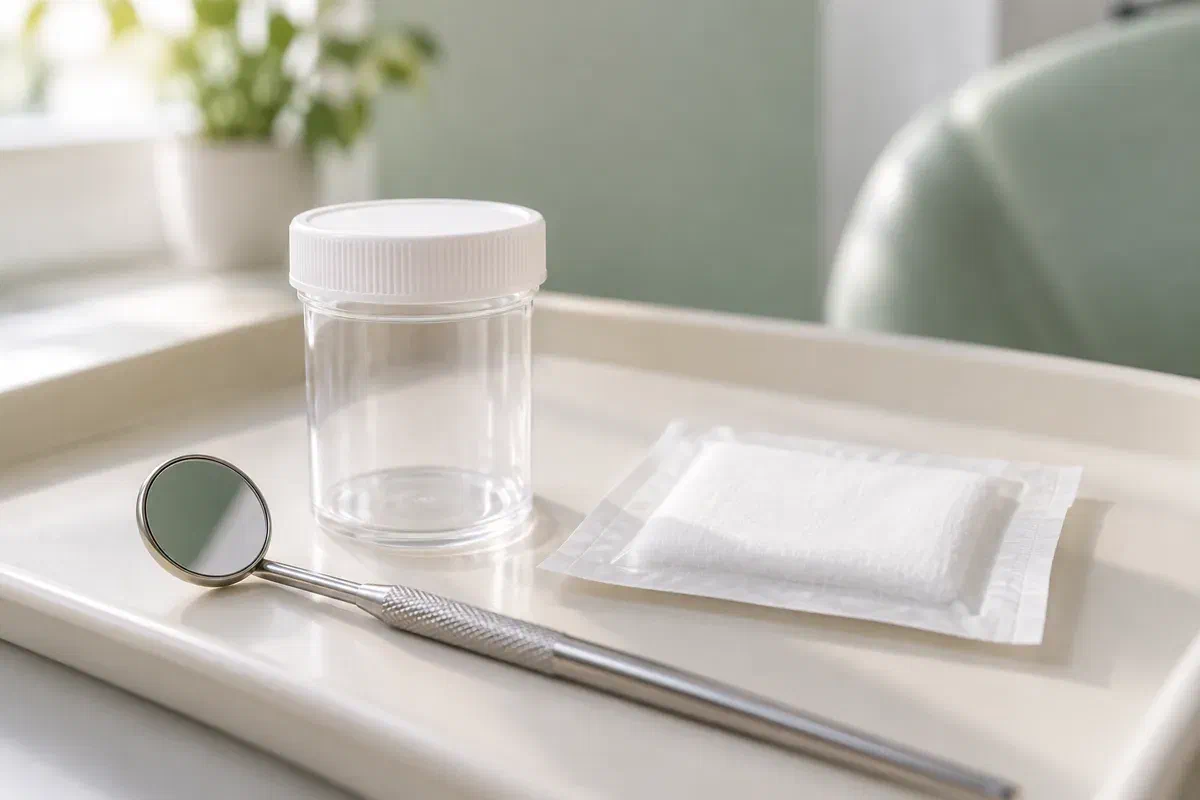
Illustrative empty closed specimen container beside packaged gauze and a dental mirror
What shapes the decision

The details you give help decide between a recheck and a sample.

Searching images cannot tell you whether a lesion needs sampling. What helps the clinician is knowing when it started, whether it persists, how it feels and what has been done so far.

How long it has lasted

Duration is one of the first things a clinician asks about. Estimate when the sore or ulcer began and whether it has changed. If something is rubbing it, say so; that may lead to a short recheck after the irritant is fixed, though a likely cause never rules out the need for assessment.

What it looks and feels like

Show where it is and describe any change in size, colour, texture or sensation. Bleeding, numbness or difficulty using that area add to the picture. A lesion can warrant investigation without any pain at all, so don't let comfort decide for you.

What has already been advised

If another clinician has already recommended a biopsy, that recommendation matters. Bring it, and ask how urgently they intended it. Be sure whether your visit is an assessment, the procedure or a results discussion.

Choosing to watch an area is a clinical decision with a set date, not a way to avoid a biopsy that has been recommended. Contact the team if anything changes in the meantime. Uncontrolled bleeding, or difficulty breathing or swallowing, needs emergency medical attention.

When sampling is the better choice

Some questions cannot be answered by waiting.

A recheck can show whether an area settles once an irritant is gone. It cannot tell you what the cells look like. When that is the question, laboratory examination is the tool. Ask what your biopsy is meant to answer and how different results would steer the plan. Clear reasoning helps, even though nobody can predict the outcome.

Before agreeing to a sample, settle how the result will come back to you: who will make contact, by what method, and the date after which you should call. Collecting tissue is a step toward an answer; the answer arrives when someone explains it.

Sampling matched to the findings

The clinician decides whether to sample a part of the area or remove a small lesion, based on the exam. Ask why. The quantity of tissue taken does not hint at the result; it reflects what the lab needs to work with.

A result read against the exam

Ask the treating clinician to put the report into plain language and relate it to the sampled site. If the original question isn't fully answered, a further review or sample may be recommended.

A defined plan afterwards

The outcome may lead to monitoring, treatment or referral. Ask who will coordinate and when. Even after a small lesion has been taken out completely, confirm whether the site and surrounding tissue should be checked again.

If a biopsy is advised

The path from recommendation to result

Mention it if the idea of a biopsy or a procedure in your mouth worries you. Questions about why it is needed, how it will feel and when results come back are all welcome before you give consent.

  1. Assessment and medical history

    Explain the timeline and bring photos or previous reports. The clinician reviews medicines, allergies, bleeding history and relevant conditions, then tells you whether more assessment or a specialist referral is needed and how soon.

  2. Discussion and consent

    The clinician describes the site, the planned biopsy type, the freezing and any risks specific to that area. Ask about stitches and any arrangements for afterward. Check who will do it and where, since the first consultation doesn't automatically include the procedure.

  3. The sample itself

    Freezing with local anaesthetic is typical for oral biopsies, though circumstances vary. The tissue goes to a lab, and the site is cared for appropriately. Ask for written aftercare instructions, and speak up if any part is unclear.

  4. The results discussion

    Keep the follow-up that was agreed. Ask what the diagnosis means, whether anything needs treating and how often the area should be reviewed. If additional tests come up, ask what they're for and who will arrange them.

Healing well

Simple care now, a firm follow-up date later

Recovery instructions depend on where tissue was removed, how much and your health. Follow the advice for your own biopsy rather than general extraction tips or someone else's experience.

Protect numb tissue

Until local anaesthetic wears off, take care not to bite your lip, cheek or tongue. Follow guidance about food, drinks and activity. Ask what soreness is normal for your procedure and which pain relief options suit your health and medicines.

Keep the area clean

Ask how to brush around the site and whether to rinse or look after stitches. Avoid tugging at the wound or checking it constantly. If something seems unusual, phone the team rather than removing anything.

Recognise problems early

Contact the team if pain grows, swelling becomes significant, a fever develops, or bleeding continues despite following your instructions. Emergency medical care is needed for bleeding that won't stop or for trouble breathing or swallowing.

Three possible next steps

Each one answers a different question.

Ask why the clinician prefers one route. Planned monitoring, a biopsy and a specialist assessment have separate purposes, and none is meant to be an indefinite way of postponing an unanswered concern.

When a recheck is the advice

Monitoring with a deadline

An area may be reviewed again after a sharp edge or other irritant is dealt with. Ask the date to return and which changes mean calling sooner. Monitoring should have a reason and a limit; a suspicious lesion should not be watched open-endedly because it doesn't hurt.

When tissue must be looked at

A biopsy

Incisional sampling takes part of an area; excisional sampling removes a suitable small lesion entirely. The findings and diagnostic need decide which. Removing the visible area does not on its own mean follow-up is finished.

When another provider should assess it

A specialist opinion

A referral to an oral medicine specialist, oral surgeon or another appropriate clinician may be made. Ask what it is meant to establish, how soon it should happen and who will keep track of the result.

Monitoring and biopsy questions

How the next step gets decided

These may help as you prepare for the assessment and any results discussion. Your clinician can explain your lesion, the proposed approach and follow-up after examining you.

(905) 876-4488
Why would a dentist choose to recheck a sore instead of taking a biopsy?
Sometimes a likely irritant is identified, and the area is reviewed after that cause is addressed. Ask what the clinician expects to see at the recheck and what would change the plan.
How long is too long to keep watching a mouth lesion?
There is no single answer for everyone, which is why the clinician should give you a specific review date. If the area hasn’t settled by then, or changes before then, the plan should be reconsidered.
If my sore improved but didn't disappear, should I still return?
Yes. Partial improvement is worth reporting, and the clinician can decide whether further watching, a biopsy or referral is appropriate. Keep the review appointment you were given even if the area looks better, and bring a note of what changed and when.
Does needing a biopsy after monitoring mean something went wrong?
No. It means the observation period did not resolve the question, so tissue examination is the next sensible step. A recheck that leads to sampling is the process working as intended. Ask what the clinician saw at the review that changed the plan, and how soon the biopsy should be booked.
Can I decline a biopsy and just keep watching it myself?
Discuss any hesitation with the recommending clinician first. Self-monitoring cannot establish a diagnosis, and a lack of pain is not reassurance. Ask what a delay could mean in your case.
Will I have to stop my medications before a biopsy?
Don’t stop or change prescribed medicines on your own. Provide a full list, including supplements and anything bought over the counter, and follow advice coordinated with your prescriber where needed. If you live out toward Acton or one of the hamlets in Halton Hills, sort this out before procedure day so a last-minute question doesn’t mean a wasted trip.
Halton Hills oral lesion assessment

Find out whether to wait or to test.

To arrange an oral lesion assessment, or to talk over a biopsy you have already been advised to have, call our Bronte Street practice on (905) 876-4488. If you were given a timeframe, tell us so we can find the right appointment or referral.

Biopsy suitability, provider, setting, sampling method, recovery and lab timing differ between people. Check results and follow-up arrangements with whoever performs your biopsy.

Visit Milton Dental Clinic
Unit 1, 342 Bronte St. S, Milton, ON L9T 5B7
Get directions Clinic hours
Monday–Thursday
11am–7pm
Friday–Sunday
By appointment only

Areas we serve

  • Milton
  • Oakville
  • Mississauga
  • Georgetown
  • Halton Hills
  • Acton
  • Campbellville
  • Brampton
  • Burlington
  • Puslinch
  • Rockwood
  • Erin
  • Caledon
  • Etobicoke
  • Old Milton
  • Bronte Meadows
  • Timberlea
  • Dorset Park
  • Dempsey
  • Clarke
  • Beaty
  • Coates
  • Harrison
  • Scott
  • Willmott
  • Ford
  • Bowes
  • Cobden
  • Walker
  • Mountain View
  • Milton Heights
  • Hawthorne Village
  • Valley View
  • Fallingbrook
  • Nassagaweya
  • Trafalgar
  • Esquesing
  • Nelson
  • Brookville
  • Moffat
  • Glen Williams
  • Norval
  • Limehouse
  • Stewarttown
  • Ashgrove
  • Hornby
  • Silver Creek
  • Speyside
  • Scotch Block
  • North Oakville
  • River Oaks
  • Glen Abbey
  • West Oak Trails
  • Palermo
  • Bronte Creek
  • College Park
  • Joshua Creek
  • Uptown Core
  • Preserve
  • Iroquois Ridge
  • Lisgar
  • Meadowvale
  • Meadowvale Village
  • Churchill Meadows
  • Erin Mills
  • Central Erin Mills
  • Streetsville
  • East Credit
  • Creditview
  • Heartland
  • Sheridan
  • Mount Pleasant
  • Credit Valley
  • Huttonville
  • Churchville
  • Springbrook
  • Northwest Brampton
  • Bram West
  • Fletcher's Meadow
  • Fletcher's Creek South
  • Alton Village
  • Orchard
  • Millcroft
  • Headon Forest
  • Tansley
  • Brant Hills
  • Tyandaga
  • Kilbride
  • Lowville
  • Aberfoyle
  • Morriston
  • Arkell
  • Hillsburgh
  • Freelton
  • Carlisle
  • Waterdown
  • Flamborough
  • Mountsberg

How can we help?

Milton Dental Clinic

Have a question about your smile? Choose the option that works best for you.

For urgent dental concerns, please call.
Messages are reviewed during clinic hours.