

Illustrative patient discussing an oral tissue assessment with a dental clinician
Specialized Care

Oral Biopsy in Milton

A dentist pointed out a patch or sore at your last checkup, and now the word biopsy has come up. Our team in Milton can talk through why a tissue sample or a specialist referral might make sense, what each step involves, and how you will hear about the result.

After the checkup comment

A spot was noticed. Here is how a clearer answer usually comes together.

It often starts with a quiet remark during a routine exam: the dentist would like a closer look at something on your cheek, gum or tongue. An oral biopsy means removing a little tissue from that area so a laboratory can study it under a microscope. It is suggested when looking and feeling cannot settle the question on their own. Being offered a biopsy is a step in finding out, not a finding of cancer.

There is more than one way to do it. Sometimes only a portion of the area is sampled; sometimes a small lesion is taken out entirely, when that suits the situation. Which one is chosen depends on where the spot is, how large it is, what the exam showed and what the clinician needs to learn. It is reasonable to ask whether your case belongs with a specialist instead of assuming any office can handle every lesion.

For people here in Milton, the first visit with us is mainly a conversation: what has been noticed, how soon it should be looked into, and which route makes sense. Bring any earlier reports and tell us how the area has behaved. Leave knowing two things: who would take the sample, and who will sit down with you to explain what the lab reports.

Talk to us about a mouth lesion
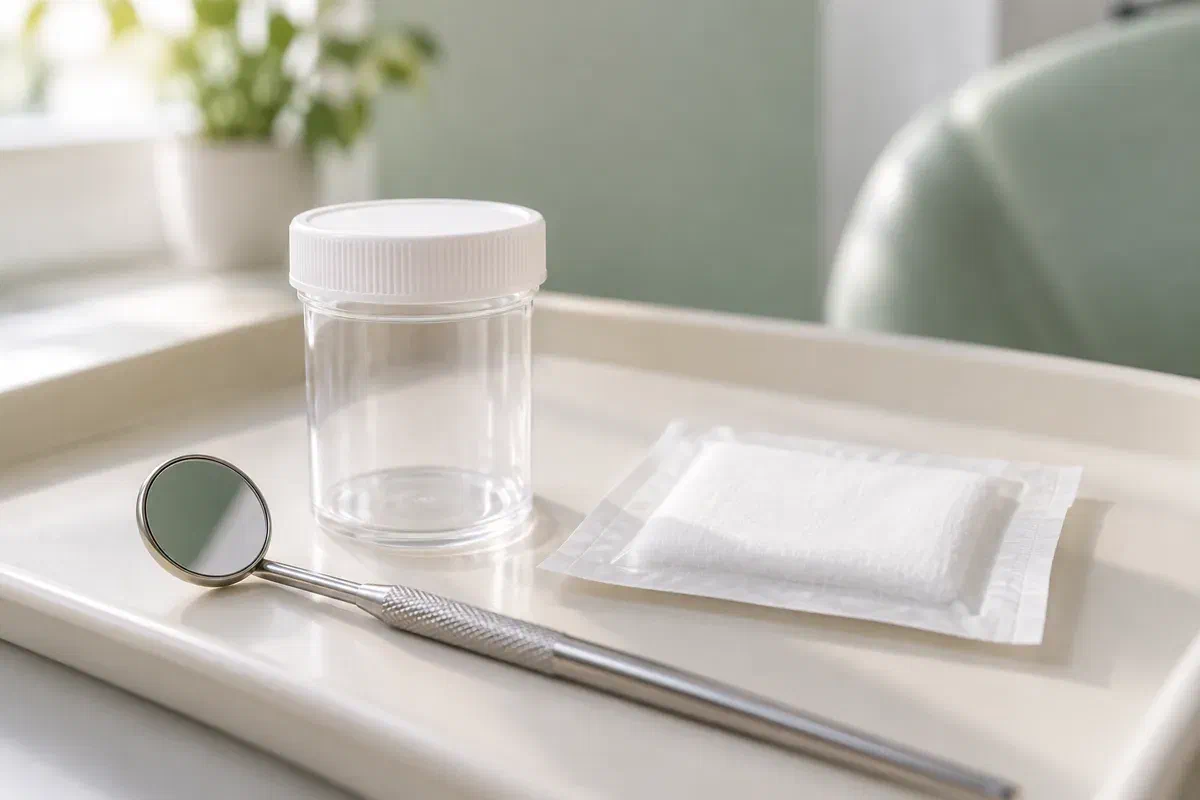
Illustrative empty closed specimen container beside packaged gauze and a dental mirror
What to tell the dentist

Give the history of the spot and let the exam do the sorting.

No photo on your phone and no picture online can tell you what a mouth lesion is. What helps most is the story: when it appeared, whether it has stayed, what it feels like, and anything that has already been tried.

A sore that has outlasted your patience

Say how many weeks the ulcer or tender spot has been there and whether it looks different now. If a sharp tooth, a habit or an appliance keeps rubbing it, mention that, but don't let a likely cause talk you out of an exam. Ask what the dentist sees and whether watching, sampling or referring fits best.

Something new on the surface or underneath

Point out where the bump, patch or rough area sits and whether its size, colour, texture or feeling has shifted. Bleeding, numbness or trouble chewing on that side are worth reporting. Plenty of lesions that need checking are not sore at all, so a lack of pain is a poor guide to whether you should book.

A referral letter you are holding

When another dentist or doctor has already suggested a biopsy, bring the paperwork and ask how quickly they wanted it done. Find out whether your visit is for an exam, for the procedure itself, or to go over a result that already exists. Each is a separate stage with its own preparation.

A recommended biopsy or specialist visit should not be pushed back because the area feels fine or looks like a harmless photo you found. If it changes while you wait, call the team handling it. Trouble breathing or swallowing, or bleeding you cannot control, needs urgent medical care.

Why a lab look helps

Turn an uncertain spot into information your care can follow.

A dentist can tell you how a lesion looks and feels, yet some answers only come from examining the tissue itself. Ask what specific question the sample is meant to answer and how the possible results might shape the plan. Knowing that makes the recommendation easier to understand, without pretending to a certainty nobody has yet.

Good planning also covers the days after the sample. Check how results come back, who will reach out, and when you should call if nobody has. Taking the tissue and explaining the diagnosis belong together; finishing one is not the same as finishing the other.

A sample that fits what needs to be learned

Based on the exam, the clinician picks a way of sampling that should give useful information. Ask whether part of the area or all of it will come out, and the reasoning. A bigger sample does not hint at a worse answer; it simply reflects what the plan requires.

A report read together with the exam

Ask whoever is treating you to put the report into everyday words and connect it to the spot that was sampled. If it leaves the original worry only partly answered, another review or sample may be suggested. A lab report makes most sense alongside what was seen in your mouth.

A clear route for what comes next

Depending on the diagnosis, the result might lead to watching the area, treating it or seeing someone else. Ask who will steer that next stage and on what timeline. Even if a small lesion was fully removed, check whether the area around it still needs periodic checks.

How the steps usually run

Exam, explanation, sample, result: four stages with a purpose each.

If the word biopsy makes you uneasy, or the thought of a procedure in your mouth does, say so early. You are welcome to ask about the reason, comfort and results before you agree to anything.

  1. Look at the area and your health background

    Walk through the timeline and bring older photos or reports if you have them. The clinician reviews your medicines, allergies, any bleeding tendency and relevant medical conditions, then explains whether more assessment or a specialist referral is needed and how soon it should happen.

  2. Talk through the plan and give consent

    Cover where the sample will come from, which kind of biopsy is planned, how the area will be frozen and the risks for that site. Ask about stitches and what you may need to arrange for afterward. Confirm who will do it and where, rather than expecting the consultation to include the procedure.

  3. Collect the tissue and get instructions for your site

    Local anaesthetic is used for many oral biopsies, though the details depend on your situation. Tissue is taken for the lab and the site is looked after appropriately. Ask for written aftercare, and speak up before you leave if any part of it is unclear.

  4. Go over the lab findings and the plan

    Keep the results appointment or call that was arranged. Ask what the diagnosis means for you, whether treatment is needed and how the area will be watched. If more tests are suggested, find out why and who is booking them.

The first days afterward

Let the site settle, and keep your place in line for the result.

How you care for the area depends on where the sample came from, how much was taken and your general health. Use the instructions you were given, not advice meant for a tooth extraction or someone else's biopsy.

Be gentle while the freezing wears off

After local anaesthetic, it is easy to bite a numb lip, cheek or tongue without noticing. Follow the guidance on food, drinks and activity. Ask how sore the area is likely to be and which pain relievers suit your medicines and medical history.

Keep the site clean the way you were shown

Find out how to brush near the area and whether rinses or stitch care are part of the plan. Try not to tug at the wound or keep checking it with your tongue or a finger. If something looks unexpected, call the team instead of trying to remove it.

Know when a symptom needs a call

Let the team know about pain that is getting worse, marked swelling, a fever or bleeding that keeps going despite the instructions. Keep their number handy. Heavy bleeding that won't stop, or difficulty breathing or swallowing, calls for urgent medical help, not a wait for the results visit.

Which path fits

Watch, sample or refer: each choice answers a different need.

Ask why the suggested route matches what was seen. Planned monitoring, a biopsy and a specialist visit each do a different job, and none of them should become a polite way of putting off an open question.

When reassessment is the advice

A set recheck when watching is reasonable

Some spots are reviewed again after a likely irritant has been dealt with. Ask when to come back and which changes mean calling sooner. Watching should have a reason and an end date; a worrying lesion should never sit on an open-ended watch list just because it doesn't hurt.

When the tissue has to be examined

Taking part or all of the area

An incisional biopsy samples a section of the area; an excisional one removes a suitable small lesion. The choice follows the findings and what needs to be learned. Removing what you can see does not by itself mean follow-up or monitoring is finished.

When another provider should be involved

A specialist and shared follow-through

You may be referred to an oral medicine specialist, an oral surgeon or another suitable clinician. Ask what the referral should clarify, how urgent it is and who will keep track of the outcome. Leave with a clear sense of the next call and appointment.

Questions people ask us

What to expect before, during and after a tissue sample.

These questions can help you get ready for the consultation and the results conversation. Your clinician can speak to your particular lesion, the planned procedure and the follow-up after examining it.

(905) 876-4488
Is a biopsy recommendation a sign the dentist suspects cancer?
Not necessarily. A biopsy is a way to find out what a tissue change is. Ask why it is being suggested and what it should tell you. Try not to jump to either the worst or the best conclusion before the lab has examined the sample.
Can I eat normally on the day of an oral biopsy?
Ask the clinician before the appointment. Afterward, you will usually be given advice about waiting for numbness to fade and about foods and drinks to choose while the site heals. That advice depends on where the sample was taken, so follow what you are told for your own site.
Will I need someone to come with me?
That depends on the anaesthetic plan and how you feel about the procedure. Ask when you book whether a companion is recommended. Some people simply prefer a second set of ears for the results conversation, which is a reasonable choice.
Should I keep taking photos of the spot while I wait?
Dated photos can help show how an area has changed, so bring them if you have them. They do not replace an exam or a lab result. If you see a change while waiting, contact the team handling the biopsy rather than comparing your photos to images online.
What happens if the result needs more explanation than a phone call?
Ask for an appointment to go over it. You are entitled to understand what the report means and what comes next. If wording in the report is technical, the treating clinician should translate it and relate it to the area that was sampled.
Can a sore that started after biting my cheek still need checking?
Yes, if it has not healed as expected. An obvious cause does not rule out the need for an exam. Tell the dentist how long it has been there, and ask whether review, a biopsy or a referral is the right next step.
Oral biopsy questions in Milton

Book a conversation about the spot and the next step.

From anywhere in Milton, call our Bronte Street practice at (905) 876-4488 to arrange an oral lesion assessment or to talk through a biopsy someone has already recommended. Let us know if you were told it is time-sensitive so we can sort out the right appointment or referral.

Whether a biopsy suits you, who performs it, where, the sampling method, recovery and lab timing all vary. Confirm results and follow-up arrangements with the clinician responsible for your procedure.

Visit Milton Dental Clinic
Unit 1, 342 Bronte St. S, Milton, ON L9T 5B7
Get directions Clinic hours
Monday–Thursday
11am–7pm
Friday–Sunday
By appointment only

Areas we serve

  • Milton
  • Oakville
  • Mississauga
  • Georgetown
  • Halton Hills
  • Acton
  • Campbellville
  • Brampton
  • Burlington
  • Puslinch
  • Rockwood
  • Erin
  • Caledon
  • Etobicoke
  • Old Milton
  • Bronte Meadows
  • Timberlea
  • Dorset Park
  • Dempsey
  • Clarke
  • Beaty
  • Coates
  • Harrison
  • Scott
  • Willmott
  • Ford
  • Bowes
  • Cobden
  • Walker
  • Mountain View
  • Milton Heights
  • Hawthorne Village
  • Valley View
  • Fallingbrook
  • Nassagaweya
  • Trafalgar
  • Esquesing
  • Nelson
  • Brookville
  • Moffat
  • Glen Williams
  • Norval
  • Limehouse
  • Stewarttown
  • Ashgrove
  • Hornby
  • Silver Creek
  • Speyside
  • Scotch Block
  • North Oakville
  • River Oaks
  • Glen Abbey
  • West Oak Trails
  • Palermo
  • Bronte Creek
  • College Park
  • Joshua Creek
  • Uptown Core
  • Preserve
  • Iroquois Ridge
  • Lisgar
  • Meadowvale
  • Meadowvale Village
  • Churchill Meadows
  • Erin Mills
  • Central Erin Mills
  • Streetsville
  • East Credit
  • Creditview
  • Heartland
  • Sheridan
  • Mount Pleasant
  • Credit Valley
  • Huttonville
  • Churchville
  • Springbrook
  • Northwest Brampton
  • Bram West
  • Fletcher's Meadow
  • Fletcher's Creek South
  • Alton Village
  • Orchard
  • Millcroft
  • Headon Forest
  • Tansley
  • Brant Hills
  • Tyandaga
  • Kilbride
  • Lowville
  • Aberfoyle
  • Morriston
  • Arkell
  • Hillsburgh
  • Freelton
  • Carlisle
  • Waterdown
  • Flamborough
  • Mountsberg

How can we help?

Milton Dental Clinic

Have a question about your smile? Choose the option that works best for you.

For urgent dental concerns, please call.
Messages are reviewed during clinic hours.