

Illustrative patient discussing an oral tissue assessment with a dental clinician
Specialized Care

Oral Biopsy in Mississauga

Between work, commuting and family, it is tempting to leave a lingering mouth sore for later. From Mississauga, you can book a focused conversation with us about whether a biopsy or specialist referral is warranted, how the stages fit into a busy week, and who will follow up on the result.

Fitting it into real life

Busy weeks are exactly when mouth sores get ignored.

A sore on the side of the tongue, a patch you notice while brushing before an early meeting: these are easy to file under “deal with it later”. When a dentist cannot work out from an exam what a tissue change is, though, a biopsy may be recommended. That means a small sample is taken from the area and sent to a lab for microscopic study. The recommendation exists to answer a question, and on its own it does not mean cancer.

Knowing the format helps with planning. A biopsy can sample part of an area, or, when it suits the findings, remove a small lesion entirely. The clinician weighs the site, the size, what the exam showed and what needs to be learned. Ask which kind is planned, and whether a specialist rather than a general dental office should handle it, since that changes where and when you will need to be.

People who live in Mississauga, particularly in western neighbourhoods such as Meadowvale and Churchill Meadows, can start with a single consultation at our office. We examine the area, look at any previous reports and talk about how soon the next step should happen. You will leave knowing who would take the sample, who would explain the findings and roughly how many visits to plan around.

Plan a lesion assessment
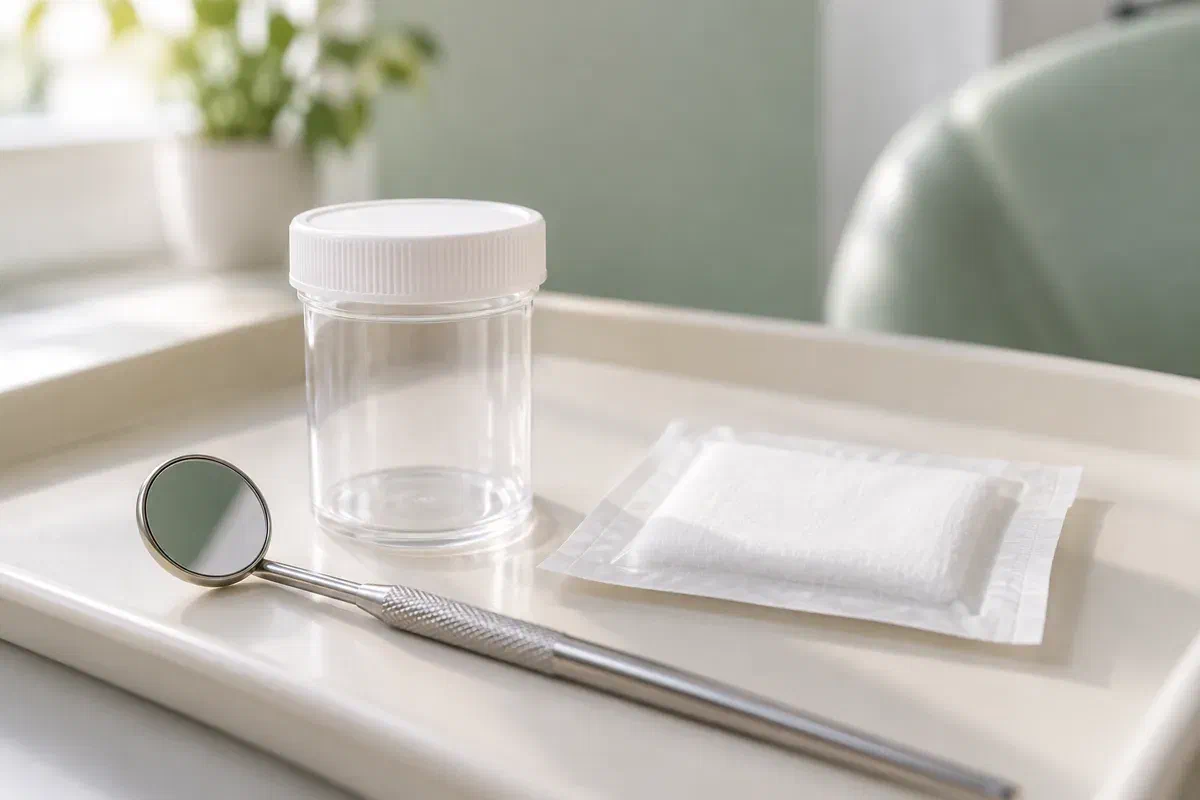
Illustrative empty closed specimen container beside packaged gauze and a dental mirror
Worth a weekday appointment

Signs that a mouth change should not wait for a quieter month.

Images online cannot identify a lesion, and neither can a quick look in the bathroom mirror. Make a note of when the change started, whether it has persisted, how it feels and what has been tried, then bring that to the exam.

A sore that stays past its welcome

Track roughly how many weeks it has been present and whether it looks different. A habit like cheek chewing during stressful days, or a rough filling, might seem to explain it. Mention that, but come in anyway if it isn't healing, and ask whether a recheck, sample or referral fits.

Patches, lumps or changes in feel

Describe the location and whether the area has grown or changed colour, surface or sensation. Report any bleeding, numbness or difficulty eating. Plenty of lesions that need investigation are not painful, so a lack of discomfort is no reason to keep postponing.

A referral that is still sitting in your bag

If a biopsy has already been suggested, dig out the referral and find out how urgently it was meant to be handled. Check whether your booking is for assessment, the procedure or a results discussion; these are distinct visits, each needing its own planning.

A full schedule is understandable, but a recommended biopsy or specialist assessment should not slip because the area feels fine or resembles a harmless picture. Call the managing team if it changes. Trouble breathing or swallowing, or bleeding that won't stop, needs emergency medical care.

Why it earns the time

One sample can end weeks of wondering.

During an exam, a dentist can describe what a lesion looks and feels like. What it actually is may take a laboratory to determine. Ask what question the sample is supposed to answer and how each likely result would change your plan. A clear purpose makes the recommendation easier to accept, without anyone claiming to know the outcome ahead of time.

Plan the follow-up as carefully as the procedure. Ask how results travel, who will contact you, and the date after which you should chase them. A sample taken is not a question answered; both pieces need to happen for care to move forward.

A method that suits the goal

The clinician picks how to sample based on the exam. Ask whether some or all of the area will be removed, and the reason. Sample size is not an early hint about the result; it reflects what the lab needs.

Results you understand

Ask whoever is treating you to explain the report in everyday language, linked to the area that was sampled. Sometimes the report leaves the original question partly open, and a further review or another sample is advised.

Next steps with a name attached

Depending on the diagnosis, the plan may be monitoring, treatment or referral. Find out who will coordinate it and when. Even after a small lesion is fully removed, confirm whether the area will need future checks.

Planning the visits

Four stages you can put in your calendar.

If the idea of a biopsy or a procedure in your mouth makes you anxious, tell us. You can ask about reasons, comfort and results before you consent, and about how long each visit is likely to take if you are driving over from Mississauga.

  1. Consultation and health review

    Explain the timeline and bring any photos or reports. The clinician reviews medications, allergies, bleeding history and medical conditions, then tells you whether further assessment or a specialist is needed and how soon you should book.

  2. Plan, risks and consent

    You will go over the site, the biopsy type, how the area will be numbed and any risks for that spot. Ask whether stitches are likely and whether you should keep the rest of the day light. Confirm the provider and location; the procedure is not assumed to happen at the consultation.

  3. Procedure day

    Local anaesthetic is used for many oral biopsies, depending on circumstances. Tissue is taken for the lab and the site is managed. Ask for written aftercare and clear up anything confusing before you head back to work or home.

  4. Results and decisions

    Keep the follow-up booking or call; put it in your calendar with a reminder. Ask what the diagnosis means, whether treatment is necessary and how the area will be kept under review. If extra tests are needed, ask their purpose and who books them.

The rest of the day, and the week

Heal well, and put the results date somewhere you will see it.

Your aftercare depends on the location and size of the biopsy and on your health. Follow the advice you are given instead of borrowing an extraction routine or a colleague's experience.

Careful eating while numb

After local anaesthetic, a lip, cheek or tongue is easy to bite without feeling it. Skip the working lunch until feeling returns, and follow the advice on food, drinks and activity. Ask how sore you may be and which pain relievers are safe with your medicines.

Gentle cleaning, hands off

Ask how to brush around the site and whether rinsing or stitch care applies. Avoid poking or tugging at it. If you see something you were not told to expect, call the team before doing anything to it yourself.

Know who to call

Report worsening pain, marked swelling, fever or bleeding that the instructions don't control. Save the office number in your phone. Heavy bleeding that won't stop, or problems breathing or swallowing, needs urgent medical care right away.

Deciding the route

What the clinician might recommend, and why.

Ask why the proposed option suits what was found. Observation, sampling and specialist care do different jobs. None should turn into a convenient way to put off a question that still needs an answer.

When observation is reasonable

Recheck after a fix

An area may be reviewed again once a probable irritant has been corrected. Book the return visit before you leave and ask which changes mean calling sooner. A watch period needs a reason and an end point; a concerning lesion should not be watched forever because it is painless.

When the tissue must be examined

Partial or complete sampling

Incisional biopsies remove a section; excisional biopsies take out a suitable small lesion. The choice follows the findings. Even when everything visible is removed, further follow-up may still be needed.

When another setting is better suited

Specialist involvement

You may be sent to an oral surgeon, oral medicine clinician or another appropriate provider. Ask what they are being asked to establish, the expected urgency and who will track the outcome, so you know what to book next.

Practical questions

Time off, results and the details in between.

These may help you prepare for the consultation and the results visit. Your clinician can explain your lesion, the planned procedure and follow-up after examining you.

(905) 876-4488
Do I need to take the whole day off for an oral biopsy?
That depends on the site, the type of biopsy and how you feel afterward. Ask the clinician when you book. Some people prefer to keep the rest of the day quiet, especially while numbness wears off.
Can the consultation and the biopsy happen in one visit?
Do not assume so. The consultation is often a separate step, and the procedure may be arranged later or with a specialist. Ask in advance so you can plan around it.
How will I be told the result?
Ask before the procedure. It may be a phone call or a follow-up appointment. Agree on the method and a date, and call if that date passes without contact.
Should I tell the clinician about stress-related habits like cheek biting?
Yes. Habits and irritation are useful history. They may explain some changes, but they do not replace an exam if an area isn’t healing.
Is it a problem if I take blood thinners for a heart condition?
Mention every medicine you take, and never stop a prescribed one on your own. The clinician can coordinate with your prescriber if needed. The plan depends on the medicine, procedure and your health.
What if further sampling is suggested after the first report?
Ask what was left unanswered and why another step helps. Sometimes a further sample or assessment is needed. The treating clinician should explain the reasoning in plain terms.
Mississauga to Bronte Street

Book the first conversation now; plan the rest from there.

Ring (905) 876-4488 to set up an oral lesion assessment at our Bronte Street practice, or to discuss a biopsy that has already been recommended. If the referring clinician mentioned urgency, tell us so we can steer you to the right appointment or referral.

Biopsy suitability, the provider and setting, sampling technique, recovery and lab timing differ case by case. Confirm results and follow-up with the clinician responsible for your procedure.

Visit Milton Dental Clinic
Unit 1, 342 Bronte St. S, Milton, ON L9T 5B7
Get directions Clinic hours
Monday–Thursday
11am–7pm
Friday–Sunday
By appointment only

Areas we serve

  • Milton
  • Oakville
  • Mississauga
  • Georgetown
  • Halton Hills
  • Acton
  • Campbellville
  • Brampton
  • Burlington
  • Puslinch
  • Rockwood
  • Erin
  • Caledon
  • Etobicoke
  • Old Milton
  • Bronte Meadows
  • Timberlea
  • Dorset Park
  • Dempsey
  • Clarke
  • Beaty
  • Coates
  • Harrison
  • Scott
  • Willmott
  • Ford
  • Bowes
  • Cobden
  • Walker
  • Mountain View
  • Milton Heights
  • Hawthorne Village
  • Valley View
  • Fallingbrook
  • Nassagaweya
  • Trafalgar
  • Esquesing
  • Nelson
  • Brookville
  • Moffat
  • Glen Williams
  • Norval
  • Limehouse
  • Stewarttown
  • Ashgrove
  • Hornby
  • Silver Creek
  • Speyside
  • Scotch Block
  • North Oakville
  • River Oaks
  • Glen Abbey
  • West Oak Trails
  • Palermo
  • Bronte Creek
  • College Park
  • Joshua Creek
  • Uptown Core
  • Preserve
  • Iroquois Ridge
  • Lisgar
  • Meadowvale
  • Meadowvale Village
  • Churchill Meadows
  • Erin Mills
  • Central Erin Mills
  • Streetsville
  • East Credit
  • Creditview
  • Heartland
  • Sheridan
  • Mount Pleasant
  • Credit Valley
  • Huttonville
  • Churchville
  • Springbrook
  • Northwest Brampton
  • Bram West
  • Fletcher's Meadow
  • Fletcher's Creek South
  • Alton Village
  • Orchard
  • Millcroft
  • Headon Forest
  • Tansley
  • Brant Hills
  • Tyandaga
  • Kilbride
  • Lowville
  • Aberfoyle
  • Morriston
  • Arkell
  • Hillsburgh
  • Freelton
  • Carlisle
  • Waterdown
  • Flamborough
  • Mountsberg

How can we help?

Milton Dental Clinic

Have a question about your smile? Choose the option that works best for you.

For urgent dental concerns, please call.
Messages are reviewed during clinic hours.