

Illustrative patient discussing an oral tissue assessment with a dental clinician
Specialized Care

Oral Biopsy in Oakville

You may already have a referral in hand and a dozen questions about it. If you are coming from Oakville, we can go through why a biopsy or specialist assessment was suggested, what the procedure would look like, and how results are passed on and acted upon.

Making sense of a referral

Understand the recommendation before you book the procedure.

A referral slip can feel abrupt. Someone examined your mouth, wrote “biopsy” and handed you a phone number. What that word describes is simple enough: a clinician removes a small amount of tissue from the area of concern, and a laboratory examines it. It is recommended when an exam has raised a question that only the tissue can answer. On its own, the suggestion tells you nothing about whether the result will be serious.

The bigger questions tend to be practical. Will the whole spot come out, or only a piece? Sometimes a portion is sampled; other times a small lesion is excised in full. Location, size, the exam findings and the diagnostic question guide that decision. Another fair question is whether the procedure belongs in a general dental office or with a specialist such as an oral surgeon or oral medicine clinician.

When you visit from Oakville, we can read the referral with you, look at the area and help you understand the pathway being proposed. Tell us how the spot has behaved since it was noticed and bring any earlier findings. Before taking the next step, be certain who will collect the sample and who will explain the report.

Review a biopsy referral with us
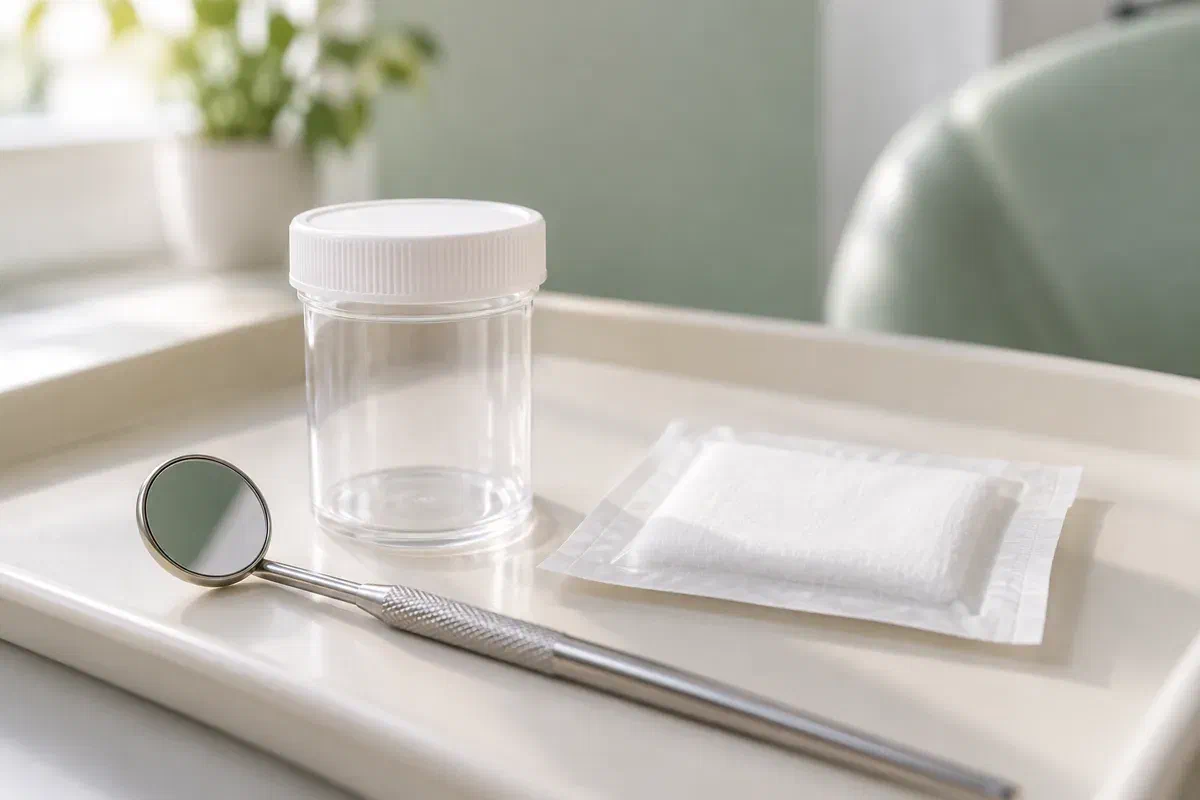
Illustrative empty closed specimen container beside packaged gauze and a dental mirror
Details worth bringing

What you have noticed matters more than what you have read.

Searching images of mouth lesions tends to produce either false alarm or false comfort. A clinician needs your account: the start date, whether it has stayed the same, any symptoms, and any care already given for it.

An ulcer or tender spot that won't close

Give the approximate start date and any change since. If a cheek bite, sharp edge or appliance seems responsible, say so, though a plausible cause does not mean the area can skip an exam. Ask whether the clinician would recheck it, sample it or refer you.

Colour, texture or a lump you can feel

Describe the place, and any change in size, shade, surface or sensation. Mention bleeding, tingling or numbness, or trouble speaking or chewing on that side. Many lesions that need investigation cause no discomfort, so “it doesn't hurt” is not a reason to stay home.

Paperwork from another clinic

Carry in the referral, any imaging and any prior report. Ask how soon the referring clinician wanted action. Then pin down what your appointment is for: an assessment, the biopsy itself, or a conversation about a result already issued.

A recommended biopsy should not be put off because the area is comfortable or looks like a reassuring photo. If it changes before your appointment, contact the team managing it. Severe bleeding that won't stop or any trouble breathing or swallowing requires emergency medical care.

The point of the sample

From “something looks off” to a diagnosis you can act on.

A clinical exam can describe a lesion in detail, but description and diagnosis are different things. A laboratory look at the tissue fills that gap. Ask what the sample is meant to clarify and how each likely result would alter the plan. That framing tends to make the recommendation feel less mysterious, without promising more than anyone knows.

Ask about the end of the process at the start. How does the report travel, who phones you, and what date should prompt you to call them? Collecting tissue is one task and explaining the outcome is another. Both have to happen before the question is closed.

Sampling chosen with a purpose

The approach is picked to answer the question raised by the exam. Ask whether a section or the entire area is planned, and the reasoning. A larger sample is not a signal of bad news; it reflects what will give the lab enough to work with.

Findings tied back to your mouth

A report reads differently once someone connects it to what was seen during the exam. Ask the treating clinician to explain it plainly. If the result does not fully address the original concern, another review or sample may follow.

Ownership of the next step

Monitoring, treatment or a referral may follow, depending on the diagnosis. Ask who coordinates it and on what schedule. Even when a small lesion has been removed completely, find out whether the area needs ongoing checks.

What the pathway looks like

Assessment first. Consent second. Then the sample and the answer.

It is normal to feel uneasy about the word biopsy, or about any procedure inside your mouth. Mention it. Questions about why, how it will feel and when results arrive are all welcome before you consent.

  1. Review the lesion and your medical picture

    Describe the timeline and share earlier photos, imaging or reports. The clinician reviews your medications, allergies, bleeding history and health conditions, and explains whether more assessment or a specialist referral is warranted, and how urgent it is.

  2. Agree on the plan

    You will discuss the site, the type of biopsy, how the area will be numbed and the risks particular to that location. Ask about stitches and any help you might need afterward. Confirm the provider and the setting instead of assuming the procedure happens at the consultation.

  3. Collect tissue and leave with instructions

    Most oral biopsies can be done under local anaesthetic, though that depends on the situation. The sample is sent for laboratory examination and the site is managed appropriately. Ask for aftercare in writing and raise any confusion before leaving.

  4. Hear the result and plan from there

    Attend the results appointment or take the agreed call. Ask what the diagnosis means for you, whether anything needs treating, and what follow-up the area should get. If further tests come up, ask why and who will arrange them.

Recovery basics

Protect the site while you wait for the report.

Your instructions should reflect where the biopsy was taken, its size and your general health. Rely on them rather than on advice written for extractions or for somebody else's procedure.

Take care until feeling comes back

Numbness from local anaesthetic makes it easy to chew a lip, cheek or tongue. Follow the guidance on what and when to eat and drink and on activity. Ask how sore you should expect to be and which pain medicines work with your prescriptions.

Keep it clean without fussing

Ask how to brush near the area and whether rinsing or stitch care applies. Try not to disturb the site with your tongue or fingers. If you notice something you weren't told to expect, phone the team rather than picking at it.

Act on warning signs

Call about increasing pain, considerable swelling, fever or bleeding that won't settle with the instructions. Keep the contact details nearby. Uncontrolled heavy bleeding, or difficulty breathing or swallowing, needs urgent medical care straight away.

How the next step is chosen

Three possible routes, each for a different reason.

Ask why one route was suggested over the others. Observation, a biopsy and specialist care each serve a different purpose. None should become a convenient way to leave a concern unresolved.

When observation is justified

Reassessment on a set date

Some areas are rechecked after a probable irritant has been addressed. Ask when you should return and which changes mean calling earlier. A watch period needs a reason and a deadline; a suspicious lesion should not be observed indefinitely because it is painless.

When the tissue must be examined

Incisional or excisional sampling

Incisional means part of the area is taken; excisional means a suitable small lesion is removed whole. The findings and the diagnostic aim drive the choice. Removing what is visible does not automatically mean follow-up is over.

When a specialist is the right fit

Referral and shared care

An oral medicine specialist, oral surgeon or other suitable provider may be involved. Ask what the referral is meant to determine, how urgent it is and who will track the result. Leave knowing the next contact and appointment.

Before you say yes

Questions to ask about a biopsy referral.

These can help you get ready for the consultation and the results conversation. Your clinician can address your specific lesion, procedure and follow-up after examining you.

(905) 876-4488
Is it reasonable to get a second opinion on a biopsy recommendation?
Yes, you can ask another clinician to look at the area. Try not to let the second opinion become a long delay, though. Bring the original referral, ask how urgent it was meant to be, and keep the timeline in mind.
How do I know whether my biopsy should be done by a specialist?
Ask the clinician directly. Location, size, the exam findings and your health can all point toward a specialist setting. A clear answer should include who would do it, where, and why that setting fits.
What should I bring from the clinic that referred me?
The referral letter, any imaging, earlier reports and a list of your medicines. Photos showing how the area has changed over time can help too. If you are unsure what was sent, ask the referring office before your appointment.
Is a lesion that has been removed already “dealt with”?
Not necessarily. The report may still recommend monitoring or further care. Ask whether the result fully explains the area and whether the surrounding tissue needs review.
Will the biopsy site leave a mark I can feel?
Healing varies with the site and the size of the sample. Ask the clinician what to expect for your particular area. If something feels unusual as it heals, contact the team rather than guessing.
Does an earlier biopsy elsewhere mean I should skip a new exam?
No. A previous result is useful background, but a new or changed area deserves its own assessment. Bring the earlier report so the clinician can compare.
From Oakville to our practice

Bring the referral. We will help you read it.

Call our Bronte Street practice at (905) 876-4488 to set up an oral lesion assessment or to discuss a biopsy that has been recommended to you. If the clinic in Oakville that referred you said the matter is urgent, mention it when you call so we can guide you to the right appointment or referral.

Whether a biopsy is right for you, and the provider, setting, technique, recovery and lab timing, all vary. Confirm results and follow-up with the clinician responsible for your procedure.

Visit Milton Dental Clinic
Unit 1, 342 Bronte St. S, Milton, ON L9T 5B7
Get directions Clinic hours
Monday–Thursday
11am–7pm
Friday–Sunday
By appointment only

Areas we serve

  • Milton
  • Oakville
  • Mississauga
  • Georgetown
  • Halton Hills
  • Acton
  • Campbellville
  • Brampton
  • Burlington
  • Puslinch
  • Rockwood
  • Erin
  • Caledon
  • Etobicoke
  • Old Milton
  • Bronte Meadows
  • Timberlea
  • Dorset Park
  • Dempsey
  • Clarke
  • Beaty
  • Coates
  • Harrison
  • Scott
  • Willmott
  • Ford
  • Bowes
  • Cobden
  • Walker
  • Mountain View
  • Milton Heights
  • Hawthorne Village
  • Valley View
  • Fallingbrook
  • Nassagaweya
  • Trafalgar
  • Esquesing
  • Nelson
  • Brookville
  • Moffat
  • Glen Williams
  • Norval
  • Limehouse
  • Stewarttown
  • Ashgrove
  • Hornby
  • Silver Creek
  • Speyside
  • Scotch Block
  • North Oakville
  • River Oaks
  • Glen Abbey
  • West Oak Trails
  • Palermo
  • Bronte Creek
  • College Park
  • Joshua Creek
  • Uptown Core
  • Preserve
  • Iroquois Ridge
  • Lisgar
  • Meadowvale
  • Meadowvale Village
  • Churchill Meadows
  • Erin Mills
  • Central Erin Mills
  • Streetsville
  • East Credit
  • Creditview
  • Heartland
  • Sheridan
  • Mount Pleasant
  • Credit Valley
  • Huttonville
  • Churchville
  • Springbrook
  • Northwest Brampton
  • Bram West
  • Fletcher's Meadow
  • Fletcher's Creek South
  • Alton Village
  • Orchard
  • Millcroft
  • Headon Forest
  • Tansley
  • Brant Hills
  • Tyandaga
  • Kilbride
  • Lowville
  • Aberfoyle
  • Morriston
  • Arkell
  • Hillsburgh
  • Freelton
  • Carlisle
  • Waterdown
  • Flamborough
  • Mountsberg

How can we help?

Milton Dental Clinic

Have a question about your smile? Choose the option that works best for you.

For urgent dental concerns, please call.
Messages are reviewed during clinic hours.