

Illustrative patient discussing an oral tissue assessment with a dental clinician
Specialized Care

Oral Biopsy in Old Milton

Some mouth changes have been around so long they feel like part of you, until one of them looks different. From Old Milton, you can talk with us about whether a tissue sample or a specialist opinion is the sensible next move, and how follow-up would work.

When a familiar spot changes

You have known that patch for years. Is it still the same?

Plenty of people carry a mark in the mouth for a long time: a pale area where a partial denture sits, a ridge along the cheek, a small bump that never bothered anyone. Familiarity is not the same as a diagnosis, though. When the dentist cannot tell from an exam what a tissue change is, a biopsy may be advised. A small piece of tissue goes to a laboratory for study. The recommendation is a way of finding out; it does not mean cancer has been found.

Biopsies vary. One approach takes a section of the area, and another removes a small lesion whole when that is suitable. Size, location, what the exam showed and the specific question all play a part. It is fair to ask which method is proposed, and whether a specialist should be the one doing it.

Many people in Old Milton have seen the same dentists for decades and kept records along the way. Bring whatever you have: older reports, notes about past treatment, a sense of how the spot has shifted. In that first visit, we can sort out how urgent it seems and which route fits, and you should come away knowing who would do the procedure and who would review the result with you.

Ask about a long-standing mouth change
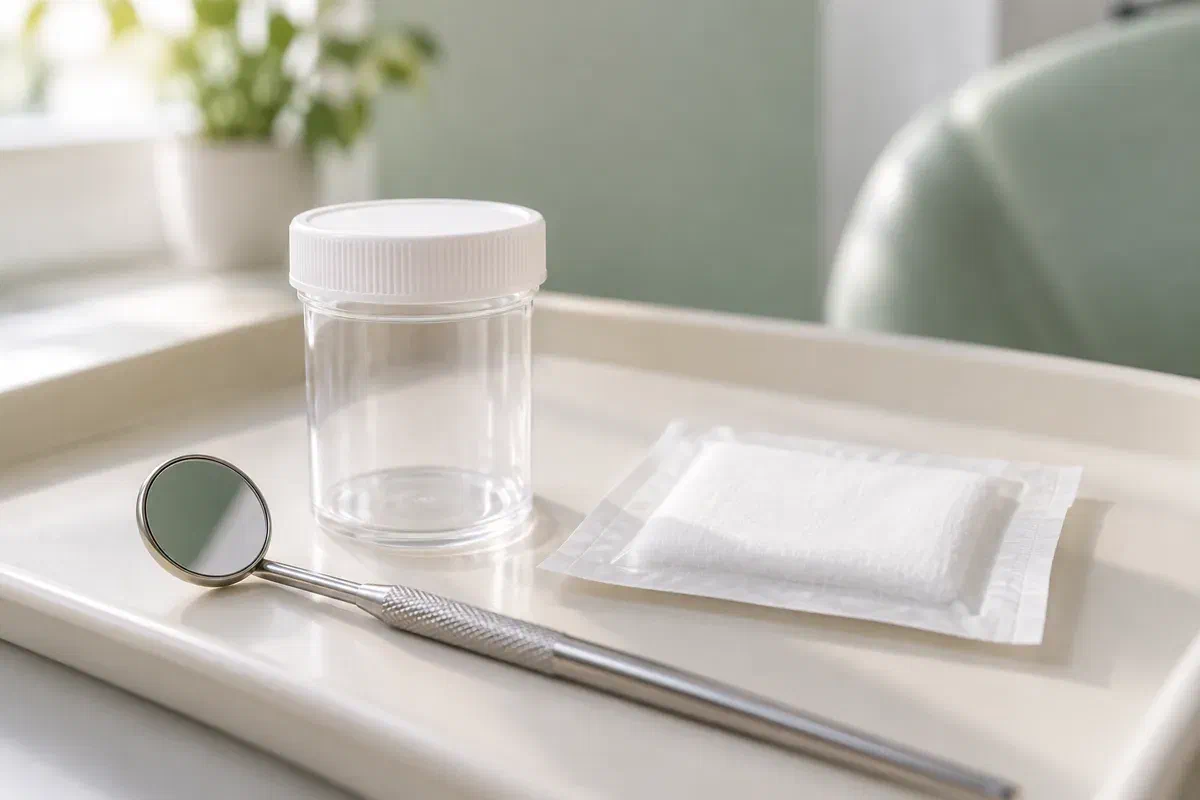
Illustrative empty closed specimen container beside packaged gauze and a dental mirror
Old marks, new questions

Tell us what has changed, even if the area has been there a while.

Comparing your mouth to a picture online, or to how it looked in your memory, cannot settle what a lesion is. Describe when it appeared, what it has done since, and any treatment or adjustments already tried.

A sore spot that keeps returning or lingering

Note how long the area has been tender or open and whether it heals and comes back. A rubbing denture edge or a broken filling may seem like the obvious culprit, and fixing it is worthwhile, but an exam is still needed if the tissue does not settle afterward.

A patch, lump or texture that looks different now

Point to where it is and say whether it has grown, darkened, lightened, hardened or started to feel numb. Mention bleeding or trouble eating on that side. A lesion can need checking even when it is painless, so comfort should not decide whether you come in.

A biopsy suggestion from a previous dentist or doctor

If someone has already advised a biopsy, bring their letter and ask how quickly they wanted it arranged. Be clear on whether your appointment is to examine the area, perform the procedure or discuss a result. Each stage asks something different of you.

Please do not postpone a recommended biopsy or specialist visit because the spot feels the same or matches a harmless image. If it changes while you wait, call whoever is handling it. Difficulty breathing or swallowing, or bleeding you cannot stop, needs urgent medical attention.

What a sample can settle

Replace a long guess with an explanation.

An exam describes the surface: colour, texture, firmness. Some questions go deeper than that and need the tissue looked at under a microscope. Ask what question your biopsy is meant to answer and how different results would change the plan. That keeps the recommendation understandable without anyone offering comfort the evidence cannot yet support.

A plan is not complete until the result has been explained. Before the sample is taken, ask how the report will reach you, who will contact you, and when to call if you have not heard. Having the procedure done and understanding the diagnosis are two separate pieces of the same job.

A method matched to the question

The clinician decides how to sample based on what the exam found. Ask whether a part or the whole area will be removed, and why. How much tissue is taken says nothing about how serious the answer will be; it reflects what is needed for a useful report.

A report explained in context

Ask the treating clinician to go through the findings in ordinary language and connect them to the spot that was sampled. When a report leaves part of the concern unanswered, a further look or a second sample may be suggested.

A next stage with a named coordinator

Depending on the diagnosis, the outcome may be observation, treatment or referral. Ask who will organise what comes next and when. Even after a small lesion has been removed completely, check whether the site or nearby tissue still needs periodic review.

Four stages, one at a time

Each visit has its own job.

Some people find the word biopsy unsettling, and some dislike the idea of any procedure in the mouth. Tell us either way. You can ask about the reasons, comfort and results before agreeing to go ahead.

  1. Examine the area and review your health

    Share how long the spot has been there and bring any photos or past reports. We go over your medicines, allergies, bleeding history and medical conditions that matter. The clinician then explains whether further assessment or a specialist referral is needed, and how soon.

  2. Explain the sample and ask for your consent

    You will hear where the tissue would come from, which type of biopsy is intended, how the area would be numbed and the risks that apply to that spot. Ask whether stitches are likely and what to arrange for afterward. Confirm who performs it and where; a consultation is not automatically a same-day procedure.

  3. Take the sample and hand over aftercare notes

    Local anaesthetic is used for many oral biopsies, though the plan depends on your situation. Tissue is collected for the lab and the site is cared for. Ask for written instructions, and say so before you leave if anything is hard to follow, such as small print or unfamiliar terms.

  4. Review the findings together

    Keep the results appointment or call that was agreed. Ask what the diagnosis means, whether treatment is needed and how the area will be watched. If more tests are called for, find out their purpose and who is arranging them.

Looking after the site

Heal carefully, then hear the answer.

What you need to do depends on where and how much tissue was taken, and on your general health. Follow your own clinician's advice, not a routine from a past extraction or a friend's biopsy.

Mind the numb areas

While local anaesthetic wears off, a lip, cheek or tongue can be bitten without your noticing. Follow the advice on eating, drinking and activity. Ask how much soreness to expect and which pain relievers are safe alongside your medicines and health conditions.

Clean as instructed, and leave it alone otherwise

Ask how to brush around the site and whether rinses or stitch care are recommended. If you wear a denture or partial, ask when and how to put it back in. Resist pulling at the wound or checking it repeatedly, and call rather than removing anything yourself.

Report anything that worries you

Let the team know about worsening pain, notable swelling, fever, or bleeding that the instructions do not control. Keep their number by the phone. Heavy bleeding that will not stop, or trouble breathing or swallowing, needs urgent medical care right away.

Possible routes

Recheck, sample or specialist?

Ask why the suggested option fits what was found. Planned observation, a biopsy and a specialist referral each serve a distinct purpose, and none should be used as a gentle way to set an unanswered question aside.

When reassessment is reasonable

A scheduled second look

Sometimes an area is reviewed again after a rough denture edge or sharp tooth has been fixed. Ask when to return and what would justify calling sooner. Observation needs a reason and a time limit; a concerning spot should not stay on watch indefinitely just because it causes no pain.

When tissue needs to be studied

Part of the area, or all of it

An incisional biopsy samples a portion; an excisional biopsy removes a suitable small lesion entirely. The choice depends on the findings and what has to be learned. Taking away what you can see does not necessarily end the need for follow-up.

When a specialist should weigh in

Another clinician's expertise

An oral medicine specialist, an oral surgeon or another appropriate provider may be advised. Ask what the referral should clarify, how soon it should happen and who will follow the result. You should know exactly what the next appointment is.

Common questions

Straight answers about tissue sampling.

These can help you prepare for the consultation and the results visit. Your clinician can explain your specific lesion, the planned procedure and follow-up once the area has been examined.

(905) 876-4488
I have had this white patch for years. Why check it now?
A change in size, colour, texture or feel is a good reason, and so is a dentist noticing something during an exam. Having a lesion for a long time does not prove it is harmless. Ask what prompted the recommendation and what the exam suggests.
Can I wear my denture after an oral biopsy?
Ask the clinician, because it depends on where the sample was taken and whether the denture touches that area. You may be given specific advice about when to wear it and how to clean it while the site heals. Do not adjust a denture yourself.
Does an excisional biopsy mean I will not need any more care?
Not always. Even when a small lesion is removed completely, the report may call for monitoring or further treatment. Ask the clinician whether the site or nearby tissue needs review and when.
My bleeding takes a while to stop. Is a biopsy still possible?
Tell the clinician about any bleeding tendency and every medicine you take. Do not stop or change a prescription on your own. The plan can be worked out with your prescriber where needed, based on the procedure and your health.
Should a family member join me for the results discussion?
That is entirely your choice and often helpful; plenty of couples in Old Milton come in together. A second person can take notes and remember questions. Let the office know ahead of time so the appointment can accommodate them.
What if my old records are with a dentist who has retired?
Bring whatever you have, and tell us the name of the previous office. Records can sometimes be requested with your consent. Even without them, a careful description of how the spot has changed is useful.
Biopsy assessment near Old Milton

Come in with your history and your questions.

Our Bronte Street practice is a short way from Milton's historic downtown. Call (905) 876-4488 to arrange an oral lesion assessment or to go over a biopsy that has already been recommended. Tell us about any urgency you were given so we can sort out the right appointment or referral.

Suitability, provider, setting, sampling method, recovery and lab timing differ from person to person. Confirm results and follow-up with the clinician responsible for your biopsy.

Visit Milton Dental Clinic
Unit 1, 342 Bronte St. S, Milton, ON L9T 5B7
Get directions Clinic hours
Monday–Thursday
11am–7pm
Friday–Sunday
By appointment only

Areas we serve

  • Milton
  • Oakville
  • Mississauga
  • Georgetown
  • Halton Hills
  • Acton
  • Campbellville
  • Brampton
  • Burlington
  • Puslinch
  • Rockwood
  • Erin
  • Caledon
  • Etobicoke
  • Old Milton
  • Bronte Meadows
  • Timberlea
  • Dorset Park
  • Dempsey
  • Clarke
  • Beaty
  • Coates
  • Harrison
  • Scott
  • Willmott
  • Ford
  • Bowes
  • Cobden
  • Walker
  • Mountain View
  • Milton Heights
  • Hawthorne Village
  • Valley View
  • Fallingbrook
  • Nassagaweya
  • Trafalgar
  • Esquesing
  • Nelson
  • Brookville
  • Moffat
  • Glen Williams
  • Norval
  • Limehouse
  • Stewarttown
  • Ashgrove
  • Hornby
  • Silver Creek
  • Speyside
  • Scotch Block
  • North Oakville
  • River Oaks
  • Glen Abbey
  • West Oak Trails
  • Palermo
  • Bronte Creek
  • College Park
  • Joshua Creek
  • Uptown Core
  • Preserve
  • Iroquois Ridge
  • Lisgar
  • Meadowvale
  • Meadowvale Village
  • Churchill Meadows
  • Erin Mills
  • Central Erin Mills
  • Streetsville
  • East Credit
  • Creditview
  • Heartland
  • Sheridan
  • Mount Pleasant
  • Credit Valley
  • Huttonville
  • Churchville
  • Springbrook
  • Northwest Brampton
  • Bram West
  • Fletcher's Meadow
  • Fletcher's Creek South
  • Alton Village
  • Orchard
  • Millcroft
  • Headon Forest
  • Tansley
  • Brant Hills
  • Tyandaga
  • Kilbride
  • Lowville
  • Aberfoyle
  • Morriston
  • Arkell
  • Hillsburgh
  • Freelton
  • Carlisle
  • Waterdown
  • Flamborough
  • Mountsberg

How can we help?

Milton Dental Clinic

Have a question about your smile? Choose the option that works best for you.

For urgent dental concerns, please call.
Messages are reviewed during clinic hours.