

Illustrative patient discussing changes around a dental implant with a clinician
Specialized Care

Peri-Implantitis Assessment

Bleeding, swelling, or another change around a dental implant deserves assessment. Our Milton team can review the surrounding tissues, available records, and implant support, then explain whether cleaning, further investigation, or coordinated specialist care is needed.

A closer look at peri-implant assessment

Check the tissues and support around the implant, not only the crown you can see.

A dental implant is surrounded by living tissues that need ongoing care. Peri-implantitis involves inflammation around an implant together with progressive loss of supporting bone. Other problems can also cause symptoms in the area, so bleeding or discomfort should lead to an assessment rather than a diagnosis made from appearance alone.

The dentist considers the condition of the soft tissues, relevant measurements, the restoration, and available images. Earlier records can be particularly useful for understanding whether support has changed. The purpose is to establish what is happening and which questions need further investigation before choosing an appropriate treatment pathway.

At Milton Dental Clinic, tell us when the implant was placed, who provided the restoration, and what has changed. Bring an implant record or earlier reports if you have them. If those records are unavailable, explain that when booking; the team can discuss assessment and how to obtain useful information without assuming every implant concern has the same cause.

Request an implant tissue assessment
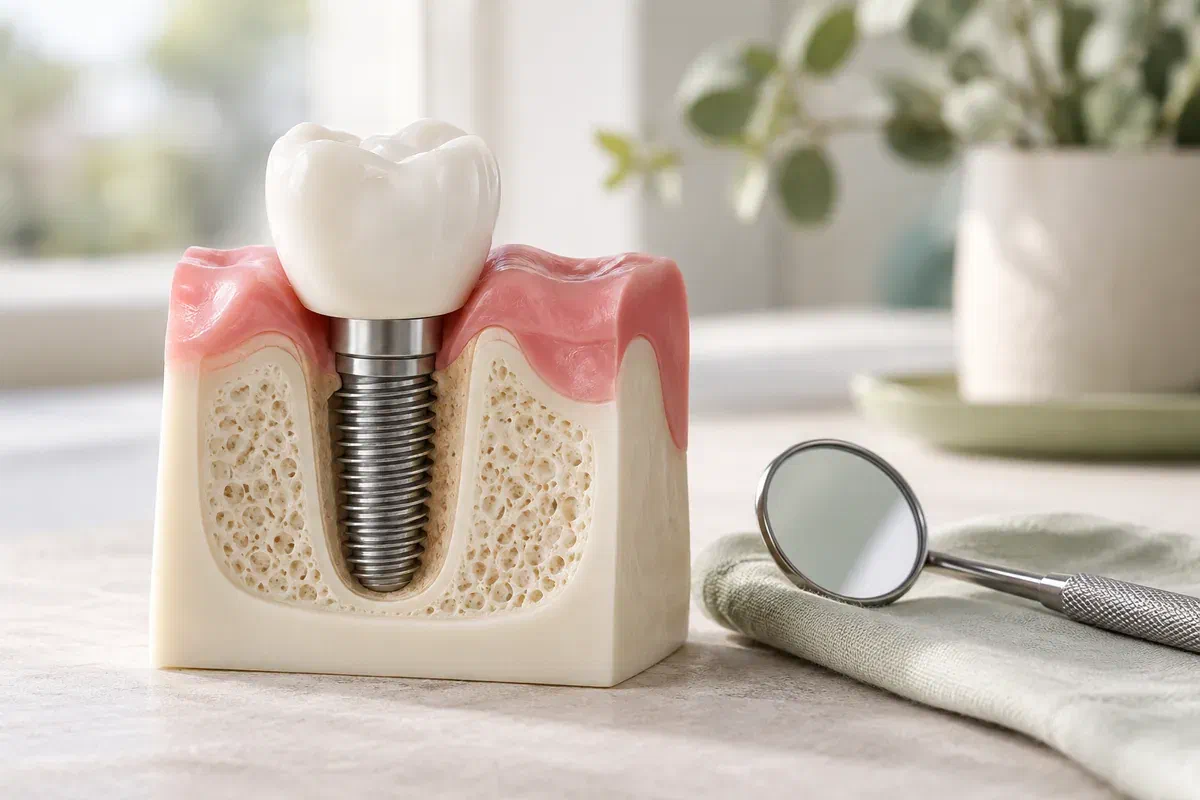
Illustrative implant teaching model with a connected crown, implant, gum, and bone base
Changes around an implant

Report a new symptom even if the implant has been comfortable for years.

Describe the location, timing, and any change in cleaning or function. An implant that feels comfortable can still need review, while a new mechanical sensation may require attention to the restoration as well as the surrounding tissues.

Bleeding, redness, swelling, or discharge

Tell the dentist whether these signs occur during cleaning or at other times and whether they are increasing. Mention any unpleasant taste or tenderness. The examination can assess inflammation and support rather than treating every bleeding site as proof of the same implant disease.

A changed gum margin or cleaning difficulty

Explain whether more of the restoration or implant is visible, food collects differently, or your usual cleaning tool no longer reaches comfortably. Ask for a practical review of access. Do not scrape an exposed surface with a household instrument or force a brush beneath the restoration.

Movement or a different feeling when biting

Describe any looseness, clicking, or change in the way the restoration meets the opposing teeth. A moving crown or component and movement of the implant itself are different concerns. Avoid repeatedly testing the area; the clinician needs to establish what is moving and why.

Contact the dental team promptly about a loose implant restoration, increasing swelling, discharge, or significant pain. Severe spreading swelling, trouble breathing or swallowing, or serious systemic illness needs emergency medical attention rather than a routine implant review.

What the assessment should clarify

Separate inflammation, bone-support changes, and restoration problems.

An assessment should leave you with an explanation of what is known and what remains uncertain. Ask whether the concern affects the soft tissues, supporting bone, restoration, or more than one area. That distinction matters because a cleaning plan, a component repair, and treatment for established peri-implantitis serve different purposes.

The conversation should also identify the provider best placed to continue care. Implant records, restoration complexity, and the required treatment can make coordination with the original implant team or a specialist useful. Ask who will arrange the next contact and what support is appropriate while further assessment is being organized.

Patient information: SDCEP — examination of peri-implant tissues and baseline records

Measurements interpreted for an implant

The clinician assesses relevant tissue findings and measurements in context. Healthy implant sites can vary in probing depth, so a single reading should not be interpreted exactly as a complete diagnosis. Ask how the current examination compares with earlier information and what the combination of findings suggests.

Images selected to answer the support question

Previous images can help establish a useful comparison, with new imaging considered when indicated. Ask what the clinician is looking for and whether earlier records are adequate. If no baseline is available, clarify what can be concluded now and what monitoring or further assessment is needed.

A realistic explanation of treatment limits

Ask what the proposed next step can achieve and how its response will be checked. Managing an affected implant can be complex, and keeping it cannot be guaranteed. The plan should explain the reasons for referral or further treatment without promising that one cleaning or product will solve every case.

From history to an appropriate pathway

Review the implant's background and connect the findings to the next decision.

Tell the team if the implant was placed elsewhere or if you do not know its details. The assessment can begin with the information available while clarifying which records or additional expertise would be useful.

  1. Gather implant, restoration, and health information

    Describe the implant's approximate age, previous problems, maintenance history, and recent symptoms. Provide the original clinic's details or implant documentation when available. Review medical changes and cleaning difficulties so the clinician understands the context rather than examining the visible crown in isolation.

  2. Examine the tissues and relevant components

    The dentist assesses inflammation, cleaning access, and the restoration, with appropriate measurements and images. Explain whether examination findings match the sensation you noticed. If there is movement, ask which component is involved and whether prompt restorative or specialist care is required.

  3. Explain the working diagnosis and outstanding questions

    Discuss whether findings indicate soft-tissue inflammation, changes in supporting bone, a mechanical issue, or a combination. Ask which conclusions are supported and which need further information. An assessment should distinguish uncertainty from a confirmed diagnosis rather than present every implant symptom as peri-implantitis.

  4. Agree on care, referral, and response review

    Confirm the immediate recommendations, the provider responsible for further treatment, and the planned review. Ask what to do if symptoms change while waiting. If care is shared, clarify how records and treatment recommendations will be communicated between the teams.

While the implant concern is being managed

Follow the cleaning advice and keep the review arrangements active.

Instructions depend on the findings and whether treatment was provided. Ask for guidance around the actual restoration in your mouth rather than using a technique intended for a different implant design.

Use suitable tools without forceful home instrumentation

Ask the clinician to demonstrate cleaning around the implant and under any accessible restoration. Explain where your hands or tools cannot reach. Do not use sharp objects to remove deposits or tighten a component yourself; those problems need appropriate professional assessment and equipment.

Keep track of meaningful changes

Report new swelling, discharge, pain, or movement and describe whether bleeding has changed. Avoid repeatedly pressing the tissues or rocking the crown to check it. A simple symptom timeline can be useful at review without disturbing the area to produce a finding.

Complete the referral and planned reassessment

If another provider is involved, confirm that the appointment and relevant records are arranged. Ask who should review the response to any initial care. Reduced symptoms do not automatically mean the support question is resolved or that a specialist recommendation can be cancelled.

Choosing the response to the findings

The diagnosis and support determine what care is appropriate.

Ask which part of the problem each recommendation addresses. Tissue inflammation, progressive support loss, and a loose restorative component may coexist, but they should not be treated as interchangeable diagnoses.

When inflammation and deposits need attention

Professional cleaning and improved access for daily care

Initial care may focus on appropriate cleaning and practical hygiene instruction. Ask whether restoration features complicate access and whether another provider should review them. This step can have a role without being presented as a guaranteed cure for established bone-support loss.

When findings indicate disease involving supporting bone

Coordinated treatment for peri-implantitis

Further treatment or specialist assessment may be necessary, and surgical options can be considered in appropriate cases. Ask about expected benefits, limitations, and the implant's outlook. Antibiotics or laser treatment should not be assumed to replace a diagnosis-specific management plan.

When the component problem or prognosis changes the choices

Restorative repair or discussion of removal when indicated

A mechanical problem may require attention to the restoration, while an implant with an unfavourable outlook may need a different discussion. Ask why retention or removal is being considered and what alternatives remain. Neither a loose crown nor a single measurement automatically decides that question.

Patient information: SDCEP — treatment limitations and referral for peri-implantitis

Peri-implantitis assessment questions

Understand what is being checked around the implant.

Bring implant records and earlier images if you have them, but contact the team even if those details are missing. The assessment can clarify which information is needed and who should be involved.

(905) 876-4488
Does bleeding around my implant automatically mean peri-implantitis?
No. Bleeding can indicate inflammation, but assessment is needed to determine whether supporting bone is also affected. Ask how the clinical findings and images fit together. Soft-tissue inflammation and peri-implantitis require a distinction rather than a diagnosis from bleeding alone.
Why are earlier implant X-rays useful during this assessment?
They can help the clinician compare support over time and interpret the current findings. Bring them or the original provider’s details when available. If no baseline can be obtained, ask what information new assessment can provide and how future review will be planned.
Can a loose implant crown feel like the implant itself is moving?
Yes, a component problem can create a similar impression. Avoid repeatedly testing or tightening it yourself. The dentist needs to establish which part is moving and whether the concern is mechanical, tissue-related, or both before recommending the appropriate care.
Should implant pocket readings be interpreted exactly like readings around natural teeth?
No. The surrounding tissues and placement circumstances differ, and healthy implant probing depths can vary. Ask how the reading is interpreted with bleeding, images, previous records, and other findings. One isolated number should not decide the diagnosis or treatment.
Can I request peri-implantitis assessment if another clinic placed the implant?
Yes. Explain where it was placed and bring available implant and restoration information. The team can discuss assessment and any coordination needed with the original provider or a specialist. Missing records may require additional investigation rather than an assumption about the implant system.
Will an antibiotic course alone settle every peri-implantitis concern?
No. The management plan must address the diagnosed condition and relevant local factors. Antibiotics are not a routine substitute for appropriate implant care. Ask why any proposed medicine is indicated and what cleaning, restorative treatment, referral, or reassessment remains necessary.
Peri-implantitis assessment in Milton

Bring the implant history and tell us what has changed.

Call Milton Dental Clinic at (905) 876-4488 to discuss an assessment of the tissues around your implant. Mention bleeding, swelling, movement, or discomfort when booking so the team can help clarify the urgency and appropriate next step.

Diagnosis, treatment complexity, referral, and implant prognosis depend on individual findings. Assessment does not guarantee implant retention or confirm the availability of a particular surgical treatment.

Visit Milton Dental Clinic
Unit 1, 342 Bronte St. S, Milton, ON L9T 5B7
Get directions Clinic hours
Monday–Thursday
11am–7pm
Friday–Sunday
By appointment only

How can we help?

Milton Dental Clinic

Have a question about your smile? Choose the option that works best for you.

For urgent dental concerns, please call.
Messages are reviewed during clinic hours.