

Illustrative patient discussing changes around a dental implant with a clinician
Specialized Care

Peri-Implantitis Assessment in Acton

An implant that has felt perfectly normal for years can quietly develop problems in the gum or bone around it. For people coming from Acton, our team offers a careful check of the tissue, the restoration and its support, plus a plain explanation of whether cleaning, closer monitoring, or specialist care is needed.

Long-term implant health in Acton

Comfortable for years, but when was it last checked?

Implants don't decay, and many people forget about theirs entirely. Yet the gum and bone holding an implant keep changing throughout life. Peri-implantitis is the name for inflammation in those tissues combined with progressive loss of supporting bone, and it does not always hurt. Other conditions can produce similar signs, so only a proper assessment can say which one is present.

A check involves more than glancing at the crown. The dentist examines the soft tissue, records measurements appropriate to implants, looks over the restoration, and reviews X-rays. If earlier images from the time of placement or later reviews exist, they provide the comparison needed to judge whether support has changed.

From Acton, the simplest preparation is a short note: when the implant went in, where the crown was made, and anything you've noticed, however small. Bring a card or report if you have one. Records missing after all these years? Mention it when you book, and our team will discuss how to proceed sensibly.

Book a long-overdue implant check
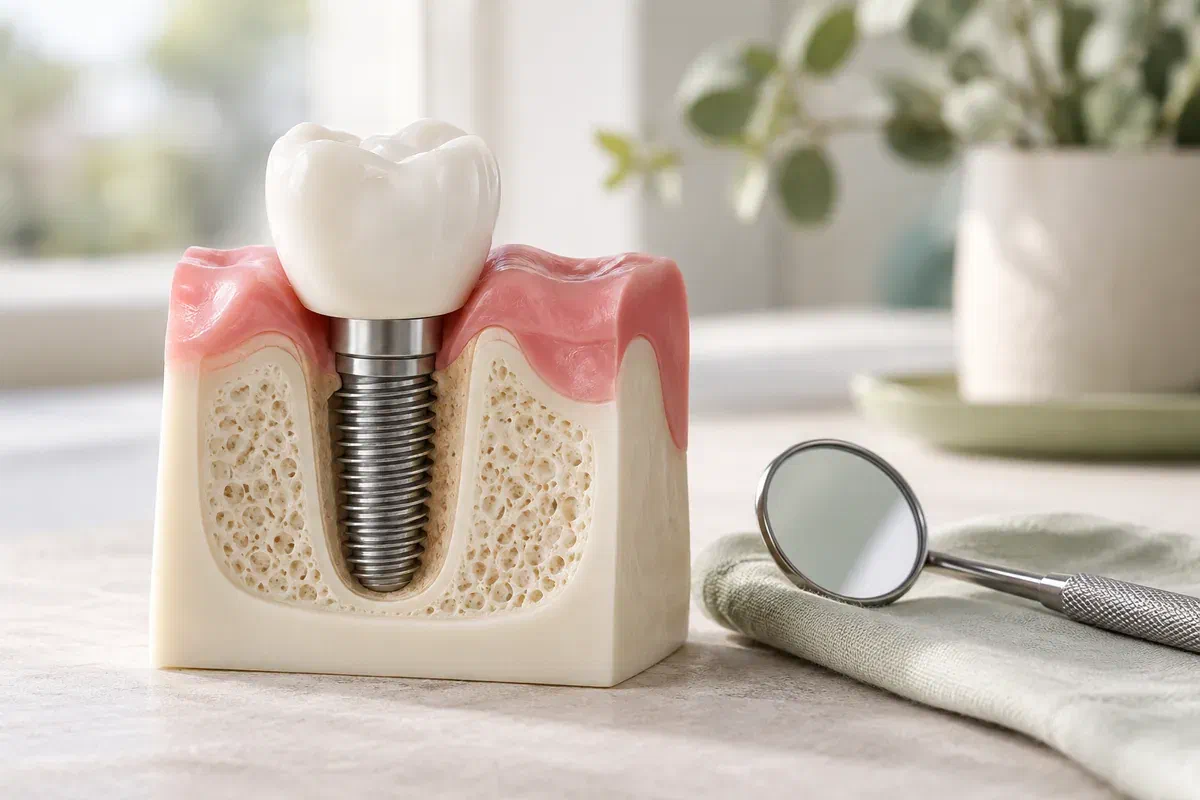
Illustrative implant teaching model with a connected crown, implant, gum, and bone base
Subtle signs to mention

Quiet changes count too.

Even small differences are worth reporting: where they are, when they began, and whether eating or cleaning feels any different. A comfortable implant can still need review, and a new sensation on biting may be about the restoration as well as the tissue.

Occasional bleeding, puffiness, or a bad taste

Say whether the gum bleeds only during cleaning or at other times, and whether it seems more frequent than before. Redness, discharge, or tenderness are worth noting. The dentist examines inflammation and support separately, so one bleeding spot isn't read as proof of disease.

A gum line that has crept back

Mention any metal or crown edge that has become visible, new food trapping, or aids that don't fit as they used to. These gradual shifts are easy to overlook. Please don't scrape the area with household objects or force a brush underneath the restoration.

A bite that has slowly changed

Report any slight looseness, clicking, or difference in how the tooth meets its partners. A crown or abutment that has loosened is a separate concern from an implant moving in bone. Avoid testing it repeatedly, and let the dentist identify what moves.

Call soon if an implant crown becomes loose, swelling increases, discharge appears, or pain is significant. Rapidly spreading swelling, difficulty breathing or swallowing, or feeling very unwell needs emergency medical care rather than an ordinary dental appointment.

What a check-up should give you

A baseline today makes tomorrow's review meaningful.

An assessment should leave you knowing where things stand. Is the implant healthy, or is there a concern in the gum, the bone, the restoration, or several of these? What remains unclear? The answers shape whether you need simple maintenance, a component repair, or treatment for established peri-implantitis.

Just as importantly, a careful record now becomes the reference point for future visits. If something needs attention beyond routine care, the dentist can explain whether a specialist or the original implant team should be involved. Ask who will coordinate that and what you should do in the meantime.

Patient information: SDCEP — examination of peri-implant tissues and baseline records

Measurements suited to implants

Probing depths at implants are interpreted with bleeding, tissue appearance and history. Healthy sites vary, so a single number doesn't settle anything. Ask how today's readings compare with older records and how they'll be used next time.

Images that start or continue a record

Earlier X-rays give a comparison, and new images are taken when they add value. Ask what the dentist is looking for and whether old films are usable. If none exist, today's findings can become the baseline for future monitoring.

Honest expectations

Ask what any recommended step can achieve and how it will be checked. Treating an implant with bone loss can be demanding, and long-term survival isn't guaranteed. Plans should be explained by their reasoning, not presented as a simple cure.

What to expect

A calm, thorough look at an older implant

Placed elsewhere, or details forgotten? That's common. The visit begins with what you can share and identifies any records or extra expertise that would help.

  1. Catch up on the implant's story

    Tell us its approximate age, any problems over the years, how often it has been professionally maintained, and what has changed recently. Name the original clinic if you can. Health changes and cleaning habits help the dentist interpret what is found.

  2. Examine tissue, access and restoration

    The dentist checks for inflammation, reviews how well you can clean the area, and inspects the restoration, adding measurements and images where appropriate. Mention whether findings match anything you've felt. If there's movement, ask which part and how soon it needs care.

  3. Discuss what the findings mean

    You'll hear whether the evidence suggests a healthy implant, gum inflammation, bone-support change, a mechanical issue, or a combination. Ask which conclusions are firm and which need more information or future comparison.

  4. Set a review rhythm

    Agree on any immediate care, who provides further treatment if needed, and how often the implant should be reviewed. Find out who to call if anything changes between visits. If another provider is involved, confirm how they'll receive your records.

Keeping it healthy

Routine care is what keeps an implant comfortable.

Instructions depend on what was found and any treatment you had. Ask for advice tailored to your restoration rather than general tips meant for a different implant design.

Refresh your cleaning technique

Ask the clinician to show you how to clean around the implant and under any reachable part of the restoration, since needs change as gums change. Mention areas you can't reach. Avoid sharp objects and never try to tighten a component yourself.

Keep an eye on gradual change

Report new swelling, discharge, soreness or movement, and any change in bleeding. Don't press the gum or wiggle the crown to check. A note in your calendar when something changes helps at your next review.

Don't let the next review slip

If a specialist or other provider is involved, confirm the appointment and the transfer of records. Ask who will check how the area responds. Feeling fine doesn't mean the bone question has been answered or that a referral can be skipped.

If something is found

Care scaled to what the exam shows

Ask what each recommendation is designed to treat. Inflamed gum, gradual loss of bone support and a worn or loose restorative part can coexist, but each is its own diagnosis.

When inflammation and deposits need attention

Cleaning and an updated home routine

Care may start with professional cleaning and a refreshed routine for home. Ask whether the restoration's shape has become harder to clean around and whether another provider should look at it. This can help, but it isn't a guaranteed cure for bone already lost.

When bone support has been affected

Coordinated peri-implantitis treatment

Further treatment or specialist assessment may be appropriate, and surgery can be considered in suitable cases. Ask about benefits, limitations and the implant's outlook. Antibiotics or lasers aren't a replacement for a plan based on the diagnosis.

When wear, a faulty part, or the prognosis changes things

Restoration renewal, or a removal discussion

An older crown or component may need repair or replacement, while an implant with an unfavourable prognosis calls for a wider conversation. Ask what supports the recommendation and what alternatives exist. A single reading doesn't decide it.

Patient information: SDCEP — treatment limitations and referral for peri-implantitis

Acton implant questions

Caring for an implant over the decades

Bring implant records and older X-rays if you still have them, but call even if you don't. The assessment can show what information is needed and who should be involved.

(905) 876-4488
Can peri-implantitis develop without any pain?
Yes. It can progress without obvious discomfort, which is why regular reviews matter. Bleeding, swelling or a change in the gum line may be the only early clues, and some people notice nothing at all until a measurement or X-ray shows a change.
How often should a long-standing implant be reviewed?
That depends on your history, risk factors and findings. Ask the dentist to recommend a review interval that suits your mouth, and to explain which signs would be a reason to come back before the next scheduled check.
Do implant crowns wear out over the years?
Restorations and their components can wear or loosen with time, much as other dental work does. The dentist will check the crown and its connection as well as the tissue during the assessment, and explain whether any part needs repair or simply monitoring.
Will today's X-rays be useful in future visits?
Yes. Current images can become a baseline, making future comparisons more informative, especially if older records are missing. Ask for copies to keep with your own files, so any provider you see later has a reference point.
Is bleeding around an older implant a sign it's failing?
Not necessarily. Bleeding suggests inflammation, but bone involvement must be assessed through examination and imaging. The dentist will explain what the findings show.
My health has changed since the implant was placed. Does that matter?
It can. Changes such as new medications or conditions like diabetes may be relevant. Share them so the dentist can take them into account when interpreting findings.
Arranging a check from Acton

It's been a while. Let's take a look.

Give Milton Dental Clinic a call at (905) 876-4488 to book an implant assessment. Mention bleeding, swelling, looseness or discomfort, even if mild, so the team can advise how soon you should come in.

The diagnosis, treatment complexity, need for referral and implant prognosis depend on what is found. An assessment can't promise the implant will be retained or that a particular surgical approach will be available.

Visit Milton Dental Clinic
Unit 1, 342 Bronte St. S, Milton, ON L9T 5B7
Get directions Clinic hours
Monday–Thursday
11am–7pm
Friday–Sunday
By appointment only

Areas we serve

  • Milton
  • Oakville
  • Mississauga
  • Georgetown
  • Halton Hills
  • Acton
  • Campbellville
  • Brampton
  • Burlington
  • Puslinch
  • Rockwood
  • Erin
  • Caledon
  • Etobicoke
  • Old Milton
  • Bronte Meadows
  • Timberlea
  • Dorset Park
  • Dempsey
  • Clarke
  • Beaty
  • Coates
  • Harrison
  • Scott
  • Willmott
  • Ford
  • Bowes
  • Cobden
  • Walker
  • Mountain View
  • Milton Heights
  • Hawthorne Village
  • Valley View
  • Fallingbrook
  • Nassagaweya
  • Trafalgar
  • Esquesing
  • Nelson
  • Brookville
  • Moffat
  • Glen Williams
  • Norval
  • Limehouse
  • Stewarttown
  • Ashgrove
  • Hornby
  • Silver Creek
  • Speyside
  • Scotch Block
  • North Oakville
  • River Oaks
  • Glen Abbey
  • West Oak Trails
  • Palermo
  • Bronte Creek
  • College Park
  • Joshua Creek
  • Uptown Core
  • Preserve
  • Iroquois Ridge
  • Lisgar
  • Meadowvale
  • Meadowvale Village
  • Churchill Meadows
  • Erin Mills
  • Central Erin Mills
  • Streetsville
  • East Credit
  • Creditview
  • Heartland
  • Sheridan
  • Mount Pleasant
  • Credit Valley
  • Huttonville
  • Churchville
  • Springbrook
  • Northwest Brampton
  • Bram West
  • Fletcher's Meadow
  • Fletcher's Creek South
  • Alton Village
  • Orchard
  • Millcroft
  • Headon Forest
  • Tansley
  • Brant Hills
  • Tyandaga
  • Kilbride
  • Lowville
  • Aberfoyle
  • Morriston
  • Arkell
  • Hillsburgh
  • Freelton
  • Carlisle
  • Waterdown
  • Flamborough
  • Mountsberg

How can we help?

Milton Dental Clinic

Have a question about your smile? Choose the option that works best for you.

For urgent dental concerns, please call.
Messages are reviewed during clinic hours.