

Illustrative patient discussing changes around a dental implant with a clinician
Specialized Care

Peri-Implantitis Assessment in Brampton

Sometimes the first hint comes from a hygienist: a deeper reading or bleeding point beside an implant during a routine cleaning. If you're coming from Brampton, our team can follow that up properly, looking at the gum, the bone support and the restoration, and explaining what the numbers mean for your next step.

Following up a flag in Brampton

A number on the chart, and a question in your mind

You felt nothing unusual, yet the hygienist paused at the implant and mentioned bleeding or a deeper measurement. It is natural to wonder what that means. Gum and bone around an implant are living tissue, and they can become inflamed. Peri-implantitis describes that inflammation when it comes with progressive loss of the bone supporting the implant.

A reading on its own, however, does not make a diagnosis. Implant sites behave differently from natural teeth, and healthy depths vary from one implant to the next. A follow-up assessment pulls together the gum's condition, careful measurements, the restoration, and X-rays. Comparing with earlier images is often the most informative part, because it reveals change over time.

When you book from Brampton, mention who flagged the concern and, if possible, bring a copy of that chart or report. Add what you know about when the implant was placed and who made the crown. If those details aren't handy, tell the team; we can work with partial information and avoid assuming that every flagged reading has the same explanation.

Follow up an implant reading
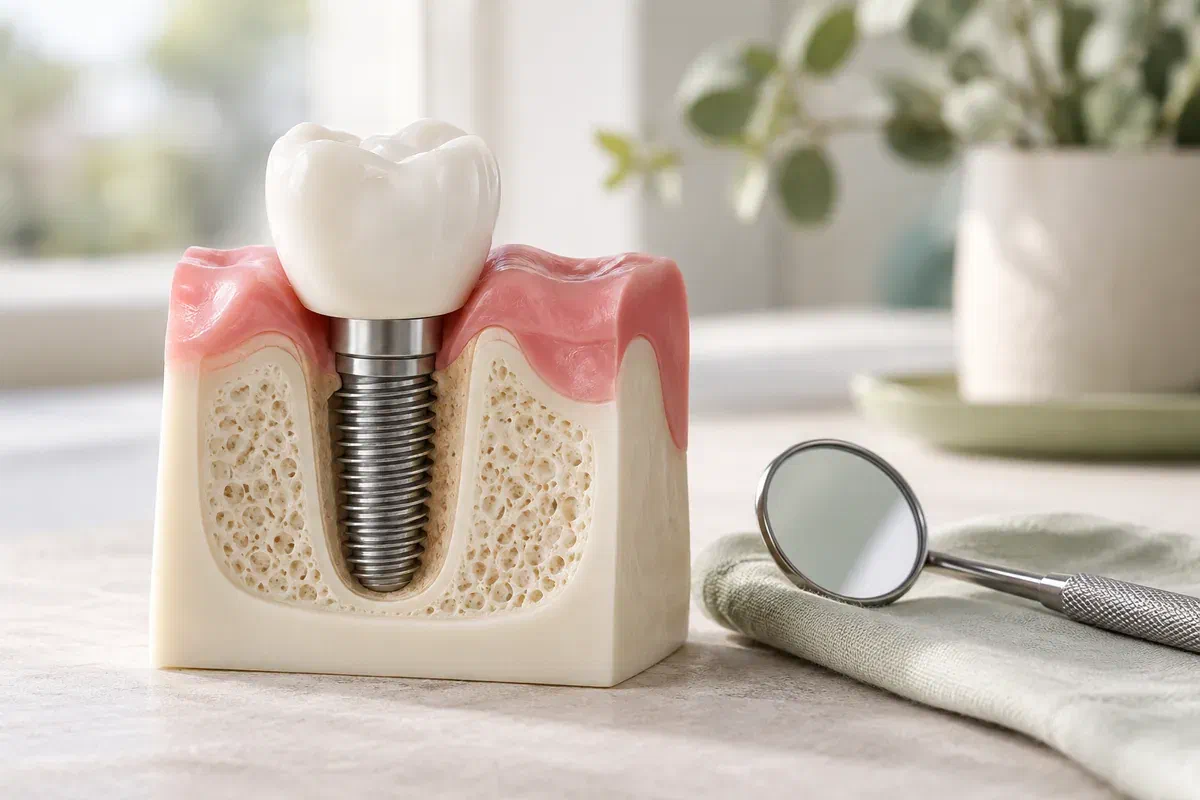
Illustrative implant teaching model with a connected crown, implant, gum, and bone base
Beyond the measurement

No symptoms yet? Still worth a closer look.

Even when the hygienist's finding is the only clue, tell us about anything you have noticed since. An implant can feel completely normal and still warrant review, while a slight change in your bite could relate to the restoration rather than the tissue.

Bleeding on probing or at home

Note whether the gum bleeds during your own cleaning too, or only when examined, and whether there is redness, puffiness, discharge, or a bad taste. The dentist weighs these signs together, so a single bleeding point is not treated as automatic evidence of disease.

Gum position and home access

Mention any new visibility of the crown edge or implant, food trapping, or difficulty getting a brush or floss in. A review of your cleaning aids can make a real difference. Please don't attack the area with sharp household objects or push bristles under the restoration.

Subtle movement or bite change

Tell the dentist if the implant tooth feels slightly loose, clicks, or meets the other teeth differently. A crown or abutment that moves is separate from an implant that moves in bone. Leave it be between appointments so the source can be identified.

Contact us soon if an implant crown becomes loose, swelling increases, discharge appears, or pain is significant. Swelling that spreads quickly, trouble breathing or swallowing, or feeling seriously unwell needs emergency medical help rather than a routine implant check.

Making sense of the findings

One reading is a starting point, not a verdict.

The goal is to turn a flagged number into an explanation you understand. Ask whether the finding points to the gum alone, to bone support, to the restoration, or to a mix. That shapes everything after: improved cleaning, a component fix, and treatment for established peri-implantitis are three quite different responses.

It is also worth clarifying who will carry the follow-up. The availability of records, the complexity of the restoration, and the care required might mean involving the original implant team or a specialist. Ask who will contact whom and what you can do while the next step is organized.

Patient information: SDCEP — examination of peri-implant tissues and baseline records

Depths read against implant norms

The clinician interprets probing results together with bleeding, tissue appearance and history. Because healthy implant depths vary, one figure can't be read as a complete diagnosis. Ask how this exam compares with the hygienist's notes and any older records.

X-rays for the support question

Prior images help establish whether bone levels have changed; new ones are added when needed. Ask what the dentist is looking for and whether past films are adequate. Without a baseline, ask what can be concluded today and how monitoring will work.

Realistic about outcomes

Ask what the recommended step aims to do and how its effect will be reassessed. Managing an affected implant can be complex, and keeping it cannot be promised. The reasons for any referral or treatment should be clear, with no claim that one cleaning or product fixes every case.

From flag to plan

What happens after a hygienist raises a concern

If the implant was placed elsewhere or you're unsure of its history, that is fine. The follow-up begins with what is known and identifies which records or specialist input would help.

  1. Review the flag and your history

    Share the hygienist's findings if you have them, along with the implant's approximate age, any earlier issues, its maintenance history, and your health. The original clinic's details help. This context lets the dentist interpret today's results properly.

  2. Repeat the examination carefully

    The dentist reassesses the gum, measures appropriately, checks cleaning access, and examines the restoration, adding images where indicated. Mention anything you've noticed since the flag. If there is movement, ask which part is involved and whether prompt restorative or specialist attention is needed.

  3. Explain what the evidence supports

    You'll hear whether the findings suggest gum inflammation, a change in bone support, a mechanical problem, or a combination, and what remains uncertain. A responsible follow-up separates a working explanation from a firm diagnosis.

  4. Set the plan and review interval

    Confirm the next steps, who will provide further care, and when the site will be rechecked. Find out how to reach the team if anything changes before then. If more than one provider is involved, clarify how records and recommendations will be shared.

Looking after the site

Small daily habits support the follow-up.

Advice depends on the findings and any care you received. Ask for instructions tailored to your restoration, rather than borrowing a method designed for a different implant.

Cleaning aids that actually fit

Ask to be shown which brushes or floss suit the space around your implant and under any reachable part of the restoration. Mention any area you can't get to. Avoid sharp tools for deposits and never try to tighten a part yourself; those need professional care.

Notice, don't test

Report new swelling, discharge, pain, or looseness, and whether bleeding has changed. Resist pressing on the gum or rocking the crown. A quick note of dates and symptoms helps at review without irritating the tissue.

Keep the recheck

If a specialist or other provider is involved, confirm the appointment and the transfer of records. Ask who will review how the site responds to initial care. A calmer gum doesn't automatically resolve the bone question or cancel a recommended referral.

What may come next

The findings, not the first number, decide the care.

Ask which part of the problem each recommendation addresses. Gum inflammation, progressive bone loss, and a loose component can coexist, but they are separate diagnoses that need separate answers.

When inflammation and deposits explain the findings

Cleaning and better home access

Initial care may involve professional cleaning and practical coaching for home hygiene. Ask whether the restoration's contours make access harder and whether another provider should look at them. This can help, but it isn't a guaranteed cure for bone support that has been lost.

When bone support is affected

Coordinated peri-implantitis care

Further treatment or a specialist assessment may follow, and surgery can be considered in appropriate cases. Ask about expected benefits, limitations, and the implant's prognosis. Antibiotics or laser treatment should not be assumed to replace a plan based on the actual diagnosis.

When a part or the prognosis changes the options

Restorative repair, or a removal discussion

A component issue may be resolved with work on the restoration, while an implant with a poor outlook leads to a different conversation. Find out the reasons behind any suggestion to keep or remove it and what alternatives exist. One reading doesn't decide that.

Patient information: SDCEP — treatment limitations and referral for peri-implantitis

Brampton follow-up questions

What a flagged implant reading means

Bring the hygienist's notes, implant records and earlier X-rays if you can, but don't let missing documents stop you calling. The assessment can show what information is needed.

(905) 876-4488
My hygienist noted a deeper measurement at my implant. Should I worry?
It deserves follow-up, not alarm. Implant depths vary, and a measurement is interpreted with bleeding, images and history. The dentist will explain whether the finding suggests a problem and what should happen next.
Why would an implant bleed at a cleaning but not at home?
Probing can reveal inflammation that gentle home cleaning doesn’t disturb. Bleeding on probing is a sign worth investigating, but on its own it doesn’t confirm bone loss or a specific diagnosis.
Can a hygienist diagnose peri-implantitis during a cleaning?
A hygienist can identify signs that need attention. Confirming a diagnosis involves an examination by the dentist, appropriate images, and ideally a comparison with earlier records.
How often should an implant be measured and reviewed?
That depends on your history, your risk factors, and the findings. Ask the dentist what review interval suits your implant and what would prompt an earlier visit.
If there's no pain, can I wait until my next routine visit?
Ask the team. Peri-implant problems are not always painful, so comfort isn’t a reliable guide. If swelling, discharge or looseness develop, call sooner rather than waiting.
Would new X-rays be needed even though I had some recently?
Not always. If recent images answer the question, they may be enough. Ask whether existing films can be shared and whether anything additional is needed to assess the bone.
Coming in from Brampton

Share the flag, and we'll take it from there.

Ring (905) 876-4488 to set up a follow-up at Milton Dental Clinic. Mention what the hygienist found and any bleeding, swelling, looseness or discomfort since, so the team can judge how soon to see you and what records to request.

Diagnosis, treatment complexity, referral, and the implant's prognosis depend on individual findings. An assessment does not guarantee the implant will be retained or that a specific surgical treatment will be available.

Visit Milton Dental Clinic
Unit 1, 342 Bronte St. S, Milton, ON L9T 5B7
Get directions Clinic hours
Monday–Thursday
11am–7pm
Friday–Sunday
By appointment only

Areas we serve

  • Milton
  • Oakville
  • Mississauga
  • Georgetown
  • Halton Hills
  • Acton
  • Campbellville
  • Brampton
  • Burlington
  • Puslinch
  • Rockwood
  • Erin
  • Caledon
  • Etobicoke
  • Old Milton
  • Bronte Meadows
  • Timberlea
  • Dorset Park
  • Dempsey
  • Clarke
  • Beaty
  • Coates
  • Harrison
  • Scott
  • Willmott
  • Ford
  • Bowes
  • Cobden
  • Walker
  • Mountain View
  • Milton Heights
  • Hawthorne Village
  • Valley View
  • Fallingbrook
  • Nassagaweya
  • Trafalgar
  • Esquesing
  • Nelson
  • Brookville
  • Moffat
  • Glen Williams
  • Norval
  • Limehouse
  • Stewarttown
  • Ashgrove
  • Hornby
  • Silver Creek
  • Speyside
  • Scotch Block
  • North Oakville
  • River Oaks
  • Glen Abbey
  • West Oak Trails
  • Palermo
  • Bronte Creek
  • College Park
  • Joshua Creek
  • Uptown Core
  • Preserve
  • Iroquois Ridge
  • Lisgar
  • Meadowvale
  • Meadowvale Village
  • Churchill Meadows
  • Erin Mills
  • Central Erin Mills
  • Streetsville
  • East Credit
  • Creditview
  • Heartland
  • Sheridan
  • Mount Pleasant
  • Credit Valley
  • Huttonville
  • Churchville
  • Springbrook
  • Northwest Brampton
  • Bram West
  • Fletcher's Meadow
  • Fletcher's Creek South
  • Alton Village
  • Orchard
  • Millcroft
  • Headon Forest
  • Tansley
  • Brant Hills
  • Tyandaga
  • Kilbride
  • Lowville
  • Aberfoyle
  • Morriston
  • Arkell
  • Hillsburgh
  • Freelton
  • Carlisle
  • Waterdown
  • Flamborough
  • Mountsberg

How can we help?

Milton Dental Clinic

Have a question about your smile? Choose the option that works best for you.

For urgent dental concerns, please call.
Messages are reviewed during clinic hours.