

Illustrative patient discussing changes around a dental implant with a clinician
Specialized Care

Peri-Implantitis Assessment in Burlington

A click when you chew, or an implant tooth that suddenly lands differently, can come from the crown, the gum, the bone, or a combination. For anyone travelling from Burlington, our team checks each layer, reads the records you have, and explains whether repair, cleaning, or specialist care should come next.

Implant tissue checks for Burlington

When the implant tooth starts to feel different in your bite

You bite into a sandwich and something feels off: a faint click, a slight give, a tooth that suddenly seems taller than its neighbours. With an implant, that sensation could start in several places. The crown or the small connecting piece might have loosened, or the gum and bone around the implant could be the source. Peri-implantitis refers to inflammation there alongside progressive loss of supporting bone.

Because those causes can overlap, the dentist checks the restoration and the tissue together. That means looking at the gum, taking implant-appropriate measurements, testing the components carefully, and reviewing X-rays. Images taken in earlier years are particularly valuable, since they let the clinician see whether bone levels have shifted.

Coming from Burlington, try to bring what you know about the implant: roughly when it was placed, where the crown was made, and when the new feeling began. Paperwork from the placing clinic is a bonus. If it can't be found, mention that on the phone, and the team will discuss how to proceed without assuming the cause before anyone has looked.

Have the implant and crown checked
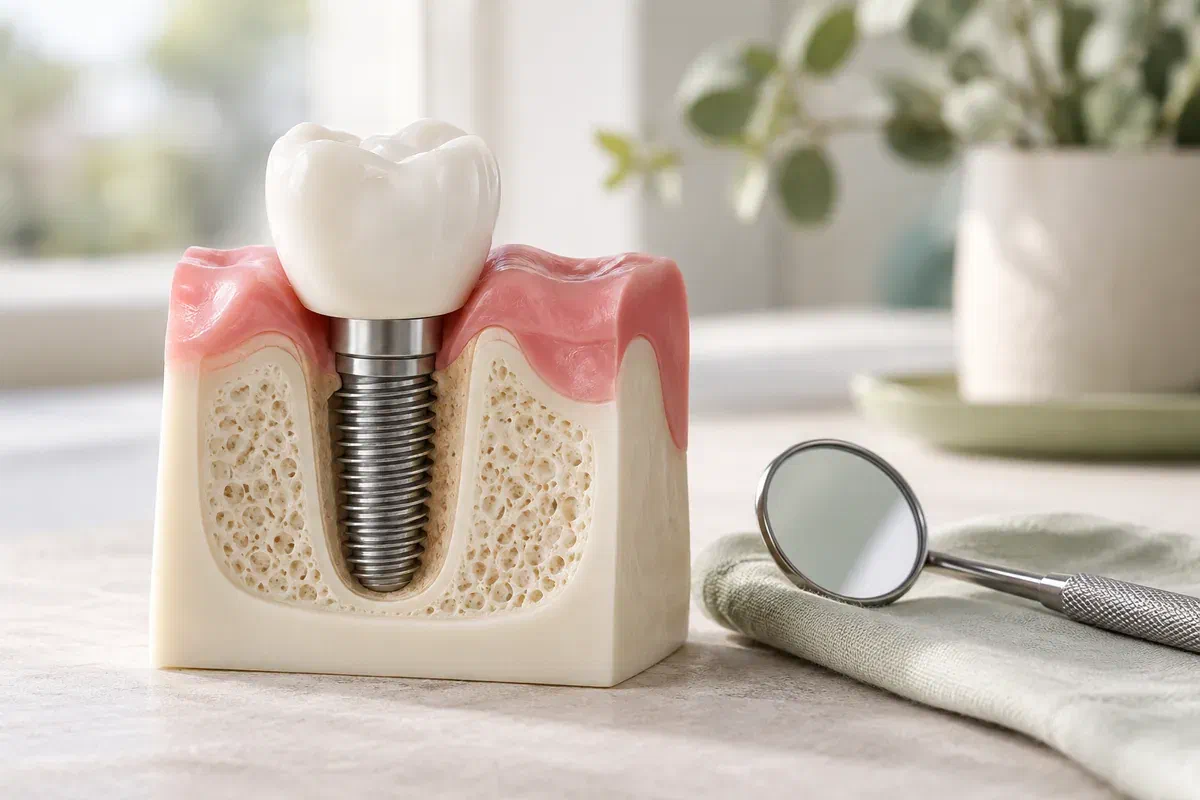
Illustrative implant teaching model with a connected crown, implant, gum, and bone base
Signals from the implant

Clicks, wobbles, blood, swelling: each tells part of the story.

Describe the spot, when the change began, and whether you have adjusted how you chew or clean. An implant can feel comfortable and still need a look, and a new sensation on biting may come from the restoration as well as the gum and bone.

Gum that bleeds, reddens, swells, or drains

Note whether bleeding shows up with brushing and flossing or without any trigger, and whether it is happening more. Mention any bad taste or soreness, too. During the exam, inflammation and support are assessed separately, so one bleeding spot is never taken as proof of a particular disease.

A shifting gum line or a spot you can't clean

Point out if more of the crown or implant has come into view, food gathers in a new place, or your usual floss or brush won't reach. The team can look at access with you. Please avoid using pins, knives or other household items on the surface, and don't force a brush underneath.

Movement or a bite that has changed

Tell the dentist about any looseness, a clicking noise, or a different contact with the teeth that meet it. A loose crown or abutment and an implant moving in bone are separate problems with separate solutions. Try not to keep pushing on it; the clinician needs to find exactly what is moving.

Reach out soon about a loose implant crown, swelling that is getting bigger, any discharge, or severe pain. Swelling that spreads rapidly, difficulty breathing or swallowing, or feeling seriously ill means seeking emergency medical care rather than waiting for a dental visit.

Sorting out the source

Mechanical fault, tissue disease, or both?

The visit should leave you with a plain summary of what is known and what is still being worked out. Ask whether the problem lies with the gum, the bone, the crown and its parts, or several at once. Each answer leads somewhere different: tightening or replacing a component, improving cleaning, or treating established peri-implantitis.

Knowing who handles the next step is just as important. Records from the placing clinic, the design of the restoration, and the type of treatment needed may make it sensible to involve the original team or a specialist. Ask who will be in touch and what you should do in the meantime.

Patient information: SDCEP — examination of peri-implant tissues and baseline records

Implant measurements in context

Probing depths and other tissue signs are interpreted together. Healthy implants can show quite a range of readings, so one figure on its own is not a diagnosis. Ask how this exam lines up with previous information and what the combined findings suggest.

X-rays that answer the bone question

Earlier images can serve as a reference, and new ones are taken when they add something. Ask what the dentist is checking and whether older films are clear enough. If no baseline exists, ask what today's images can tell you and what follow-up will involve.

Straight talk about limits

Ask what the next step is designed to achieve and how its effect will be measured. Treating an implant with bone loss can be demanding, and keeping it is never guaranteed. The plan should explain why further treatment or referral is suggested, without promising one cleaning or product will solve it.

What the appointment covers

Listen, examine, explain, plan

If another clinic placed your implant or you don't know its details, that's fine. The assessment starts with what you can tell us and identifies which records or specialist input might help.

  1. Talk through the implant's past

    Share how long you've had the implant, any earlier issues, how often it has been professionally maintained, and what you've noticed lately. Bring the placing clinic's details or documents if available. Changes in your health and any difficulty cleaning help the dentist interpret the findings.

  2. Check the tissue and each component

    The dentist looks for inflammation, assesses access for cleaning, and examines the crown and its connection, with measurements and images as appropriate. Mention whether the findings match the sensation you've had. If something moves, ask which part and whether it needs prompt restorative or specialist care.

  3. Explain what seems to be happening

    You'll discuss whether the evidence points to gum inflammation, bone-support change, a mechanical issue, or a mix. Ask which conclusions are firm and which need more information. A responsible assessment won't label every implant complaint as peri-implantitis.

  4. Agree on care and how it will be reviewed

    Confirm the immediate plan, who will provide any further treatment, and when progress will be checked. Ask what to do if the sensation or swelling changes before then. If two teams are involved, clarify how records and recommendations will be shared.

Until the next check

Protect the area and leave the parts alone.

Advice will depend on what was found and any treatment you received. Ask for cleaning guidance specific to your restoration rather than a general technique designed for another kind of implant.

Suitable aids, gentle hands

Ask for a demonstration of cleaning around the implant and beneath any reachable part of the restoration. Mention the areas you can't reach. Never scrape at deposits with sharp items or try to tighten a loose piece; these need professional assessment and proper instruments.

Watch for changes worth reporting

Report new swelling, drainage, pain, or movement, and note whether bleeding is improving or worsening. Avoid pressing on the gum or rocking the crown to test it. A few dated notes about symptoms help at review without aggravating the area.

Finish the referral and the recheck

If another provider is involved, make sure the appointment is booked and the records have been sent. Ask who will review the response to initial care. Fewer symptoms don't necessarily mean the bone question is answered or that a specialist visit can be skipped.

Where the findings lead

Repair, clean, refer: the cause sets the course.

Ask what each recommendation is meant to address. Gum inflammation, ongoing bone loss, and a loose part can all be present at the same time, but they are distinct problems with distinct treatments.

When inflammation and deposits are present

Professional cleaning and better daily access

Initial care might focus on professional cleaning and practical coaching for home care. Ask whether the restoration's shape is making cleaning harder and whether another provider should assess it. This step can help, but it should not be presented as a guaranteed fix for lost bone support.

When the findings show bone involvement

Coordinated care for peri-implantitis

Further treatment or a specialist referral may be needed, and surgical options can be explored in suitable cases. Ask about expected benefits, limitations, and the implant's outlook. Antibiotics or laser treatment should not be assumed to replace a plan based on the diagnosis.

When a component issue or the prognosis changes things

Restorative repair, or a conversation about removal

A mechanical problem may be resolved by work on the crown or abutment, while an implant with a poor prognosis needs a different conversation. Ask why keeping or removing it is being discussed and what alternatives exist. A loose crown or one reading doesn't settle that alone.

Patient information: SDCEP — treatment limitations and referral for peri-implantitis

Burlington implant FAQs

About clicks, looseness and the tissue underneath

Bring implant records and earlier X-rays if you have them, but don't let missing paperwork delay a call. The assessment can determine what information is needed and whether anyone else should be involved.

(905) 876-4488
My implant crown clicks when I chew. Is that peri-implantitis?
Not necessarily. A click often points to a loose crown or connecting screw, which is a mechanical issue. The dentist will still check the gum and bone, since mechanical and tissue problems can occur together.
Can I tighten a loose implant crown myself?
Please don’t. Home attempts can damage the parts or disturb the tissue. Book an assessment and avoid chewing hard foods on that side until the dentist has identified which component is loose and why.
Can a loose screw lead to gum problems around the implant?
A loose or poorly fitting component can make the area harder to clean and may trap deposits. The dentist will look at both the part and the surrounding tissue so that each issue is addressed on its own terms.
How is a moving crown told apart from a moving implant?
The clinician examines the restoration and the implant separately, often with images. A crown or abutment that moves is a different concern from an implant that has lost support. Avoid testing it repeatedly in the meantime.
Is bleeding around the implant a sure sign of bone loss?
No. Bleeding can mean inflammation, but deciding whether bone is involved takes an examination and appropriate imaging. Ask how the findings fit together, because gum-only inflammation and peri-implantitis need to be distinguished.
Should I avoid chewing on the implant while I wait for the appointment?
If it feels loose or sore, favouring the other side is sensible until it is checked. Call sooner if swelling increases, discharge appears, or pain becomes significant, so the team can advise on timing.
Planning a visit from Burlington

Tell us how it feels when you bite.

Our number is (905) 876-4488. Ring Milton Dental Clinic to arrange an assessment of your implant, its crown and the tissue around it. Let the team know about any looseness, clicking, bleeding or pain so they can advise how soon you should come in.

Diagnosis, the complexity of treatment, any referral, and the implant's prognosis depend on individual findings. An assessment does not guarantee implant retention or that a particular surgical treatment will be available.

Visit Milton Dental Clinic
Unit 1, 342 Bronte St. S, Milton, ON L9T 5B7
Get directions Clinic hours
Monday–Thursday
11am–7pm
Friday–Sunday
By appointment only

Areas we serve

  • Milton
  • Oakville
  • Mississauga
  • Georgetown
  • Halton Hills
  • Acton
  • Campbellville
  • Brampton
  • Burlington
  • Puslinch
  • Rockwood
  • Erin
  • Caledon
  • Etobicoke
  • Old Milton
  • Bronte Meadows
  • Timberlea
  • Dorset Park
  • Dempsey
  • Clarke
  • Beaty
  • Coates
  • Harrison
  • Scott
  • Willmott
  • Ford
  • Bowes
  • Cobden
  • Walker
  • Mountain View
  • Milton Heights
  • Hawthorne Village
  • Valley View
  • Fallingbrook
  • Nassagaweya
  • Trafalgar
  • Esquesing
  • Nelson
  • Brookville
  • Moffat
  • Glen Williams
  • Norval
  • Limehouse
  • Stewarttown
  • Ashgrove
  • Hornby
  • Silver Creek
  • Speyside
  • Scotch Block
  • North Oakville
  • River Oaks
  • Glen Abbey
  • West Oak Trails
  • Palermo
  • Bronte Creek
  • College Park
  • Joshua Creek
  • Uptown Core
  • Preserve
  • Iroquois Ridge
  • Lisgar
  • Meadowvale
  • Meadowvale Village
  • Churchill Meadows
  • Erin Mills
  • Central Erin Mills
  • Streetsville
  • East Credit
  • Creditview
  • Heartland
  • Sheridan
  • Mount Pleasant
  • Credit Valley
  • Huttonville
  • Churchville
  • Springbrook
  • Northwest Brampton
  • Bram West
  • Fletcher's Meadow
  • Fletcher's Creek South
  • Alton Village
  • Orchard
  • Millcroft
  • Headon Forest
  • Tansley
  • Brant Hills
  • Tyandaga
  • Kilbride
  • Lowville
  • Aberfoyle
  • Morriston
  • Arkell
  • Hillsburgh
  • Freelton
  • Carlisle
  • Waterdown
  • Flamborough
  • Mountsberg

How can we help?

Milton Dental Clinic

Have a question about your smile? Choose the option that works best for you.

For urgent dental concerns, please call.
Messages are reviewed during clinic hours.