

Illustrative patient discussing changes around a dental implant with a clinician
Specialized Care

Peri-Implantitis Assessment in Caledon

When an implant is troubling you, the real worry is often its future: can it be kept, and what happens if not? For people in Bolton and the rest of Caledon, our team assesses the gum, bone support and restoration, explains the outlook honestly, and talks through every reasonable option.

Honest implant assessments for Caledon

Can this implant be kept?

That question tends to arrive the moment something feels wrong, and it deserves a careful answer rather than a quick one. The tissues around an implant can develop inflammation; when that inflammation brings progressive bone loss with it, the condition is peri-implantitis. A loose part, trapped debris or gum-only inflammation can feel just as alarming, yet carry a very different outlook.

No one can judge the future of an implant without first establishing the present. The dentist examines the soft tissue, takes implant-appropriate measurements, checks the restoration, and reviews X-rays. Older images are especially valuable here, because the rate and extent of any change in support shape the conversation about prognosis.

From anywhere in Caledon, it helps to note when the implant was placed, who restored it, and how symptoms have developed. Bring any card, letter or earlier report. If those are gone, say so when you call; our team can explain what information is worth seeking and how the assessment can proceed without it.

Ask about your implant's outlook
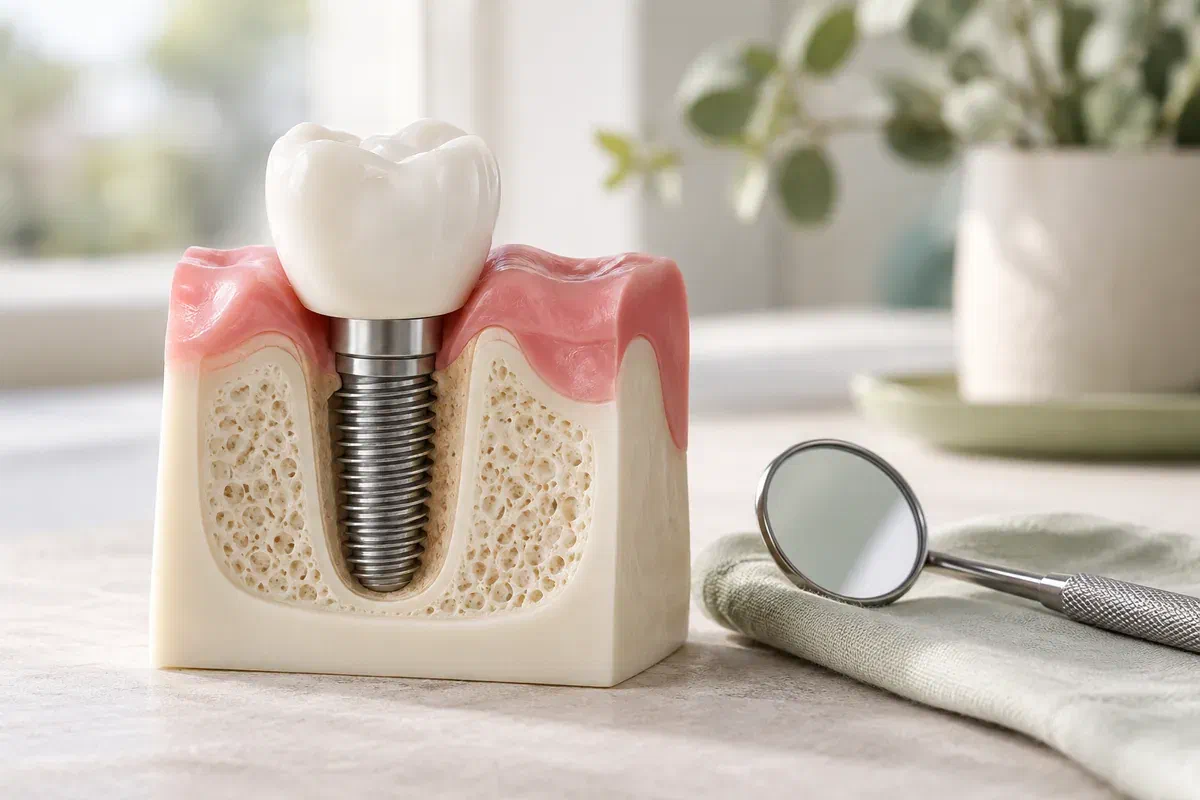
Illustrative implant teaching model with a connected crown, implant, gum, and bone base
Signs that prompt the question

Report changes early, while more options remain open.

Tell us which implant, when the change appeared, and whether eating or cleaning now feels different. Comfort doesn't confirm health, and a new sensation on biting can involve the restoration rather than, or as well as, the tissue.

Bleeding, swelling, redness or discharge

Describe whether bleeding happens with cleaning or without a trigger, and whether these signs are worsening. Note any taste or tenderness. The exam judges inflammation and support as distinct questions, which matters a great deal when the outlook is being discussed.

Recession and cleaning difficulty

Mention exposed crown edge or implant surface, new food trapping, or aids that won't fit. These changes can reflect the tissue, the restoration, or both. Please don't scrape the area with household instruments or push bristles under the crown.

Looseness or a changed bite

Mention any give, any clicking, or a bite that now lands unevenly. When the crown or abutment is what's moving, a repair is often possible, which is a very different situation from an implant shifting in bone. Try not to test it; the dentist needs to see exactly what moves.

Contact us promptly about a loose implant crown, increasing swelling, discharge, or significant pain. Swelling that spreads rapidly, difficulty breathing or swallowing, or serious illness requires emergency medical attention rather than a routine implant appointment.

What an honest assessment offers

The facts first, then a conversation about the future

Before any talk of keeping or replacing an implant, you should know what is going on. Is the soft tissue inflamed, is bone being lost, is the crown at fault, or are several of these happening together? And how sure is each conclusion? A loose component, inflamed gum and established peri-implantitis carry very different implications for the implant's future.

Where the outlook is uncertain, a second view can be valuable. A specialist or the clinic that placed the implant may be well placed to advise, depending on the records and the treatment being considered. Ask who will provide that input, how it will be arranged, and what care you'll have meanwhile.

Patient information: SDCEP — examination of peri-implant tissues and baseline records

Readings that inform the outlook

A probing depth means little alone; it is read alongside bleeding, how the tissue looks, and the implant's past. Healthy implants vary, so a single figure can't decide the prognosis. Ask how today's findings compare with earlier records and what pattern they suggest.

Images that show the trend

Earlier X-rays reveal whether bone levels have changed and how quickly; new images are taken when needed. Ask what the clinician hopes to learn from them. Without a baseline, ask how monitoring will clarify the trend over time.

A frank discussion of prognosis

For each option, it's reasonable to ask what it can achieve and how success will be judged. Where bone has already been lost, management is rarely simple, and nobody can promise the implant stays. You deserve reasons for each recommendation, not reassurance that one product or cleaning will solve it.

How we reach a recommendation

History, findings, outlook, decision

If the implant came from another clinic or its details are unclear, mention it. We start from what is known and identify which records or specialist opinions would sharpen the picture.

  1. Understand the background

    Share the implant's approximate age, the clinics involved, past problems, maintenance history, health changes and recent symptoms. Documents help but aren't required. This context is essential when the discussion turns to outlook.

  2. Examine all the components

    Gum health, how well you can clean the site, and the crown with its connecting piece are all reviewed, supported by measurements and images where they are needed. Tell the dentist if anything found differs from what you've been feeling. Where there's movement, ask which part it is and whether a repair is possible.

  3. Weigh what the evidence shows

    You'll discuss whether the findings point to soft-tissue inflammation, changing bone support, a mechanical problem, or several of these, and how confident each conclusion is. Uncertainty should be stated plainly, not hidden behind a label.

  4. Decide together, with time to think

    Agree on immediate care, any referral, and when the site will be reviewed. If retention is uncertain, ask for time to consider options and whether a second opinion would help. Confirm how records will reach anyone else involved.

While decisions are made

Look after the implant as if you're keeping it.

What you're asked to do at home will reflect what was found and whether any treatment has started. Request cleaning guidance for the crown or bridge you actually wear, not a generic method meant for some other implant.

Keep cleaning carefully

Have the team show you, in your own mouth, how to reach around the implant and under whatever part of the crown or bridge is accessible. Point out the spots that defeat you. Leave hard deposits and loose parts to the clinic; picking or tightening at home can do harm.

Note how things change

Report fresh swelling, drainage, pain or looseness, and whether bleeding is easing or worsening. Leave the gum and crown alone rather than testing them. A brief dated record supports the decision at review.

Complete referrals and second opinions

If a specialist is involved, confirm the booking and that images and notes have been sent. Ask who will judge how the area responds to initial care. Settling symptoms don't on their own resolve the bone question or remove the need for specialist advice.

Options on the table

From simple care to difficult decisions

For every suggestion, find out which problem it targets and what it means for the implant's future. Inflamed gum, shrinking bone support and a faulty component can all be present at once, and none of them is fixed by treating another.

When the gum is inflamed but support looks stable

Cleaning and improved home access

When the problem is mostly in the gum, a thorough professional clean and coaching on your daily routine often come first. It is fair to ask whether the crown's contours are getting in the way and whether the dentist who made it should take a look. Helpful as this is, it won't restore bone already lost.

When disease has affected the supporting bone

Coordinated treatment aimed at retaining the implant

A specialist may need to be involved, and in some situations a surgical approach is worth discussing. Find out what benefit is realistically expected, what the limits are, and how likely retention is afterwards. A prescription or a laser session is not, by itself, a plan for diagnosed peri-implantitis.

When a part fails or the prognosis is unfavourable

Repair, or an open discussion about removal

A mechanical problem may be fixed with restorative work. An implant with a poor prognosis leads to a conversation about removal and what could replace it. Ask what supports the recommendation and what alternatives remain; no single reading or loose crown decides it.

Patient information: SDCEP — treatment limitations and referral for peri-implantitis

Outlook questions from Caledon

Keeping, repairing or replacing an implant

Bring whatever implant records and older images you have, but call even without them. The assessment can show what information would help and who else might contribute.

(905) 876-4488
How does the dentist decide whether an implant can be saved?
The outlook depends on the extent of bone loss, how the tissue responds to care, the restoration, your health and other factors. No single finding decides it. Ask the dentist to explain which factors matter most in your case.
If an implant has to be removed, what are the alternatives?
Options may include another implant after healing, a bridge, or a removable appliance, depending on your situation. Ask the dentist and any specialist what is realistic for you before deciding.
Can I get a second opinion on my implant's prognosis?
Yes. A second opinion from a specialist can be helpful when the outlook is uncertain. The team can share records with your consent so the specialist has the full picture.
Is a loose crown a sign that the implant is failing?
Not necessarily. A loose crown or screw is often a mechanical issue that can be repaired. The dentist will check whether the crown, the abutment, or the implant itself is moving.
Does bleeding near the implant mean it can't be kept?
No. Bleeding signals inflammation, which may be limited to the gum. Whether bone support is affected, and what that means for the outlook, depends on a full examination and images.
Will treatment guarantee the implant lasts?
No treatment can guarantee that. Care aims to manage the condition and support the implant’s health, with regular reviews to check how it responds over time.
Booking from Caledon

Ask the question. Expect a straight answer.

To book a careful look at your implant, phone Milton Dental Clinic at (905) 876-4488. Let the team hear about any bleeding, swelling, looseness or pain, since those details shape how quickly an appointment is offered.

The diagnosis, treatment complexity, need for referral and the implant's prognosis all depend on individual findings. An assessment cannot guarantee the implant will be kept or that a particular surgical treatment will be available.

Visit Milton Dental Clinic
Unit 1, 342 Bronte St. S, Milton, ON L9T 5B7
Get directions Clinic hours
Monday–Thursday
11am–7pm
Friday–Sunday
By appointment only

Areas we serve

  • Milton
  • Oakville
  • Mississauga
  • Georgetown
  • Halton Hills
  • Acton
  • Campbellville
  • Brampton
  • Burlington
  • Puslinch
  • Rockwood
  • Erin
  • Caledon
  • Etobicoke
  • Old Milton
  • Bronte Meadows
  • Timberlea
  • Dorset Park
  • Dempsey
  • Clarke
  • Beaty
  • Coates
  • Harrison
  • Scott
  • Willmott
  • Ford
  • Bowes
  • Cobden
  • Walker
  • Mountain View
  • Milton Heights
  • Hawthorne Village
  • Valley View
  • Fallingbrook
  • Nassagaweya
  • Trafalgar
  • Esquesing
  • Nelson
  • Brookville
  • Moffat
  • Glen Williams
  • Norval
  • Limehouse
  • Stewarttown
  • Ashgrove
  • Hornby
  • Silver Creek
  • Speyside
  • Scotch Block
  • North Oakville
  • River Oaks
  • Glen Abbey
  • West Oak Trails
  • Palermo
  • Bronte Creek
  • College Park
  • Joshua Creek
  • Uptown Core
  • Preserve
  • Iroquois Ridge
  • Lisgar
  • Meadowvale
  • Meadowvale Village
  • Churchill Meadows
  • Erin Mills
  • Central Erin Mills
  • Streetsville
  • East Credit
  • Creditview
  • Heartland
  • Sheridan
  • Mount Pleasant
  • Credit Valley
  • Huttonville
  • Churchville
  • Springbrook
  • Northwest Brampton
  • Bram West
  • Fletcher's Meadow
  • Fletcher's Creek South
  • Alton Village
  • Orchard
  • Millcroft
  • Headon Forest
  • Tansley
  • Brant Hills
  • Tyandaga
  • Kilbride
  • Lowville
  • Aberfoyle
  • Morriston
  • Arkell
  • Hillsburgh
  • Freelton
  • Carlisle
  • Waterdown
  • Flamborough
  • Mountsberg

How can we help?

Milton Dental Clinic

Have a question about your smile? Choose the option that works best for you.

For urgent dental concerns, please call.
Messages are reviewed during clinic hours.