

Illustrative patient discussing changes around a dental implant with a clinician
Specialized Care

Peri-Implantitis Assessment in Erin

Most of what keeps an implant healthy happens at your own bathroom sink, between appointments. For anyone in Erin or Hillsburgh, our assessment checks the gum, bone support and restoration, then gives you a home routine that genuinely reaches your implant, plus a clear plan for anything that needs more.

Implant care that continues at home in Erin

The routine at your sink matters as much as the visit.

Daily cleaning is the part of implant care that you control, and it works best when it is shaped around the actual implant in your mouth. When deposits linger, the gum around an implant can become inflamed. Inflammation combined with progressive loss of the supporting bone is called peri-implantitis. Similar soreness can come from a loose crown or trapped food, so a proper examination comes first.

During the assessment, the dentist studies the gum, takes measurements suited to implants, checks the restoration, and reviews X-rays, comparing against older images when available to see whether support has changed. Just as important, the team watches how you clean and which spots your tools miss.

Coming from Erin, bring the brushes, floss or other aids you use each day, along with what you know about when the implant was placed and who made the crown. Records help but aren't essential. If you have none, mention it when you call, and the team will plan around the gaps.

Book an implant check and routine review
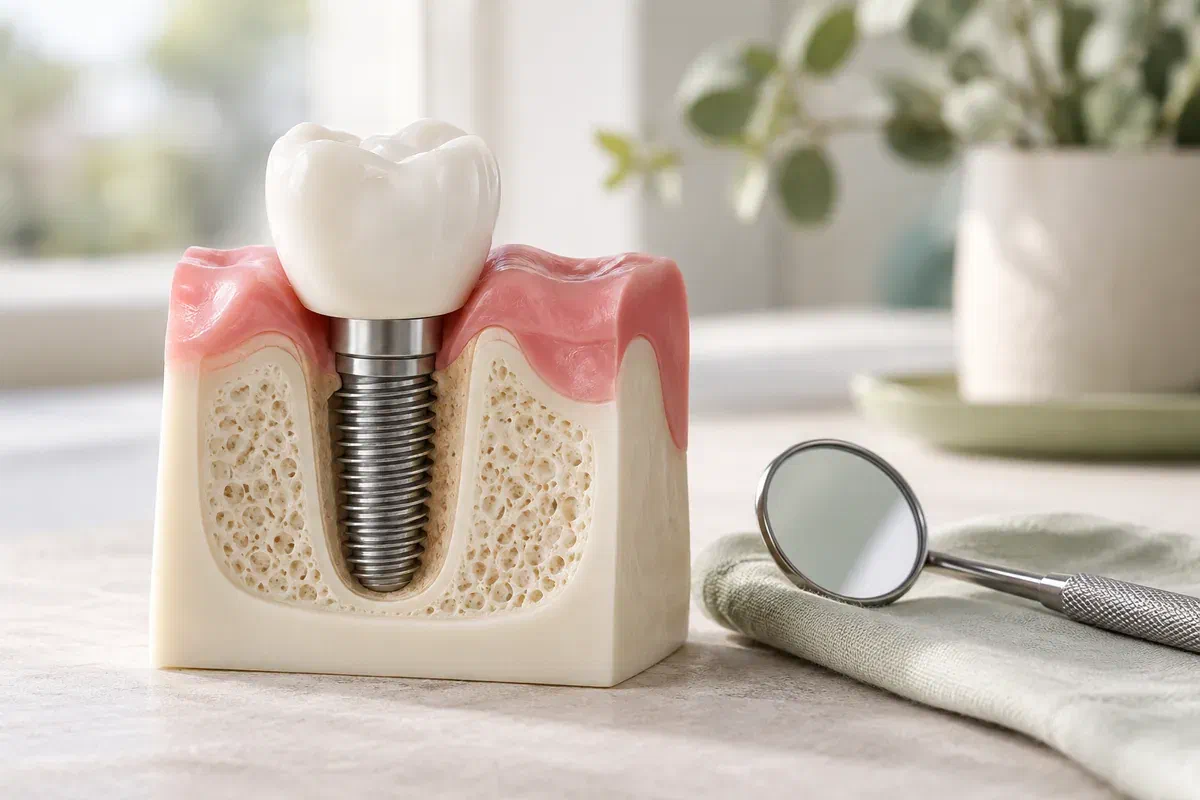
Illustrative implant teaching model with a connected crown, implant, gum, and bone base
What you might notice at the sink

Small signs that turn up during your routine

Mention which implant, when you first spotted the change, and whether cleaning or chewing has become different. A comfortable implant can still need checking, and a new bite sensation may be about the crown as well as the gum.

Pink rinse water, puffy gum, or seepage

Say whether bleeding shows up only while cleaning or also at other times, and whether it is increasing. Redness, a bad taste, tenderness or discharge are all worth reporting. The exam weighs inflammation and support separately, so one bleeding site isn't treated as a diagnosis.

Aids that catch, slip or won't fit

Describe a brush that suddenly catches, floss that shreds, a gum line that has moved, or food that collects. These can signal changes in the tissue or the restoration. Avoid pushing harder or using sharp household items to clear the area.

Movement you notice while brushing

Report any looseness, clicking, or change in how the tooth meets its opposite. A loose crown or abutment is a separate issue from an implant moving in the bone. Stop testing it with the brush or your tongue; let the dentist identify the moving part.

Call promptly about a loose implant crown, swelling that's increasing, discharge, or significant pain. Swelling that spreads quickly, difficulty breathing or swallowing, or feeling seriously ill needs emergency medical care, not a wait for a dental booking.

What you'll take home

An explanation, a plan, and a routine that fits

After the assessment, you should understand whether the issue sits in the gum, the bone, the restoration, or a combination, and what still needs clarifying. That shapes the response. A refined home routine, a component repair, and treatment for established peri-implantitis address very different problems.

You should also know who is guiding the next step. Depending on the records, the restoration's design, and the care needed, that may include the original implant team or a specialist. Ask who will be in touch, how soon, and what your home routine should look like until then.

Patient information: SDCEP — examination of peri-implant tissues and baseline records

Measurements explained in plain terms

Probing depths are interpreted with bleeding, appearance and history. Healthy implants vary, so a single number isn't the answer. Ask what today's readings mean, how they compare with earlier records, and what change at home might influence them.

Images to settle the support question

Earlier X-rays offer a comparison, with new ones taken when needed. Ask what the clinician hopes to learn and whether old films are adequate. If none exist, ask what can be said now and how future visits will track change.

Realistic expectations about home care

Ask what the plan can achieve and how progress will be checked. Good cleaning can calm gum inflammation, but it can't rebuild lost bone, and implant retention isn't guaranteed. Recommendations for further care should come with clear reasons.

Inside the visit

Talk, examine, explain, and practise

If another clinic placed your implant or its details are hazy, just say so. The assessment builds on what you can share and identifies which records or specialist opinions would add value.

  1. Walk us through your routine and history

    Describe how you clean, the aids you use, the implant's approximate age, past issues, maintenance history and any health changes. Bring the original clinic's name if you know it. Your routine tells the dentist a lot about the findings.

  2. Assess the tissue and the restoration

    The dentist checks for inflammation, studies where deposits gather, and examines the crown or bridge, with measurements and images as appropriate. Mention whether the findings match what you've felt. If anything moves, ask which part and how soon it should be addressed.

  3. Explain what's going on

    Together you'll look at whether the evidence fits soft-tissue inflammation, bone-support change, a mechanical issue, or more than one. Ask which conclusions are firm and which need more information. Not every bleeding implant has peri-implantitis.

  4. Practise, plan and book the review

    Try your cleaning aids with guidance before you leave. Confirm any further treatment, who provides it, and when you'll be rechecked. Ask how to reach the team if the area worsens, and how records will be shared with any other clinic.

Your home routine

Gentle, consistent, and built for your implant

What you do at home depends on the findings and any treatment provided. Ask for a technique designed around your restoration, since aids that suit one implant may not reach another.

Use the aids you were shown

Stick with the brushes, floss or other tools demonstrated for the space around your implant and under any reachable part of the restoration. Mention any area you still can't reach. Don't scrape deposits with sharp objects or try to tighten a component.

Watch without poking

Report new swelling, discharge, pain or movement, and whether bleeding is easing. Resist pressing the gum or rocking the crown to check progress. Jotting the date beside any change is enough.

Return for the recheck

If a specialist or other provider is involved, confirm the appointment and that records have gone ahead. Ask who will judge how the area responds. Less bleeding is encouraging, but it doesn't confirm bone support is stable or replace a referral.

Depending on what's found

Home care alone, or something more?

Ask which part of the issue each recommendation targets. Inflamed gum, progressive loss of support and a faulty part may appear together, and each needs its own response.

When inflammation and deposits are the focus

Professional cleaning plus a revised routine

Care may begin with a thorough professional clean and a revised home routine. Ask whether the restoration's contour makes access hard and whether its maker should assess it. This step can be valuable, but it isn't a guaranteed cure for lost bone support.

When the bone around the implant is involved

Coordinated treatment for peri-implantitis

More treatment or a specialist's opinion may be needed, and surgery can be considered in suitable cases. Ask about benefits, limitations and the implant's outlook. Antibiotics or a laser shouldn't be assumed to replace a plan built on the diagnosis.

When a part or the prognosis changes the choices

Restoration changes, or talking about removal

A mechanical problem may need restorative work, and a restoration that is hard to clean may need reshaping. An implant with an unfavourable prognosis prompts a wider discussion. Ask what supports any recommendation and which alternatives exist.

Patient information: SDCEP — treatment limitations and referral for peri-implantitis

Home care questions from Erin

Cleaning around an implant, day to day

Bring your cleaning aids, and any implant paperwork you have. Missing records shouldn't stop you calling; the visit can show what information is needed.

(905) 876-4488
Should I use a soft or a firm brush around my implant?
A soft brush is generally recommended so the gum isn’t irritated. The clinician can suggest the right size and type for your restoration and show you how to angle it at the gum line.
Are interdental brushes safe around implants?
Many are suitable, and some are made with coated wire for implants. Ask the clinician which size fits the space around yours, since a brush that’s too large or too small won’t clean well.
How many times a day should I clean around the implant?
Follow the routine your clinician recommends, which usually includes brushing twice a day and cleaning between teeth daily. Your plan may differ depending on the findings.
What should I do if cleaning makes the gum bleed?
Keep cleaning gently rather than stopping, and book an assessment. Bleeding is a sign of inflammation worth investigating, and the dentist can check whether your technique or aids need adjusting.
Can good home care reverse peri-implantitis?
Home care is important, but it can’t rebuild bone that has been lost. Inflammation limited to the gum may improve with professional and home care; bone involvement usually needs further management.
My implant crown feels loose when I brush. What now?
Stop testing it and book an assessment. A loose crown or screw can feel like a moving implant. The dentist needs to identify which part is moving and why before recommending care.
Booking from Erin

Bring your toothbrush. Really.

Call (905) 876-4488 to arrange an implant assessment at Milton Dental Clinic. Mention bleeding, swelling, looseness or pain, and the team can advise how soon to come in and what to bring for your routine review.

Diagnosis, treatment complexity, referral and the implant's prognosis depend on individual findings. Assessment doesn't guarantee the implant will be retained or confirm that a particular surgical treatment is available.

Visit Milton Dental Clinic
Unit 1, 342 Bronte St. S, Milton, ON L9T 5B7
Get directions Clinic hours
Monday–Thursday
11am–7pm
Friday–Sunday
By appointment only

Areas we serve

  • Milton
  • Oakville
  • Mississauga
  • Georgetown
  • Halton Hills
  • Acton
  • Campbellville
  • Brampton
  • Burlington
  • Puslinch
  • Rockwood
  • Erin
  • Caledon
  • Etobicoke
  • Old Milton
  • Bronte Meadows
  • Timberlea
  • Dorset Park
  • Dempsey
  • Clarke
  • Beaty
  • Coates
  • Harrison
  • Scott
  • Willmott
  • Ford
  • Bowes
  • Cobden
  • Walker
  • Mountain View
  • Milton Heights
  • Hawthorne Village
  • Valley View
  • Fallingbrook
  • Nassagaweya
  • Trafalgar
  • Esquesing
  • Nelson
  • Brookville
  • Moffat
  • Glen Williams
  • Norval
  • Limehouse
  • Stewarttown
  • Ashgrove
  • Hornby
  • Silver Creek
  • Speyside
  • Scotch Block
  • North Oakville
  • River Oaks
  • Glen Abbey
  • West Oak Trails
  • Palermo
  • Bronte Creek
  • College Park
  • Joshua Creek
  • Uptown Core
  • Preserve
  • Iroquois Ridge
  • Lisgar
  • Meadowvale
  • Meadowvale Village
  • Churchill Meadows
  • Erin Mills
  • Central Erin Mills
  • Streetsville
  • East Credit
  • Creditview
  • Heartland
  • Sheridan
  • Mount Pleasant
  • Credit Valley
  • Huttonville
  • Churchville
  • Springbrook
  • Northwest Brampton
  • Bram West
  • Fletcher's Meadow
  • Fletcher's Creek South
  • Alton Village
  • Orchard
  • Millcroft
  • Headon Forest
  • Tansley
  • Brant Hills
  • Tyandaga
  • Kilbride
  • Lowville
  • Aberfoyle
  • Morriston
  • Arkell
  • Hillsburgh
  • Freelton
  • Carlisle
  • Waterdown
  • Flamborough
  • Mountsberg

How can we help?

Milton Dental Clinic

Have a question about your smile? Choose the option that works best for you.

For urgent dental concerns, please call.
Messages are reviewed during clinic hours.