

Illustrative patient discussing changes around a dental implant with a clinician
Specialized Care

Peri-Implantitis Assessment in Etobicoke

Making the trip from Etobicoke for an implant concern means you want the visit to count. Our team prepares ahead, examines the gum, bone support and restoration in one well-organized appointment where possible, and leaves you with a clear plan for cleaning, more tests, or specialist care.

Planning ahead from Etobicoke

Fewer trips, better prepared, nothing rushed

When the drive is longer, it pays to arrive with the right information and leave with a clear answer. An implant concern is a good example. The gum and bone surrounding an implant need ongoing care, and peri-implantitis describes inflammation in those tissues together with progressive loss of the bone that holds the implant. Similar symptoms can have other causes, so an examination is what sorts them out.

In one appointment, the dentist can usually cover the essentials: the condition of the gum, measurements suited to an implant, the restoration and its parts, and X-rays. If you can send or bring earlier images beforehand, they make the comparison much more useful, since they show whether support has actually changed.

Before travelling from Etobicoke, call to share the implant's approximate age, the clinic that placed it, and what you've noticed. Ask what to bring so nothing is missed. If records are lost, say so early; the team can plan around the gaps and discuss what is worth tracking down without assuming a single cause.

Plan an implant assessment visit
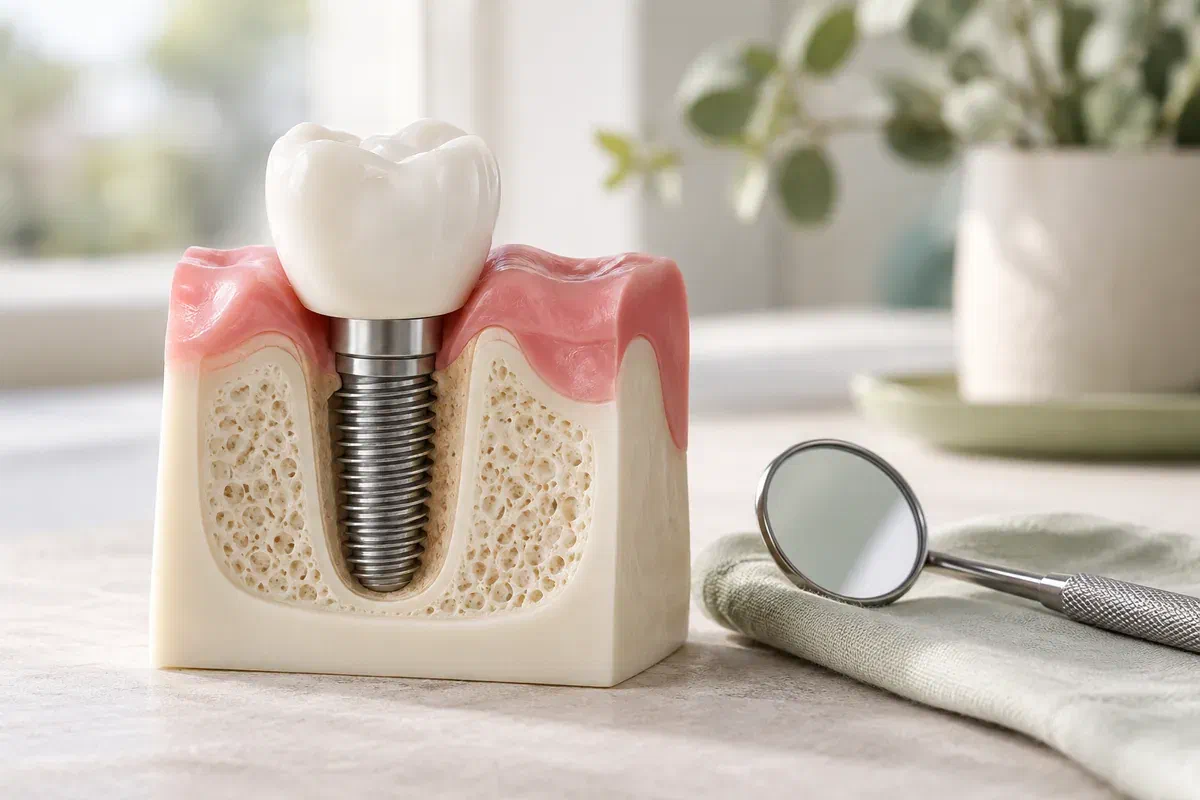
Illustrative implant teaching model with a connected crown, implant, gum, and bone base
Before you set out

Which changes mean call first, and which mean go now?

Describe the implant, how long the change has been present, and whether chewing or cleaning feels different. A comfortable implant may still need review, and a new sensation on biting might involve the restoration as well as the tissue.

Bleeding, redness, swelling, discharge

Tell us whether bleeding happens when you clean or at other times, and whether these signs are increasing. Mention any taste or tenderness. On the phone, the team can help judge urgency; in the chair, inflammation and support are assessed separately rather than lumped together.

Receding gum or cleaning trouble

Report if more of the restoration or implant is showing, if food gets stuck, or if your usual tools no longer reach. Bring those tools to the visit so access can be reviewed. Don't scrape the area with household instruments or jam a brush under the crown.

Looseness or a changed bite

Explain any wobble, clicking, or difference in how the tooth meets its opposite. A loose crown or abutment differs from an implant moving in bone. Avoid testing it on the way in; the dentist needs to identify exactly which part moves.

Call promptly about a loose implant crown, increasing swelling, discharge, or severe pain. If swelling spreads rapidly, breathing or swallowing becomes difficult, or you feel seriously unwell, seek emergency medical care near you immediately instead of making the drive for a dental visit.

Making one visit count

Leave with answers, not just another appointment card.

A well-run assessment should send you home understanding what was found and what is still unsettled. Is the problem in the gum, the bone, the crown and its connection, or a combination? Knowing that tells you whether the next step is cleaning, a repair, or treatment for established peri-implantitis, each with a different purpose.

For anyone travelling a distance, the question of who continues care matters a great deal. Records, restoration complexity and the type of treatment needed may make a specialist or the original implant team the right next stop, possibly one closer to home. Ask who will arrange that contact and what to do in the interim.

Patient information: SDCEP — examination of peri-implant tissues and baseline records

Measurements in an implant context

Probing depths are interpreted with bleeding, tissue appearance and history. Healthy implant sites vary, so a single number isn't a diagnosis. Ask how today's results compare with any earlier records and what they suggest together.

Images chosen to save repeat visits

Sending earlier X-rays ahead of time can reduce the need for extra trips, and new images are taken when necessary. Ask what the dentist needs to see and whether older films are good enough. Without a baseline, ask what can be concluded today and how monitoring will work.

Candour about what's achievable

Ask what the recommended step can do and how its effect will be assessed. Treating an implant with bone loss can be complex, and keeping it isn't guaranteed. Any referral or further care should come with clear reasons and no promise that one cleaning solves everything.

An organized appointment

Prepare by phone, examine in person, plan before you leave

If the implant was placed elsewhere or you don't know its details, mention that when you call. Preparing in advance means more can be done in a single visit.

  1. A call to gather the basics

    Share the implant's age, past problems, maintenance history, health changes, and what prompted your concern. Ask the original clinic for records or images and forward them if you can. The more context the dentist has, the less likely you'll need a return trip just for information.

  2. A thorough examination

    The dentist checks for inflammation, assesses cleaning access, and inspects the restoration, with measurements and images as needed. Mention whether the findings match the sensation you've had. If something moves, ask which component and whether restorative or specialist care is needed soon.

  3. A clear working explanation

    Discuss whether the findings point to gum inflammation, a bone-support change, a mechanical problem, or more than one. Ask what is confirmed and what still needs information. You should leave knowing where the uncertainty lies, not with every symptom called peri-implantitis.

  4. A plan that respects the distance

    Confirm immediate recommendations, who will provide further treatment, and when the site will be reviewed. Ask whether any follow-up can be combined with other appointments, and what to do locally if symptoms flare before then. Clarify how records will be shared if another provider steps in.

Back home in Etobicoke

Steady habits between visits

Your instructions depend on what was found and any treatment done. Ask for a cleaning method specific to your restoration so you aren't relying on advice meant for a different implant.

Gentle cleaning with the right aids

Have the clinician demonstrate cleaning around the implant and beneath any reachable part of the restoration before you leave. Mention spots you can't reach. Avoid sharp objects for deposits, and don't attempt to tighten anything; those need professional equipment.

Notes instead of extra trips

Record new swelling, discharge, pain, or looseness, and whether bleeding has changed. Avoid pressing the gum or rocking the crown. A dated symptom log, shared by phone, can sometimes help the team decide whether an earlier visit is needed.

Referral and review, completed

If another provider is involved, confirm the booking and that records have arrived. Ask who will assess the response to initial care. Easing symptoms don't by themselves settle the bone question or make a specialist recommendation unnecessary.

Next steps after the exam

Care matched to the cause

For each recommendation, ask what it is meant to fix. Inflamed gum, progressive bone loss and a loose component can appear together, but each is a separate diagnosis needing its own response.

When inflammation and deposits are the focus

Cleaning and improved home access

Early care may involve professional cleaning and coaching on daily hygiene. Ask whether the restoration's shape hampers access and whether another provider should evaluate it. This can be a worthwhile stage, but it is not a guaranteed cure for lost bone support.

When the supporting bone is involved

Coordinated treatment for peri-implantitis

Further treatment or a specialist opinion may be needed, and surgery can be considered in suitable cases. Ask about benefits, limitations, and the implant's outlook, and whether care could be arranged closer to home. Antibiotics or lasers aren't a replacement for a diagnosis-based plan.

When a part fails or the prognosis changes

Repairing the restoration, or discussing removal

A mechanical issue may need restorative work, while an implant with a poor outlook prompts a different discussion. Ask what is behind any suggestion to keep or remove it and what alternatives exist. Neither a loose crown nor a single measurement makes that decision.

Patient information: SDCEP — treatment limitations and referral for peri-implantitis

Travel and timing questions

Getting the most from a longer trip

Send or bring implant records and earlier X-rays if you can, but call even if you have none. The assessment can identify what information is needed and who else should be involved.

(905) 876-4488
Can most of the assessment be completed in one appointment?
Often the examination, measurements and initial images can be done in one visit. Further tests, treatment or a specialist referral may still be needed depending on the findings. Ask the team what to expect when booking.
What should I do if swelling gets worse before my appointment?
Call the clinic for advice. If swelling spreads quickly, or you have difficulty breathing or swallowing, seek emergency medical care near you rather than travelling for a dental visit.
Is it possible to send my implant X-rays before I come in?
Yes, ask the team how to share them. Having earlier images ahead of time helps the dentist compare support and may reduce the need for return trips.
If I need a specialist, could that be closer to where I live?
Possibly. Ask the dentist about referral options and how records would be shared. The priority is that care is coordinated, whoever provides it.
Does bleeding at my implant mean the bone has already been damaged?
No, not automatically. Bleeding shows inflammation, but whether bone support is involved needs examination and images. The dentist will explain which condition fits the findings.
Could a loose crown be mistaken for a loose implant?
Yes. A loose crown or screw can feel very similar. Avoid rocking it or tightening it yourself. The dentist will establish which part is moving and whether the cause is mechanical, tissue-related, or both.
Booking from Etobicoke

One call to prepare. One visit to understand.

Phone (905) 876-4488 and tell the Milton Dental Clinic team you're travelling from Etobicoke. Describe any bleeding, swelling, looseness or pain, and ask what records to bring, so the appointment can be planned to cover as much as possible.

Diagnosis, treatment complexity, referral and implant prognosis depend on individual findings. An assessment does not guarantee the implant will be kept or that a particular surgical treatment will be available.

Visit Milton Dental Clinic
Unit 1, 342 Bronte St. S, Milton, ON L9T 5B7
Get directions Clinic hours
Monday–Thursday
11am–7pm
Friday–Sunday
By appointment only

Areas we serve

  • Milton
  • Oakville
  • Mississauga
  • Georgetown
  • Halton Hills
  • Acton
  • Campbellville
  • Brampton
  • Burlington
  • Puslinch
  • Rockwood
  • Erin
  • Caledon
  • Etobicoke
  • Old Milton
  • Bronte Meadows
  • Timberlea
  • Dorset Park
  • Dempsey
  • Clarke
  • Beaty
  • Coates
  • Harrison
  • Scott
  • Willmott
  • Ford
  • Bowes
  • Cobden
  • Walker
  • Mountain View
  • Milton Heights
  • Hawthorne Village
  • Valley View
  • Fallingbrook
  • Nassagaweya
  • Trafalgar
  • Esquesing
  • Nelson
  • Brookville
  • Moffat
  • Glen Williams
  • Norval
  • Limehouse
  • Stewarttown
  • Ashgrove
  • Hornby
  • Silver Creek
  • Speyside
  • Scotch Block
  • North Oakville
  • River Oaks
  • Glen Abbey
  • West Oak Trails
  • Palermo
  • Bronte Creek
  • College Park
  • Joshua Creek
  • Uptown Core
  • Preserve
  • Iroquois Ridge
  • Lisgar
  • Meadowvale
  • Meadowvale Village
  • Churchill Meadows
  • Erin Mills
  • Central Erin Mills
  • Streetsville
  • East Credit
  • Creditview
  • Heartland
  • Sheridan
  • Mount Pleasant
  • Credit Valley
  • Huttonville
  • Churchville
  • Springbrook
  • Northwest Brampton
  • Bram West
  • Fletcher's Meadow
  • Fletcher's Creek South
  • Alton Village
  • Orchard
  • Millcroft
  • Headon Forest
  • Tansley
  • Brant Hills
  • Tyandaga
  • Kilbride
  • Lowville
  • Aberfoyle
  • Morriston
  • Arkell
  • Hillsburgh
  • Freelton
  • Carlisle
  • Waterdown
  • Flamborough
  • Mountsberg

How can we help?

Milton Dental Clinic

Have a question about your smile? Choose the option that works best for you.

For urgent dental concerns, please call.
Messages are reviewed during clinic hours.