

Illustrative patient discussing changes around a dental implant with a clinician
Specialized Care

Peri-Implantitis Assessment in Halton Hills

Food that keeps packing in beside an implant, or a floss threader that no longer slides through, is often the first practical sign that something has changed. For households across Halton Hills, our team looks at access, gum health and bone support together, then explains what kind of care the findings call for.

Halton Hills implant care

It used to be easy to clean. Now it isn't.

Bits of dinner lodging next to the implant, a brush that suddenly catches, gum that seems to have crept back: these everyday frustrations deserve attention. Deposits that sit around an implant can inflame the gum, and when that inflammation comes with progressive loss of supporting bone, the condition is called peri-implantitis. A change in access can also come from the restoration itself, which is why an exam matters.

The dentist looks at how the gum and crown meet, how your cleaning aids reach, and whether the tissue is inflamed. Measurements suited to implants and appropriate X-rays add the deeper layer. Older images, if you have them, show whether bone has changed over time, which a mirror can never tell you.

Bring the brushes, floss or threaders you use; seeing them helps the team understand the struggle. From anywhere in Halton Hills, it is worth noting roughly when the implant was placed and who made the crown or bridge. Records are useful, but missing ones shouldn't delay a call; the team can plan around what you have.

Book an implant access and gum review
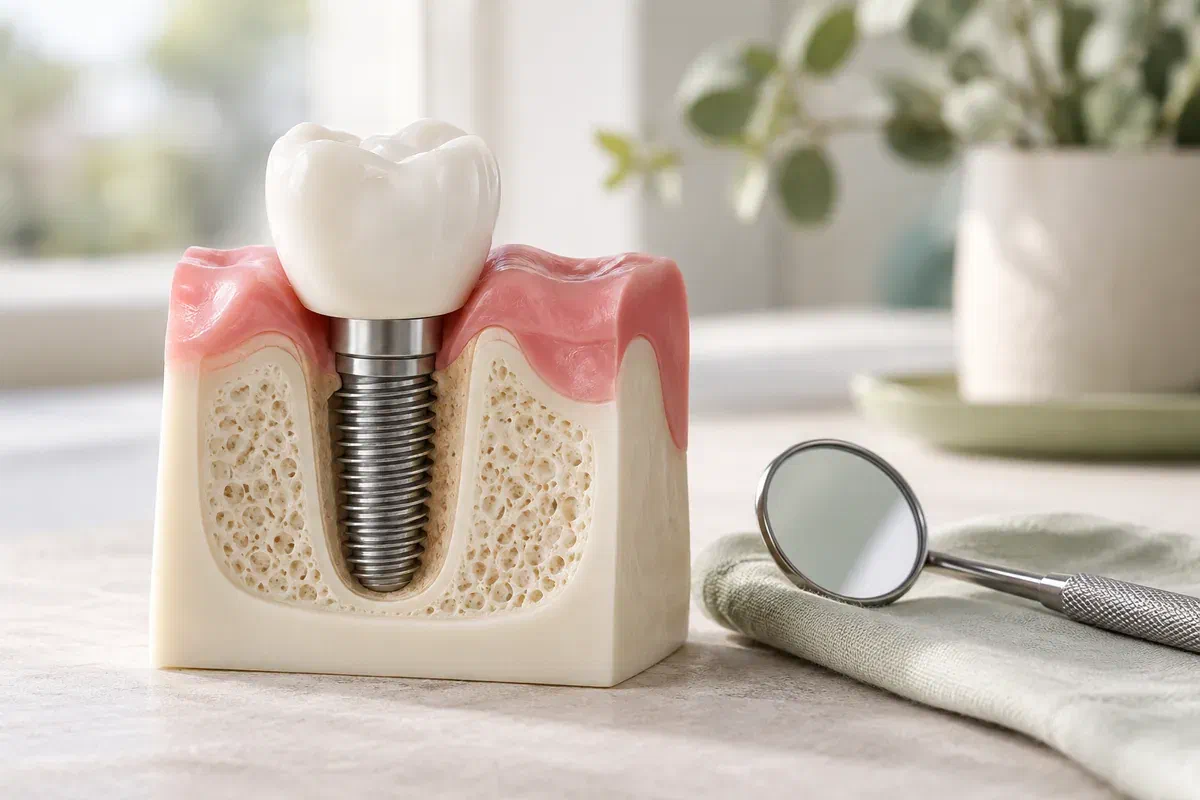
Illustrative implant teaching model with a connected crown, implant, gum, and bone base
Everyday warning signs

Notice the small things your mouth is telling you.

Say which implant it is, when the change began, and what feels different about eating or cleaning. An implant that is comfortable may still need checking, and a new sensation when chewing could involve the crown or bridge as well as the tissue.

Gum that bleeds, swells, reddens, or oozes

Explain whether bleeding is tied to cleaning or happens on its own, and whether it is getting more frequent. A lingering taste or tender spot matters as well. The dentist assesses inflammation and support as separate questions rather than reading every bleed as one disease.

Food trapping and tools that no longer fit

Describe where food collects, whether more of the crown edge or implant is showing, and which aids have stopped working. A hands-on review of access can often help. Avoid prying debris out with toothpicks pushed hard into the gum, pins, or anything sharp.

A tooth that moves or bites differently

Report any looseness, clicking, or change in how the implant tooth meets the others. A loose crown or connecting part is not the same as an implant shifting in bone. Leave it alone between visits so the dentist can see what is really moving.

Call soon if an implant crown or bridge comes loose, swelling grows, pus appears, or pain is strong. Swelling that spreads fast, breathing or swallowing difficulty, or feeling very ill requires emergency medical attention rather than a regular dental booking.

What the review should tell you

Is it a cleaning problem, a crown problem, or a bone problem?

You deserve a straightforward account of the findings and the open questions. Ask whether the trouble is confined to the gum, involves bone, relates to the restoration's shape or fit, or spans several of these. A new cleaning routine, an adjustment to the crown, and treatment for established peri-implantitis each solve a different problem.

Sometimes the answer involves someone else. If the restoration is hard to clean because of its design, the clinic that made it may need to be involved; if bone support is affected, a specialist may be appropriate. Ask who will make contact and what support is available meanwhile.

Patient information: SDCEP — examination of peri-implant tissues and baseline records

Readings understood for implants

Probing depths are weighed alongside bleeding, appearance and history. Healthy implants vary, so one measurement can't make the call. Ask how today's results compare with previous records and what the full picture suggests.

X-rays with a purpose

Earlier images give a reference point, with new ones taken when they will answer something. Ask what the dentist is looking for and whether your past films are usable. With no baseline, find out what today can tell you and what monitoring will follow.

A frank view of what helps

Ask what any recommended step is meant to achieve and how results will be checked. Managing an implant with bone involvement can be complex, and its survival isn't something anyone can promise. The reasoning for further care or referral should be explained without overselling a quick fix.

Inside the appointment

Your routine, the examination, the explanation, the plan

Placed at another clinic, or unsure of the details? Mention it. The visit starts with what you know and works out which records or extra expertise would be helpful.

  1. Show us how you clean

    Describe your routine and bring the aids you use, along with the implant's approximate age, earlier problems, maintenance history and any health changes. The original clinic's name or paperwork is a help. This gives the dentist context the crown alone can't provide.

  2. Look closely at gum, access and restoration

    The dentist checks for inflammation, studies where deposits gather, and examines the crown or bridge, using measurements and images as needed. Say whether the findings match what you've felt. If there is movement, ask which part is involved and how soon it should be addressed.

  3. Talk through the likely cause

    Together you'll consider whether the signs fit gum inflammation, bone-support change, a restoration issue, or a combination. Ask which conclusions are firm and which need more information. A careful dentist won't call every implant complaint peri-implantitis.

  4. Leave with a practical plan

    Confirm the immediate steps, who handles further treatment, and when you'll be reviewed. Check how to reach the team if anything worsens in the meantime. If another clinic is involved, clarify how records and recommendations will be shared.

At home in Halton Hills

A cleaning routine that fits your implant

Advice will depend on what was found and any treatment provided. Ask for instructions designed for your actual restoration, because a technique for one implant style may not reach another.

Aids chosen for your restoration

Ask the clinician to demonstrate the brushes, floss or other aids best suited to the space around your implant and under any accessible part of the restoration. Mention areas you can't reach. Never scrape deposits with sharp items or tighten a component yourself.

Watch how the site responds

Let the team know about fresh swelling, drainage, soreness or movement, and whether bleeding is easing. Don't press the gum or wiggle the crown to check. A brief record of what you notice is useful at review.

Complete the next appointments

If a specialist or the restoring clinic is involved, confirm the booking and that records have gone ahead. Ask who will review the response to initial care. A calmer gum isn't proof that bone support is fine or that a referral can be cancelled.

Choosing a response

Fix the cause you actually have.

Ask what each recommendation is targeting. Gum inflammation, progressive support loss and a restoration that is loose or hard to clean may all be present, yet each needs a response of its own.

When deposits and inflammation drive the problem

Professional cleaning and simpler home access

Care may begin with a thorough professional clean and practical coaching on your daily routine. Ask whether the restoration's contour is part of the problem and whether the restoring clinic should assess it. This stage can help, but it doesn't reverse bone support already lost.

When findings show bone involvement

Coordinated management of peri-implantitis

Further treatment or specialist assessment may be needed, and surgery can be considered when suitable. Ask about likely benefits, limitations and the implant's future. Antibiotics or laser treatment are not a substitute for a plan built around the diagnosis.

When restoration design or prognosis changes the choices

Changing the restoration, or discussing removal

A crown or bridge that traps food may need modifying or replacing, while an implant with an unfavourable outlook leads to a different conversation. Ask what is behind any recommendation and which alternatives remain. One reading or one loose crown doesn't decide it.

Patient information: SDCEP — treatment limitations and referral for peri-implantitis

Cleaning and access questions

Keeping an implant clean when it gets tricky

Implant records and older X-rays help if you have them, but please call even without them. The assessment can work out what information is needed and who should be involved.

(905) 876-4488
Why does food keep getting stuck around my implant crown?
It could relate to the crown’s shape, a change in the gum line, or a loose component. The dentist will examine the area to find the cause rather than assume the implant itself is failing.
Which cleaning aids work best around an implant?
It depends on your restoration and the space around it. Interdental brushes, floss designed for implants, or other aids may suit. Ask the clinician to show you what fits your implant specifically.
Can a crown or bridge be reshaped to make cleaning easier?
Sometimes. If the restoration’s design is limiting access, the dentist may discuss adjusting or replacing it, possibly with the clinic that made it. Ask what is realistic for your situation.
Is a water flosser safe to use around an implant?
Many people use one as part of their routine. Ask the dentist whether it suits your restoration and how it fits with other cleaning, rather than relying on it alone.
Does bleeding when I clean the implant mean bone is being lost?
Not by itself. Bleeding signals inflammation, but whether bone support is affected takes an examination and appropriate images. Gum-only inflammation and peri-implantitis need to be told apart.
Can I be seen if a different clinic did my implant and crown?
Yes. Share where it was done and bring whatever information you have. The team can assess it and discuss whether to involve the original provider or a specialist.
Visiting from Halton Hills

Bring your cleaning aids and your questions.

To arrange an assessment of the gum and bone around your implant, call Milton Dental Clinic on (905) 876-4488. Mention food trapping, bleeding, swelling, looseness or pain so the team can decide how soon you should be seen.

What is found shapes the diagnosis, how complex treatment may be, whether referral is needed, and the implant's outlook. An assessment can't guarantee the implant is kept or that a specific surgical option will be offered.

Visit Milton Dental Clinic
Unit 1, 342 Bronte St. S, Milton, ON L9T 5B7
Get directions Clinic hours
Monday–Thursday
11am–7pm
Friday–Sunday
By appointment only

Areas we serve

  • Milton
  • Oakville
  • Mississauga
  • Georgetown
  • Halton Hills
  • Acton
  • Campbellville
  • Brampton
  • Burlington
  • Puslinch
  • Rockwood
  • Erin
  • Caledon
  • Etobicoke
  • Old Milton
  • Bronte Meadows
  • Timberlea
  • Dorset Park
  • Dempsey
  • Clarke
  • Beaty
  • Coates
  • Harrison
  • Scott
  • Willmott
  • Ford
  • Bowes
  • Cobden
  • Walker
  • Mountain View
  • Milton Heights
  • Hawthorne Village
  • Valley View
  • Fallingbrook
  • Nassagaweya
  • Trafalgar
  • Esquesing
  • Nelson
  • Brookville
  • Moffat
  • Glen Williams
  • Norval
  • Limehouse
  • Stewarttown
  • Ashgrove
  • Hornby
  • Silver Creek
  • Speyside
  • Scotch Block
  • North Oakville
  • River Oaks
  • Glen Abbey
  • West Oak Trails
  • Palermo
  • Bronte Creek
  • College Park
  • Joshua Creek
  • Uptown Core
  • Preserve
  • Iroquois Ridge
  • Lisgar
  • Meadowvale
  • Meadowvale Village
  • Churchill Meadows
  • Erin Mills
  • Central Erin Mills
  • Streetsville
  • East Credit
  • Creditview
  • Heartland
  • Sheridan
  • Mount Pleasant
  • Credit Valley
  • Huttonville
  • Churchville
  • Springbrook
  • Northwest Brampton
  • Bram West
  • Fletcher's Meadow
  • Fletcher's Creek South
  • Alton Village
  • Orchard
  • Millcroft
  • Headon Forest
  • Tansley
  • Brant Hills
  • Tyandaga
  • Kilbride
  • Lowville
  • Aberfoyle
  • Morriston
  • Arkell
  • Hillsburgh
  • Freelton
  • Carlisle
  • Waterdown
  • Flamborough
  • Mountsberg

How can we help?

Milton Dental Clinic

Have a question about your smile? Choose the option that works best for you.

For urgent dental concerns, please call.
Messages are reviewed during clinic hours.