

Illustrative patient discussing changes around a dental implant with a clinician
Specialized Care

Peri-Implantitis Assessment in Milton

A streak of pink on the floss beside an implant is easy to dismiss, yet it is worth a proper look. In Milton, our team can examine the gum and bone support around the implant, read any records you bring, and explain whether you need cleaning, more investigation, or shared specialist care.

Implant checks close to home in Milton

The evening floss turned pink by the implant. What happens next?

Many people first notice a problem during an ordinary clean before bed: a little blood on the floss, a tender spot, or gum that looks puffier than the tissue beside it. An implant has no nerve of its own, but the gum and bone that hold it are living tissue. Peri-implantitis means inflammation there together with progressive loss of the bone that supports the implant.

Those signs can have other causes, too, so nobody should label the problem by its look alone. During the visit, the dentist studies the gum, takes measurements suited to an implant, checks the crown or bridge, and compares any images. Older X-rays are especially helpful because they show whether the support has actually changed over time.

Before you come to our Bronte Street practice, jot down roughly when the implant went in, who made the crown, and what you have noticed lately. An implant card or earlier report is worth bringing. Missing paperwork is common, so just mention it when you call; the team can talk through how to fill the gaps without assuming every concern has one cause.

Book an implant gum check
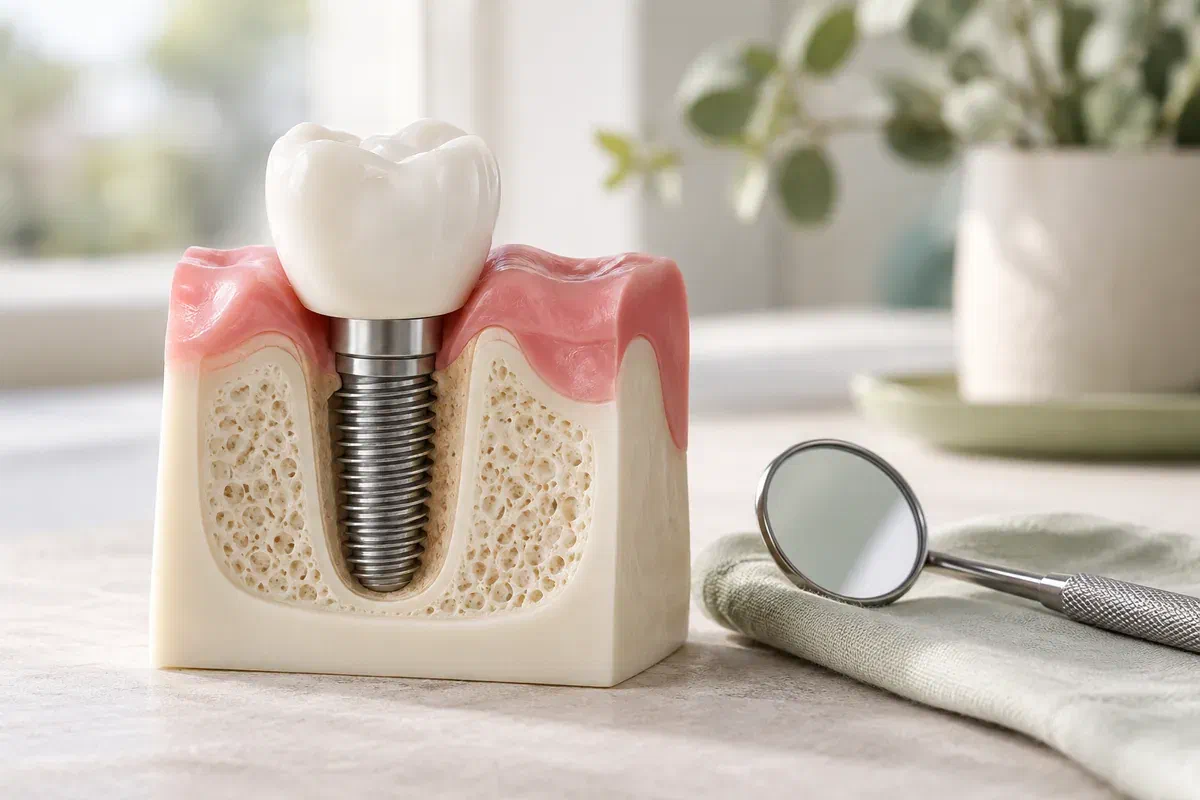
Illustrative implant teaching model with a connected crown, implant, gum, and bone base
Signs worth mentioning

Years of comfort do not rule out a new problem.

Tell us where the change is, when it started, and whether cleaning or chewing feels different. A comfortable implant may still need a review, and a new sensation when biting could involve the crown as much as the gum and bone around it.

Blood, puffiness, a red margin, or fluid

Say whether the bleeding happens only with floss or brushing, or at other moments, and whether it is getting worse. A bad taste or soreness belongs in the description as well. The exam looks at inflammation and support separately instead of assuming every bleeding spot is the same disease.

Gum that sits differently or is harder to clean

Let us know if more metal or crown edge now shows, if food packs in where it never used to, or if your brush or pick no longer fits. A practical access review can help. Please don't scrape the surface with a household tool or force bristles under the crown.

Looseness or a new feeling as you bite

Describe any wobble, clicking, or change in how the crown meets the teeth above or below it. A loose crown or screw is a different matter from an implant that moves in the bone. Try not to keep testing it; the clinician will work out which part is moving and why.

Call promptly about a crown on an implant that has come loose, swelling that keeps growing, discharge, or strong pain. Swelling that spreads quickly, difficulty breathing or swallowing, or feeling seriously unwell calls for emergency medical care, not a routine dental review.

What you should leave knowing

Gum, bone, or crown: which one is the real problem?

A useful assessment ends with a clear account of what has been found and what is still unknown. Ask whether the issue sits in the gum, the bone underneath, the restoration, or a mix of these. The answer shapes the plan, since a cleaning routine, a component repair and treatment for established peri-implantitis each do a different job.

You should also hear who is best placed to carry care forward. The implant's records, how complex the restoration is, and the treatment required may point toward working with the team that placed it or with a specialist. Find out who makes the next call and what support you can expect while that is being arranged.

Patient information: SDCEP — examination of peri-implant tissues and baseline records

Readings judged against implant norms

Measurements and tissue findings are read together, not on their own. Healthy implant sites can show a range of probing depths, so one number is not a diagnosis. Ask how today's findings compare with anything recorded earlier and what the overall picture suggests.

X-rays chosen to answer a specific question

Earlier images can provide a baseline, and new ones are taken when they are needed. Ask what the dentist hopes to see and whether your older records are good enough. Without a baseline, find out what can be said today and what monitoring should follow.

An honest account of what treatment can do

Ask what the next step is meant to achieve and how its effect will be checked. Treating an affected implant can be complicated, and nobody can guarantee the implant will be kept. A sound plan explains why referral or further care is suggested instead of promising that one cleaning or product will fix everything.

How the visit unfolds

Four steps from your story to a plan

Mention it if the implant was placed somewhere else or if you are unsure of its details. We can start with what you have and work out together which records or extra expertise would help.

  1. Your implant and health background

    Share roughly how old the implant is, any earlier trouble, how it has been maintained, and what you have noticed recently. Bring the original clinic's name or implant paperwork if you have it. Health changes and cleaning struggles matter too, so the visible crown is never judged in isolation.

  2. A careful look at tissue and parts

    The dentist checks for inflammation, how well you can reach the area, and the condition of the restoration, using suitable measurements and images. Say whether the findings match what you felt. If something moves, ask which component it is and whether prompt restorative or specialist attention is needed.

  3. What the findings point to, and what is still open

    You will talk through whether the signs fit gum inflammation, a change in bone support, a mechanical fault, or more than one of these. Ask which conclusions are firm and which need more information. Uncertainty should be named as uncertainty, not every implant symptom called peri-implantitis.

  4. A plan, a referral if needed, and a review date

    Confirm what happens now, who is responsible for any further treatment, and when the response will be checked. Ask what to do if things change while you wait. When care is shared, make sure you know how records and recommendations will pass between the two teams.

Between visits

Keep cleaning gently and keep every follow-up on the calendar.

What you do at home depends on the findings and any treatment you had. Ask for advice tailored to the restoration you actually have, not a technique meant for a different implant design.

The right tools, used without force

Ask to be shown how to clean around the implant and under any part of the restoration you can reach. Point out spots your hand or brush can't get to. Never pick at deposits with sharp objects or try to tighten a part yourself; those need professional assessment and the proper equipment.

Note changes that matter

Tell us about new swelling, discharge, pain, or movement, and whether the bleeding has eased or increased. Resist pressing the gum or rocking the crown to check. A short dated list of symptoms is useful at the review and spares the area from being disturbed.

See the referral and recheck through

If another provider is involved, check that the appointment is booked and the records have been sent. Ask who will assess how the area responds to the first stage of care. Feeling better does not by itself settle the bone question or mean a specialist visit can be dropped.

Matching care to the findings

What is found decides what is offered.

Ask which part of the problem each suggestion is aimed at. Gum inflammation, ongoing bone loss, and a loose component can happen together, but they are different diagnoses and need different answers.

When inflammation and build-up are the main issue

Professional cleaning and easier daily access

The first stage may be careful professional cleaning and hands-on coaching for home care. Ask whether the shape of the restoration makes cleaning harder and whether someone else should look at it. This step can help, but it should not be described as a sure cure for bone support already lost.

When the findings show disease affecting bone

Shared treatment for peri-implantitis

Further treatment or a specialist opinion may be needed, and surgery can be an option in suitable cases. Ask about likely benefits, limits, and the implant's outlook. Antibiotics or a laser should not be treated as a stand-in for a plan built on the actual diagnosis.

When a component fault or the outlook changes the options

Repairing the restoration, or talking about removal

A mechanical fault may mean work on the crown or its parts, while an implant with a poor outlook calls for a different conversation. Ask why keeping or removing it is being raised and what alternatives exist. Neither a loose crown nor one measurement settles that decision.

Patient information: SDCEP — treatment limitations and referral for peri-implantitis

Questions we hear in Milton

Straight answers about implant gum checks

Bring implant paperwork and older X-rays if you can find them, but don't wait on them before calling. The assessment itself can show which details matter and who else might need to be involved.

(905) 876-4488
Should I stop flossing around the implant if it bleeds?
Usually not, but switch to a gentle touch and book an assessment. Stopping cleaning altogether can let deposits build up. Ask the dentist to check your technique and tools, since bleeding is a sign to investigate rather than a reason to avoid the area.
Is a little blood near an implant proof that the bone is affected?
No. Bleeding can point to inflammation, but only an assessment can show whether bone support is involved too. Ask how the exam and images fit together. Gum inflammation alone and peri-implantitis are separate conditions and need to be told apart.
What should I bring to a peri-implantitis assessment?
Bring any implant card, letters from the clinic that placed it, and older X-rays if you have them. A list of medicines and recent health changes helps as well. If you have none of this, come anyway and tell the team what you remember.
Could the crown be loose rather than the implant itself?
Yes. A loose crown or screw can feel a lot like a moving implant. Avoid rocking or tightening it at home. The dentist needs to find out which part is moving and whether the cause is mechanical, related to the tissue, or both.
Can I book here in Milton if my implant was placed somewhere else?
Yes. Tell us where it was done and bring whatever details you have about the implant and crown. The team can assess it and discuss whether to involve the original provider or a specialist. Missing information may mean extra investigation rather than a guess about the system.
Do health conditions or smoking matter for implant gum health?
They can. Mainstream patient guidance links smoking, diabetes, and a history of gum disease with a higher risk of problems around implants. Mention these honestly at the visit so the dentist can weigh them when interpreting findings and planning reviews.
Book in Milton

Tell us what changed and when it started.

Phone Milton Dental Clinic at (905) 876-4488 to arrange a check of the gum and bone around your implant. Mention any bleeding, swelling, looseness, or pain when you book, so the team can judge how soon you should be seen and what the first step should be.

Diagnosis, the complexity of treatment, the need for referral, and the implant's outlook all depend on what is found. An assessment cannot guarantee the implant will be kept or that a particular surgical treatment will be available.

Visit Milton Dental Clinic
Unit 1, 342 Bronte St. S, Milton, ON L9T 5B7
Get directions Clinic hours
Monday–Thursday
11am–7pm
Friday–Sunday
By appointment only

Areas we serve

  • Milton
  • Oakville
  • Mississauga
  • Georgetown
  • Halton Hills
  • Acton
  • Campbellville
  • Brampton
  • Burlington
  • Puslinch
  • Rockwood
  • Erin
  • Caledon
  • Etobicoke
  • Old Milton
  • Bronte Meadows
  • Timberlea
  • Dorset Park
  • Dempsey
  • Clarke
  • Beaty
  • Coates
  • Harrison
  • Scott
  • Willmott
  • Ford
  • Bowes
  • Cobden
  • Walker
  • Mountain View
  • Milton Heights
  • Hawthorne Village
  • Valley View
  • Fallingbrook
  • Nassagaweya
  • Trafalgar
  • Esquesing
  • Nelson
  • Brookville
  • Moffat
  • Glen Williams
  • Norval
  • Limehouse
  • Stewarttown
  • Ashgrove
  • Hornby
  • Silver Creek
  • Speyside
  • Scotch Block
  • North Oakville
  • River Oaks
  • Glen Abbey
  • West Oak Trails
  • Palermo
  • Bronte Creek
  • College Park
  • Joshua Creek
  • Uptown Core
  • Preserve
  • Iroquois Ridge
  • Lisgar
  • Meadowvale
  • Meadowvale Village
  • Churchill Meadows
  • Erin Mills
  • Central Erin Mills
  • Streetsville
  • East Credit
  • Creditview
  • Heartland
  • Sheridan
  • Mount Pleasant
  • Credit Valley
  • Huttonville
  • Churchville
  • Springbrook
  • Northwest Brampton
  • Bram West
  • Fletcher's Meadow
  • Fletcher's Creek South
  • Alton Village
  • Orchard
  • Millcroft
  • Headon Forest
  • Tansley
  • Brant Hills
  • Tyandaga
  • Kilbride
  • Lowville
  • Aberfoyle
  • Morriston
  • Arkell
  • Hillsburgh
  • Freelton
  • Carlisle
  • Waterdown
  • Flamborough
  • Mountsberg

How can we help?

Milton Dental Clinic

Have a question about your smile? Choose the option that works best for you.

For urgent dental concerns, please call.
Messages are reviewed during clinic hours.