

Illustrative patient discussing changes around a dental implant with a clinician
Specialized Care

Peri-Implantitis Assessment in Mississauga

Your implant may have been placed by another clinic, even in another country, and now the gum around it is sore or bleeding. From Mississauga, you can book an independent assessment with our team: we examine the tissue and restoration, review any records, and help coordinate with the original provider or a specialist.

Second looks for Mississauga implants

Placed somewhere else? It can still be assessed here.

People move, clinics close, and implants are sometimes done while travelling. None of that changes what the implant needs: healthy gum and bone around it, checked over the years. When inflammation in those tissues comes with progressive bone loss, it is called peri-implantitis. Other issues can produce similar soreness or bleeding, so the cause has to be established by examination.

An independent assessment covers the same ground any careful review would. The dentist examines the soft tissue, measures appropriately for an implant, inspects the crown or bridge and its fit, and looks at X-rays. Any earlier images you can obtain from the original clinic are worth the effort, because they show whether support has changed since placement.

Before calling from Mississauga, gather what you can: the name and location of the placing clinic, an approximate date, and any implant card or treatment summary. Requests for records can take time, so don't hold off booking while you wait. Tell the team what is missing; we can begin the assessment and talk about which details are most worth chasing.

Arrange an independent implant review
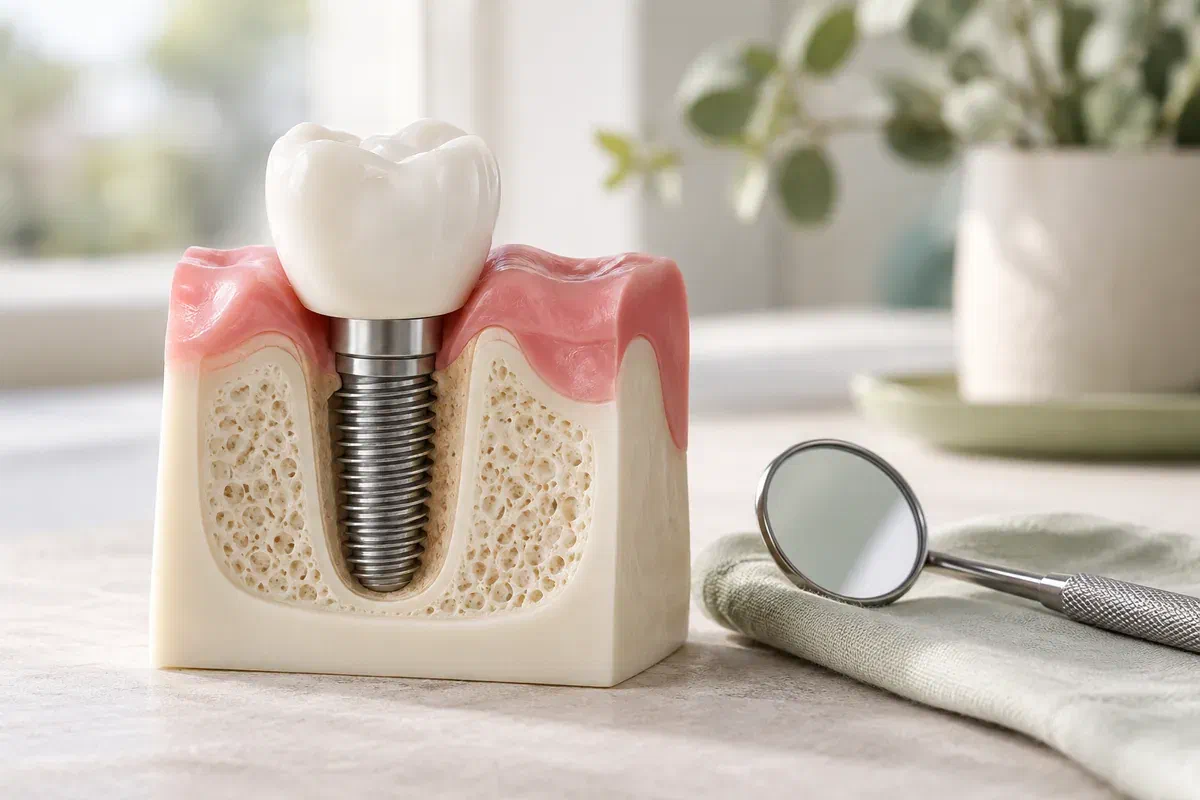
Illustrative implant teaching model with a connected crown, implant, gum, and bone base
Reasons to book

What has changed since the implant was placed?

Point out the implant, describe when the change started, and say whether eating or cleaning has become harder. Comfort doesn't guarantee health, and a new feeling on biting can involve the restoration as well as the gum and bone holding the implant.

Signs of inflamed tissue

Bleeding with brushing, redness, puffiness, or fluid seeping from the gum all deserve mention, along with whether they are increasing. A persistent bad taste or soreness matters too. The exam distinguishes inflammation from support loss instead of treating every bleeding point as the same condition.

Exposure or awkward access

Say if more of the implant or crown edge has become visible, if food catches where it didn't before, or if your floss and brushes can't get in. The team can look at access with you. Don't scrape exposed metal with household tools or force bristles under the restoration.

Any movement or bite change

Report looseness, a click, or a change in how the implant tooth meets the others. Movement of the crown or abutment is distinct from an implant moving within bone, and they lead to different care. Avoid testing it between visits so the dentist can identify what is moving.

Call without delay if an implant crown loosens, swelling worsens, discharge appears, or pain is severe. Quickly spreading swelling, difficulty breathing or swallowing, or significant illness needs emergency medical attention rather than a scheduled implant review.

What an independent review offers

A clear picture you can share with any provider

A good assessment gives you a summary that makes sense whichever clinic continues your care. It should spell out whether the concern is in the gum, the bone, the restoration, or more than one of these, and what is still uncertain. Those distinctions decide whether cleaning, a component repair, or peri-implantitis treatment comes next.

Because the implant began elsewhere, coordination often matters. Depending on the records available, the restoration design, and the care required, the sensible route may run back to the original team or on to a specialist. Ask who will make the next contact, how findings will be passed along, and what support you have in between.

Patient information: SDCEP — examination of peri-implant tissues and baseline records

Findings interpreted for an implant

Probing depths are read alongside bleeding, tissue appearance and history. Healthy implant sites vary, so a single number cannot settle the diagnosis. Ask how current results compare with any records from the original clinic and what the whole set of findings suggests.

Imaging that fits the question

Earlier X-rays from the placing clinic can provide a valuable baseline, and new images are taken when needed. Ask what the dentist is looking for and whether imported records are usable. If none can be obtained, ask what today's findings show and how monitoring will proceed.

Honest limits, clearly explained

Ask what the recommended step is expected to do and how its success will be judged. Implants with bone loss can be complex to manage, and saving one cannot be guaranteed. Any referral or further treatment should come with reasons, never with a promise that one cleaning will settle everything.

How we approach outside implants

Start with the records you have, then fill the gaps.

It's normal not to know the implant brand or system when it was placed elsewhere. The assessment works from the information available and identifies which records or specialist opinions would add the most.

  1. Map out where and when it was done

    Tell us the placing clinic, the approximate year, any problems since, how it has been maintained, and what prompted the call. Share documents or a treatment summary if you have one. Health changes and difficulty cleaning also shape how the findings are interpreted.

  2. Examine the site in full

    The dentist checks the gum for inflammation, reviews cleaning access, and assesses the restoration and its connection, with measurements and images as needed. Say whether the findings match what you have been feeling. If anything moves, ask which component and whether prompt restorative or specialist help is needed.

  3. Summarize the working diagnosis

    You'll go over whether the evidence suggests gum inflammation, a change in bone support, a mechanical fault, or a combination. Ask which points are confirmed and which require more information. Every implant symptom shouldn't be labelled peri-implantitis by default.

  4. Decide who does what next

    Confirm the immediate recommendations, whether the original clinic or a specialist should be involved, and when the area will be reviewed. Ask what to do if symptoms change while arrangements are made. Clarify how records will move between providers.

While care is being arranged

Keep it clean, keep notes, keep the momentum.

Instructions depend on what was found and any treatment provided. Ask for cleaning advice built around the restoration you actually have, since implant designs differ from clinic to clinic.

Clean around it without force

Ask the clinician to show you which aids fit around the implant and under any accessible part of the restoration. Mention any area you can't reach. Avoid pointed tools for removing deposits and never try to tighten a part at home; both need professional equipment.

Record symptoms with dates

Let us know about new swelling, discharge, pain, or looseness, and whether bleeding has changed. Don't press the gum or rock the crown to check. A dated list of symptoms is useful to whichever provider sees you next.

Follow through on coordination

If the original clinic or a specialist is involved, confirm the appointment and that records have arrived. Ask who will assess the response to initial care. Improvement in symptoms doesn't by itself resolve the bone question or replace a recommended referral.

Possible pathways

Each finding has its own answer.

Ask what each recommendation is designed to treat. Inflamed gum, progressive bone loss, and a loose restorative part can occur together, but treating one doesn't treat the others.

When inflammation and deposits are the concern

Professional cleaning with home-care coaching

Early care may focus on thorough cleaning and practical advice for daily hygiene. Ask whether the restoration design limits access and whether the original provider should review it. This step can be valuable, though it shouldn't be described as a sure remedy for bone support already lost.

When disease involves the supporting bone

Peri-implantitis care with specialist input

Additional treatment or specialist assessment may be required, and surgery can be considered in suitable cases. Ask about expected benefits, limits, and the implant's prognosis. Antibiotics or lasers shouldn't be taken as a substitute for a plan matched to the diagnosis.

When a component problem or poor outlook shifts the options

Restorative work, or weighing removal

A mechanical issue may need work on the restoration, sometimes with parts sourced through the original clinic. An implant with an unfavourable outlook calls for a different discussion about alternatives. Ask what is driving any recommendation; a loose crown or one reading doesn't decide it alone.

Patient information: SDCEP — treatment limitations and referral for peri-implantitis

Mississauga questions about outside implants

Implants from other clinics, explained

Records and older X-rays are helpful but not required to book. The assessment can identify which details matter and whether the original provider or a specialist should be involved.

(905) 876-4488
Do I need my original clinic's permission to be assessed elsewhere?
No. You can choose where to be assessed. With your consent, the team can request records or share findings with the original provider when coordination would help your care.
My implant was placed abroad. Can it still be reviewed?
Yes. Bring whatever documentation you have, even if it is in another language. Unknown components may mean some repairs need extra planning, but the gum, bone and restoration can still be assessed.
How do I request X-rays from the clinic that placed my implant?
Contact that clinic and ask for copies of your implant records and images. Our team can explain what is most useful to request. Don’t delay booking while you wait; the assessment can begin with current findings.
Will parts be available if the implant system is unfamiliar?
That depends on the system. Sometimes identification is straightforward, sometimes it takes investigation. Ask the dentist what is known and how it affects options before any restorative work is planned.
Does bleeding by the implant automatically mean it is failing?
No. Bleeding indicates inflammation, but whether supporting bone is affected requires examination and imaging. Gum-only inflammation and peri-implantitis are different, and the dentist will explain which fits your findings.
Can an antibiotic prescription replace a full assessment?
No. Medicines are not a routine substitute for diagnosing and managing the problem. Ask why any prescription is suggested and what cleaning, restorative care, referral, or follow-up still needs to happen.
Booking from Mississauga

Bring what you know about where it was placed.

To book, call (905) 876-4488 and let Milton Dental Clinic know your implant was done elsewhere. Describe any bleeding, swelling, movement, or pain so the team can help decide how soon you should be seen and what to bring.

Diagnosis, treatment complexity, referral, and implant prognosis depend on what is found. An assessment cannot guarantee the implant will be kept or confirm that a particular surgical treatment is available.

Visit Milton Dental Clinic
Unit 1, 342 Bronte St. S, Milton, ON L9T 5B7
Get directions Clinic hours
Monday–Thursday
11am–7pm
Friday–Sunday
By appointment only

Areas we serve

  • Milton
  • Oakville
  • Mississauga
  • Georgetown
  • Halton Hills
  • Acton
  • Campbellville
  • Brampton
  • Burlington
  • Puslinch
  • Rockwood
  • Erin
  • Caledon
  • Etobicoke
  • Old Milton
  • Bronte Meadows
  • Timberlea
  • Dorset Park
  • Dempsey
  • Clarke
  • Beaty
  • Coates
  • Harrison
  • Scott
  • Willmott
  • Ford
  • Bowes
  • Cobden
  • Walker
  • Mountain View
  • Milton Heights
  • Hawthorne Village
  • Valley View
  • Fallingbrook
  • Nassagaweya
  • Trafalgar
  • Esquesing
  • Nelson
  • Brookville
  • Moffat
  • Glen Williams
  • Norval
  • Limehouse
  • Stewarttown
  • Ashgrove
  • Hornby
  • Silver Creek
  • Speyside
  • Scotch Block
  • North Oakville
  • River Oaks
  • Glen Abbey
  • West Oak Trails
  • Palermo
  • Bronte Creek
  • College Park
  • Joshua Creek
  • Uptown Core
  • Preserve
  • Iroquois Ridge
  • Lisgar
  • Meadowvale
  • Meadowvale Village
  • Churchill Meadows
  • Erin Mills
  • Central Erin Mills
  • Streetsville
  • East Credit
  • Creditview
  • Heartland
  • Sheridan
  • Mount Pleasant
  • Credit Valley
  • Huttonville
  • Churchville
  • Springbrook
  • Northwest Brampton
  • Bram West
  • Fletcher's Meadow
  • Fletcher's Creek South
  • Alton Village
  • Orchard
  • Millcroft
  • Headon Forest
  • Tansley
  • Brant Hills
  • Tyandaga
  • Kilbride
  • Lowville
  • Aberfoyle
  • Morriston
  • Arkell
  • Hillsburgh
  • Freelton
  • Carlisle
  • Waterdown
  • Flamborough
  • Mountsberg

How can we help?

Milton Dental Clinic

Have a question about your smile? Choose the option that works best for you.

For urgent dental concerns, please call.
Messages are reviewed during clinic hours.