

Illustrative patient discussing changes around a dental implant with a clinician
Specialized Care

Peri-Implantitis Assessment in Oakville

Sore gum around an implant raises one question before any other: is this surface irritation, or is the bone underneath changing? Coming from Oakville, you can have our team examine the tissue, the restoration and your records, then lay out whether cleaning, further tests or specialist input is the sensible route.

For Oakville implant wearers

Irritated gum, or trouble below the surface?

Two conditions can look alike in the mirror. Inflammation confined to the gum around an implant is one; peri-implantitis, where that inflammation comes with progressive loss of the bone holding the implant, is another. A sore spot might also stem from food trapped under a crown or a part that has worked loose. Telling these apart is the whole point of an assessment.

To do that, the dentist examines the gum, records measurements appropriate to an implant, checks the restoration, and looks at X-rays. Previous images carry special weight, because a side-by-side comparison shows whether support has really been lost or has simply always looked that way.

When you book from Oakville, it helps to have a rough placement date, the name of the clinic that fitted the crown, and a sense of what has changed. Bring any implant card or earlier report. Paperwork lost along the way? Say so on the phone; our team can talk about how to rebuild a useful picture without treating every concern as the same problem.

Request a gum and bone check
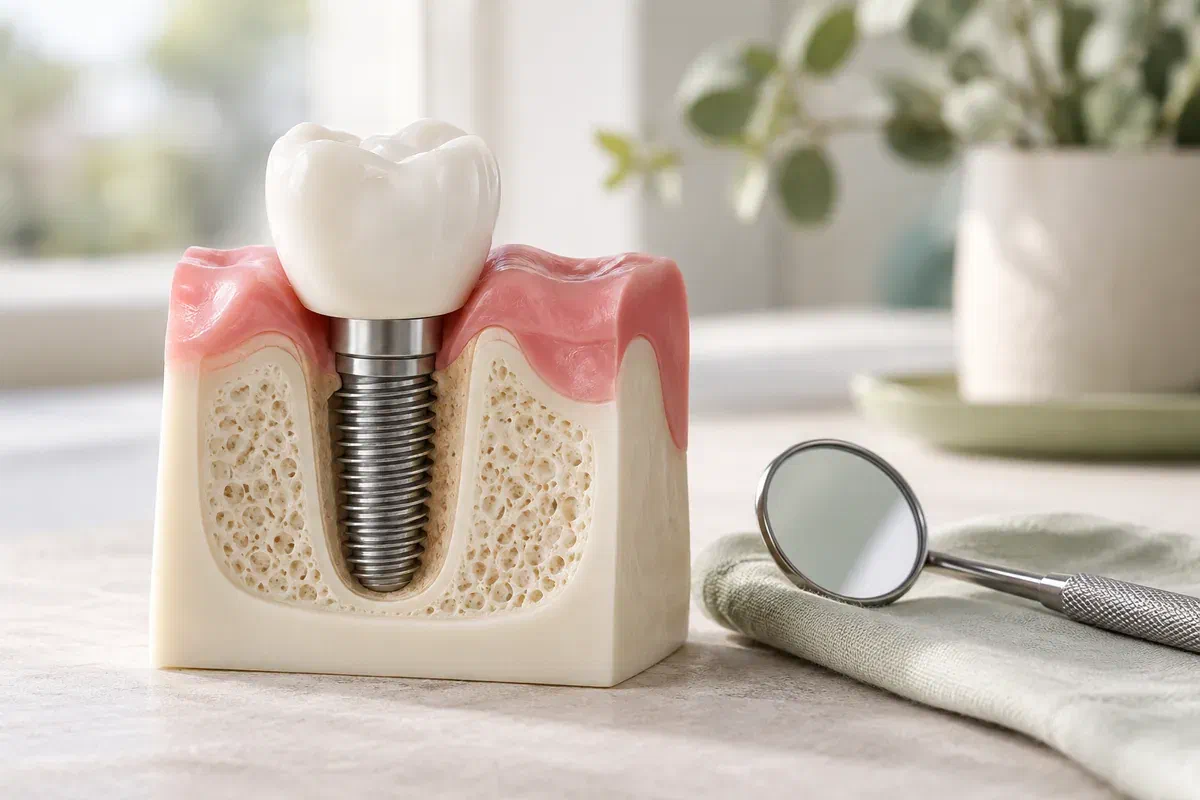
Illustrative implant teaching model with a connected crown, implant, gum, and bone base
Clues the dentist will ask about

Small changes are worth reporting early.

Note which implant it is, when you first noticed the change, and whether eating or cleaning feels different. Comfort is not proof that all is well, and a new sensation on biting may involve the restoration as much as the surrounding tissue.

Bleeding, redness, puffiness, or pus

Mention if bleeding appears only when you clean or also at random times, and whether it is becoming more common. Any foul taste or tenderness is relevant. The exam assesses inflammation and support as separate questions, so not every bleeding site is assumed to be one disease.

More of the crown showing, or a site that's hard to reach

Describe a gum line that seems to have pulled back, food that now catches, or a brush that no longer fits under the bridge. The dentist can review how you reach the area. Avoid scratching the surface with household tools or wedging bristles below the restoration.

Looseness, clicking, or an uneven bite

Report any play in the tooth, a clicking sound, or a change in how it lands against the opposite teeth. A loose crown or abutment is a separate issue from an implant moving in bone. Resist checking it over and over; the clinician will pin down what moves and why.

Contact us promptly if an implant crown comes loose, swelling grows, there is drainage, or pain is significant. Fast-spreading swelling, difficulty breathing or swallowing, or serious general illness needs emergency medical attention, not a routine implant appointment.

Why the distinction matters

Different causes, different plans

By the end of the visit, you should understand which findings are confirmed and which still need work. Ask directly whether the trouble is limited to the gum, reaches the bone, involves the restoration, or spans more than one of these. The plan depends on it: a cleaning routine, a part repair and treatment for established peri-implantitis each answer a different problem.

The other key outcome is knowing who will look after the next stage. The implant's paperwork, the nature of the restoration, and the treatment required may favour working with the original implant team or a specialist. Ask who will reach out and what help is available while that gets arranged.

Patient information: SDCEP — examination of peri-implant tissues and baseline records

Measurements read the implant way

Probing figures are interpreted alongside other tissue signs. Healthy implant sites can have differing depths, so a single reading never makes a diagnosis. Ask how today's examination compares with any earlier notes and what the findings suggest when viewed together.

The right images for the question

Old images may provide a reference, and new ones are taken if the question requires them. Ask what the dentist wants to see and whether earlier films are sufficient. Without a baseline, ask what can be said now and what monitoring should come next.

Expectations set honestly

Ask what the recommended step can realistically do and how its effect will be checked later. Managing an affected implant can be complicated, and its survival is not guaranteed. A good plan explains any referral or further treatment without implying one cleaning or product will resolve every case.

The assessment, step by step

History first, then the exam, then a decision

Let the team know if your implant was placed at another clinic or if its details are unclear. The visit can start with what is available and highlight which records or specialist views would help.

  1. Background on implant, crown and health

    Give an approximate age for the implant, any earlier issues, how it has been maintained, and your recent symptoms. The original clinic's details or documents are useful if you have them. Medical changes and cleaning challenges add context the crown alone cannot show.

  2. Examination of tissue and parts

    The dentist checks inflammation, access for cleaning, and the restoration, using measurements and images where needed. Say whether what is found matches what you felt. If there is movement, ask which part is involved and whether prompt restorative or specialist care is needed.

  3. Diagnosis so far, and the open questions

    Together you go over whether the findings fit gum-only inflammation, bone-support change, a mechanical issue, or a mix. Ask which conclusions are solid and which need more information. A careful assessment separates a working explanation from a confirmed diagnosis.

  4. Care, referral and a review date

    Confirm what will happen now, who will provide further treatment, and when the response will be checked. Ask what to do if symptoms change while waiting. If care is shared, find out how records and recommendations will travel between teams.

Home care during management

Clean carefully, watch closely, return as planned.

Your instructions will depend on the findings and any treatment provided. Ask for guidance designed around your own restoration, rather than tips meant for a different implant set-up.

Proper tools, light pressure

Ask the clinician to show you how to clean around the implant and under any accessible part of the restoration. Explain which areas you struggle to reach. Do not dig at deposits with pointed objects or attempt to tighten a component; those jobs need a professional and the right equipment.

Track what actually changes

Let us know about new swelling, drainage, pain, or looseness, and whether bleeding has changed. Avoid pressing the gum or rocking the crown to test it. A brief timeline of symptoms gives useful information at review without irritating the site.

Keep the referral and recheck

If another provider is part of your care, confirm the appointment and that records have been forwarded. Ask who will review how the area responds to initial care. Feeling better does not automatically settle the bone question or cancel a specialist's recommendation.

Options after the findings

One diagnosis, one matching response

Ask which part of the problem each recommendation targets. Gum inflammation, progressive bone loss and a loose component can overlap, but they are not interchangeable and should not be treated as if they were.

When inflammation and build-up need attention

Cleaning and easier access for home care

Initial care may involve professional cleaning plus practical coaching on daily hygiene. Ask whether the restoration's shape makes access difficult and whether another provider should look at it. This stage can play a part, but it is not a promised cure for bone support already lost.

When findings show disease reaching the bone

Coordinated peri-implantitis treatment

Further treatment or a specialist assessment may be required, and surgical approaches can be considered when suitable. Ask about likely benefits, limitations, and the implant's prognosis. Antibiotics or laser therapy should not be presumed to take the place of a plan built on the diagnosis.

When a part fails or the prognosis changes

Restoration repair, or a discussion about removal

A mechanical fault may need attention to the restoration, while an implant with a poor outlook leads to a different discussion. Ask why keeping or removing it is being considered and what other paths remain. A loose crown or one number doesn't decide that by itself.

Patient information: SDCEP — treatment limitations and referral for peri-implantitis

Oakville questions, answered

Gum inflammation versus peri-implantitis

Implant records and earlier X-rays are helpful if you have them, but please call even without them. The assessment will show what information is needed and who should be involved.

(905) 876-4488
What is the difference between peri-implant mucositis and peri-implantitis?
Mucositis is inflammation limited to the soft tissue around an implant. Peri-implantitis adds progressive loss of supporting bone. Patient guidance describes mucositis as potentially reversible with appropriate care, which is one reason early assessment is worthwhile.
Can gum inflammation around an implant settle with better cleaning?
In some cases, inflammation limited to the gum improves with professional care and improved home cleaning. The dentist will explain whether that applies to you and how the response will be checked, rather than assuming improvement means the bone is unaffected.
How can the dentist tell whether bone has been lost?
Clinical findings and images are interpreted together, ideally alongside earlier X-rays for comparison. Ask what the current images show and how confident the conclusion is, especially if no previous record exists.
Is a deep reading around an implant the same as a deep pocket around a tooth?
No. Implant sites differ from natural teeth, and healthy probing depths can vary. A reading is considered with bleeding, images, and history. No single measurement should decide the diagnosis or the treatment.
Could my symptoms be caused by something other than peri-implantitis?
Yes. Trapped food, a loose crown or screw, or a problem with a nearby tooth can cause similar discomfort. That is why the dentist examines the whole area and the restoration rather than diagnosing from appearance.
Is it worth coming in from Oakville if the symptoms are mild?
Mild changes are often the best time to have an implant checked. Book a time that suits you and mention any increase in swelling, drainage, or pain so the team can advise whether you should be seen sooner.
Arranging your visit

Mention the implant and what you've noticed.

Call Milton Dental Clinic at (905) 876-4488 to set up an assessment of the gum and bone around your implant. Describe any bleeding, swelling, movement, or discomfort when you book so our team can advise on how urgently to see you and where to begin.

The diagnosis, treatment complexity, need for referral, and implant prognosis depend on individual findings. An assessment cannot promise the implant will be retained or that a particular surgical option will be available.

Visit Milton Dental Clinic
Unit 1, 342 Bronte St. S, Milton, ON L9T 5B7
Get directions Clinic hours
Monday–Thursday
11am–7pm
Friday–Sunday
By appointment only

Areas we serve

  • Milton
  • Oakville
  • Mississauga
  • Georgetown
  • Halton Hills
  • Acton
  • Campbellville
  • Brampton
  • Burlington
  • Puslinch
  • Rockwood
  • Erin
  • Caledon
  • Etobicoke
  • Old Milton
  • Bronte Meadows
  • Timberlea
  • Dorset Park
  • Dempsey
  • Clarke
  • Beaty
  • Coates
  • Harrison
  • Scott
  • Willmott
  • Ford
  • Bowes
  • Cobden
  • Walker
  • Mountain View
  • Milton Heights
  • Hawthorne Village
  • Valley View
  • Fallingbrook
  • Nassagaweya
  • Trafalgar
  • Esquesing
  • Nelson
  • Brookville
  • Moffat
  • Glen Williams
  • Norval
  • Limehouse
  • Stewarttown
  • Ashgrove
  • Hornby
  • Silver Creek
  • Speyside
  • Scotch Block
  • North Oakville
  • River Oaks
  • Glen Abbey
  • West Oak Trails
  • Palermo
  • Bronte Creek
  • College Park
  • Joshua Creek
  • Uptown Core
  • Preserve
  • Iroquois Ridge
  • Lisgar
  • Meadowvale
  • Meadowvale Village
  • Churchill Meadows
  • Erin Mills
  • Central Erin Mills
  • Streetsville
  • East Credit
  • Creditview
  • Heartland
  • Sheridan
  • Mount Pleasant
  • Credit Valley
  • Huttonville
  • Churchville
  • Springbrook
  • Northwest Brampton
  • Bram West
  • Fletcher's Meadow
  • Fletcher's Creek South
  • Alton Village
  • Orchard
  • Millcroft
  • Headon Forest
  • Tansley
  • Brant Hills
  • Tyandaga
  • Kilbride
  • Lowville
  • Aberfoyle
  • Morriston
  • Arkell
  • Hillsburgh
  • Freelton
  • Carlisle
  • Waterdown
  • Flamborough
  • Mountsberg

How can we help?

Milton Dental Clinic

Have a question about your smile? Choose the option that works best for you.

For urgent dental concerns, please call.
Messages are reviewed during clinic hours.