

Illustrative patient discussing changes around a dental implant with a clinician
Specialized Care

Peri-Implantitis Assessment in Old Milton

An implant placed many years ago can still develop trouble in the gum or bone around it. For people in Old Milton, our nearby team reviews the tissue, the restoration and whatever history you can piece together, then explains whether cleaning, more tests, or a specialist's help makes sense.

Old Milton implant reviews

An implant with a long history, and a few gaps in the paperwork

Plenty of implants in Old Milton were placed a decade or more ago, sometimes by a dentist who has since retired or moved on. That age is no reason to ignore a change. The implant sits in gum and bone that stay alive and need care for as long as it is there. Peri-implantitis is inflammation in those tissues combined with steady loss of the supporting bone.

Tenderness, bleeding or a sore patch can come from several sources, which is why the cause has to be confirmed through examination rather than guessed from a mirror. The dentist looks at the soft tissue, takes measurements, inspects the crown or bridge, and reviews images. When older films exist, they give the clearest picture of whether support has shifted.

Our Bronte Street practice sits a short way from Milton's historic downtown. When you call, share what you recall: the approximate year, the clinic that placed the implant, and anything that has changed. If a card, letter or old report is tucked in a drawer, bring it. If nothing survives, tell the team; there are ways to gather useful information without presuming a single cause.

Ask about an implant assessment
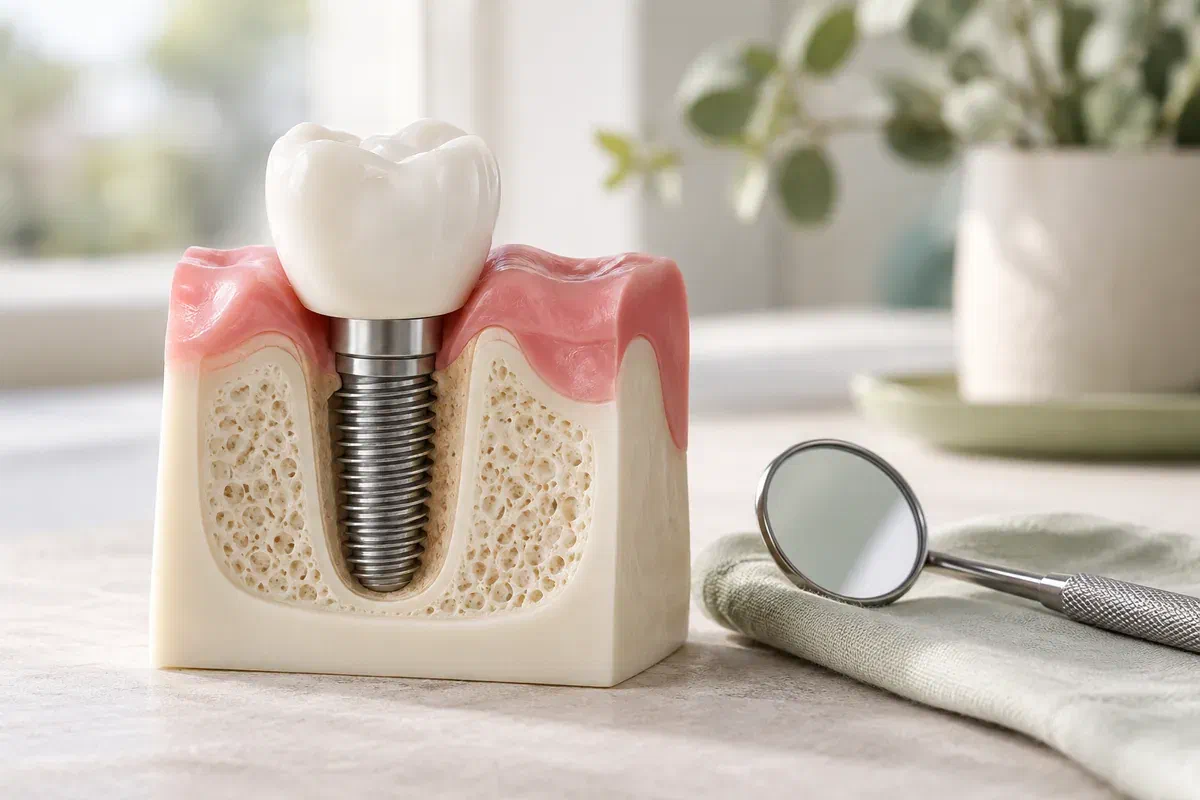
Illustrative implant teaching model with a connected crown, implant, gum, and bone base
What to watch for

Old implant, new symptom? Say so.

Point to where the change is, describe when it appeared, and mention any difference in how you clean or chew. Even an implant that has never bothered you can need a review, and an odd feeling on biting may relate to the crown as well as the tissue.

Bleeding, colour change, swelling, or seepage

It helps to know whether bleeding shows up only while cleaning or happens on its own, and whether it is becoming more frequent. A sour taste or a tender spot is also worth reporting. The dentist separates inflammation from support loss instead of treating any bleeding as the same disease.

Receding gum or a cleaning routine that no longer works

Tell us if the edge of the crown or a strip of metal has become visible, if food now lodges there, or if a favourite brush won't reach any more. A review of access can sort this out. Avoid scraping with anything sharp or pushing bristles beneath the restoration.

A wobble, a click, or a bite that feels off

Explain whether the tooth seems loose, makes a sound, or meets its neighbours differently. Movement of the crown or a connecting part is not the same as the implant shifting in the bone. Leave it alone between visits so the clinician can establish what moves and why.

Get in touch soon if an implant crown loosens, swelling increases, fluid drains from the area, or pain becomes significant. Rapidly spreading swelling, any struggle to breathe or swallow, or feeling very unwell needs emergency medical help rather than a dental appointment.

Clarity from the visit

Three questions the dentist should help you answer

Expect to come away knowing what has been confirmed and where doubt remains. Is the problem in the gum, the bone beneath it, the restoration, or several places at once? That matters, because a hygiene plan, a repair to a part, and treatment for established peri-implantitis are aimed at quite different things.

With an older implant, the discussion often turns to who should take the next step. Sparse records, a complex restoration, or the type of treatment needed might make it sensible to involve a specialist or, where possible, the original implant team. Ask who will make contact and what interim support you will have.

Patient information: SDCEP — examination of peri-implant tissues and baseline records

Numbers put in an implant context

Probing results and tissue findings are considered as a set. Healthy implant sites vary in depth, so a single figure tells only part of the story. Ask how today's results line up with any previous notes and what the full set of findings indicates.

Imaging with a clear purpose

Older images may serve as a starting point, and new ones are added when the question calls for them. Ask what the dentist is checking for and whether past records are usable. If no earlier image survives, ask what can be concluded now and how monitoring will work.

Plain talk about what is achievable

Find out what the proposed step is meant to accomplish and how progress will be measured. Managing an implant with bone loss can be involved, and its long-term survival can't be promised. The reasoning for any referral should be explained, with no suggestion that a single cleaning or product resolves every case.

Piecing the history together

From what you remember to what the exam shows

Unsure who placed the implant, or what system was used? That is common with older work. The visit starts from what is known and identifies which records or extra expertise would add something.

  1. Collect the story behind the implant

    Share an estimate of its age, any past problems, how often it has been professionally cleaned, and what has changed recently. Names of the original clinic or any documents help. Health updates and trouble reaching the area all shape how the dentist reads the findings.

  2. Assess the gum, bone and components

    The dentist checks for inflammation, how accessible the area is, and the state of the restoration, adding measurements and images where appropriate. Mention whether the findings match the sensation you noticed. If anything moves, ask which part it is and whether it needs prompt restorative or specialist care.

  3. Hear the working explanation

    The conversation covers whether the signs suggest gum inflammation, bone-support change, a mechanical problem, or a combination. Ask which points are well supported and which need more evidence. A careful assessment keeps uncertainty visible rather than calling every implant symptom peri-implantitis.

  4. Settle the plan and the follow-up

    Confirm the immediate advice, the person responsible for further treatment, and when you will be reviewed. Ask what to do if symptoms change in the meantime. If more than one team is involved, clarify how records and recommendations will be shared.

Looking after it meanwhile

Steady cleaning, honest notes, and appointments kept

Home care depends on what was found and whether any treatment was done. Ask for instructions that fit your own restoration, since a method designed for another implant style may not suit yours.

Gentle technique with suitable aids

Ask for a demonstration of cleaning around the implant and beneath any reachable part of the crown or bridge. Mention places you simply cannot reach. Skip sharp tools for removing build-up, and never try tightening a loose part; both need professional assessment and equipment.

A simple symptom diary

Report fresh swelling, drainage, pain, or looseness, and note whether bleeding is better or worse. Avoid poking the gum or wiggling the crown to test it. Dates and brief notes help at the review without stirring up the area.

Follow the referral to the end

If a specialist or another clinic is involved, confirm the booking and that records have gone ahead. Ask who will judge how the first stage of care has worked. Symptoms easing does not prove the bone question is settled or make a recommended referral unnecessary.

Possible next steps

Care follows the diagnosis, not the other way round.

Ask what each recommendation is targeting. Gum inflammation, progressive bone loss and a loose part may exist side by side, yet each is its own diagnosis and calls for its own response.

When inflammation and deposits are the focus

Thorough cleaning and better home access

Early care may centre on professional cleaning and coaching on how to clean the site yourself. Ask whether the restoration's design gets in the way and whether another provider should assess it. This can be a helpful stage, but it is not a guaranteed fix for bone already lost.

When bone support is involved

Coordinated care for confirmed peri-implantitis

Additional treatment or a specialist assessment may follow, and surgery can be considered in appropriate situations. Ask about expected gains, limitations, and how the implant's future looks. Antibiotics or lasers shouldn't be assumed to replace a plan tailored to the diagnosis.

When a part has failed or the outlook shifts

Fixing the restoration, or discussing removal

A mechanical issue may be handled by work on the restoration, whereas an implant with a poor prognosis prompts a different talk. Ask why keeping or removing it is on the table and what other options exist. A loose crown or one reading doesn't decide that alone.

Patient information: SDCEP — treatment limitations and referral for peri-implantitis

Questions about older implants in Old Milton

When the implant is older than your current dentist

Old records and X-rays help, though you don't need them to book. The assessment can identify what information would be useful and who else, if anyone, should be involved.

(905) 876-4488
My original implant dentist has retired. Can I still be assessed?
Yes. Many people are in the same position. Share what you remember and any paperwork you have kept. The team can assess the area and, if needed, discuss how to obtain records or involve a specialist rather than guessing at the implant’s details.
Is there a way to identify an implant when no records exist?
Sometimes images and the features of the restoration give useful clues, but certainty is not always possible. Ask the dentist what can and can’t be determined. Missing details may mean extra steps before certain repairs are planned.
Does gum bleeding beside an old implant always signal bone loss?
Not necessarily. Bleeding suggests inflammation, but deciding whether bone support is affected needs an examination and appropriate images. Ask how the findings fit together, since soft-tissue inflammation and peri-implantitis are distinct.
How does the dentist judge support if there is no earlier X-ray?
Current images and clinical findings still provide information, though a past comparison is helpful when it exists. Ask what can be said now and how future reviews will track any change from today’s starting point.
Can implant problems appear after many trouble-free years?
They can. Patient guidance from periodontal organisations notes that peri-implant disease may develop long after placement. That is why ongoing reviews and good cleaning matter even when the implant has always felt fine.
Will a course of antibiotics clear up an implant gum problem?
Not on its own. Any plan needs to match the diagnosis and the local factors involved. Ask why a medicine is being suggested, and what cleaning, restorative work, referral, or reassessment is still part of the plan.
Visiting from Old Milton

Start with what you remember. We'll help with the rest.

Call Milton Dental Clinic at (905) 876-4488 to book a look at the gum and bone around your implant. When booking, mention bleeding, swelling, looseness or pain so the team can gauge how quickly you should come in and which step should come first.

Findings determine the diagnosis, the complexity of any treatment, whether a referral is needed, and the implant's outlook. An assessment does not guarantee the implant will be saved or that a specific surgical option will be offered.

Visit Milton Dental Clinic
Unit 1, 342 Bronte St. S, Milton, ON L9T 5B7
Get directions Clinic hours
Monday–Thursday
11am–7pm
Friday–Sunday
By appointment only

Areas we serve

  • Milton
  • Oakville
  • Mississauga
  • Georgetown
  • Halton Hills
  • Acton
  • Campbellville
  • Brampton
  • Burlington
  • Puslinch
  • Rockwood
  • Erin
  • Caledon
  • Etobicoke
  • Old Milton
  • Bronte Meadows
  • Timberlea
  • Dorset Park
  • Dempsey
  • Clarke
  • Beaty
  • Coates
  • Harrison
  • Scott
  • Willmott
  • Ford
  • Bowes
  • Cobden
  • Walker
  • Mountain View
  • Milton Heights
  • Hawthorne Village
  • Valley View
  • Fallingbrook
  • Nassagaweya
  • Trafalgar
  • Esquesing
  • Nelson
  • Brookville
  • Moffat
  • Glen Williams
  • Norval
  • Limehouse
  • Stewarttown
  • Ashgrove
  • Hornby
  • Silver Creek
  • Speyside
  • Scotch Block
  • North Oakville
  • River Oaks
  • Glen Abbey
  • West Oak Trails
  • Palermo
  • Bronte Creek
  • College Park
  • Joshua Creek
  • Uptown Core
  • Preserve
  • Iroquois Ridge
  • Lisgar
  • Meadowvale
  • Meadowvale Village
  • Churchill Meadows
  • Erin Mills
  • Central Erin Mills
  • Streetsville
  • East Credit
  • Creditview
  • Heartland
  • Sheridan
  • Mount Pleasant
  • Credit Valley
  • Huttonville
  • Churchville
  • Springbrook
  • Northwest Brampton
  • Bram West
  • Fletcher's Meadow
  • Fletcher's Creek South
  • Alton Village
  • Orchard
  • Millcroft
  • Headon Forest
  • Tansley
  • Brant Hills
  • Tyandaga
  • Kilbride
  • Lowville
  • Aberfoyle
  • Morriston
  • Arkell
  • Hillsburgh
  • Freelton
  • Carlisle
  • Waterdown
  • Flamborough
  • Mountsberg

How can we help?

Milton Dental Clinic

Have a question about your smile? Choose the option that works best for you.

For urgent dental concerns, please call.
Messages are reviewed during clinic hours.