

Illustrative patient discussing periodontal findings with a clinician and a supported tooth model
Specialized Care

Periodontal Pocket Treatment in Acton

Hearing the word “periodontist” can make gum treatment sound more serious than it may be. For people coming from Acton, our team explains what your pocket findings show, what general cleaning below the gumline can do and when, and why, a specialist opinion might be suggested.

General care and specialist care

Who treats gum pockets, and when does a specialist step in?

Plenty of gum pocket care happens with a general dentist and hygienist. Sometimes a periodontist, a dentist who specialises in the gums and supporting bone, is asked to help. Either way the starting point is the same examination, in which a gentle probe records how deeply the space between gum and tooth extends around each tooth.

Those depths become meaningful only next to other findings: bleeding, gum position, lost attachment and the bone seen on suitable images. Treatment aims at the condition they describe. Cleaning below the gumline is often the first step where indicated, followed by a review. A referral may then be raised if some sites have not settled or the case is complex.

Living in a smaller community such as Acton, you may prefer to understand the reasons for each step before committing to extra appointments elsewhere. Ask which teeth are involved, what the general team can manage and what a specialist would add. You should also know how your home care and regular visits continue in the meantime.

Talk about general and specialist gum care
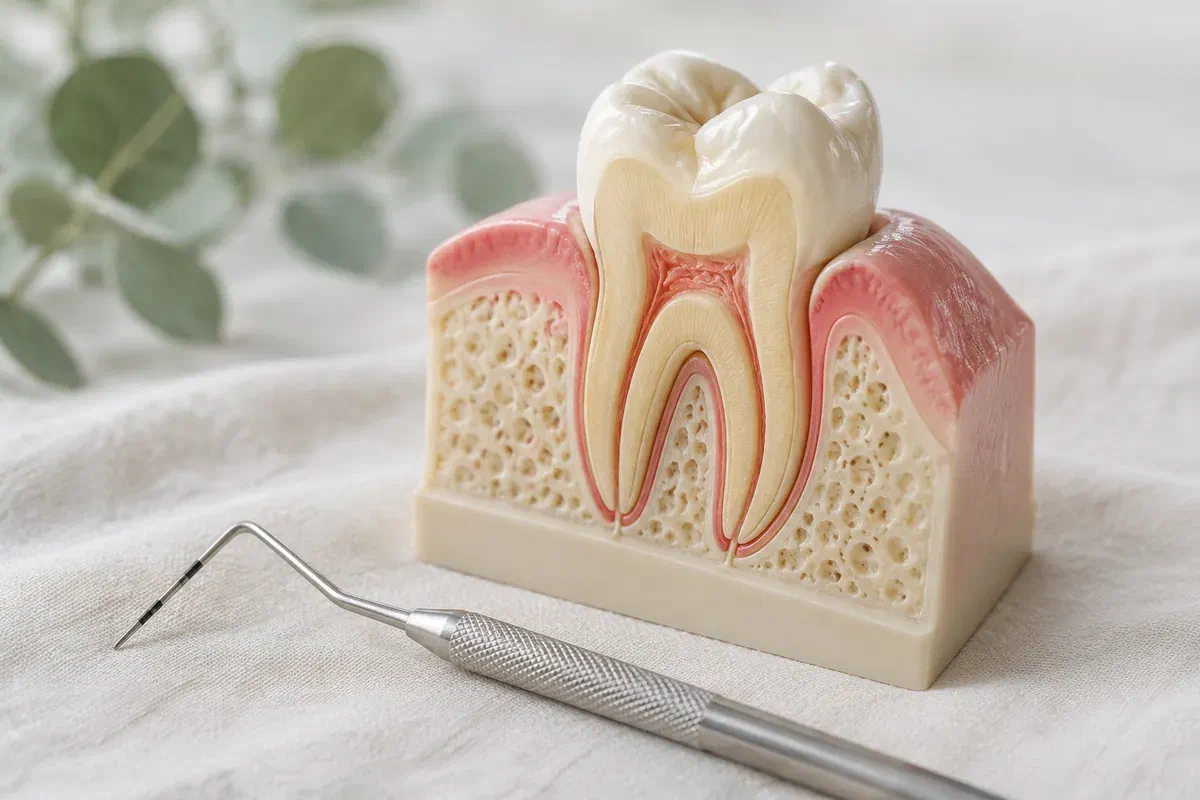
Illustrative tooth-and-gum teaching model beside a periodontal examination probe
Factors behind the recommendation

What makes a site simple, and what makes it complex

Share your symptoms, any previous gum treatment and changes in your health or medications. Teeth without discomfort are examined as well, since a tooth can feel normal while its supporting tissue is not stable.

How inflamed the tissue is

Bleeding when gently measured, swelling and recession all change how a depth is read. Widespread inflammation may simply need well-planned cleaning. Your clinician can explain the pattern and whether a full periodontal charting or more records are needed first.

Access to the surfaces involved

Root shapes, spaces between roots, crowding or old restorations can make some deposits hard to reach, both at home and in the chair. Point out where food lodges. Difficult access is one of the factors that can lead to a specialist conversation.

Previous care and present support

Earlier charts, images and specialist letters show how things have changed. A tooth with reduced support needs its own assessment of how it is likely to do. Depth on its own is not a sufficient reason for any particular referral.

Acute problems such as new swelling, pus, fever or severe pain need a call for advice, whether or not a referral is pending. Never put a tool into a pocket to check or clean it yourself.

One plan, whoever provides it

Good coordination keeps you from falling between appointments

Whether care stays with the general team or involves a specialist, the purpose is the same: control periodontal disease and support teeth you are able to look after. Ask what is realistic for each affected site and what limits remain. Existing support loss, access for cleaning and general health all affect that outlook.

The stages are similar too. Initial advice and cleaning, deeper targeted care and reassessment each have their own role. Ask which stage you have reached, who will provide the next one and what has to happen before anyone can say active treatment is complete.

Patient information: SDCEP — stepwise treatment of periodontitis

Cleaning provided where it is indicated

Professional removal of deposits at and under the gumline may be done by the general team at the sites involved. Ask why those sites were chosen and how comfort will be managed. Visits should reflect your findings, not a standard package.

Home care that stays consistent

Your daily routine matters regardless of who treats you. Ask for a demonstration with tools that fit your spaces, and say if something is difficult. The aim is thorough cleaning of reachable surfaces; work below the gum remains professional.

A review that informs any referral

Bleeding, depths, cleaning access and related signs are reassessed after initial care. Ask which areas responded. If a referral is raised, the review findings should explain why a periodontist’s view would add something at those particular sites.

The usual path

Diagnosis, cleaning, review, and a decision about who does what next

Mention sensitive teeth or dental anxiety early. Ask for explanations and pauses as needed, so each step, including any referral discussion, is clear to you.

  1. Establishing the diagnosis

    Your history and periodontal findings are reviewed, with images or added assessment if indicated. Ask how the diagnosis relates to the readings and supporting tissue, and whether this visit is assessment, initial care, targeted cleaning or a check on earlier work.

  2. Planning sessions and home support

    Agree on the sites to be treated, an expected number of visits and whether freezing would help. Your daily routine and risk factors are covered. Before consenting, ask what to prepare and which after-effects to expect.

  3. Carrying out the planned cleaning

    The clinician removes deposits from the agreed areas using suitable instruments. Report discomfort so the approach can be adjusted. Treatment follows your findings and the access available; it is not described as a certain way to clear every pocket in one appointment.

  4. Reassessing, and referring if useful

    Return when advised for the tissue response to be reviewed. Ask which findings support maintenance and which suggest more care. If a periodontist is recommended, clarify the purpose of that visit and who will continue your cleanings and reviews while you wait.

Afterwards

Looking after treated gums while next steps are arranged

Advice is shaped by the amount of cleaning, any freezing and additional procedures. Ask what to expect and how to raise a concern, including while a referral is being organised, without abandoning your home routine.

Keep to the routine you were given

Continue the brushing and interdental cleaning demonstrated, following any short-term guidance for treated areas. If a tool is awkward, ask about size or technique. Do not replace the routine with forceful scraping, picking or a rinse that was not suggested.

Sensitivity and changes in gum shape

Treated teeth may be tender for a while, and as inflammation settles the gum may sit lower and gaps may look wider. Ask whether this is expected for you, and report symptoms that persist or worsen instead of assuming what they mean.

Keep both the review and any referral

Feeling better does not show how every site has responded. Attend the planned reassessment, and if you are referred, keep that appointment too. If a date clashes with work or family plans, call to reschedule rather than letting either lapse.

Patient information: NHS — dental abscess symptoms and urgent care

Paths after review

Referral is one option among several

The right step depends on your diagnosis, care already completed and how each site appears now. Ask how a recommendation relates to those findings and what it is expected to achieve.

When cleaning and inflammation control remain appropriate

More nonsurgical care with the general team

Additional cleaning beneath the gum can continue active treatment without a referral. Ask which sites need it and how you will know whether they responded. Antibiotics, lasers and other additions are not automatic because a pocket is present.

When disease persists or the case is complex

A periodontist’s assessment

A specialist can consider further nonsurgical care, a surgical approach or another plan. Ask what about your sites makes that opinion useful. Being referred does not guarantee surgery, and pocket depth alone never fully explains a procedure.

When active care has reached a sensible checkpoint

Supportive maintenance, shared if needed

Maintenance tracks previously affected tissue and offers cleaning support. Sometimes visits alternate between offices. Ask what interval fits your condition and which findings will be followed. Past gum disease remains part of your history.

Patient information: American Academy of Periodontology — nonsurgical treatment and its limitations

Acton questions about specialist care

Referrals, explained without the jargon

Ask the clinician to point out the sites under discussion and explain plainly how the plan, including any referral, connects to your findings, home care and review.

(905) 876-4488
What is the difference between a dentist and a periodontist?
A periodontist is a dentist with additional specialist training in the gums and supporting bone. Many gum problems are managed by general teams, with a specialist asked to help when sites are complex or have not responded as hoped.
Will my regular dental visits stop if I am referred?
Not usually. Care is often shared, and your general team may continue checkups and some cleanings. Ask how responsibilities will be divided so nothing is missed between offices, and make sure both teams have up-to-date details of your health and medications.
Can I decline a referral and continue treatment here?
You can discuss it. Ask what the specialist would offer, what continued general care can and cannot do for your sites and what the trade-offs are. The decision should be informed by your findings.
Does being referred mean I will definitely need gum surgery?
No. A periodontist may recommend more nonsurgical care, maintenance or another approach. Ask why the referral is suggested and what the specialist is being asked to assess. Knowing the question being put to them makes the specialist visit easier to understand.
Is the deepest number on my chart the reason for the referral?
Rarely on its own. Depth is weighed with bleeding, attachment, bone support, access and history. Ask which combination of findings led to the suggestion.
Should I keep cleaning between my teeth while waiting for a specialist?
Yes, using the routine you were shown. Avoid sharp or improvised tools below the gum. Ask the team if a cleaner no longer fits a space and needs changing. Steady home care during the wait gives the specialist a clearer picture of how the tissue behaves.
Gum assessments for Acton

Start with a clear diagnosis, then decide who does what

To arrange a gum assessment or talk through recommended pocket treatment, call our Bronte Street practice at (905) 876-4488. Bring any earlier periodontal records or a specialist’s letter so we can see the full history.

The extent of treatment, response, review timing and any specialist involvement depend on your own findings. A single pocket measurement does not guarantee a diagnosis, a particular procedure or an outcome.

Visit Milton Dental Clinic
Unit 1, 342 Bronte St. S, Milton, ON L9T 5B7
Get directions Clinic hours
Monday–Thursday
11am–7pm
Friday–Sunday
By appointment only

Areas we serve

  • Milton
  • Oakville
  • Mississauga
  • Georgetown
  • Halton Hills
  • Acton
  • Campbellville
  • Brampton
  • Burlington
  • Puslinch
  • Rockwood
  • Erin
  • Caledon
  • Etobicoke
  • Old Milton
  • Bronte Meadows
  • Timberlea
  • Dorset Park
  • Dempsey
  • Clarke
  • Beaty
  • Coates
  • Harrison
  • Scott
  • Willmott
  • Ford
  • Bowes
  • Cobden
  • Walker
  • Mountain View
  • Milton Heights
  • Hawthorne Village
  • Valley View
  • Fallingbrook
  • Nassagaweya
  • Trafalgar
  • Esquesing
  • Nelson
  • Brookville
  • Moffat
  • Glen Williams
  • Norval
  • Limehouse
  • Stewarttown
  • Ashgrove
  • Hornby
  • Silver Creek
  • Speyside
  • Scotch Block
  • North Oakville
  • River Oaks
  • Glen Abbey
  • West Oak Trails
  • Palermo
  • Bronte Creek
  • College Park
  • Joshua Creek
  • Uptown Core
  • Preserve
  • Iroquois Ridge
  • Lisgar
  • Meadowvale
  • Meadowvale Village
  • Churchill Meadows
  • Erin Mills
  • Central Erin Mills
  • Streetsville
  • East Credit
  • Creditview
  • Heartland
  • Sheridan
  • Mount Pleasant
  • Credit Valley
  • Huttonville
  • Churchville
  • Springbrook
  • Northwest Brampton
  • Bram West
  • Fletcher's Meadow
  • Fletcher's Creek South
  • Alton Village
  • Orchard
  • Millcroft
  • Headon Forest
  • Tansley
  • Brant Hills
  • Tyandaga
  • Kilbride
  • Lowville
  • Aberfoyle
  • Morriston
  • Arkell
  • Hillsburgh
  • Freelton
  • Carlisle
  • Waterdown
  • Flamborough
  • Mountsberg

How can we help?

Milton Dental Clinic

Have a question about your smile? Choose the option that works best for you.

For urgent dental concerns, please call.
Messages are reviewed during clinic hours.