

Illustrative patient reviewing gum-treatment priorities with a clinician
Specialized Care

Periodontitis Treatment in Brampton

Watching a parent or grandparent lose teeth to gum disease can make your own diagnosis feel like a verdict. It is not. We look at your gums on their own terms, explain your findings, and build a plan of treatment, daily care and review around your mouth.

Brampton · when it runs in the family

Will I end up like my dad?

Family history can shape how worried you feel about gum disease, and it may be one of several factors that affect risk. But your mouth is not a copy of anyone else’s. Periodontitis is diagnosed when the gum attachment and bone supporting your teeth have been lost in places, a step beyond gingivitis, which involves inflammation of the gums alone.

So the first job is to learn what is actually happening in your mouth. Ask the dentist to show you your measurements and X-rays and to explain which teeth have lost support, which look healthy, and what is still uncertain. Specific answers are usually far less frightening than the picture you have been carrying from a relative’s experience.

Treatment typically combines professional care, a home routine that you can maintain, and regular review of how your gums respond. Coming from Brampton, you can plan that around family commitments once you know the sequence. The aim is control and long-term stability, and no single visit can promise that lost support will be replaced.

Find out where your gums stand
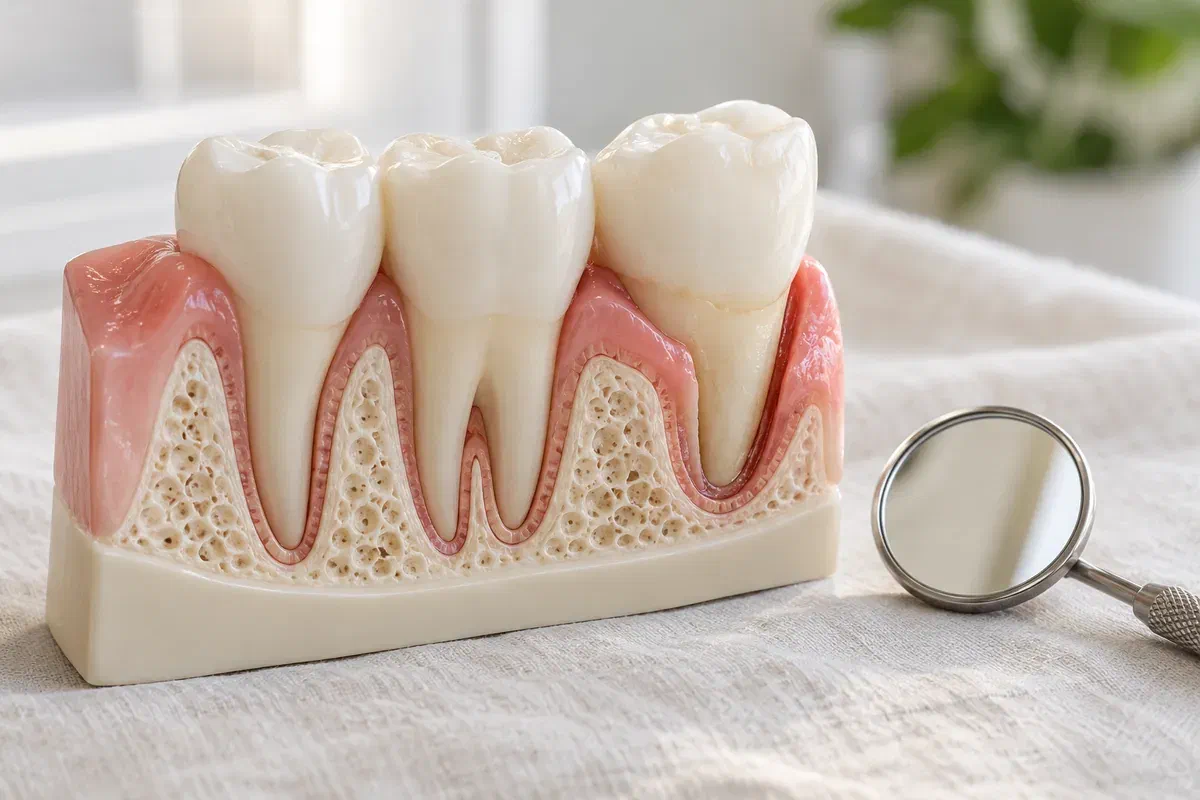
Illustrative connected tooth, gum, and supporting-bone teaching model
Your history, not just theirs

Tell us about your family, then let your own findings lead.

Family experience is useful context, but the diagnosis depends on your examination. Periodontal changes can be important even when your teeth feel fine, so there is no need to wait for pain.

What you have noticed yourself

Share any bleeding, gums that seem to have receded, spaces that trap food, or teeth that feel different when you chew. Mention relatives who had gum disease and roughly when it started for them. Your own tissues still need to be measured, since appearance and family stories cannot confirm a diagnosis.

Gum treatment you have already had

If you have received periodontal care before, bring records or the name of the office. Explain what was completed and whether a reassessment followed. That timeline helps the team tell whether an area was never fully treated or has changed since maintenance began.

Health factors you can and cannot change

Talk about medical conditions, medicines, smoking and anything that makes cleaning hard. Some factors, like family history, are fixed, while others can be supported. The goal is a realistic plan with no blame attached, and routines should be adjusted when they no longer work.

Please call promptly about new swelling, pus, fever, severe pain or a tooth that becomes loose. These acute changes should not wait for the rest of the plan to be arranged.

What a personal plan looks like

Your prognosis is written tooth by tooth.

Even with a strong family history, outcomes vary between people and between teeth. Ask which areas of your mouth are most affected, which are sound, and what could influence how each tooth does over time. If a stage or grade is part of the diagnosis, ask what it says about severity, treatment complexity and the likely pace of progression.

You also deserve a clear order of events. Ask what the first phase of treatment is meant to change, when your response will be measured, and what results might lead to a periodontist referral. That way you understand the purpose behind each visit and do not assume your future is decided by one reading.

Professional treatment where it is needed

The team can show which sites have deposits or active disease and how the treatment will be arranged over visits. Ask about comfort, the length of each appointment and whether local anaesthetic will be used. The scope should be tailored to your findings, not to what a relative once needed.

A home routine you can sustain for years

Ask which brushes and interdental cleaners fit your teeth, and request a demonstration where access is difficult. Bring along any tool you have struggled with. Learning practical technique is part of treatment, and it is worth getting right because it supports everything else.

Review that follows your response

Find out what your gums would need to show before maintenance takes over, and what would keep you in active treatment a while longer. Every review should be talked through with today’s results. Ongoing visits manage a history of disease and do not mean that earlier treatment failed.

Taking it in stages

Understand, treat, recheck, decide

Expect a series of appointments and possibly specialist input. Ask who will coordinate each step and how information will be shared if a periodontist is involved in your care.

  1. Assess your gums and explain the findings

    The clinician considers your history, measurements, appropriate X-rays and relevant family background. Find out where support has thinned and whether anything else should be gathered first. The explanation should separate what is known from what remains uncertain and highlight anything that needs early care.

  2. Start plaque control and professional treatment

    This stage covers your daily routine, risk factors that can be addressed, and professional cleaning at and beneath the gumline where it is indicated. Ask how many visits are involved and how discomfort will be managed. Mention any barriers early so the plan stays achievable.

  3. Recheck how your tissues responded

    Some weeks after treatment, your gums are examined again and set against the first readings. You will hear which spots calmed down and which did not. Ask what any lingering bleeding or awkward corner means. If more work is proposed, it should have a goal you can name, not be a rerun of round one.

  4. Settle the longer-term plan

    The way your tissues responded, and how tricky each area is, points toward further active care, a periodontist’s view, or regular maintenance. Pin down the interval and who is responsible for what. Before agreeing that any tooth should come out, hear the specific reasons and the other routes available.

Looking after your gums at home

Habits that break the pattern you have seen before

The right home care after a treatment visit is specific to what was done in your mouth. Lean on the instructions you were given for particular teeth, and speak up whenever cleaning turns sore or the advice stops making sense.

Follow the cleaning method you practised

Work with the brushes and approach you rehearsed in the chair. Something that will not slide into a space easily should not be pushed. When one corner of your mouth keeps defeating you, the team would rather hear about it than have you struggle, and a single fix tends to beat a drawer of new gadgets.

Report new symptoms and health changes

Tell the team about ongoing sensitivity, swelling, or teeth that start to feel loose or uncomfortable. Keep us informed about any new diagnoses or prescriptions, and leave prescribed care as directed by your physician. Dental and medical care may need coordinating when your health changes.

Attend reassessment and plan ongoing visits

Less bleeding is a good sign but does not mean active treatment is finished. Keep the review that measures your response and sets the next stage. If attending becomes difficult, contact the clinic to discuss timing rather than leaving the plan without a decision.

If further treatment is suggested

Each option should be explained for your teeth specifically.

Ask what each recommendation offers, what it cannot do and what alternatives exist. A periodontitis diagnosis, even with a family history, does not automatically mean surgery, antibiotics or extractions.

When professional cleaning and daily care come first

Nonsurgical treatment and reassessment

This care addresses deposits and inflammation in affected areas, followed by a review of the response. Ask what is included and what would trigger a further stage. Antibiotics and particular branded technologies are not needed in every periodontal plan.

When remaining disease or complexity needs extra input

A periodontist’s opinion or further site treatment

Depending on what remains, a specialist might talk through more nonsurgical work or a surgical approach for particular sites. Find out what each would realistically achieve. Rebuilding support is only possible in some situations, so the trade-offs deserve a personal explanation.

When the long-term picture becomes the focus

Maintenance or planning for a tooth with a poor outlook

Teeth that have settled can carry on with regular supportive visits, and a single weaker tooth can be discussed on its own terms. Weigh up holding on to it against taking it out and filling the gap later. Your teeth will not all share the same future, and your plan should recognize that.

Patient information: American Academy of Periodontology — nonsurgical care and further treatment

Family history and gum disease

Questions people ask when relatives have had periodontitis

A relative’s story often prompts these questions. The answers that matter for you come from your own gums, your measurements and how you respond to treatment, so use these as a starting point for the conversation.

(905) 876-4488
Is periodontitis hereditary?
Genes may play some part, and a family pattern is one of several factors linked to risk, but it does not decide your outcome. Daily care, professional treatment and other health factors also matter. Ask how your own findings compare with what you know about your relatives.
My parent wore dentures by sixty. Does that mean I will too?
Not necessarily. Treatment options and knowledge about managing gum disease have changed, and your mouth may behave differently. Ask the dentist what your examination suggests and what you can do to support long-term stability.
Should my children be checked if I have periodontitis?
Regular dental checkups for the whole family are a sensible habit. Mention your diagnosis at their visits so the dentist can keep an eye on their gums. Ask what signs to watch for at home.
Can I share my toothbrush or utensils with family members?
Sharing toothbrushes is generally discouraged for hygiene reasons. Ask the team if you have specific concerns about your household. The more useful focus is helping everyone keep their own daily cleaning routine.
Does having a family history change how often I need maintenance?
Maintenance intervals are based mainly on your own findings and response to treatment. Family history may be part of the conversation about risk. Ask how the team will decide your interval and when it might change.
How can I fit appointments around family life in Brampton?
Ask about the expected number of visits and book the reassessment before you leave. Weekday hours run until 7pm, and Friday to Sunday are by appointment only. Report urgent symptoms promptly rather than waiting for a planned visit.
Starting care from Brampton

Your gums, your plan, your timeline

To book a periodontal assessment or talk about a diagnosis you already have, call (905) 876-4488 and our team will find a time. Bring any records from earlier gum treatment so we can connect past care with your next appropriate step.

The amount of treatment, the outlook for individual teeth, specialist involvement and maintenance timing vary. Your plan requires examination and review, and no procedure guarantees complete recovery of lost support or a future without gum disease.

Visit Milton Dental Clinic
Unit 1, 342 Bronte St. S, Milton, ON L9T 5B7
Get directions Clinic hours
Monday–Thursday
11am–7pm
Friday–Sunday
By appointment only

Areas we serve

  • Milton
  • Oakville
  • Mississauga
  • Georgetown
  • Halton Hills
  • Acton
  • Campbellville
  • Brampton
  • Burlington
  • Puslinch
  • Rockwood
  • Erin
  • Caledon
  • Etobicoke
  • Old Milton
  • Bronte Meadows
  • Timberlea
  • Dorset Park
  • Dempsey
  • Clarke
  • Beaty
  • Coates
  • Harrison
  • Scott
  • Willmott
  • Ford
  • Bowes
  • Cobden
  • Walker
  • Mountain View
  • Milton Heights
  • Hawthorne Village
  • Valley View
  • Fallingbrook
  • Nassagaweya
  • Trafalgar
  • Esquesing
  • Nelson
  • Brookville
  • Moffat
  • Glen Williams
  • Norval
  • Limehouse
  • Stewarttown
  • Ashgrove
  • Hornby
  • Silver Creek
  • Speyside
  • Scotch Block
  • North Oakville
  • River Oaks
  • Glen Abbey
  • West Oak Trails
  • Palermo
  • Bronte Creek
  • College Park
  • Joshua Creek
  • Uptown Core
  • Preserve
  • Iroquois Ridge
  • Lisgar
  • Meadowvale
  • Meadowvale Village
  • Churchill Meadows
  • Erin Mills
  • Central Erin Mills
  • Streetsville
  • East Credit
  • Creditview
  • Heartland
  • Sheridan
  • Mount Pleasant
  • Credit Valley
  • Huttonville
  • Churchville
  • Springbrook
  • Northwest Brampton
  • Bram West
  • Fletcher's Meadow
  • Fletcher's Creek South
  • Alton Village
  • Orchard
  • Millcroft
  • Headon Forest
  • Tansley
  • Brant Hills
  • Tyandaga
  • Kilbride
  • Lowville
  • Aberfoyle
  • Morriston
  • Arkell
  • Hillsburgh
  • Freelton
  • Carlisle
  • Waterdown
  • Flamborough
  • Mountsberg

How can we help?

Milton Dental Clinic

Have a question about your smile? Choose the option that works best for you.

For urgent dental concerns, please call.
Messages are reviewed during clinic hours.