

Illustrative patient reviewing gum-treatment priorities with a clinician
Specialized Care

Periodontitis Treatment in Burlington

A tooth that shifts slightly when you bite, or front teeth that seem to be spreading apart, can be the moment periodontitis becomes real. We assess the support around those teeth, explain what is happening, and plan treatment and follow-up around what we find.

Burlington · when a tooth feels different

That slight wobble is worth a proper look.

Biting into something crisp and feeling a tooth give a little is unsettling. So is noticing in photos that a gap has opened between your front teeth. Changes like these can happen when periodontitis has reduced the bone and attachment that hold teeth firmly in place. Gingivitis, by contrast, affects the gums alone, although both conditions can make them bleed.

Movement does not automatically mean a tooth is lost, and a calm assessment is far more useful than guessing. The clinician measures the supporting tissues, reviews X-rays and checks how your teeth meet. Ask for the results to be explained against your own mouth: which teeth are firm, which are affected, and where the picture remains uncertain.

Care then follows a plan with three strands: professional treatment, home cleaning you can sustain, and review to see how things respond. For people coming from Burlington, knowing the shape of that plan early makes it easier to schedule. The goal is to control disease and keep teeth stable, without promising that lost support returns.

Have a moving tooth assessed
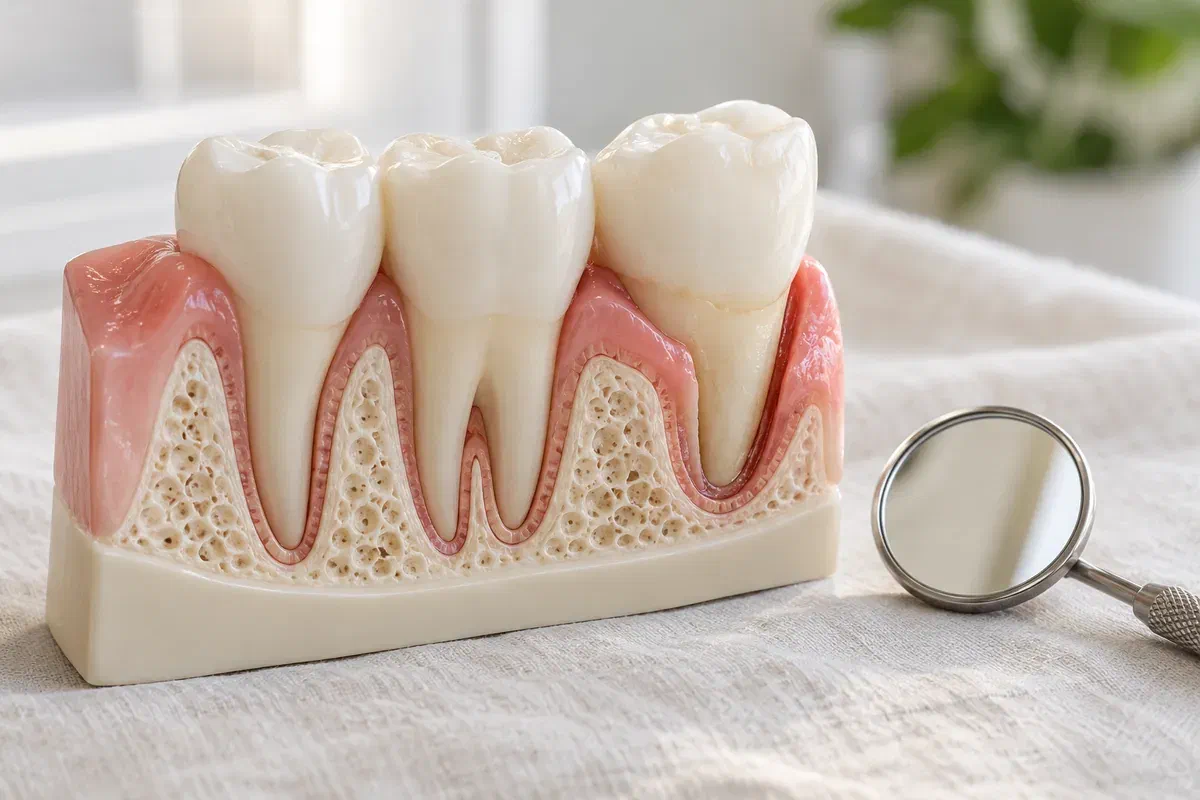
Illustrative connected tooth, gum, and supporting-bone teaching model
Clues worth sharing

Mobility is one sign among several

A loose tooth gets attention, but many periodontal findings are silent. Mention what you have noticed and book an assessment even if nothing aches and meals feel normal.

Movement, drifting or bleeding

Describe which tooth moves, whether front teeth have fanned outward, and whether your gums bleed or look lower than before. Mention food catching in new places. These details steer the examination, though the diagnosis depends on assessing the tissues and bone rather than on how teeth appear.

Earlier gum care and what came after

If you have had periodontal treatment before, tell us what was done and whether anyone measured the result. Bring records or a specialist letter if you can. That history helps sort an untreated problem from something that has changed during maintenance.

Health habits and practical barriers

Share medical conditions, medicines, tobacco use and any difficulty cleaning. Clenching or grinding is also worth mentioning when teeth feel loose. None of this is about blame; it helps the team suggest support that fits, and a routine that has become hard to manage can be adapted.

Sudden extra looseness, new swelling, discharge, fever or significant pain needs a prompt call. Report it now rather than waiting for the full plan to come together.

Planning around stability

Firm teeth, weaker teeth, and how to tell them apart

One mobile tooth does not set the outlook for the rest. Ask which sites have the most loss of support, which remain sturdy, and what factors shape each tooth’s prognosis. When the dentist mentions a stage or grade, ask how it relates to severity, the complexity of care and what is known about how the disease has progressed.

It also helps to understand the sequence. What will the first phase of treatment change? When will stability be checked again? What would prompt a periodontist referral? With those answers you know why each visit is happening, and you are not relying on a single reading to define everything that follows.

Professional care for the affected areas

The team can show which deposits and sites need treatment and how it will be spread over appointments. Ask about comfort, how long visits take and whether local anaesthetic is planned. The work should reflect your examination and life, not a standard set of steps.

Cleaning that reaches around loose or crowded teeth

Ask which brushes and interdental tools are gentle enough for a mobile tooth yet still effective, and request a demonstration. If something feels unsafe or awkward, bring it in. Hands-on guidance is part of treatment, and you are not expected to work it out alone.

Reviews that track firmness over time

Ask what would show that the gums and support are steady enough for maintenance, and what would suggest more active care. Each review should be explained using your current findings. Continuing care manages a history of disease, and needing it says nothing bad about earlier treatment.

The path through treatment

Assess first, treat second, then check before deciding more

Treatment usually spans several appointments and may include a specialist. Ask who is coordinating each step and how information will be shared if a periodontist becomes involved.

  1. Check support, mobility and the bite

    History, gum measurements, suitable X-rays and how your teeth come together are considered as a whole. Ask which teeth have reduced support and whether anything more is needed. The explanation should separate firm findings from open questions and flag what needs early care.

  2. Begin home plaque control and needed professional care

    Daily cleaning, modifiable risk factors and professional treatment above and below the gumline, where indicated, are addressed together. Ask how the appointments will be divided and how discomfort will be handled. Raising barriers early keeps the plan achievable.

  3. Reassess tissue response and tooth movement

    At review, the team compares relevant findings with the starting point and explains which areas settled. Ask what remaining inflammation, mobility or difficult access means for the next step. Additional treatment should have a stated goal rather than repeating earlier care without explanation.

  4. Choose further treatment, referral or maintenance

    How the tissues settled, and how complicated each site is, shape whether more active care or a specialist visit fits. Moving into maintenance means agreeing on an interval and who handles what. Where one tooth looks doubtful, hear the reasoning and the alternatives before any talk of removal.

Care at home after treatment

Gentle, consistent and easy to keep up

How you look after your mouth depends on the treatment provided and how your gums are healing. Follow the advice for your own sites and ask about anything that makes cleaning uncomfortable.

Keep to the method that was demonstrated

Use the tools and technique agreed at your visit, taking extra care around any mobile tooth. Never force a cleaner into a space that is too tight. If an area is still awkward, raise it at review or call for advice rather than piling on new products without guidance.

Watch for changes and let us know

Persistent sensitivity, new swelling or a tooth that seems looser are all worth reporting. Keep us up to date on medical treatment and medicines, but do not adjust prescribed care on your own. Coordination with your physician may be needed when your circumstances change.

Attend reassessment and book continuing care

Less bleeding is promising, though it does not prove that active treatment is done. The review checks how your gums and teeth responded and sets the next stage. If attending becomes difficult, call the clinic to discuss timing instead of leaving the plan open-ended.

After the first round

What comes next depends on how firmly each tooth is held.

Ask about the benefits, limits and alternatives of every recommendation. Periodontitis, even with a loose tooth, does not automatically mean surgery, antibiotics or extraction.

When cleaning and home care are the clear next step

Nonsurgical periodontal care and a planned recheck

Treatment targets deposits and inflammation in the affected sites, followed by a review of the response. Ask what it includes and what would lead to another phase. Antibiotics or a named technology should not be assumed necessary for every periodontal plan.

When ongoing disease or complexity needs more expertise

Specialist opinion or targeted procedures

A periodontist may outline further nonsurgical or surgical approaches based on the findings. Ask what outcome is realistic and what a procedure would change. Lost support cannot be regained at every site, so benefits and risks should be discussed individually.

When long-term planning takes over

Maintenance or a decision about a mobile tooth

Stable areas may continue with supportive care while one tooth gets a separate outlook discussion. Ask how keeping it, removing it and any later replacement compare. Different teeth can have different futures, and that should shape the plan.

Patient information: American Academy of Periodontology — nonsurgical care and further treatment

Loose-tooth and gum questions

Straight answers about mobility and periodontitis

Ask for a clear account of which areas are affected, the first priorities and the longer plan. The answers should reflect your examination and response to care, not a generic prediction.

(905) 876-4488
Does a loose tooth always mean it has to come out?
No. Mobility can have several causes, and some teeth become steadier once inflammation is treated. The outlook depends on the remaining support and other factors. Ask what the examination shows for that specific tooth before considering removal.
Why are my front teeth spreading apart?
Drifting can happen when supporting tissues have been lost, though bite forces and other factors may also play a part. Ask the dentist to assess the cause. Treating gum disease comes first; any later orthodontic or cosmetic discussion depends on stability.
Could grinding my teeth be making things worse?
Heavy biting forces can add stress to teeth with reduced support. Mention clenching or grinding so it can be assessed. Ask whether a night guard or bite adjustment is worth discussing as part of the overall plan.
Should I avoid chewing on a tooth that feels loose?
Favouring the other side for now is reasonable while you wait to be seen. Call promptly if the looseness increases or you notice swelling or pain. Ask the team for specific advice once the tooth has been assessed.
Can a loose tooth be splinted to its neighbours?
Splinting is sometimes considered for selected teeth, usually alongside gum treatment rather than instead of it. Ask whether it suits your situation, what it would achieve and what its limitations are.
If a tooth loosens between visits from Burlington, what should I do?
Call the clinic and describe the change, especially if swelling or pain accompanies it. The team can advise whether you need to be seen soon. If you have severe swelling or difficulty breathing or swallowing, seek emergency care close to you.
Booking from Burlington

Steady teeth start with understanding what holds them.

Ring the clinic on (905) 876-4488 to book a periodontal assessment or to review a diagnosis you already have. Earlier gum-treatment records are helpful, so we can connect what was done before with the next suitable step.

Treatment extent, prognosis for individual teeth, specialist input and maintenance intervals vary. Planning depends on examination and review, and no procedure can guarantee full restoration of lost support or permanent freedom from disease.

Visit Milton Dental Clinic
Unit 1, 342 Bronte St. S, Milton, ON L9T 5B7
Get directions Clinic hours
Monday–Thursday
11am–7pm
Friday–Sunday
By appointment only

Areas we serve

  • Milton
  • Oakville
  • Mississauga
  • Georgetown
  • Halton Hills
  • Acton
  • Campbellville
  • Brampton
  • Burlington
  • Puslinch
  • Rockwood
  • Erin
  • Caledon
  • Etobicoke
  • Old Milton
  • Bronte Meadows
  • Timberlea
  • Dorset Park
  • Dempsey
  • Clarke
  • Beaty
  • Coates
  • Harrison
  • Scott
  • Willmott
  • Ford
  • Bowes
  • Cobden
  • Walker
  • Mountain View
  • Milton Heights
  • Hawthorne Village
  • Valley View
  • Fallingbrook
  • Nassagaweya
  • Trafalgar
  • Esquesing
  • Nelson
  • Brookville
  • Moffat
  • Glen Williams
  • Norval
  • Limehouse
  • Stewarttown
  • Ashgrove
  • Hornby
  • Silver Creek
  • Speyside
  • Scotch Block
  • North Oakville
  • River Oaks
  • Glen Abbey
  • West Oak Trails
  • Palermo
  • Bronte Creek
  • College Park
  • Joshua Creek
  • Uptown Core
  • Preserve
  • Iroquois Ridge
  • Lisgar
  • Meadowvale
  • Meadowvale Village
  • Churchill Meadows
  • Erin Mills
  • Central Erin Mills
  • Streetsville
  • East Credit
  • Creditview
  • Heartland
  • Sheridan
  • Mount Pleasant
  • Credit Valley
  • Huttonville
  • Churchville
  • Springbrook
  • Northwest Brampton
  • Bram West
  • Fletcher's Meadow
  • Fletcher's Creek South
  • Alton Village
  • Orchard
  • Millcroft
  • Headon Forest
  • Tansley
  • Brant Hills
  • Tyandaga
  • Kilbride
  • Lowville
  • Aberfoyle
  • Morriston
  • Arkell
  • Hillsburgh
  • Freelton
  • Carlisle
  • Waterdown
  • Flamborough
  • Mountsberg

How can we help?

Milton Dental Clinic

Have a question about your smile? Choose the option that works best for you.

For urgent dental concerns, please call.
Messages are reviewed during clinic hours.