

Illustrative patient reviewing gum-treatment priorities with a clinician
Specialized Care

Periodontitis Treatment in Etobicoke

Periodontitis care involves a series of visits, and a longer trip makes each one count. We explain your diagnosis, organize treatment into well-planned appointments, and talk through which problems you can call about and which need urgent care closer to home.

Etobicoke · planning around distance

Fewer trips, better organized, with nothing left vague

Travelling from the west end of Toronto for dental care changes how you think about appointments. You want each one to accomplish something definite. With periodontitis, that planning matters, because the condition involves lost bone and attachment around the teeth and is managed over time rather than fixed in one sitting. It differs from gingivitis, which is confined to the gums.

Use your first visit to get a thorough explanation. Which teeth have reduced support? Which areas are healthy? What remains unclear until treatment begins? Ask the dentist to relate every point to your own measurements and X-rays, and note anything you want to think about on the way home. A clear picture makes the rest of the plan easier to commit to.

From there, the work combines professional treatment, a home routine designed to carry you between visits, and scheduled review. Grouping appointments thoughtfully can reduce the number of trips without cutting corners. The purpose is control and stability over time, and it would be misleading to promise that lost support will grow back.

Plan a periodontal assessment
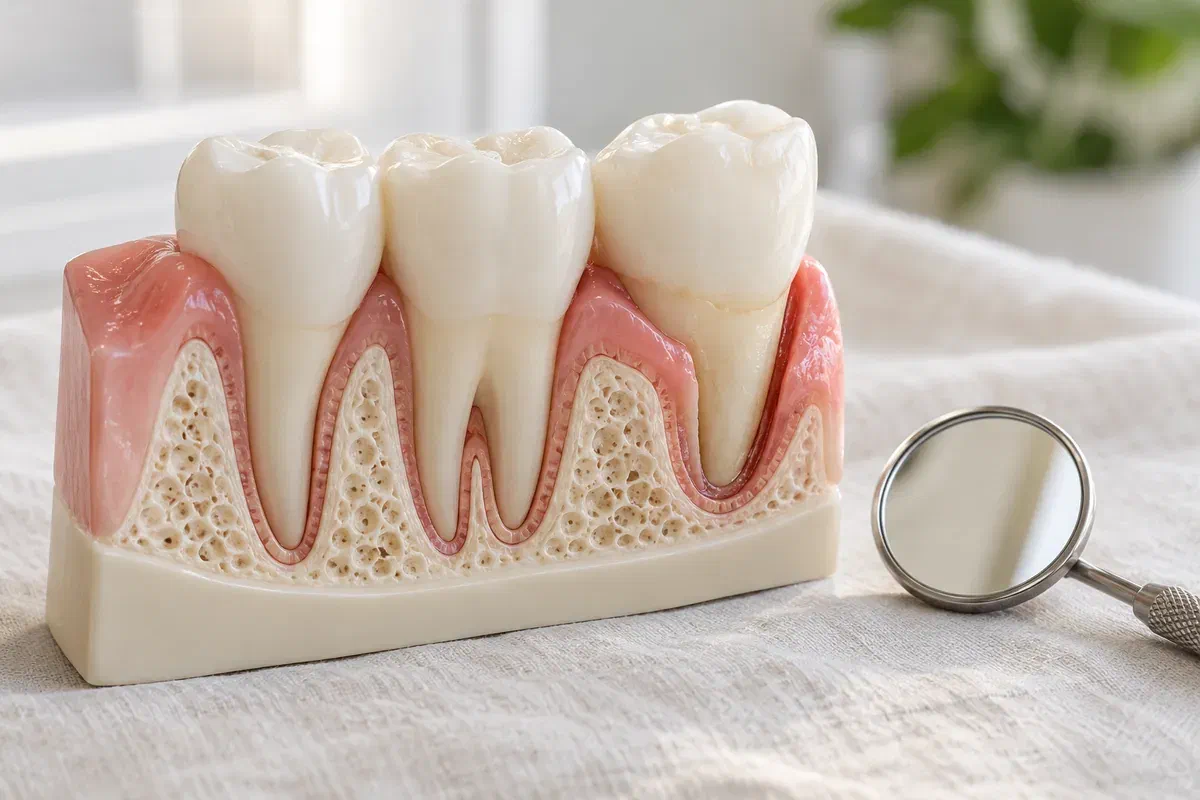
Illustrative connected tooth, gum, and supporting-bone teaching model
Getting the most from the first visit

Arrive with your history ready.

Periodontal problems may be significant even without pain. Gathering information beforehand means less back-and-forth later, and a comfortable mouth is not a reason to delay an assessment.

Signs you have seen at home

Write down any bleeding, receding gums, new spaces that trap food, or teeth that feel unusual when you bite. A short list helps you remember on the day. These clues shape the examination, but the diagnosis comes from assessing the supporting tissues rather than from appearance alone.

Previous records sent ahead

Ask your previous dentist or periodontist to forward charts and X-rays before your appointment. Note what treatment you had and whether it was reassessed. That history helps distinguish untreated disease from a problem that has re-emerged during maintenance, and may spare you a repeat explanation.

Health and practical considerations

Share medical conditions, medicines, tobacco use and any difficulty with cleaning. Let us know how often you can realistically make the trip. That is useful planning information, never a cause for judgement, and the routine and schedule should both be adapted to your circumstances.

Sudden swelling, discharge, fever, severe pain or a tooth that becomes loose needs prompt attention. Call us first for advice, and if swelling is spreading or you have trouble breathing or swallowing, seek emergency care close to you.

A plan worth the drive

Know the priorities before you book the next trip

Your diagnosis opens a set of choices rather than predicting one outcome for all your teeth. Ask which sites need attention most, which are stable, and what will influence the prognosis for each. If your chart lists a stage or grade, ask what that reveals about severity, the complexity of care and how fast the disease has progressed so far.

With priorities set, the sequence can be arranged with travel in mind. Ask what the initial phase aims to change, when it will be reviewed, and which findings might lead to a referral. Knowing this lets you group appointments and understand the purpose of each, without expecting one measurement to determine the entire course.

Professional treatment organized efficiently

The team can explain which areas have deposits or inflammation and whether several sections can be treated in one longer appointment. Ask about comfort, total time in the chair and whether freezing is planned. Scheduling should respect your findings and your travel, not follow a fixed template.

Home care that holds up between longer gaps

Request a thorough demonstration of brushing and interdental cleaning, and practise on the difficult areas while you are there. Bring any tool that has not worked for you. Because visits may be spaced out, confident technique at home is especially valuable.

Review timed to show your response

Ask what results would indicate readiness for maintenance and what would suggest further active treatment. Each review should be explained with up-to-date findings. Ongoing visits manage a history of periodontitis; they do not imply the earlier work was ineffective.

Four stages, planned in advance

Map the whole route before the first treatment visit

Ask at the start how many appointments are likely and roughly when each will fall. If a periodontist becomes involved, ask how records will be shared and who will coordinate.

  1. Comprehensive assessment and a full explanation

    History, periodontal measurements and suitable X-rays are reviewed together. Ask which teeth have lost support and whether anything further is needed. Leave knowing what is certain, what is not, and whether any area needs prompt attention before the main treatment starts.

  2. Home routine and professional treatment, grouped

    This phase pairs daily plaque control and attention to risk factors with professional care beneath the gums where indicated. Ask whether treatment can be combined into fewer visits and how comfort will be handled. Mention travel limits so the plan is practical.

  3. Reassessment to compare findings

    After a healing interval, the team rechecks the sites and explains which have responded. Ask what remaining inflammation or awkward access means for your next decision. Additional care should come with a clear aim, not repeat the first stage automatically.

  4. Further care, a specialist, or maintenance

    The response and complexity guide whether you need more active treatment or a specialist assessment. When maintenance begins, agree on the interval and responsibilities. For a tooth with a poor outlook, ask for the specific reasoning and alternatives before agreeing to removal.

Back home in Etobicoke, between trips

Know what to watch for, and who to call

Aftercare depends on the treatment provided and how your gums settle. Follow the instructions for your specific sites, and phone with questions rather than waiting for the next scheduled appointment.

Keep using the method you learned

Stay with the agreed tools and technique, and never force a cleaner into a space too small for it. If one area remains difficult, call for advice or raise it at your review. A single sensible adjustment tends to help more than experimenting with several new products.

Phone about changes before driving in

Lingering sensitivity, new swelling or a tooth that seems to move are worth a call. The team can advise whether you need to come in or can wait. Keep us informed about medical treatment and prescriptions, and do not stop prescribed care unless your physician advises it.

Hold onto the reassessment appointment

Reduced bleeding is encouraging but does not confirm that active treatment is complete. The review measures your response and sets the next step. If the date becomes hard to reach, call to reschedule rather than letting the plan drift.

When the first phase is done

Next steps, shaped by how each area healed

Ask what each recommendation would achieve, what its limits are and which alternatives exist. Periodontitis does not mean surgery, antibiotics or extraction of affected teeth are inevitable.

When cleaning and home care are the immediate needs

Nonsurgical care with a planned review

Treatment removes deposits and reduces inflammation at affected sites, followed by a check on the response. Ask what is involved and what would prompt another stage. Antibiotics and branded technologies are not standard for every periodontal plan.

When remaining disease or complexity calls for more

Specialist input or further site-specific care

A periodontist may discuss additional nonsurgical or surgical options. Ask what is realistic and what the procedure would change, and whether a specialist closer to you might also be an option. Not every site can regain lost support, and risks and benefits should be explained individually.

When long-term planning becomes the priority

Maintenance or a decision about a weak tooth

Stable areas can move into supportive care, while one tooth may need its own prognosis discussion. Ask how keeping it, removing it and replacing it later would compare. Your teeth can have different futures, and your plan should allow for that.

Patient information: American Academy of Periodontology — nonsurgical care and further treatment

Questions about travel and treatment

Good answers make every trip worthwhile.

Ask for a clear explanation of the affected areas, the first priorities and the longer plan. Answers should reflect your examination and response to care rather than a general forecast.

(905) 876-4488
Can several areas be treated in one longer appointment?
Sometimes, depending on the extent of treatment, your comfort and your health. Ask whether combining sections is suitable for you and what the trade-offs are. The team can explain how the plan might be arranged to reduce trips.
What if my gums flare up and I cannot get to the clinic quickly?
Call first for advice. Some problems can be managed until your next visit, while others need to be seen sooner. If swelling is spreading, you have a fever, or breathing or swallowing is affected, seek urgent care near you.
Is it possible to have my maintenance done closer to home later?
That is something you can discuss once the active phase is complete. Ask how records would be shared and who would coordinate future care. Continuity matters, so make sure any change is clearly arranged.
How long does periodontal treatment usually take from start to finish?
It varies with the extent of the disease and how your gums respond. Ask for an estimated timeline, including the healing interval before reassessment. The plan may change based on what that review shows.
Do I need to bring someone with me to drive home?
For most nonsurgical periodontal visits with local anaesthetic, people drive themselves, but ask the team about your specific treatment and any medication you might be given. Plan accordingly if sedation or a specialist procedure is involved.
What is the best way to prepare before leaving Etobicoke for an appointment?
Confirm the appointment, bring your medicine list and any records, and eat beforehand if appropriate. Note questions as they come up. Call ahead if you develop new symptoms, so the team can plan the visit around them.
Booking from Etobicoke

A periodontal plan built around the trip

Give us a call at (905) 876-4488 to arrange a periodontal assessment or discuss a diagnosis you have already received. Ask your previous office to send gum-treatment records ahead of time so the first visit can be as productive as possible.

Treatment scope, tooth-by-tooth prognosis, referral and maintenance intervals vary. Planning requires examination and review, and no procedure can guarantee full return of lost support or permanent protection from periodontal disease.

Visit Milton Dental Clinic
Unit 1, 342 Bronte St. S, Milton, ON L9T 5B7
Get directions Clinic hours
Monday–Thursday
11am–7pm
Friday–Sunday
By appointment only

Areas we serve

  • Milton
  • Oakville
  • Mississauga
  • Georgetown
  • Halton Hills
  • Acton
  • Campbellville
  • Brampton
  • Burlington
  • Puslinch
  • Rockwood
  • Erin
  • Caledon
  • Etobicoke
  • Old Milton
  • Bronte Meadows
  • Timberlea
  • Dorset Park
  • Dempsey
  • Clarke
  • Beaty
  • Coates
  • Harrison
  • Scott
  • Willmott
  • Ford
  • Bowes
  • Cobden
  • Walker
  • Mountain View
  • Milton Heights
  • Hawthorne Village
  • Valley View
  • Fallingbrook
  • Nassagaweya
  • Trafalgar
  • Esquesing
  • Nelson
  • Brookville
  • Moffat
  • Glen Williams
  • Norval
  • Limehouse
  • Stewarttown
  • Ashgrove
  • Hornby
  • Silver Creek
  • Speyside
  • Scotch Block
  • North Oakville
  • River Oaks
  • Glen Abbey
  • West Oak Trails
  • Palermo
  • Bronte Creek
  • College Park
  • Joshua Creek
  • Uptown Core
  • Preserve
  • Iroquois Ridge
  • Lisgar
  • Meadowvale
  • Meadowvale Village
  • Churchill Meadows
  • Erin Mills
  • Central Erin Mills
  • Streetsville
  • East Credit
  • Creditview
  • Heartland
  • Sheridan
  • Mount Pleasant
  • Credit Valley
  • Huttonville
  • Churchville
  • Springbrook
  • Northwest Brampton
  • Bram West
  • Fletcher's Meadow
  • Fletcher's Creek South
  • Alton Village
  • Orchard
  • Millcroft
  • Headon Forest
  • Tansley
  • Brant Hills
  • Tyandaga
  • Kilbride
  • Lowville
  • Aberfoyle
  • Morriston
  • Arkell
  • Hillsburgh
  • Freelton
  • Carlisle
  • Waterdown
  • Flamborough
  • Mountsberg

How can we help?

Milton Dental Clinic

Have a question about your smile? Choose the option that works best for you.

For urgent dental concerns, please call.
Messages are reviewed during clinic hours.