

Illustrative patient reviewing gum-treatment priorities with a clinician
Specialized Care

Periodontitis Treatment in Georgetown

A drawer full of floss picks and interdental brushes you never quite got the hang of is more common than you might think. Our team explains your periodontitis findings, treats the areas that need it, and helps you settle on a daily routine that genuinely fits your mouth.

Georgetown · the bathroom-sink part of treatment

Professional care does a lot. Your evening routine does the rest.

Standing at the mirror with an interdental brush that will not go where it is supposed to is frustrating, and it is where many people quietly give up. That matters with periodontitis, a disease in which some of the bone and attachment around your teeth has been lost. Unlike gingivitis, which involves only the gums, it leaves spaces and surfaces that need deliberate cleaning.

Start by understanding why those spaces exist. Ask the dentist to show you, on your own measurements and X-rays, which teeth have reduced support, which are in good health, and what remains unclear. Once you can picture the problem areas, it becomes much easier to see why one tool suits a gap and another does not.

Treatment pairs professional care with home cleaning and regular review, and no part works well alone. For anyone coming in from Georgetown, the clinic visits set the direction, while daily habits carry the progress between them. Together they aim to control disease and support long-term stability, although lost support cannot be guaranteed to return.

Get help with your periodontal routine
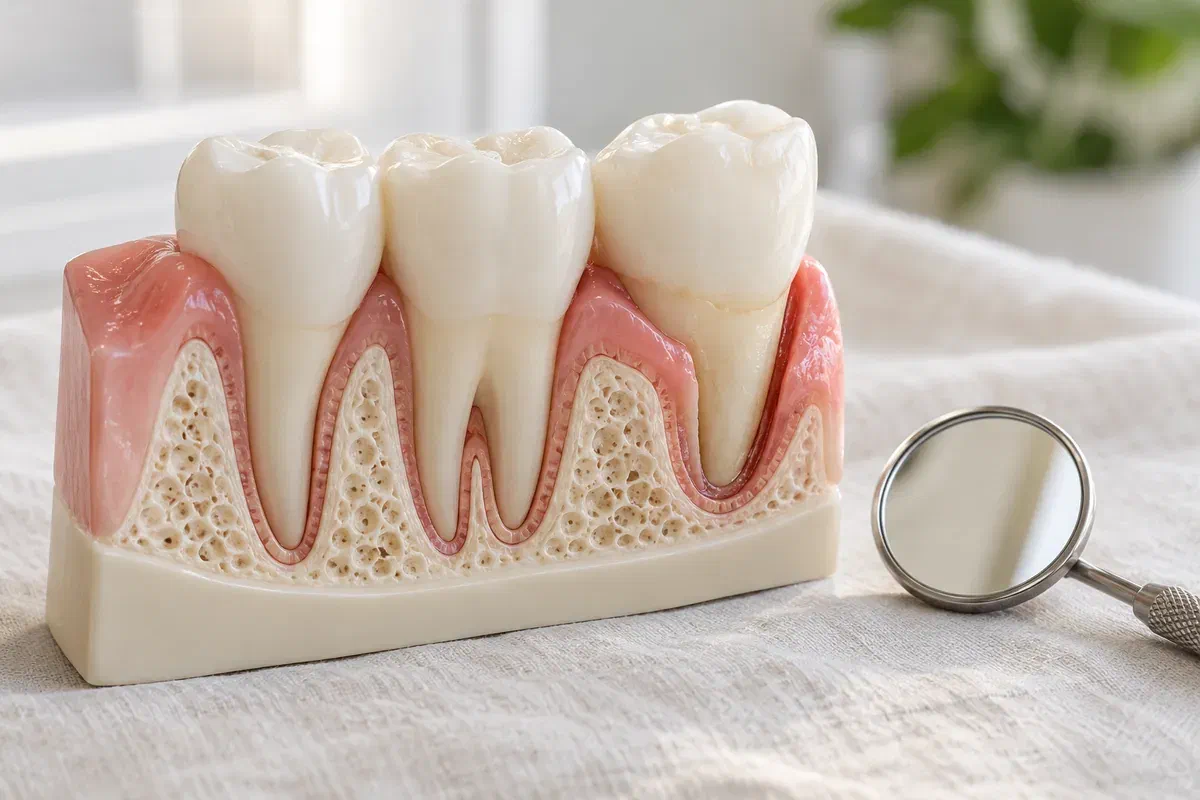
Illustrative connected tooth, gum, and supporting-bone teaching model
Telling us how things really go

Honest details lead to practical advice.

Periodontal disease is often painless, so mention anything you have noticed even if eating feels normal. And be candid about your routine; the team can only help with problems they know about.

What happens when you clean

Describe bleeding, tender spots, gums that have pulled back, or places where food always seems to collect. Mention any tooth that bites strangely. These details tell the clinician where to look, but periodontitis is confirmed by assessing the supporting tissues rather than by appearance.

Past treatment and how it went

If you have had gum care before, share what was done and whether you returned for a recheck. Records are helpful if you can get them. Knowing the order of events helps separate areas that were never fully treated from ones that changed later.

Tools, habits and what gets in the way

Bring the brushes, picks or flossers you use, or tried and abandoned. Mention health conditions, medicines, smoking and any trouble with grip or vision. The point is to understand your barriers, not to judge them, and to redesign the routine until it is realistic.

Some changes cannot wait for the next lesson in technique. New swelling, discharge, fever, sharp pain or a tooth that is becoming loose should be reported promptly.

Understanding the plan

Knowing where to clean starts with knowing where support was lost

Different sites in your mouth may face very different futures. Ask which areas are most affected, which are healthy, and what affects the outlook at each. If a stage or grade appears in your notes, ask the dentist to explain what it reflects about severity and complexity, and what is known about how quickly things have progressed.

The treatment sequence should also be clear. Ask what the first phase will try to accomplish, when your response will be checked, and what would lead to a periodontist referral. Knowing this helps you understand why each visit happens and why a single reading is not expected to settle everything.

Professional treatment at the affected sites

You will be shown where deposits have built up and which sites need cleaning, and how the appointments will be laid out. Ask about comfort, time in the chair and whether local anaesthetic is planned. The amount of treatment should come from your examination and circumstances.

A routine chosen together, then practised

Ask which brush sizes and interdental aids suit each space, and try them in the chair with guidance. A water flosser, a smaller brush head or a handle that is easier to grip might be suggested. Practising with feedback is part of treatment, not homework you must perfect first.

Follow-up based on how sites respond

Ask what results would mean you are ready for maintenance and what would point to further active care. Reviews should be explained using current findings. Ongoing visits help manage a history of disease, and needing them does not mean the routine or treatment failed.

Treatment and coaching, side by side

Each visit leaves you with something to practise.

Expect several appointments, possibly including a specialist. Ask who coordinates each stage, how records are shared, and what home-care goals you should focus on between visits.

  1. Assessment and a tour of your problem areas

    History, measurements and suitable X-rays are reviewed. Ask where support has been lost and whether any further information is needed. The team can point out which spaces will need special attention at home and flag anything that should be dealt with soon.

  2. Professional cleaning plus hands-on instruction

    Treatment beneath the gums where needed is combined with practical coaching and a look at risk factors. Ask how the work will be split and how discomfort will be managed. Say which tools feel awkward so alternatives can be tried before you leave.

  3. Recheck how the tissues responded

    At reassessment, the team compares findings and explains which sites settled. Ask what any remaining bleeding or hard-to-reach area means, and whether your technique there needs adjusting. More treatment should come with a clear reason.

  4. Decide on more care, referral or maintenance

    Response and complexity guide whether further treatment or a specialist opinion makes sense. For maintenance, agree on the interval and your role at home. If a tooth looks unlikely to do well, ask why and what the alternatives are before deciding to remove it.

Living with the routine

Good technique, done most days, beats perfect technique done rarely.

The routine after a treatment visit is shaped by the work you had and the way your gums are recovering. Follow the advice for your own sites, and get in touch if cleaning is uncomfortable or confusing.

Stick with the tools that fit

Use the sizes and method you practised, and resist pushing a brush into a gap that resists it. If something still feels wrong, bring the tool to your review or phone for advice. One well-chosen change usually beats a cupboard of products picked at random.

Notice and report changes

Persistent sensitivity, new swelling or a tooth that seems to shift should be mentioned. Keep the team informed about health changes and medicines, but leave prescribed care as your physician directed. Coordination with other clinicians may be needed when your situation changes.

Return to check the result

Less bleeding is encouraging, though it is not proof that active treatment is finished. The review measures the response and plans the next step. If timing becomes awkward, call to rearrange rather than letting the follow-up slip away.

What may come next

The response at each site points the way forward.

Ask about the advantages, drawbacks and alternatives of every recommendation. Periodontitis does not automatically lead to surgery, antibiotics or removing affected teeth.

When professional cleaning and home care remain the focus

Nonsurgical care with a recheck

This treatment targets deposits and inflammation and then reviews the outcome. Ask what it involves and what result would lead to another phase. Antibiotics or branded technology are not a standard requirement for every plan.

When disease persists or a site is especially complex

A specialist’s view or targeted treatment

A periodontist may discuss further nonsurgical or surgical options. Ask what is realistic and how a procedure would change cleaning access at that site. Lost support cannot always be regained, and the risks and benefits should be explained for you.

When long-term planning is the priority

Maintenance, or a conversation about one tooth

Settled areas may continue with supportive visits while one tooth is discussed on its own. Ask how keeping it compares with removing and later replacing it. Each tooth can have a different outlook, and the plan should acknowledge that.

Patient information: American Academy of Periodontology — nonsurgical care and further treatment

Home-care questions

Brushes, floss and everything in between

Most of these come up while someone is standing at the mirror wondering if they are doing it right. The best answer for you depends on the spaces in your own mouth, so bring the question, and the tool, to your next visit.

(905) 876-4488
Are interdental brushes better than floss for periodontitis?
It depends on the size of the spaces and what you can use well. Wider gaps often suit interdental brushes, while tight contacts may need floss. Ask the team to check which works for each area of your mouth.
Is a water flosser enough on its own?
Some people find a water flosser helpful, especially around bridges or crowded teeth. Whether it can replace other tools depends on your mouth. Ask the team whether it suits your situation and how to use it alongside brushing.
Should my gums still bleed when I clean between my teeth?
Bleeding often lessens as inflammation settles with treatment and regular cleaning. Persistent bleeding in one spot is worth mentioning at review. Do not stop cleaning an area because it bleeds unless you are advised to.
Is an electric toothbrush worth it with gum disease?
Many people find powered brushes easier to use well, but a manual brush used carefully can also be effective. Ask the team which suits your mouth and technique, especially if grip or dexterity is a concern.
How often should I replace my interdental brushes?
Replace them when the bristles look worn or the wire bends. Ask for advice specific to the brand and size you use. Having a few spares in the right sizes helps you stay consistent.
Can someone in Georgetown check my technique between treatment visits?
You can book a short visit at the clinic if a tool or area keeps giving you trouble. Bring the products you are using. It is better to ask than to keep guessing until the next scheduled review.
Planning from Georgetown

Bring your toothbrush questions along.

For a periodontal assessment or to talk about a diagnosis you already have, phone (905) 876-4488. Bring your current cleaning tools and any records of earlier gum treatment so we can link your history to the right next step.

The scope of treatment, prognosis, referral and maintenance intervals differ for each person. Planning depends on examination and review, and no treatment guarantees full restoration of lost support or an end to the need for ongoing care.

Visit Milton Dental Clinic
Unit 1, 342 Bronte St. S, Milton, ON L9T 5B7
Get directions Clinic hours
Monday–Thursday
11am–7pm
Friday–Sunday
By appointment only

Areas we serve

  • Milton
  • Oakville
  • Mississauga
  • Georgetown
  • Halton Hills
  • Acton
  • Campbellville
  • Brampton
  • Burlington
  • Puslinch
  • Rockwood
  • Erin
  • Caledon
  • Etobicoke
  • Old Milton
  • Bronte Meadows
  • Timberlea
  • Dorset Park
  • Dempsey
  • Clarke
  • Beaty
  • Coates
  • Harrison
  • Scott
  • Willmott
  • Ford
  • Bowes
  • Cobden
  • Walker
  • Mountain View
  • Milton Heights
  • Hawthorne Village
  • Valley View
  • Fallingbrook
  • Nassagaweya
  • Trafalgar
  • Esquesing
  • Nelson
  • Brookville
  • Moffat
  • Glen Williams
  • Norval
  • Limehouse
  • Stewarttown
  • Ashgrove
  • Hornby
  • Silver Creek
  • Speyside
  • Scotch Block
  • North Oakville
  • River Oaks
  • Glen Abbey
  • West Oak Trails
  • Palermo
  • Bronte Creek
  • College Park
  • Joshua Creek
  • Uptown Core
  • Preserve
  • Iroquois Ridge
  • Lisgar
  • Meadowvale
  • Meadowvale Village
  • Churchill Meadows
  • Erin Mills
  • Central Erin Mills
  • Streetsville
  • East Credit
  • Creditview
  • Heartland
  • Sheridan
  • Mount Pleasant
  • Credit Valley
  • Huttonville
  • Churchville
  • Springbrook
  • Northwest Brampton
  • Bram West
  • Fletcher's Meadow
  • Fletcher's Creek South
  • Alton Village
  • Orchard
  • Millcroft
  • Headon Forest
  • Tansley
  • Brant Hills
  • Tyandaga
  • Kilbride
  • Lowville
  • Aberfoyle
  • Morriston
  • Arkell
  • Hillsburgh
  • Freelton
  • Carlisle
  • Waterdown
  • Flamborough
  • Mountsberg

How can we help?

Milton Dental Clinic

Have a question about your smile? Choose the option that works best for you.

For urgent dental concerns, please call.
Messages are reviewed during clinic hours.