

Illustrative patient reviewing gum-treatment priorities with a clinician
Specialized Care

Periodontitis Treatment in Mississauga

Gum treatment that needs several visits can feel impossible to fit around work and family. We explain the diagnosis, show which areas need care first, and help you map out appointments, reassessment and maintenance in a way your calendar can handle.

Mississauga · fitting care into a busy week

Several visits, one clear purpose

The first thing many working adults ask after a periodontitis diagnosis is how much time it will take. That is a fair question. Periodontitis means some of the bone and attachment anchoring your teeth has been lost, which sets it apart from gingivitis, where inflammation stays within the gums. Managing it well usually involves more than a single appointment.

Before booking anything, make sure you understand why the visits are needed. Ask the dentist to go through your measurements and X-rays and explain which teeth are affected, which are in good shape, and what still cannot be known. When you can see the reasoning, it is much easier to protect those appointments in a crowded calendar.

From Meadowvale, Churchill Meadows or anywhere else in Mississauga, the plan is built from the same three parts: professional treatment, a home routine short enough to do on a weeknight, and a scheduled review. It is designed to bring disease under control and keep things stable. It does not guarantee that lost support will regrow.

Plan your periodontal appointments
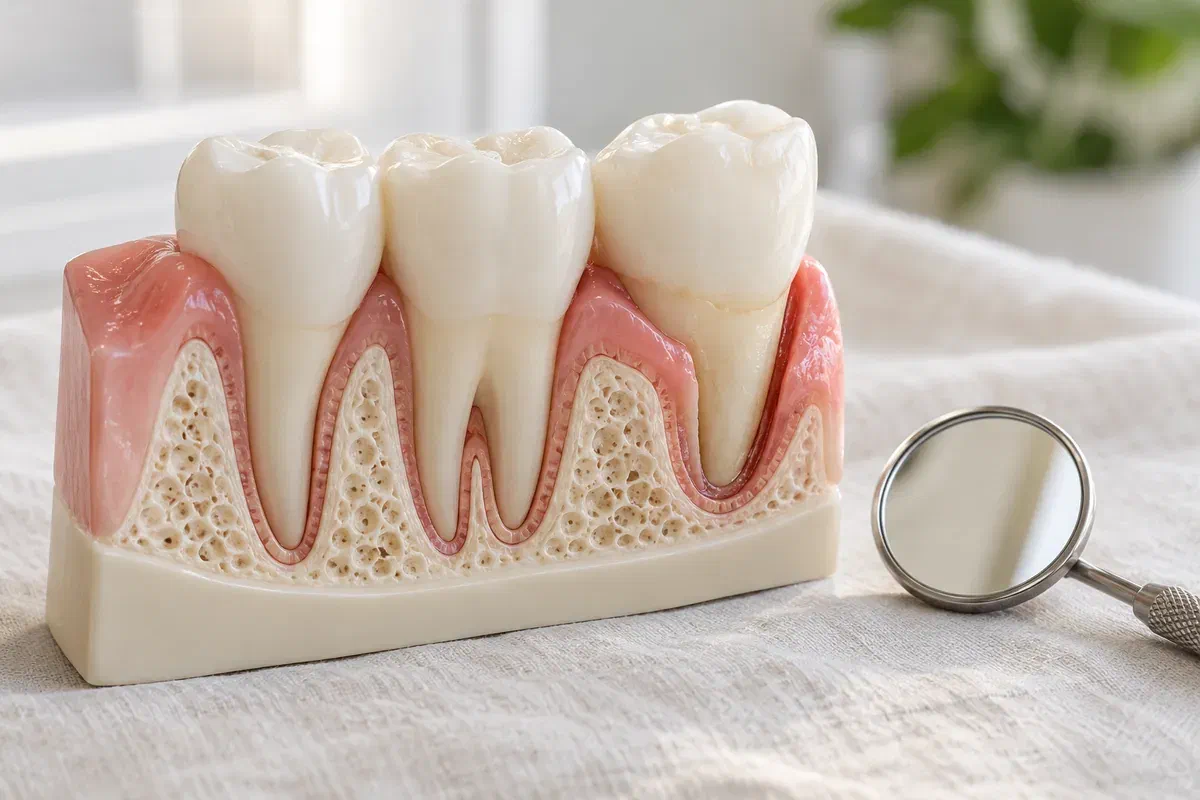
Illustrative connected tooth, gum, and supporting-bone teaching model
Before the first appointment

Bring the details that save time later.

Periodontal disease often causes no pain, so a quiet mouth is not proof that everything is fine. Telling us what you have noticed helps the assessment focus on what matters.

Changes you have spotted

Note bleeding during brushing, gums that look as if they have shrunk back, new gaps that catch food, or a tooth that bites differently. A quick list on your phone is enough. These signs direct the examination, but confirming periodontitis requires assessing the supporting tissues, not just looking.

Records from other offices

If you moved or switched dentists, earlier charts, X-rays or specialist letters can be requested in advance. Knowing what treatment happened and whether it was ever reassessed helps distinguish untreated disease from a problem that reappeared during maintenance.

Health, routine and real-world limits

Mention medical conditions, medicines, smoking, and honest details about your routine, such as late nights or travel for work. The aim is to design support that fits, not to criticize. If your current habits are hard to sustain, the advice should be reshaped around them.

Do not save urgent symptoms for a convenient slot. New swelling, discharge, fever, sharp pain or a tooth that loosens should be reported promptly, even if your planned treatment has not yet started.

Why the order matters

Treat the priorities first, then measure what changed

Not every tooth carries the same risk, and the plan should show that. Ask where support loss is greatest, which teeth look most secure, and what influences the outlook for each. If you hear the terms stage or grade, ask what they indicate about severity, how complex treatment may be and how quickly the disease seems to have advanced.

Once priorities are set, the sequence follows. Ask what the opening phase is supposed to accomplish, how long until the response is checked, and which findings could lead to a referral. That gives each booking a reason, and it stops you from treating one appointment or one measurement as the whole story.

Professional treatment, grouped sensibly

The team can explain which areas have deposits or active disease and whether the work might be split by section of the mouth. Ask about appointment length, comfort and whether freezing is planned. The amount of treatment should follow your findings and schedule, not a preset package.

A routine that fits a weeknight

Ask which interdental brushes or cleaners suit your teeth and request a quick demonstration in the hard-to-reach areas. If a gadget you bought never gets used, bring it in for advice. Practical coaching is part of care, and short, consistent routines tend to last.

Follow-up timed to your response

Ask what would show that you are ready for maintenance and what would suggest more active care. Each review should be explained using your latest results. Long-term visits are how a history of periodontitis is managed; they are not a sign the initial treatment did not help.

Mapping out the visits

What happens at each stage, and why

Treatment can involve several appointments and sometimes a periodontist. Ask who is coordinating the plan, how long each stage typically takes, and how records will be passed along if a specialist is involved.

  1. Assessment and a clear explanation

    Your history, periodontal measurements and suitable X-rays are reviewed to understand the condition. Ask which teeth have lost support and whether further information is needed. You should leave knowing what is established, what is uncertain and whether anything needs early attention.

  2. Home care plus targeted professional treatment

    This stage combines daily cleaning, any risk factors you can change, and professional care beneath the gum margin where indicated. Ask how many visits the treatment will take and how comfort will be managed. Mention scheduling limits early so the plan stays realistic.

  3. A reassessment visit to compare results

    The team compares current findings with your starting point and explains which sites improved. Ask what persistent inflammation or awkward areas mean for the next decision. Any additional treatment should have a clear purpose, not simply repeat the first phase.

  4. The next decision: more care, referral or maintenance

    Response and complexity determine whether further active treatment or a specialist opinion is sensible. If you move to maintenance, agree on the interval and who is responsible for what. Should a tooth have a poor outlook, ask for the specific reasons and alternatives before any removal is decided.

Between busy days

A few minutes a day keeps the plan on track.

What you need to do after treatment depends on the care provided and how your tissues are healing. Follow the guidance for your own sites and ask if anything feels sore or confusing.

Repeat the technique you were shown

Stick with the tools and method agreed at your visit, and avoid forcing anything into a space where it does not fit. If one area stays difficult, bring it up at review or call. A small, workable change usually outperforms a basket of new products picked without advice.

Flag symptoms or health updates

Let us know about lingering sensitivity, fresh swelling, or a tooth that feels different or moves. Share changes to medical treatment and medicines, but do not alter prescribed care yourself. Your dental care may need coordinating with other clinicians when your health changes.

Protect the reassessment date

Bleeding that eases is encouraging but does not confirm that active treatment is complete. The review is what measures your response and decides the next step. If work makes the date impossible, call to move it rather than letting the plan stall.

Choosing the next step

Match further care to how your gums responded

For each recommendation, ask what it offers, where it falls short and what else could be done. Periodontitis does not mean surgery, antibiotics or extracting every affected tooth by default.

When cleaning and home care are the main priorities

Nonsurgical treatment and a scheduled recheck

Care focuses on deposits and inflammation in affected areas, followed by a review. Ask what the treatment covers and what would prompt another stage. Antibiotics and named technologies are not routine parts of every periodontal plan.

When residual disease or complexity needs extra input

Specialist assessment or site-specific care

A periodontist may discuss additional nonsurgical or surgical options based on what remains. Ask which goals are achievable and what a procedure would change. Regaining lost support is not possible at every site, and risks and advantages should be explained for you.

When long-term planning becomes central

Maintenance, or a plan for one weaker tooth

Stable areas can move into supportive care while a struggling tooth gets its own outlook discussion. Ask how keeping it, taking it out and replacing it later would compare. Each site can have a different future, and the plan should reflect that.

Patient information: American Academy of Periodontology — nonsurgical care and further treatment

Scheduling and treatment questions

Practical answers for a packed calendar

Ask for a clear explanation of affected areas, immediate priorities and the longer plan. The answers should depend on your examination and response to care rather than a general prediction.

(905) 876-4488
Can periodontal treatment be split into shorter appointments?
Often it can be divided by area of the mouth, though the best arrangement depends on your findings and comfort. Ask how the team would organize the work and whether fewer, longer visits or more, shorter ones would suit you better.
Will I be able to go back to work after a treatment visit?
Many people return to normal activities, but numbness from local anaesthetic may last a while and some tenderness can follow. Ask what to expect for your planned treatment so you can arrange your day.
How long is the wait between treatment and reassessment?
The interval allows the tissues time to respond and varies by situation. Ask when your review is planned and why. Booking it before you leave makes it easier to keep.
What happens if I miss part of the treatment sequence?
Call to reschedule as soon as you can. Leaving areas untreated or skipping the review can make it harder to judge your response. The team can help you get back on track without starting over unnecessarily.
Is there anything I should do before my first treatment visit?
Keep brushing and cleaning between your teeth gently, even if your gums bleed. Bring a list of medicines and any earlier records. Mention any health changes or questions about anaesthetic when you book.
Do evening hours help when travelling from Mississauga after work?
The clinic is open Monday to Thursday until 7pm, with Friday to Sunday by appointment only. Ask which times suit the length of your planned treatment, and book the reassessment early so it fits your week.
Getting started from Mississauga

Book once, plan the rest together

Our front desk can be reached at (905) 876-4488 for a periodontal assessment or to talk over a diagnosis you have already received. Send or bring any previous gum-treatment records so we can tie earlier care to what you need next.

How much treatment you need, the outlook for each tooth, whether a specialist is involved and how often you return all vary. Planning requires examination and review, and no treatment can promise full recovery of lost support or lasting freedom from gum disease.

Visit Milton Dental Clinic
Unit 1, 342 Bronte St. S, Milton, ON L9T 5B7
Get directions Clinic hours
Monday–Thursday
11am–7pm
Friday–Sunday
By appointment only

Areas we serve

  • Milton
  • Oakville
  • Mississauga
  • Georgetown
  • Halton Hills
  • Acton
  • Campbellville
  • Brampton
  • Burlington
  • Puslinch
  • Rockwood
  • Erin
  • Caledon
  • Etobicoke
  • Old Milton
  • Bronte Meadows
  • Timberlea
  • Dorset Park
  • Dempsey
  • Clarke
  • Beaty
  • Coates
  • Harrison
  • Scott
  • Willmott
  • Ford
  • Bowes
  • Cobden
  • Walker
  • Mountain View
  • Milton Heights
  • Hawthorne Village
  • Valley View
  • Fallingbrook
  • Nassagaweya
  • Trafalgar
  • Esquesing
  • Nelson
  • Brookville
  • Moffat
  • Glen Williams
  • Norval
  • Limehouse
  • Stewarttown
  • Ashgrove
  • Hornby
  • Silver Creek
  • Speyside
  • Scotch Block
  • North Oakville
  • River Oaks
  • Glen Abbey
  • West Oak Trails
  • Palermo
  • Bronte Creek
  • College Park
  • Joshua Creek
  • Uptown Core
  • Preserve
  • Iroquois Ridge
  • Lisgar
  • Meadowvale
  • Meadowvale Village
  • Churchill Meadows
  • Erin Mills
  • Central Erin Mills
  • Streetsville
  • East Credit
  • Creditview
  • Heartland
  • Sheridan
  • Mount Pleasant
  • Credit Valley
  • Huttonville
  • Churchville
  • Springbrook
  • Northwest Brampton
  • Bram West
  • Fletcher's Meadow
  • Fletcher's Creek South
  • Alton Village
  • Orchard
  • Millcroft
  • Headon Forest
  • Tansley
  • Brant Hills
  • Tyandaga
  • Kilbride
  • Lowville
  • Aberfoyle
  • Morriston
  • Arkell
  • Hillsburgh
  • Freelton
  • Carlisle
  • Waterdown
  • Flamborough
  • Mountsberg

How can we help?

Milton Dental Clinic

Have a question about your smile? Choose the option that works best for you.

For urgent dental concerns, please call.
Messages are reviewed during clinic hours.