

Illustrative patient reviewing gum-treatment priorities with a clinician
Specialized Care

Periodontitis Treatment in Old Milton

Perhaps you had gum treatment years ago, the recall visits slipped, and now something feels familiar again. We can look at where your gums stand today, compare that with any past records, and rebuild a plan of treatment, home care and review that suits you now.

Old Milton · picking up the thread

When gum disease is part of your history, not just your present

Many people who settled in Milton’s historic downtown long ago have a dental story that stretches back decades: a deep cleaning in the nineties, a specialist visit after a move, a maintenance schedule that faded when life got busy. Periodontitis fits that kind of story, because the loss of bone and attachment around teeth is something to manage over the long term.

Coming back after a gap often brings mixed feelings. You may wonder whether the earlier treatment was wasted, whether the disease has advanced, or whether you will be lectured. None of that is the purpose of the visit. The examination simply records how the supporting tissues look now, so that today’s plan rests on current facts rather than old assumptions.

From there, the work is a combination of professional care, a home routine adjusted to your hands and your mouth as they are today, and planned review. That approach aims to bring active disease under control and keep it steady. It cannot promise that support lost in the past will grow back, or that periodontal care will one day stop being needed.

Arrange a periodontal review
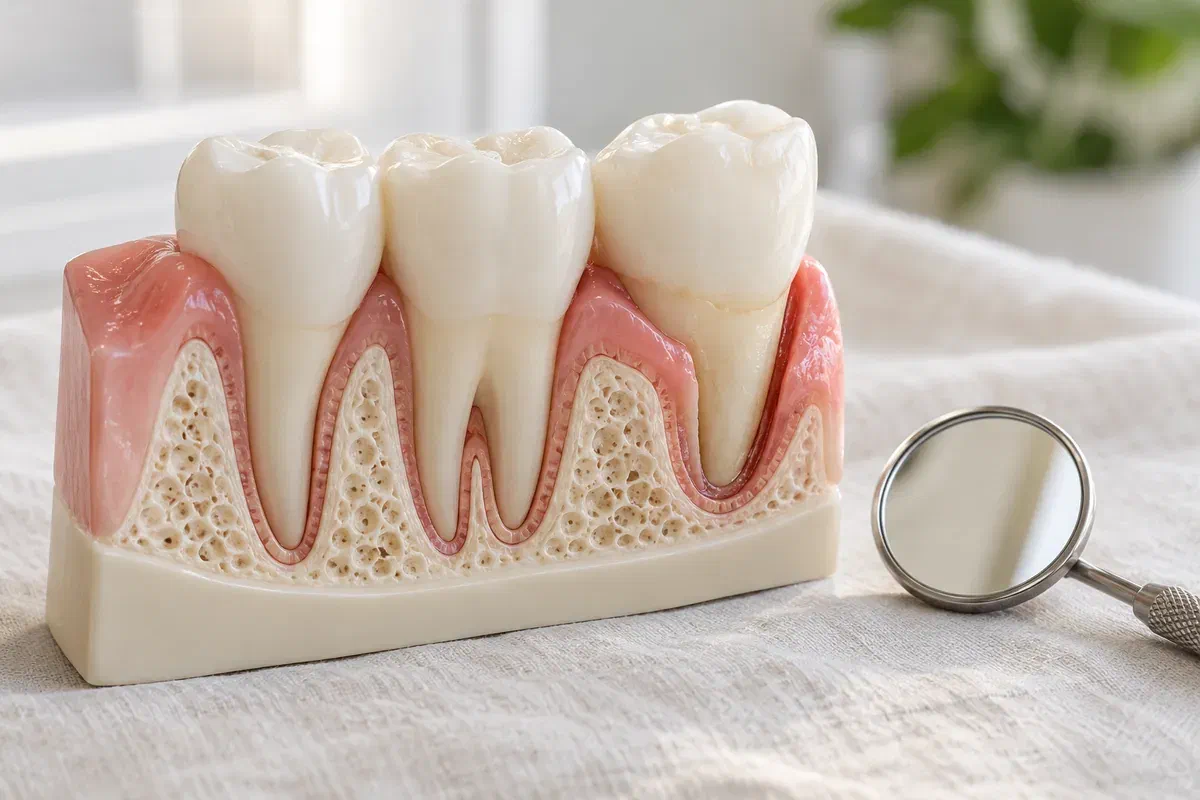
Illustrative connected tooth, gum, and supporting-bone teaching model
Reading old and new findings together

Your past treatment is useful evidence.

Gum disease that has returned may feel no different from day to day, so a lack of pain is not a reason to wait. Tell us what you remember about earlier care and what has changed since.

What looks or feels different now

Describe any return of bleeding, gums that sit lower than they did, wider spaces between teeth, or a tooth that feels unsteady when you chew. These details help point the examination in the right direction, though the diagnosis rests on measuring the tissues and support, not on appearance.

Records from earlier gum treatment

Old charts, X-rays or letters from a periodontist can be surprisingly helpful. Try to recall what was done, roughly when, and whether a follow-up check happened. That sequence helps separate disease that was never fully settled from new activity that began after maintenance lapsed.

Health, medicines and changing abilities

Over the years, health conditions, new prescriptions, tobacco habits and manual dexterity can all shift. Share what is relevant so the advice fits your situation. This is about finding practical help, never about fault, and a routine that has become harder to manage deserves to be changed.

Contact us promptly about new swelling, discharge, fever, severe pain or a tooth that is suddenly loose. Report an acute change straight away rather than holding it for a planned appointment.

An Old Milton plan that starts from today

Same mouth, updated priorities

Your earlier diagnosis is context, but it does not decide what happens to each tooth now. Ask which sites have changed since the last records, which have held steady, and what affects the outlook for each. If a stage or grade is mentioned, ask what it says about severity, treatment complexity and how quickly the disease appears to have progressed.

A returning plan still benefits from a clear order. Find out what the first phase is meant to achieve, when the response will be measured, and what results might prompt a referral. That way each appointment has a stated reason, and you are not left expecting a single reading to define the whole course.

Professional treatment for the sites that need it

The team can identify which areas have deposits or active disease and explain how treatment will be spread over appointments. Ask about comfort, visit length and whether freezing is planned. The extent of care should match today’s examination and your circumstances, not a set formula.

A routine refreshed for the mouth you have now

Interdental brush sizes that worked years ago may not suit wider spaces or a new crown. Ask for a fresh demonstration in the awkward spots, and bring any tool you have given up on. Being shown again is part of care, and nobody expects you to remember instructions from long ago.

Continuing visits that track your response

Ask what would show that your gums are stable enough for maintenance, and what would call for more active treatment. Reviews should be explained with your current measurements. Ongoing care reflects a history of disease; it does not mean the treatment you had before was pointless.

Step by step, again

Reassess, treat, check, and then decide

Restarting care may take several visits and could involve a periodontist you saw before or a new one. Ask who is coordinating each step and how records will be shared between offices.

  1. Measure current support and compare with the past

    Your history, today’s examination and appropriate X-rays are considered alongside any older records. Ask which teeth show reduced support and whether anything else is needed to complete the picture. The explanation should mark what is clear, what is uncertain and what deserves prompt attention.

  2. Restart daily plaque control and indicated treatment

    This phase pairs your home routine with professional care above and below the gumline where it is needed, and looks at risk factors you can influence. Ask how visits will be arranged and how discomfort will be managed. Mention any barriers so the plan stays achievable.

  3. Look again at how the tissues responded

    At the review appointment, findings are compared with the starting point and the team explains which sites settled. Ask what remaining inflammation or difficult access could mean. Further treatment should come with a reason attached rather than repeating the earlier approach by default.

  4. Move toward maintenance, referral or more care

    The response and the complexity of each site help determine whether further active treatment or specialist assessment makes sense. If maintenance is the next step, settle the interval and each person’s role. Before removing a tooth with a poor outlook, ask for the reasoning and the alternatives.

Keeping the momentum

This time, plan the follow-up before you leave.

Home care after treatment depends on what was done and how your gums are healing. Follow the guidance for your specific sites and let us know if cleaning becomes uncomfortable or unclear.

Use the method you practised at the visit

Work with the agreed tools and technique, and do not push a device into a gap where it does not fit. If a spot is still hard to reach, raise it at review or call for advice. A single workable change usually does more than several new products picked without help.

Keep us informed about your mouth and health

Report lingering sensitivity, new swelling, or a tooth that feels different or more mobile. Share updates on medical treatment and prescriptions, but leave prescribed care unchanged unless your physician advises otherwise. Your dental plan may need coordination with other clinicians when your health shifts.

Book the reassessment and the visits after it

Fewer bleeding spots are a good sign, but they do not confirm that treatment is finished. Attend the review that checks the response and sets the next stage. If keeping appointments gets difficult, call to talk about timing instead of letting the plan drift again.

If more care is needed

Choices that follow the response, one site at a time

Ask about the benefits, limits and alternatives of each suggestion. A history of periodontitis does not mean surgery, antibiotics or extraction are automatically next.

When professional cleaning and home care come first

Nonsurgical periodontal care with a planned review

This care removes deposits and calms inflammation in affected areas, followed by a check on the result. Ask what the treatment includes and what would lead to another phase. Neither antibiotics nor a particular named device should be assumed necessary for every plan.

When persistent disease or complexity needs a second view

A periodontist’s assessment or focused treatment

A specialist may talk through additional nonsurgical or surgical options depending on the findings. Ask what is realistic and what the procedure would change. Lost support cannot be rebuilt at every site, and the benefits and risks should be discussed for your own mouth.

When the long view becomes the main concern

Ongoing maintenance or a tooth-by-tooth decision

Steady areas can move into supportive care while a weaker tooth gets a separate discussion of its outlook. Ask how keeping, removing and later replacing that tooth would compare. Each part of the mouth can follow its own path, and the plan should allow for that.

Patient information: American Academy of Periodontology — nonsurgical care and further treatment

Returning-patient questions

What people ask when gum disease comes back into the conversation

Ask for a clear explanation of the affected areas, what comes first and the longer-term outlook. Answers should rest on your current examination and response to care, not on a general forecast.

(905) 876-4488
My gum treatment years ago seemed to work. Why is periodontitis showing up again?
Periodontitis can become active again, particularly if maintenance stopped or health factors changed. It does not mean the earlier treatment had no value. Ask which sites look different from your old records and what may have contributed.
Do I have to start from the very beginning after a long gap?
Usually a fresh assessment is needed, because the plan should reflect your mouth as it is now. Earlier records still help. Ask whether all areas need active treatment again or whether some sites have remained stable.
Are my older fillings and crowns affected by gum disease?
The gum and bone around restored teeth can be affected like any other tooth, and some edges can be harder to clean. Ask whether any restoration is making plaque control difficult and whether that needs attention as part of the plan.
Can I return to a periodontist I saw many years ago?
Often that is possible, and it can help with continuity. Ask whether a referral is recommended and how records will be shared. The dentist can explain what the specialist would be asked to assess.
Is it normal to feel embarrassed about letting recall visits slip?
It is a common feeling, and it should not stop you from coming in. Explain what got in the way so the plan can account for it. The team’s focus is on your gums now and on a schedule you can keep.
How can I fit periodontal visits around life near downtown Old Milton?
Ask about appointment timing early so the sequence suits your week. Hours are Monday to Thursday, 11am to 7pm, with Friday to Sunday by appointment only. Booking the reassessment before you leave makes it less likely to slip.
Returning to care from Old Milton

Bring your gum history and we will start from where you are.

Call our Bronte Street practice at (905) 876-4488 to book a periodontal review, whether you are newly diagnosed or picking up after a long break. Old gum-treatment records, if you can find them, help us connect what happened then with what is needed now.

The scope of treatment, prognosis, specialist involvement and maintenance timing differ from person to person. Planning depends on examination and review, and no procedure guarantees full recovery of lost support or permanent freedom from disease.

Visit Milton Dental Clinic
Unit 1, 342 Bronte St. S, Milton, ON L9T 5B7
Get directions Clinic hours
Monday–Thursday
11am–7pm
Friday–Sunday
By appointment only

Areas we serve

  • Milton
  • Oakville
  • Mississauga
  • Georgetown
  • Halton Hills
  • Acton
  • Campbellville
  • Brampton
  • Burlington
  • Puslinch
  • Rockwood
  • Erin
  • Caledon
  • Etobicoke
  • Old Milton
  • Bronte Meadows
  • Timberlea
  • Dorset Park
  • Dempsey
  • Clarke
  • Beaty
  • Coates
  • Harrison
  • Scott
  • Willmott
  • Ford
  • Bowes
  • Cobden
  • Walker
  • Mountain View
  • Milton Heights
  • Hawthorne Village
  • Valley View
  • Fallingbrook
  • Nassagaweya
  • Trafalgar
  • Esquesing
  • Nelson
  • Brookville
  • Moffat
  • Glen Williams
  • Norval
  • Limehouse
  • Stewarttown
  • Ashgrove
  • Hornby
  • Silver Creek
  • Speyside
  • Scotch Block
  • North Oakville
  • River Oaks
  • Glen Abbey
  • West Oak Trails
  • Palermo
  • Bronte Creek
  • College Park
  • Joshua Creek
  • Uptown Core
  • Preserve
  • Iroquois Ridge
  • Lisgar
  • Meadowvale
  • Meadowvale Village
  • Churchill Meadows
  • Erin Mills
  • Central Erin Mills
  • Streetsville
  • East Credit
  • Creditview
  • Heartland
  • Sheridan
  • Mount Pleasant
  • Credit Valley
  • Huttonville
  • Churchville
  • Springbrook
  • Northwest Brampton
  • Bram West
  • Fletcher's Meadow
  • Fletcher's Creek South
  • Alton Village
  • Orchard
  • Millcroft
  • Headon Forest
  • Tansley
  • Brant Hills
  • Tyandaga
  • Kilbride
  • Lowville
  • Aberfoyle
  • Morriston
  • Arkell
  • Hillsburgh
  • Freelton
  • Carlisle
  • Waterdown
  • Flamborough
  • Mountsberg

How can we help?

Milton Dental Clinic

Have a question about your smile? Choose the option that works best for you.

For urgent dental concerns, please call.
Messages are reviewed during clinic hours.