

Illustrative patient reviewing gum-treatment priorities with a clinician
Specialized Care

Periodontitis Treatment in Puslinch

Seeing bone loss on your own X-ray is sobering, and the natural next question is whether it can be rebuilt. We explain what the images show, what periodontal treatment can realistically achieve, and how care, cleaning and review protect the support you still have.

Puslinch · reading your X-rays

The bone that is left is what treatment works to protect.

On a dental X-ray, bone shows up as the lighter area surrounding each root. When the dentist points to places where that line sits lower than it should, you are looking at one of the hallmarks of periodontitis: a loss of the bone and attachment that support your teeth. Gingivitis, by comparison, is inflammation of the gums that has not caused that kind of loss.

It is easy to fixate on the images and assume the worst. Ask the dentist to put them in context alongside your gum measurements. Which teeth have lost the most support? Which are still well anchored? What cannot be judged yet? Having the whole picture usually makes the X-ray feel less like a verdict and more like a map.

The usual approach brings together professional treatment, a daily routine you can maintain, and reassessment. For households in Puslinch, setting out that sequence early helps with planning. The main goal is to stop or slow further loss and keep teeth stable. Some selected sites might be considered for regenerative procedures, but rebuilding lost bone is not something any plan can promise in general.

Have your X-rays explained
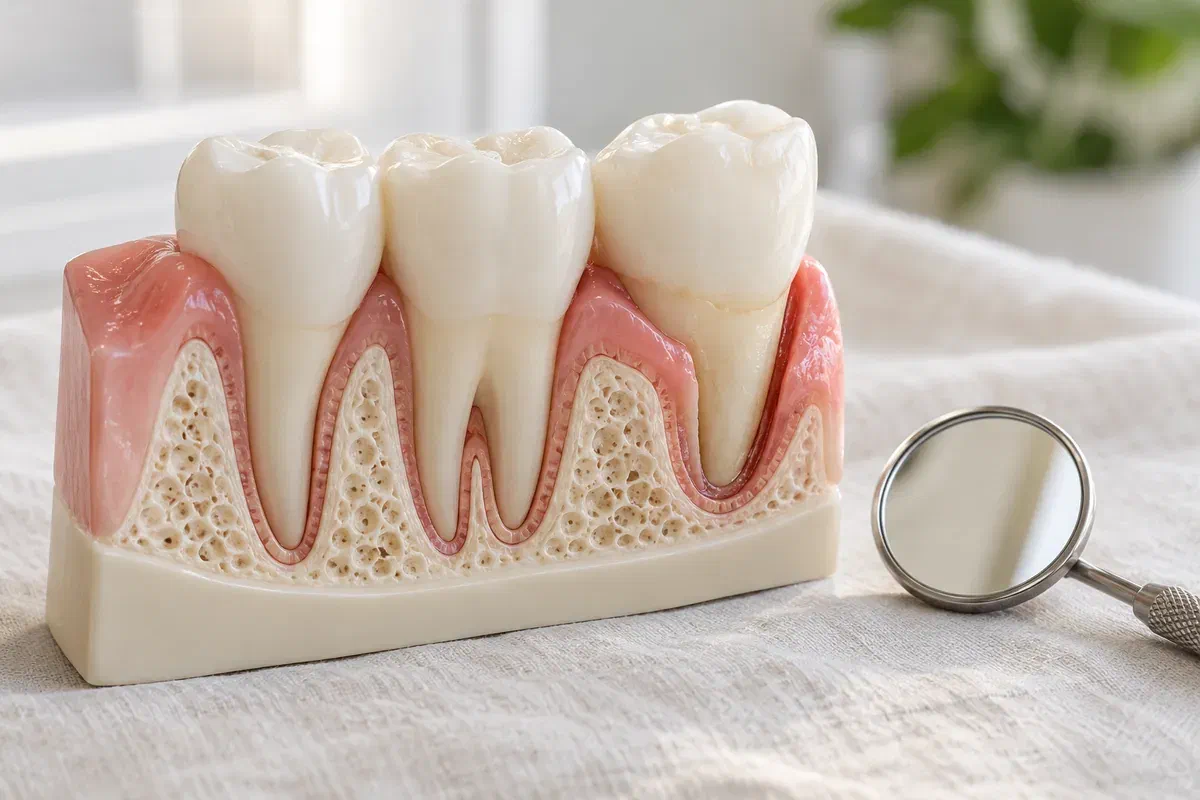
Illustrative connected tooth, gum, and supporting-bone teaching model
More than one image

Pictures, measurements and your own observations

X-rays show only part of the story. Tell us what you have noticed, and do not wait for discomfort before arranging care, because bone loss itself is often painless.

Signs in daily life

Mention bleeding, receding gums, widening gaps between teeth, food trapping or a change in your bite. These clues help focus the examination. The diagnosis still depends on assessing the tissues around each tooth, since neither the mirror nor a single image tells the full story.

Older X-rays and gum records

Earlier images are especially valuable because they allow comparison. If you have had periodontal care elsewhere, ask for X-rays and charts to be sent. Note what treatment you had and whether you were reassessed afterward, since this helps show whether loss is old, ongoing or recent.

Health factors and cleaning barriers

Share medical conditions, medicines, tobacco use and any trouble keeping teeth clean. These affect how the disease behaves and how your tissues heal. The conversation is about support, never blame, and a routine that has become difficult should be reworked rather than abandoned.

X-ray findings rarely need same-day action, but symptoms can. New swelling, pus, fever, severe pain or a loosening tooth should prompt a call without waiting for planned treatment.

Realistic expectations

Protecting support matters more than chasing what was lost.

Bone levels differ from one tooth to the next, so the outlook does too. Ask which sites show the greatest loss, which teeth are well supported, and what will influence each one’s prognosis. If the dentist refers to a stage or grade, ask how it captures severity, the likely complexity of care and what the records suggest about how quickly bone has been lost.

A clear order of treatment helps keep expectations grounded. Ask what the first phase is meant to accomplish, when the response will be judged, and what findings might lead to a specialist conversation about regeneration or other procedures. That way you know why each visit is happening, and no single X-ray is treated as the last word.

Professional treatment to halt active disease

The team can show which deposits and sites need care and explain how appointments will be arranged. Ask about comfort, how long each visit takes and whether freezing will be used. The scope of treatment should reflect your findings and circumstances.

Cleaning that suits changed spaces

As bone and gum levels change, the spaces between teeth can widen. Ask which interdental aids fit those gaps, and request a hands-on demonstration. Bring any tool that feels wrong. Practical guidance is a core part of treatment.

Comparison over time

Ask what findings would support a move to maintenance and what would suggest further active care. Later X-rays, taken when clinically appropriate, may be compared with today’s. Ongoing review is how a history of bone loss is managed, and it says nothing negative about earlier care.

The sequence of care

Stabilize first, then consider what else is possible

Treatment usually spans several appointments and may involve a periodontist, especially if regenerative options are being considered. Ask who coordinates each stage and how images will be shared.

  1. Combine X-rays with a periodontal examination

    Your history, gum measurements and appropriate images are interpreted together. Ask where bone has been lost and whether any further images or information are needed. The explanation should distinguish clear findings from uncertainty and highlight anything urgent.

  2. Treat active disease and set up your routine

    Professional cleaning beneath the gums where indicated is combined with daily plaque control and attention to risk factors. Ask how the visits will be arranged and how discomfort will be managed. Let the team know about barriers early.

  3. Recheck how the gums responded

    At reassessment, the team compares relevant findings with the baseline and explains which sites improved. Ask what remaining inflammation or deep areas mean for the next decision. Further care should have a clearly stated aim.

  4. Discuss maintenance, referral or site-specific options

    Depending on the response and the shape of the bone at particular sites, the next step could be maintenance, more treatment or a specialist assessment. Agree on intervals and responsibilities. If a tooth’s outlook is poor, ask for the reasoning and alternatives before deciding on removal.

Holding the line between visits

What you do at home protects the bone you have.

Aftercare depends on what was done and how your gums are responding. Follow the instructions for your own sites, and call with any question about cleaning, comfort or what you are noticing.

Clean the way you were shown

Use the agreed tools and technique, and never force a brush or pick into a gap that resists. If somewhere stays awkward, mention it at review or phone for guidance. A focused change usually helps more than a pile of new products.

Keep us informed

Let the team know about sensitivity that does not settle, any swelling, or teeth that begin to feel loose. Share updates on medical care and medicines, without stopping prescribed treatment yourself. When your health changes, coordination with your physician may be helpful.

Return for reassessment and ongoing care

Fewer bleeding spots are encouraging, but they do not confirm that active treatment is over. Keep the review that measures your response. If the timing stops working, call to reschedule rather than letting follow-up lapse.

Options after the first phase

Where regeneration fits, and where it does not

Ask what each option could accomplish, its limitations and the alternatives. A diagnosis of periodontitis does not make surgery, antibiotics or removal of affected teeth inevitable.

When controlling active disease is the priority

Nonsurgical treatment followed by review

This care removes deposits and reduces inflammation at affected sites, and a later appointment checks the result. Ask exactly what it covers and what would justify another stage. Antibiotics and branded technologies are not routinely needed.

When certain sites may suit further procedures

Specialist assessment, including regenerative options

A periodontist may discuss whether a particular defect could be suitable for regenerative or other surgical treatment. Ask what success would look like, how predictable it is at that site and what the risks are. Regeneration applies only to selected situations.

When long-term decisions come to the fore

Maintenance or planning for a poorly supported tooth

Stable sites can continue with supportive care, while a tooth with very little bone may need its own conversation. Ask how keeping it compares with removal and possible replacement later. Different teeth can have different futures.

Patient information: American Academy of Periodontology — nonsurgical care and further treatment

Bone-loss questions

Honest answers about what can be rebuilt

These are some of the questions X-ray findings tend to raise. Your own answers depend on your examination and how you respond to treatment, so bring them to your appointment and ask the team to relate each one to your images.

(905) 876-4488
Can bone lost to periodontitis grow back by itself?
Generally, no. Treatment aims to stop or slow further loss. In some selected sites, regenerative procedures may help rebuild part of the support. Ask whether any of your sites might be suitable and what realistic results would be.
Why does my X-ray look worse than my gums feel?
Bone loss can occur without pain, and gums may look fairly normal while support beneath them is reduced. Ask the dentist to show you how the images relate to your measurements and what they mean for each tooth.
Will I need more X-rays during treatment?
New images may be taken when clinically useful, for example to compare over time or plan further care. Ask when the next ones might be appropriate and what they would help decide.
Does bone loss mean I will eventually need implants?
Not necessarily. Many teeth with reduced support remain functional for years with treatment and maintenance. If a tooth is eventually lost, replacement options would be discussed then. Ask about the outlook for your specific teeth.
What kinds of bone defects are suitable for regeneration?
Suitability depends on the shape and location of the defect and other factors a periodontist assesses. Ask your dentist whether a referral to explore this is worthwhile in your case and what the specialist would look for.
Can my Puslinch appointments and any specialist visits be coordinated?
Ask the team how referrals are arranged and how images will be shared, so you are not repeating tests unnecessarily. Booking the reassessment before you leave also helps keep the sequence on track.
Planning from Puslinch

See what the images mean for your teeth.

Call the clinic at (905) 876-4488 to book a periodontal assessment or to discuss X-rays and a diagnosis you already have. Earlier images and gum-treatment records help us compare and connect past care with the most suitable next step.

Treatment scope, prognosis, the suitability of any regenerative procedure and maintenance intervals vary. Every plan depends on examination and review; no treatment can guarantee that lost bone will return or that disease will never recur.

Visit Milton Dental Clinic
Unit 1, 342 Bronte St. S, Milton, ON L9T 5B7
Get directions Clinic hours
Monday–Thursday
11am–7pm
Friday–Sunday
By appointment only

Areas we serve

  • Milton
  • Oakville
  • Mississauga
  • Georgetown
  • Halton Hills
  • Acton
  • Campbellville
  • Brampton
  • Burlington
  • Puslinch
  • Rockwood
  • Erin
  • Caledon
  • Etobicoke
  • Old Milton
  • Bronte Meadows
  • Timberlea
  • Dorset Park
  • Dempsey
  • Clarke
  • Beaty
  • Coates
  • Harrison
  • Scott
  • Willmott
  • Ford
  • Bowes
  • Cobden
  • Walker
  • Mountain View
  • Milton Heights
  • Hawthorne Village
  • Valley View
  • Fallingbrook
  • Nassagaweya
  • Trafalgar
  • Esquesing
  • Nelson
  • Brookville
  • Moffat
  • Glen Williams
  • Norval
  • Limehouse
  • Stewarttown
  • Ashgrove
  • Hornby
  • Silver Creek
  • Speyside
  • Scotch Block
  • North Oakville
  • River Oaks
  • Glen Abbey
  • West Oak Trails
  • Palermo
  • Bronte Creek
  • College Park
  • Joshua Creek
  • Uptown Core
  • Preserve
  • Iroquois Ridge
  • Lisgar
  • Meadowvale
  • Meadowvale Village
  • Churchill Meadows
  • Erin Mills
  • Central Erin Mills
  • Streetsville
  • East Credit
  • Creditview
  • Heartland
  • Sheridan
  • Mount Pleasant
  • Credit Valley
  • Huttonville
  • Churchville
  • Springbrook
  • Northwest Brampton
  • Bram West
  • Fletcher's Meadow
  • Fletcher's Creek South
  • Alton Village
  • Orchard
  • Millcroft
  • Headon Forest
  • Tansley
  • Brant Hills
  • Tyandaga
  • Kilbride
  • Lowville
  • Aberfoyle
  • Morriston
  • Arkell
  • Hillsburgh
  • Freelton
  • Carlisle
  • Waterdown
  • Flamborough
  • Mountsberg

How can we help?

Milton Dental Clinic

Have a question about your smile? Choose the option that works best for you.

For urgent dental concerns, please call.
Messages are reviewed during clinic hours.