

Illustrative conversation about preparing the mouth for a dental prosthesis
Specialized Care

Pre-Prosthetic Oral Surgery in Rockwood

A bump, a raw patch or a fold of gum under your denture is easy to blame on the appliance. From Rockwood, learn why tissue changes are looked at on their own first, and when preparing the ridge or gum for a new prosthesis comes into the discussion.

What’s under the denture? Rockwood

Look at the tissue before planning the teeth.

Many people first notice something is off when they take the denture out at night: a red patch, a ridge of extra gum along the edge, or a spot that feels tender to the touch. Often these are related to pressure from the appliance. Sometimes they are not, which is why the tissue itself deserves a careful look before anyone talks about a new denture or surgery.

Once the tissue has been assessed, the planning question can be asked. Pre-prosthetic oral surgery covers targeted procedures on the bone or gum when one feature, such as overgrown tissue at the denture border, a sharp ridge or a tight attachment, would keep the planned replacement from working. Irritated gum frequently settles when the appliance is adjusted, so surgery is not the default.

Bring the denture, a note of when you first noticed the change and any plan from another office. Our team can examine the area, explain what we see and how it relates to a future appliance, and discuss when a surgeon, a specialist or the person making the prosthesis should be involved.

Have the area checked
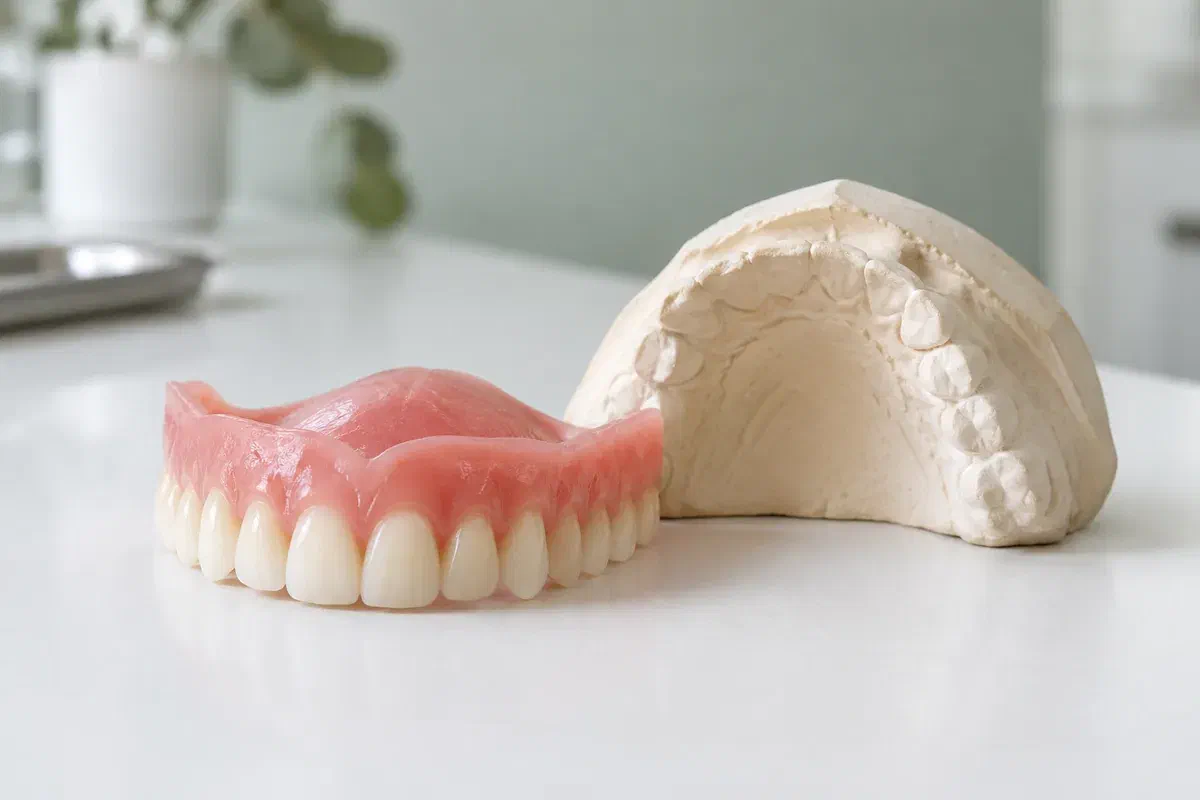
Illustrative denture and dental cast used to explain restorative planning
Changes to mention

Something new under the appliance

Describe what you have noticed and how long it has been there. That history helps the clinician decide whether a finding is a fit problem, a tissue problem that needs its own assessment, or both.

A tender spot that returns

Show where it hurts and whether adjustments have helped. Bony irregularity can be one cause; an ill-fitting denture or inflamed gum are others. Bring the appliance, even if you have stopped wearing it, so its fit can be checked against the tissue.

Extra folds of gum at the denture edge

Tissue that has grown or folded where the denture border sits is often linked to an appliance that no longer fits well. Ask whether adjusting or resting the denture might let it settle, and whether a second look is planned before any removal is discussed.

A tissue finding and a denture plan in different hands

If one office is assessing a tissue change and another is planning your denture, ask what each needs to know. Bring any written findings. The denture plan should wait until the tissue question has been answered, and one person should confirm readiness for impressions.

An ulcer that hasn’t healed within a couple of weeks, a lump that is growing, or a patch that has changed colour or texture without explanation should be assessed promptly and separately. Don’t wait for a new denture to see if it goes away.

Why sequence matters

Answers about the tissue, then a plan for the teeth

If surgery is eventually recommended, its purpose should be explained in relation to the prosthesis. Ask what specific obstacle it removes, what change is realistic and what limits will remain. Reshaping or removing tissue gives a better starting point, but it doesn’t determine how the new appliance fits, looks or must be maintained.

Taking things in order also makes the period between appointments easier to manage. Find out whether the current denture should be worn, adjusted or rested, and how the timeline changes if the tissue needs more time or a further assessment. That makes it easier to organise meals, work and any interim arrangement.

Patient information: AAOMS — preparation before fitting a dental prosthesis

A clear explanation of the finding

Ask the clinician to describe what they see, and whether it is related to the denture, the bone, the gum or something that needs a different kind of assessment. Understanding this helps you follow the reasoning behind each recommendation.

Coordination between assessment and restoration

If a specialist is assessing tissue and another clinician is planning the prosthesis, they should share findings and agree on timing. Ask who is coordinating and how results will be passed on.

Realistic expectations for the new appliance

Discuss comfort, stability, cleaning and future adjustments separately. Preparation may solve one problem without eliminating every challenge of a removable denture. Ask which outcomes can be estimated now and which will be judged after you start wearing it.

A careful order of steps

Examine first. Plan second. Prepare only if needed.

Ask about any tissue finding, the possibility of surgery and the denture design in one conversation. If something is unclear, resolve it before a procedure is booked or an appliance is made.

  1. Describe the change and your denture history

    Explain what you noticed, when it began and how your appliance has felt. Share medical conditions, medicines, smoking history if relevant, and earlier oral surgery. Mention if several appointments would be hard to manage.

  2. Examine the tissue and the denture together

    The clinician checks the area, the fit of the appliance and the supporting ridge, and decides whether imaging, a period of observation or a specialist opinion is needed. Ask what each step is meant to find out.

  3. Discuss what the findings mean for treatment

    Options may include adjusting or resting the denture, redesign, a targeted procedure or referral. If surgery is proposed, review the intended change, significant risks, pain control, alternatives and recovery. Ask how the plan would change if new information comes to light.

  4. Plan healing and the move to a new appliance

    Agree who will review the treated area and confirm it has healed. Get written guidance on wearing an appliance, cleaning, food and contact details. Ask whether impressions depend on that review rather than a fixed date.

While the area recovers

Protect the healing tissue from old pressure.

Aftercare depends on the procedure and whether you wear an appliance during healing. Follow the written instructions from your treating clinician rather than going straight back to your old routine.

Check how and when to wear the denture

Your current appliance may need relief over the treated area, a soft liner or a reduced wearing time. Ask before putting it back in, and report any pressure. Avoid adjusting it at home, since that is how sore spots often recur.

Follow the cleaning and eating plan

Find out which areas to brush, how to keep the surgical site clean and when firmer foods can return. Tell the team if soreness or the appliance makes eating difficult. Use only the rinses and medicines prescribed for you.

Return for review before any next step

The follow-up checks healing, how the denture meets the tissue and whether new impressions can be taken. Bring the appliance and describe what feels different. If any tissue was sent for assessment, ask how and when you will hear the result.

Approaches to consider

Rest, relieve, then reassess

Each option should link what the examination found with what the replacement needs. Ask what each involves, its limits and whether it changes the timing or cost of treatment.

When irritation is driving the problem

Adjusting or resting the appliance

Easing the denture where it presses, adding a temporary soft lining or leaving it out for periods as directed can let irritated tissue settle. A reline or new denture may follow. The choice depends on the state of the tissue and appliance.

When a defined feature persists

Removing or reshaping a specific area

If excess tissue or a ridge irregularity remains after irritation has been addressed, targeted surgery may be discussed. Ask what would be removed or reshaped, how much and why. Useful support should be preserved and risks explained.

When a finding needs another opinion

Specialist assessment or a different plan

Some tissue changes call for specialist evaluation, and complex anatomy may justify rethinking the type of prosthesis. Ask what further assessment would involve and how it affects the denture timeline. A specialist should help clarify the next step.

Questions about tissue changes

Sores, folds and lumps under a denture

Bring your appliance and a note of when you noticed the change. These answers are general information; any recommendation depends on examination and the replacement planned.

(905) 876-4488
What causes extra folds of gum along the edge of a denture?
They are often linked to an appliance whose border presses on or rubs the tissue over time, especially as the ridge changes. Adjusting or replacing the denture may help. Some cases need removal of the excess tissue, but that is decided after examination.
How long should a denture sore take to heal?
A sore caused by pressure usually improves once the cause is addressed. If a sore persists for more than a couple of weeks, or keeps returning in the same place, it should be examined, even if you think it is simply the denture.
Will a lump under my denture need a biopsy?
Not necessarily. Many lumps relate to irritation or the shape of the bone. If a finding is unusual or doesn’t respond to removing the source of irritation, the clinician may recommend further assessment, which can include a biopsy or specialist referral.
Should I stop wearing my denture if the gum is sore?
Giving the tissue a rest can help, but ask for advice rather than guessing. You may be told to leave the appliance out for certain periods, or it may be adjusted to relieve pressure.
Can tissue changes be treated at the same time as ridge preparation?
Sometimes, if both are planned and the tissue has been properly assessed. In other cases, the tissue question needs to be answered first. Ask how the steps would be ordered for you.
Should I wait for a convenient trip from Rockwood to have a sore checked?
If it is new and mild, call to describe it and ask for advice. If it has lasted weeks, is growing or has changed in appearance, book an assessment rather than waiting.
From Rockwood

Notice something new? Bring it, and the denture, in.

Tell us what you have noticed and what replacement you have in mind. We can examine the area, explain the findings and discuss how any next steps would be coordinated.

Advice on treatment and referral comes after we have examined the area.

Visit Milton Dental Clinic
Unit 1, 342 Bronte St. S, Milton, ON L9T 5B7
Get directions Clinic hours
Monday–Thursday
11am–7pm
Friday–Sunday
By appointment only

Areas we serve

  • Milton
  • Oakville
  • Mississauga
  • Georgetown
  • Halton Hills
  • Acton
  • Campbellville
  • Brampton
  • Burlington
  • Puslinch
  • Rockwood
  • Erin
  • Caledon
  • Etobicoke
  • Old Milton
  • Bronte Meadows
  • Timberlea
  • Dorset Park
  • Dempsey
  • Clarke
  • Beaty
  • Coates
  • Harrison
  • Scott
  • Willmott
  • Ford
  • Bowes
  • Cobden
  • Walker
  • Mountain View
  • Milton Heights
  • Hawthorne Village
  • Valley View
  • Fallingbrook
  • Nassagaweya
  • Trafalgar
  • Esquesing
  • Nelson
  • Brookville
  • Moffat
  • Glen Williams
  • Norval
  • Limehouse
  • Stewarttown
  • Ashgrove
  • Hornby
  • Silver Creek
  • Speyside
  • Scotch Block
  • North Oakville
  • River Oaks
  • Glen Abbey
  • West Oak Trails
  • Palermo
  • Bronte Creek
  • College Park
  • Joshua Creek
  • Uptown Core
  • Preserve
  • Iroquois Ridge
  • Lisgar
  • Meadowvale
  • Meadowvale Village
  • Churchill Meadows
  • Erin Mills
  • Central Erin Mills
  • Streetsville
  • East Credit
  • Creditview
  • Heartland
  • Sheridan
  • Mount Pleasant
  • Credit Valley
  • Huttonville
  • Churchville
  • Springbrook
  • Northwest Brampton
  • Bram West
  • Fletcher's Meadow
  • Fletcher's Creek South
  • Alton Village
  • Orchard
  • Millcroft
  • Headon Forest
  • Tansley
  • Brant Hills
  • Tyandaga
  • Kilbride
  • Lowville
  • Aberfoyle
  • Morriston
  • Arkell
  • Hillsburgh
  • Freelton
  • Carlisle
  • Waterdown
  • Flamborough
  • Mountsberg

How can we help?

Milton Dental Clinic

Have a question about your smile? Choose the option that works best for you.

For urgent dental concerns, please call.
Messages are reviewed during clinic hours.