

Illustrative consultation about a changing gumline and tooth sensitivity
Specialized Care

Receding Gums Assessment in Acton

No pain, no bleeding, just a gum that seems to have slipped a little. It is easy to put off. A receding gums assessment, booked from Acton, records where the gum sits now, checks for anything active, and tells you how closely it really needs watching.

Quiet changes at the gumline

Does a gum that does not hurt still need a look?

Usually, yes, and here is why. Recession is the gum margin moving lower on the tooth, so a strip of root that was once covered is now exposed. It can happen with no discomfort at all. Without symptoms to go on, there is no way to tell from the mirror whether the change is old, still under way, or linked to something that needs care.

An assessment fills that gap. The clinician reviews the gum tissue, the exposed root, your cleaning habits and your dental history, and records the gum position so it can be compared later. Recession has more than one possible contributor and does not always reflect the same underlying problem. A single site is considered with the rest of the mouth.

Since Acton is a smaller community, many people prefer to tie a gum check into a regular visit rather than make a separate trip. Tell us when you noticed the change and what, if anything, worries you about it. We will explain what we find, how often it should be reviewed, and whether anything beyond monitoring would be useful.

Book a check on a painless gum change
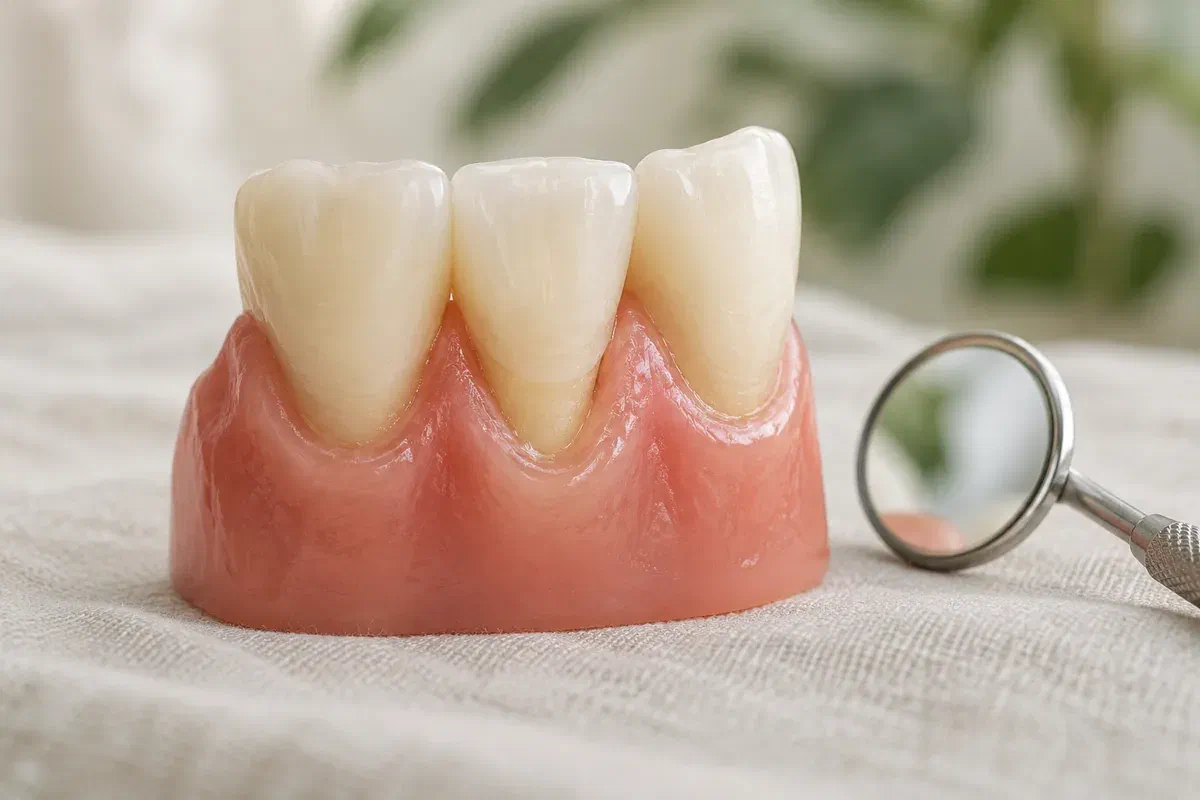
Illustrative teaching model showing an exposed tooth neck beside neighbouring teeth
Small details, useful context

Even without symptoms, you have information to share.

Leave the measuring to us. Tell us what you have noticed and when, and if you have older dental records or photos that show the area before, they can help with the timeline.

A gum edge that looks lower than before

Lower front teeth and canines are common places to spot this, but it can happen anywhere. Mention past orthodontic work, fillings near the gum or earlier gum care. These facts help guide the examination without settling the cause or showing whether anything is still moving.

Sensitivity, now or in the past

Painless now does not always mean painless before. Mention any twinges from cold or brushing, even if they stopped. Since other tooth problems can feel similar, any pain that returns, starts without a trigger or slowly intensifies needs proper examination rather than an assumption.

Small changes in how you clean

Perhaps you brush that side a little faster, or skip floss there because it catches. Tell us, and describe your products. The aim is a gentle routine that keeps the area clean, not harder brushing and not quietly giving up on the spot.

No pain does not mean no reason to look. If the gum ever swells suddenly, discharges pus, becomes very painful, or a tooth starts to feel loose, treat that as a different situation and call us promptly.

Why a quiet change still matters

A record today makes tomorrow’s answer easy.

For a painless change, the most valuable result is often a clear baseline. The clinician checks whether the gum is inflamed, looks for any hint of periodontitis and notes where the margin sits. If earlier measurements exist, they can be compared; if not, this visit creates the reference that future appointments will use.

Your own concerns still steer the plan. Perhaps you are not bothered now but want to avoid sensitivity later, or you would like to know whether the change will affect how the tooth looks. Ask what each suggestion is for, and what, if anything, would simply be monitored.

Patient information: Cambridge University Hospitals — recession factors and soft-tissue grafting

A starting measurement for the site

With the gum position recorded, the next review can show whether anything has moved. Ask which teeth are on the watch list. It is a much more dependable approach than glancing in the mirror whenever you happen to remember.

Preventive advice while things are calm

This is a good moment to review brushing pressure, cleaning aids and any irritation the clinician notices. Ask to be shown the technique on the affected tooth. Some factors, such as how thick your gum tissue naturally is, are anatomy rather than anything you have done.

An idea of when a specialist would help

If the site looks complex, a periodontist might be suggested to assess it or discuss grafting. Ask what that visit would answer. Seeing a specialist does not oblige you to have surgery, and the consultation should cover benefits, limits, alternatives and recovery.

During the appointment

Straightforward, and focused on the record

If you find gum measurements uncomfortable or a spot is tender, mention it first. Nothing will be decided at this visit before you understand the findings and the options.

  1. Talk about what you have seen

    Explain when you noticed the change and any earlier advice or treatment. Expect a few questions about your cleaning routine, whether you smoke, and any medical conditions or prescriptions. Then tell us what you would like to know, such as how likely further change is or whether appearance could be affected.

  2. Measure and examine the area

    The gum position is recorded alongside gum health, the tooth’s condition and other findings. Imaging is used only where it helps answer a specific question. Ask what this examination can tell you today and whether older records might show the change is longstanding.

  3. Decide whether anything needs action now

    If there is active disease or irritation, that comes first. Otherwise, the choice may be between monitoring, preventive care and, occasionally, a specialist view. Ask which findings support the recommendation, so it is based on the examination rather than on how the tooth looks.

  4. Set a review interval and home routine

    You should leave knowing how to care for the area and when it will be rechecked. Ask what signs should prompt you to call before then, and whether any referral is planned. If there are several steps, confirm their order.

Keeping it calm

Simple habits for a gum that is behaving

Home care should reflect what the clinician found. Ask for a routine that is easy to keep up, and avoid swapping several products at once on your own, which can make sensitivity harder to read.

Brush softly and clean between teeth

A soft brush and a light hand are typical advice, along with an interdental aid that suits the space. Neglecting the area is not protective, and scrubbing it will not encourage the gum to return. Mention any aid that causes discomfort.

Know what to do if sensitivity starts

If the root becomes sensitive later, call or mention it at your next visit; the clinician can check the tooth and may suggest a desensitizing product or other care. A calmer tooth does not mean the gum position has changed.

Keep the review, skip the self-testing

Come back for the planned recheck and bring up anything new, such as a twinge or a spot that has become awkward to clean. Findings are then compared with the baseline and the plan adjusted. Inspecting the gum in the mirror every few days, or biting on ice to see whether it twinges, will not tell you much.

What the plan might involve

Most quiet changes start with watching.

Ask what each option would do for the tooth. When the gum is calm, monitoring and good daily care are often enough, with the need for anything more reconsidered at each review.

When the site is stable enough to observe

Monitoring with sensible home care

Gentle technique, removal of any irritation and comparison at future visits may be all that is needed. Ask why monitoring fits and what would change that. A watch plan should have a clear review date.

When disease, decay or sensitivity appears

Care for any finding that needs it

Gum disease, decay on the root or sensitivity may need specific treatment. Find out exactly which condition is being treated and what stays the same. Treating a tooth surface does not move the gum edge, even if both issues show up together.

When the tissue condition raises questions

A periodontal opinion on grafting

Occasionally a graft is discussed to thicken tissue or cover some exposed root. Whether that suits you depends on the tooth and the approach a specialist would use. It is worth asking how much root could realistically be covered, where tissue would be taken from, how healing goes and where the limits lie; full coverage and no further recession cannot be promised.

Patient information: American Academy of Periodontology — gum graft procedures

Acton FAQs

Questions about recession you cannot feel

General guidance only. Your examination is where the gum’s condition and the tooth’s health are considered together, so mention any concern, however minor.

(905) 876-4488
Can recession lead to losing a tooth?
Recession alone does not usually mean a tooth will be lost. Tooth loss is more closely linked to loss of supporting bone, such as in advanced gum disease. The clinician checks the supporting tissues as part of the assessment.
How fast does gum recession usually progress?
There is no single rate. Some sites remain stable for years, while others change more quickly. That is why a recorded baseline and planned reviews matter more than a general estimate.
Why is recession common on the lower front teeth?
Gum tissue there is often thin, and tartar can build up behind those teeth. Tooth position may also play a role. The clinician can explain which factors seem relevant in your mouth.
Can I just have my gums checked at my regular cleaning?
Often, yes. Recession can be measured and recorded during a routine visit. If the clinician thinks a site needs a more focused look, they will explain why.
My gum does not hurt, so why does it need measuring?
Measurement gives a fixed point to compare against later. Without it, it is hard to know whether the gum is stable. The lack of symptoms does not explain the cause.
Would a night guard help if I clench my teeth?
A night guard is mainly used to protect teeth from grinding and clenching. Whether it is relevant to your gums depends on the findings, so mention any clenching and the clinician can advise.
Visiting from Acton

A short visit now saves guessing later.

Contact Milton Dental Clinic about a gum that has receded, an exposed root, or sensitivity near the gumline. Any previous records are helpful, and together we can settle on how closely the area should be followed.

Monitoring intervals and any treatment depend on what the examination shows.

Visit Milton Dental Clinic
Unit 1, 342 Bronte St. S, Milton, ON L9T 5B7
Get directions Clinic hours
Monday–Thursday
11am–7pm
Friday–Sunday
By appointment only

Areas we serve

  • Milton
  • Oakville
  • Mississauga
  • Georgetown
  • Halton Hills
  • Acton
  • Campbellville
  • Brampton
  • Burlington
  • Puslinch
  • Rockwood
  • Erin
  • Caledon
  • Etobicoke
  • Old Milton
  • Bronte Meadows
  • Timberlea
  • Dorset Park
  • Dempsey
  • Clarke
  • Beaty
  • Coates
  • Harrison
  • Scott
  • Willmott
  • Ford
  • Bowes
  • Cobden
  • Walker
  • Mountain View
  • Milton Heights
  • Hawthorne Village
  • Valley View
  • Fallingbrook
  • Nassagaweya
  • Trafalgar
  • Esquesing
  • Nelson
  • Brookville
  • Moffat
  • Glen Williams
  • Norval
  • Limehouse
  • Stewarttown
  • Ashgrove
  • Hornby
  • Silver Creek
  • Speyside
  • Scotch Block
  • North Oakville
  • River Oaks
  • Glen Abbey
  • West Oak Trails
  • Palermo
  • Bronte Creek
  • College Park
  • Joshua Creek
  • Uptown Core
  • Preserve
  • Iroquois Ridge
  • Lisgar
  • Meadowvale
  • Meadowvale Village
  • Churchill Meadows
  • Erin Mills
  • Central Erin Mills
  • Streetsville
  • East Credit
  • Creditview
  • Heartland
  • Sheridan
  • Mount Pleasant
  • Credit Valley
  • Huttonville
  • Churchville
  • Springbrook
  • Northwest Brampton
  • Bram West
  • Fletcher's Meadow
  • Fletcher's Creek South
  • Alton Village
  • Orchard
  • Millcroft
  • Headon Forest
  • Tansley
  • Brant Hills
  • Tyandaga
  • Kilbride
  • Lowville
  • Aberfoyle
  • Morriston
  • Arkell
  • Hillsburgh
  • Freelton
  • Carlisle
  • Waterdown
  • Flamborough
  • Mountsberg

How can we help?

Milton Dental Clinic

Have a question about your smile? Choose the option that works best for you.

For urgent dental concerns, please call.
Messages are reviewed during clinic hours.