Illustrative consultation about a changing gumline and tooth sensitivity
Specialized Care

Receding Gums Assessment in Erin

Checking the same tooth in the mirror every morning, unsure whether the gum looks worse or just different in this light? A receding gums assessment for people in Erin and Hillsburgh replaces that guesswork with a measured record and a plan.

Erin · from mirror checks to measurements

The bathroom mirror is a poor ruler.

Once you have noticed a receding gum, it is hard to stop looking. Morning light, evening light, phone camera, lip pulled down: each view seems a little different, and the worry grows. Recession means the gum margin has shifted down the tooth and exposed some root. Studying it at home cannot show why that happened or whether it is still going on.

What settles the question is a consistent clinical record. During an assessment, the clinician examines the gum tissue, the root surface, your cleaning habits and your dental history, and measures the gum position. Recession can have several contributing factors and is not always a sign of one particular disease. A single tooth is considered with every other tooth in view.

For many people in Erin, the relief of having a baseline is half the value of the visit. Tell us when you first noticed the change and what worries you most. You will hear, in plain language, what the clinician found, how the area will be followed, and whether anything beyond monitoring, such as treatment or a periodontal opinion, is warranted.


Swap mirror checks for a measured baseline
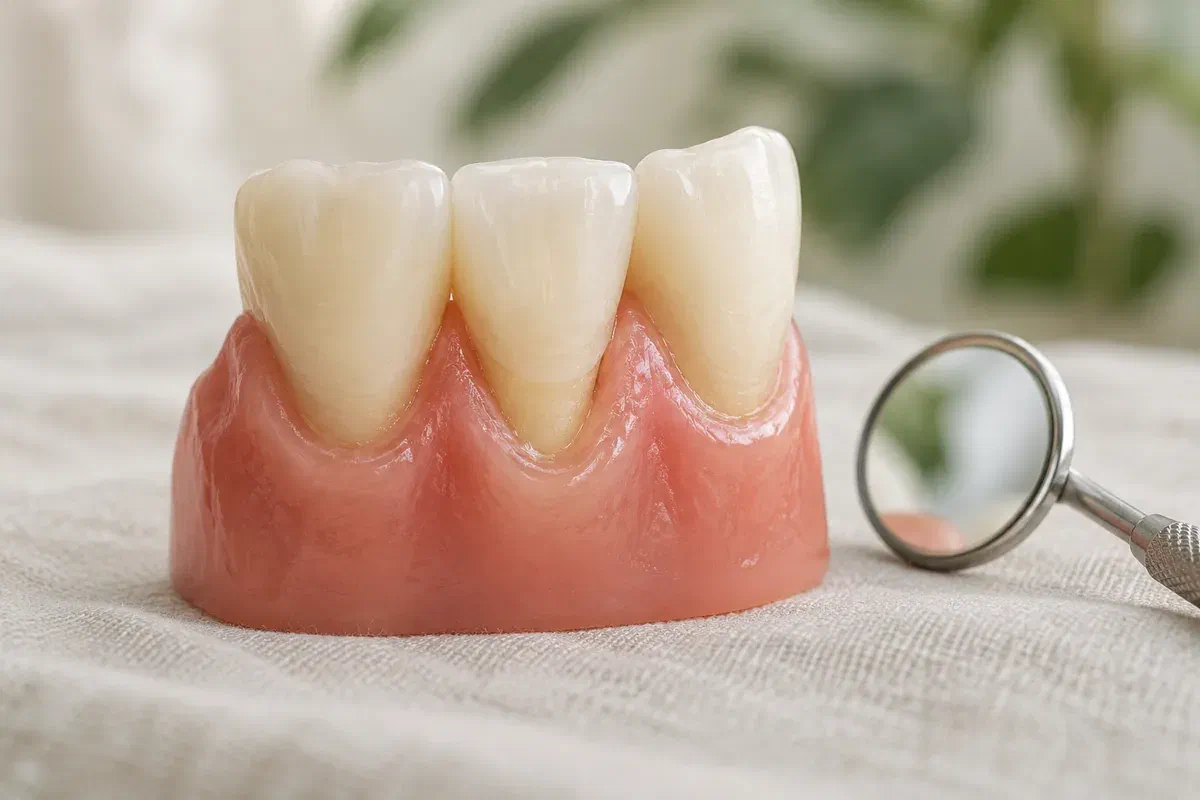
Illustrative teaching model showing an exposed tooth neck beside neighbouring teeth
What to bring besides the worry

Your observations are useful; your measurements are not needed.

Your account of what you have seen and felt is a good place to start. If older photographs or dental records show the tooth before, bring them as a rough timeline, but leave the measuring to the clinician.

The tooth you keep checking

Point it out and mention any others that have caught your eye. Orthodontic history, fillings or crowns at the gum and earlier gum treatment are all worth sharing. Such details guide the examination but cannot confirm a cause or show active change.

Sensitivity, if it comes and goes

Explain which triggers produce it and how long it lasts. Root exposure often causes brief twinges, but other dental problems can feel very similar. Discomfort that lingers, appears without a trigger or slowly increases needs a proper examination rather than an assumption.

Cleaning you have changed out of worry

Some people stop flossing a tooth they are anxious about, or brush it extra hard. Tell us what you do now and which products you use. The team will help you find a gentle, effective method so the area is neither scrubbed nor neglected.

Assessment is worthwhile even when the only symptom is worry. If the gum swells suddenly, leaks pus, becomes very painful, or a tooth begins to move, that is a different matter; phone us about it right away.

Why a baseline brings peace of mind

One measured starting point beats a hundred mirror checks.

The assessment establishes facts you cannot gather at home. Is the gum tissue healthy or inflamed? Are there signs of periodontitis? Is the margin at a position that has been recorded before? If older measurements cannot be found, the figures from this visit become the benchmark, and future visits can show whether anything has truly moved.

It also gives your concerns a proper hearing. If anxiety about progression is the main issue, the plan may focus on monitoring. If sensitivity or a hard-to-clean area is more pressing, the first step may differ. Ask which worry each suggestion is designed to address, and what will still be followed.

Patient information: Cambridge University Hospitals — recession factors and soft-tissue grafting

A comparison you can rely on

Measurements repeated the same way at each review show real change, unlike photos taken in different light. Ask which sites are being tracked and what would count as significant. Knowing that someone else is watching makes it easier to stop checking yourself.

Calm, practical cleaning advice

Discuss pressure, brush type and the interdental aids that suit you, and ask for a demonstration on the tooth that worries you. Recommendations should be manageable. How thick your gum is and where the tooth sits are anatomy, not something you caused.

An honest view of specialist care

If the site is complex or the gum is changing, a periodontist may be suggested to assess it or discuss grafting. Ask what the referral would answer. Seeing a specialist is not agreeing to surgery, and you should hear about benefits, limits, alternatives and recovery.

What the visit looks like

Calm, unhurried and measured

If having your gums examined makes you anxious, or one spot is tender, please say so first. The appointment is about understanding, and nothing is decided until you have heard what was found.

  1. Start with what has been worrying you

    Describe what you noticed, when and how often you have been checking, plus any earlier advice. We may ask about smoking, medical conditions and medicines. Tell us the outcome you most want, whether reassurance, comfort, appearance or a clear sense of risk.

  2. Record the gum position and gum health

    The clinician measures the recession and checks gum health, the tooth’s condition and other findings. Imaging is used only where it answers a particular question. Ask what the examination can establish now, and whether your older photos or records might show the change is longstanding.

  3. Explain the findings in plain terms

    Active disease or irritation, if present, is addressed first. Then the options, usually monitoring, sensitivity care or a periodontal view, are explained. Ask what in the examination supports each, so you understand why a particular path is suggested.

  4. Agree on a review so you can stop checking

    Leave with clear home care instructions and a date for the next comparison. Ask which signs mean calling sooner, and whether any referral is being arranged. If several steps are planned, confirm their order and how each will be judged.

Between reviews

Care for the tooth, then leave it be.

Your home routine should reflect the findings. Ask the team to show you each step, and try not to experiment with several new products at once, since that makes it harder to tell what is helping.

Clean gently and consistently

A soft brush, a light touch and the right interdental aid are usually advised. Avoiding the worrying tooth lets plaque build up, and brushing it harder will not restore the gum. Tell us if a suggested aid is painful.

Manage any sensitivity calmly

If the tooth is sensitive, the clinician may recommend a suitable toothpaste or other protective care after checking it. Find out how long to try it before review. Less sensitivity is welcome, but it does not show the gum has grown back.

Put the mirror away

Come to the agreed review and mention any new symptoms or trouble cleaning. The clinician will repeat the measurements and update the plan. Daily lip-pulling, phone photos or testing with cold drinks will only feed the worry without giving a reliable answer.

Possible plans

From watchful waiting to a specialist referral

Ask what each option is intended to do for the tooth. Very often, good daily care and planned monitoring come first, and further treatment is considered only if the comparison shows it is needed.

When the gum appears healthy and stable

Planned monitoring with home care

Gentle technique, attention to any irritation and repeat measurements at set intervals may be the right approach. Ask what would lead the clinician to change course. Monitoring should have dates and criteria, so you are not left to watch it yourself.

When disease, decay or root sensitivity is found

Treatment for a separate problem

Gum disease, decay on the root or a sensitive surface may need specific care. Ask which problem each treatment is aimed at and what it will not change. Treating the tooth or easing discomfort does not alter the gum’s position.

When tissue condition calls for more input

Specialist discussion of grafting

In a suitable case, a periodontist may discuss a graft to add tissue or improve root coverage. Results depend on the site and method. Ask what coverage is realistic, where tissue would come from, how recovery goes and what the limits are; a complete or permanent result is not something that can be promised.

Patient information: American Academy of Periodontology — gum graft procedures

Questions from Erin

Easing the worry about a receding gum

General answers only. The clinician relates your gum’s condition to the health of the tooth during the examination, so bring every question, however small it seems.

(905) 876-4488
Is it normal to feel anxious about a receding gum?
Yes, many people find a visible change unsettling. An assessment and a clear review plan often help, because they replace uncertainty with information. Let the team know if anxiety affects how you clean or how you feel about examinations.
Can I measure my own gums with a ruler or app?
Home measurements are not reliable for judging gum position. Clinical measurements use consistent reference points and techniques. Bring any notes or photos as a timeline, but let the examination guide conclusions.
Can a lip or tongue piercing cause gum recession?
Oral piercings have been associated with gum recession in some people, particularly where jewellery rubs against the gum. Mention any piercing so the clinician can check the nearby tissue and advise you.
Does diabetes affect receding gums?
Diabetes is linked with gum disease, which can be one factor in recession. Share your medical history so the clinician can consider it. Good communication between your dental and medical care can be helpful.
Do gum changes during pregnancy mean recession?
Hormonal changes in pregnancy can make gums more prone to inflammation and bleeding. That is different from recession, though both can be checked. Mention a pregnancy when booking so care can be planned appropriately.
If the clinician says watch it, how will I know if it gets worse?
Measurements at your review are compared with the baseline. You can also call if you notice new sensitivity, swelling or looseness. You do not need to track it yourself between visits.
Booking from Erin or Hillsburgh

Let us do the measuring.

Contact Milton Dental Clinic about a gum that seems to have receded, a root that now shows, or sensitivity near the gum. Bring any old photos or records, and we will record a baseline and explain what comes next.

Follow-up, treatment and any referral depend on what your examination shows.

Visit Milton Dental Clinic
Unit 1, 342 Bronte St. S, Milton, ON L9T 5B7
Get directions Clinic hours
Monday–Thursday
11am–7pm
Friday–Sunday
By appointment only

Areas we serve

  • Milton
  • Oakville
  • Mississauga
  • Georgetown
  • Halton Hills
  • Acton
  • Campbellville
  • Brampton
  • Burlington
  • Puslinch
  • Rockwood
  • Erin
  • Caledon
  • Etobicoke
  • Old Milton
  • Bronte Meadows
  • Timberlea
  • Dorset Park
  • Dempsey
  • Clarke
  • Beaty
  • Coates
  • Harrison
  • Scott
  • Willmott
  • Ford
  • Bowes
  • Cobden
  • Walker
  • Mountain View
  • Milton Heights
  • Hawthorne Village
  • Valley View
  • Fallingbrook
  • Nassagaweya
  • Trafalgar
  • Esquesing
  • Nelson
  • Brookville
  • Moffat
  • Glen Williams
  • Norval
  • Limehouse
  • Stewarttown
  • Ashgrove
  • Hornby
  • Silver Creek
  • Speyside
  • Scotch Block
  • North Oakville
  • River Oaks
  • Glen Abbey
  • West Oak Trails
  • Palermo
  • Bronte Creek
  • College Park
  • Joshua Creek
  • Uptown Core
  • Preserve
  • Iroquois Ridge
  • Lisgar
  • Meadowvale
  • Meadowvale Village
  • Churchill Meadows
  • Erin Mills
  • Central Erin Mills
  • Streetsville
  • East Credit
  • Creditview
  • Heartland
  • Sheridan
  • Mount Pleasant
  • Credit Valley
  • Huttonville
  • Churchville
  • Springbrook
  • Northwest Brampton
  • Bram West
  • Fletcher's Meadow
  • Fletcher's Creek South
  • Alton Village
  • Orchard
  • Millcroft
  • Headon Forest
  • Tansley
  • Brant Hills
  • Tyandaga
  • Kilbride
  • Lowville
  • Aberfoyle
  • Morriston
  • Arkell
  • Hillsburgh
  • Freelton
  • Carlisle
  • Waterdown
  • Flamborough
  • Mountsberg

How can we help?

Milton Dental Clinic

Have a question about your smile? Choose the option that works best for you.

For urgent dental concerns, please call.
Messages are reviewed during clinic hours.