

Illustrative consultation about a changing gumline and tooth sensitivity
Specialized Care

Receding Gums Assessment in Etobicoke

When the trip is a longer one, it pays to arrive prepared. Our receding gums assessment for people coming from Etobicoke is built to make the most of each visit: a clear look at the gumline, honest explanations, and a review plan that keeps appointments sensible.

Planning a gumline visit from Etobicoke

Fewer trips, better answers

Coming in from the west end of Toronto takes some planning, so it makes sense to know what the visit is for. Gum recession is when the gum edge has slipped lower on a tooth and uncovered part of the root. You may have seen it, felt it as sensitivity, or had it pointed out. Seeing it, however, does not explain the cause or show whether it is still changing.

The assessment covers the gum tissue, the root surface, your cleaning habits and your dental history. Recession can stem from more than one factor and does not always point to the same condition. Even a single affected tooth is judged in the context of the whole mouth, which is why the first appointment tends to be thorough.

Gather what you can before you leave home: past dental records, a list of medicines, the products you clean with and any photographs that show when you first noticed the change. Tell us what concerns you most. By the end of the appointment you should understand what was found, which parts can safely be left for monitoring, and whether any care, here or with a periodontist, is worth arranging.

Plan a receding gums assessment
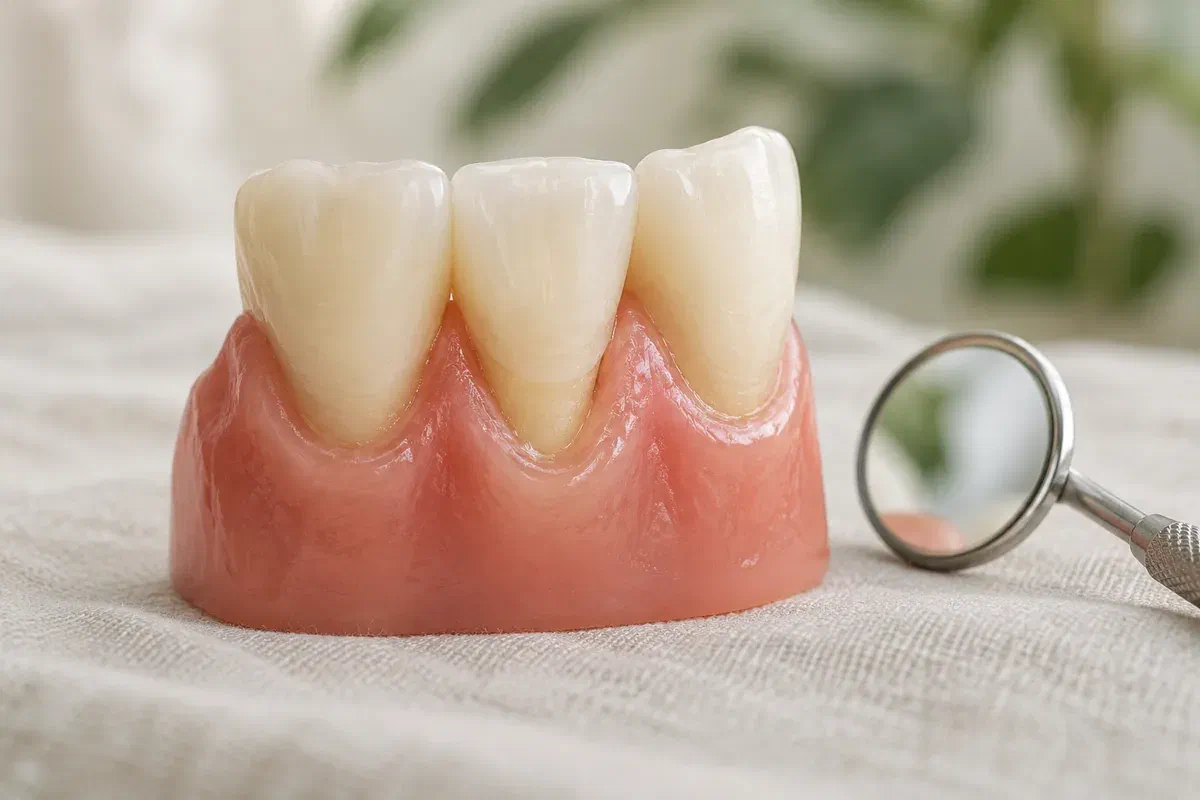
Illustrative teaching model showing an exposed tooth neck beside neighbouring teeth
A short checklist for the day

Bring the details so nothing has to wait for a second trip.

No home measurement is needed. Jot down what you have noticed and roughly when, and pack any earlier records or images that help show the timeline.

Which teeth look longer or uneven

Note whether one tooth or several are involved, and list any braces, crowns, fillings or gum treatment you have had. These details guide the examination. They cannot by themselves prove why the gum receded or confirm that it is still moving.

What the sensitivity feels like

Record the triggers, such as cold drinks, sweets or brushing, and how long each episode lasts. Exposed roots are often sensitive, but cracked teeth and decay can feel alike. Pain that lingers, appears without warning or keeps getting worse needs to be assessed rather than assumed.

Your current cleaning kit

Bring your toothbrush, floss or interdental brushes, and mention any area you avoid. Seeing your tools lets the team adjust your technique in the same visit. The goal is gentle, effective cleaning, not harder scrubbing and not giving up on the spot.

Painless recession is still worth assessing. If the gum swells up quickly, you see pus, the pain turns intense, or a tooth begins to wobble, call before setting out; depending on the situation, closer urgent care may be the safer first step.

What a thorough first visit offers

One clear baseline instead of repeated uncertainty

The goal is to come away knowing more than how much root is showing. The clinician checks for gum inflammation, looks for any evidence of periodontitis, and considers whether the site has changed over time. If there are no earlier measurements to compare, this visit lays down the first set, which makes future reviews meaningful.

What matters to you should guide the order of things. Sensitivity relief may be a different starting point from recession that appears to be advancing, or a spot you cannot clean well. Ask which concern each recommendation addresses and what will still be tracked afterwards, so you know what future appointments are for.

Patient information: Cambridge University Hospitals — recession factors and soft-tissue grafting

A record that justifies each return visit

Measurements taken now let the clinician judge any change later, so follow-up is purposeful. Ask which sites are being watched and how often they really need review. That is more useful than checking the mirror without any consistent reference.

Hands-on cleaning advice in one sitting

Discuss brushing pressure, suitable aids and any irritation spotted during the examination, and ask for a demonstration while you are in the chair. Advice should fit your mouth and routine. Gum thickness and tooth position are not things you can change through effort.

Clarity about any referral

A periodontist may help with a complex site or a graft discussion. Ask what the referral is meant to answer and whether a specialist closer to home is an option for you. Booking that consultation is a step toward information, not a promise to have an operation, and the specialist should go over benefits, limits, alternatives and recovery with you.

How the visit runs

History, examination, priorities, plan

Please mention tender areas or nervousness about gum checks at the start. The visit is about understanding what is happening, and nothing is booked or agreed before you have heard the options.

  1. Review your notes and history together

    Go through your symptom notes, earlier advice, past treatment, cleaning habits, tobacco use, health conditions and medicines. Say what you most want to leave with, whether that is comfort, a better appearance, or an idea of how likely further change is.

  2. Assess the gumline and supporting tissue

    The clinician examines the recession alongside gum health, tooth condition and other findings, using measurements or imaging where they answer a particular question. Ask what can be confirmed on the day and whether your older records suggest a longstanding feature.

  3. Set priorities you can act on

    Active disease or irritation is addressed first. After that, sensitivity care, monitoring or a specialist view can be compared. Ask what in the findings supports each recommendation, and which steps could be grouped into the same future visit.

  4. Leave with a routine and a realistic schedule

    You should have clear instructions for the affected teeth and a review interval that makes sense for the travel involved. Confirm which changes mean calling sooner and whether a referral is being arranged. If several steps are planned, ask about their order.

At home, between appointments

Small, steady habits do the most good.

Your routine should reflect the examination. Ask the team to show you exactly what to do, and avoid switching several products or methods at once on your own, so any change can be traced.

Keep to the cleaning method you were taught

A soft brush, gentle pressure and a suitable interdental aid are usually advised. Skipping the area allows plaque to settle, and scrubbing will not regrow gum. If an aid hurts, call to ask rather than waiting until your next visit.

Use sensitivity care, then report back

The clinician may recommend a desensitizing toothpaste or other protection after checking the tooth. Make sure you know how long to try it. Relief is welcome, but it does not mean the gum has recovered, and pain that changes deserves a phone call.

Save the comparison for the review

Attend the follow-up and describe any new symptoms or cleaning trouble. The clinician compares findings and adjusts the plan. Pulling at the gum or testing the tooth with cold drinks will not give you a reliable reading.

Choosing a direction

Monitor, treat or refer?

Ask what each choice is meant to achieve. Often the first step deals with active disease or daily care, and further treatment is reviewed afterwards, which can also help keep the number of visits down.

When observation suits the findings

Guided home care with scheduled monitoring

A change in technique, attention to local irritation and comparison at later visits may be all that is needed now. Ask why watching is appropriate and what would change that. A monitoring plan should have a clear schedule.

When disease, decay or sensitivity needs care

Treatment for the problem that is present

Gum disease, decay or a sensitive root surface may each need specific treatment. Ask what the treatment targets and what it will leave unchanged. Easing pain or repairing a surface does not alter where the gum sits.

When the tissue warrants further discussion

A specialist view on grafting or other care

For some sites, a periodontist may suggest grafting to build up thin tissue or to cover some of the exposed root, with results depending on the site and technique. Ask about realistic coverage, donor tissue, healing time and limits; complete coverage and an end to recession cannot be promised.

Patient information: American Academy of Periodontology — gum graft procedures

Questions from Etobicoke

Planning around a changing gumline

General information for planning. Your examination ties together the condition of the gum and the health of the tooth, so bring up both comfort and appearance.

(905) 876-4488
Can a receding gum turn into an emergency?
Recession on its own is usually not an emergency. Sudden swelling, pus, severe pain or a loose tooth may suggest a different problem and need prompt attention. Call us to describe what is happening, and seek closer urgent care if the situation calls for it.
How long does a receding gums assessment take?
Allow enough time for a history, examination and discussion, and longer if imaging is needed. When you book, ask the team how long to expect so you can plan your trip and the rest of your day.
Can my regular hygiene cleaning be done on the same day?
Sometimes, depending on scheduling and the findings. Ask when booking whether the assessment and cleaning can be combined, which can save a separate trip.
Should I get X-rays sent over from a previous dentist?
If recent images exist, it can help to have them forwarded before your visit. The clinician will decide whether any new imaging is needed for the questions being asked.
Do I need monitoring visits every few months?
Not necessarily. Review intervals depend on what is found. Some sites can be checked at regular dental visits; others need a closer look sooner. Ask what interval is planned and why.
Does smoking or vaping affect receding gums?
Tobacco use is linked to gum disease and can affect how gums heal. Mention it during the history so the clinician can consider it. Advice can include support for cutting back if you would like it.
Book ahead from Etobicoke

Arrive prepared, and leave with a plan.

Contact Milton Dental Clinic about receding gums, an exposed root, or sensitivity near the gumline. Send or bring earlier records if you can. When you book, mention that you are travelling from Etobicoke so the team can suggest a time and length of appointment that suits the trip.

What we recommend, including any referral, is decided only after the examination.

Visit Milton Dental Clinic
Unit 1, 342 Bronte St. S, Milton, ON L9T 5B7
Get directions Clinic hours
Monday–Thursday
11am–7pm
Friday–Sunday
By appointment only

Areas we serve

  • Milton
  • Oakville
  • Mississauga
  • Georgetown
  • Halton Hills
  • Acton
  • Campbellville
  • Brampton
  • Burlington
  • Puslinch
  • Rockwood
  • Erin
  • Caledon
  • Etobicoke
  • Old Milton
  • Bronte Meadows
  • Timberlea
  • Dorset Park
  • Dempsey
  • Clarke
  • Beaty
  • Coates
  • Harrison
  • Scott
  • Willmott
  • Ford
  • Bowes
  • Cobden
  • Walker
  • Mountain View
  • Milton Heights
  • Hawthorne Village
  • Valley View
  • Fallingbrook
  • Nassagaweya
  • Trafalgar
  • Esquesing
  • Nelson
  • Brookville
  • Moffat
  • Glen Williams
  • Norval
  • Limehouse
  • Stewarttown
  • Ashgrove
  • Hornby
  • Silver Creek
  • Speyside
  • Scotch Block
  • North Oakville
  • River Oaks
  • Glen Abbey
  • West Oak Trails
  • Palermo
  • Bronte Creek
  • College Park
  • Joshua Creek
  • Uptown Core
  • Preserve
  • Iroquois Ridge
  • Lisgar
  • Meadowvale
  • Meadowvale Village
  • Churchill Meadows
  • Erin Mills
  • Central Erin Mills
  • Streetsville
  • East Credit
  • Creditview
  • Heartland
  • Sheridan
  • Mount Pleasant
  • Credit Valley
  • Huttonville
  • Churchville
  • Springbrook
  • Northwest Brampton
  • Bram West
  • Fletcher's Meadow
  • Fletcher's Creek South
  • Alton Village
  • Orchard
  • Millcroft
  • Headon Forest
  • Tansley
  • Brant Hills
  • Tyandaga
  • Kilbride
  • Lowville
  • Aberfoyle
  • Morriston
  • Arkell
  • Hillsburgh
  • Freelton
  • Carlisle
  • Waterdown
  • Flamborough
  • Mountsberg

How can we help?

Milton Dental Clinic

Have a question about your smile? Choose the option that works best for you.

For urgent dental concerns, please call.
Messages are reviewed during clinic hours.