

Illustrative patient and clinician discussing assessment of a retained tooth root
Specialized Care

Retained Root Removal in Acton

Been told to “keep an eye on” a root fragment and unsure what that involves? From Acton, you can have the root reassessed, learn what active monitoring looks like, and understand when removal or a surgeon’s opinion would make more sense.

When the advice is to wait and watch

Monitoring a root is a plan, and it should feel like one.

Not every piece of root left in the jaw needs to come out. Some fragments, often small ones sitting deep in the bone, are safer left where they are than disturbed. Others, such as a decayed stump close to the surface or a root linked to infection, usually call for treatment. Many people are simply told to watch it, with little detail.

Whichever way the advice goes, it should rest on particulars you can understand: what symptoms you have, whether there is disease around the fragment, exactly where it is, and what removing it would put at risk. A tip lying near a nerve may be best left alone, while a similar piece under thin gum may be more straightforward to reach.

For households in Acton, a monitoring plan is most useful when it fits real life. Tell us how the root was found, what you were told and whether anything has changed since. Bring any images or letters. We can reassess the site, explain what we see, and talk about whether removal or an oral surgery referral would be a better fit.

Book a monitoring review
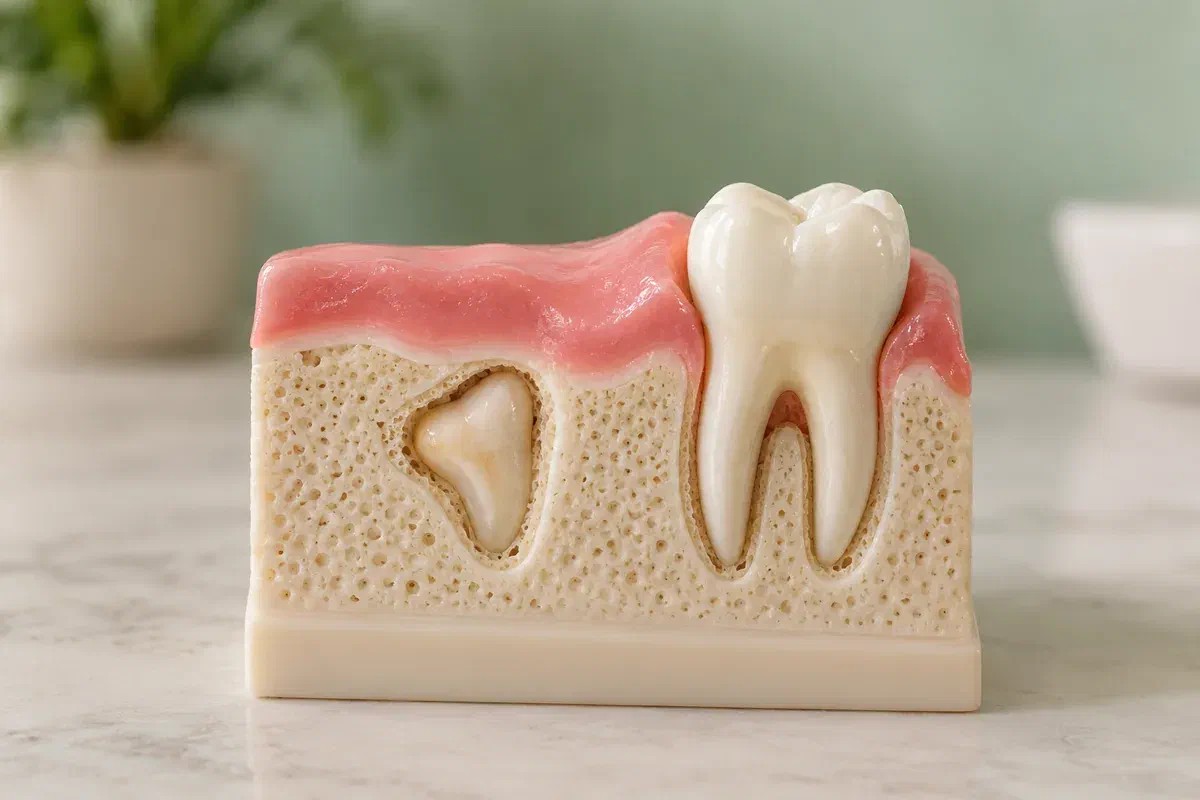
Illustrative cutaway teaching model showing a buried root fragment beside an intact tooth
Changes that end the waiting

These are the signs that a watched root needs another look.

You are not expected to decide when a monitored root has become a problem. If something feels different, describe it along with what you were told before, and let the clinician judge.

New pain, swelling or drainage

Any of these near a watched root is a reason to call, especially if they keep coming back. Say so if you have a fever or the swelling seems to be spreading. An examination confirms the cause; a sore spot nearby might still be coming from a different tooth or the gum.

A fragment you can now feel

A root that was buried may become noticeable at the surface as tissues change, or a hard spot may turn out to be bone. Do not try to work it out with tweezers. Note when you first felt it and whether it bothers your tongue, an appliance or your cleaning.

A new plan for the space

Deciding on an implant, bridge or denture changes the question. A root that was fine to leave alone may or may not affect the new plan. Ask what needs to be known before deciding, and remember that a fragment in the area is not an automatic reason for surgery.

Some symptoms cannot wait for a review date. Call 911 for difficulty breathing or swallowing, rapidly spreading swelling, or bleeding you cannot control. Urgent dental concerns without those signs should be phoned through to the clinic so we can talk about timing.

What a reassessment gives you

A reason to keep watching, or a reason to stop

A reassessment looks at whether the original balance still holds. On one side is what the root might cause if it stays; on the other is what removal would involve and the risks it carries. You should come away knowing which way that balance tips today and why, based on your own findings.

It can also clarify how the root fits with anything else you are planning. Removing a fragment may settle one concern while a gap still needs filling, and leaving one may affect future treatment in the same area. Talk about timing, follow-up and who will keep the overall plan joined up.

Patient information: York and Scarborough Teaching Hospitals — retained fragments and surgical risks

A current picture of the root

Imaging can show whether the fragment or the area around it has changed since it was last checked. Ask the clinician to compare with earlier images if you have them, and to explain what the difference, if any, means. New images should have a clear reason behind them.

An answer about the right setting

If treatment becomes advisable, access, anatomy, medical history and the procedure needed will shape who should do it. You are welcome to ask why care can happen at our Bronte Street practice or why a surgeon is preferred, and what a referral letter would include.

A monitoring schedule you understand

If watching remains the advice, agree on when the next check should be and which symptoms mean calling before then. Keep the decision on file and mention it to any future dentist. Monitoring is active; it never means ignoring a change.

Reviewing a watched root

What changed, what we see now, and what makes sense next

If treatment worries you, or your last extraction was unpleasant, tell us at the start. Knowing that lets the clinician explain the findings carefully and plan the visit around your comfort.

  1. Catch up on the history

    Tell the clinician how and when the root was found, what was advised then, and anything that has changed. Your medicines and health are reviewed, with attention to bone-related treatment and any radiation to the jaw in the past. Please keep taking prescribed medicine unless the clinician in charge of it advises a change.

  2. Re-examine the site

    The clinician looks at the gum, neighbouring teeth and any previous images before explaining what has or has not changed. Fresh imaging is considered if it would affect the decision. This is a good moment to ask how reachable the root is and whether an oral surgeon’s opinion would add anything.

  3. Decide whether to continue watching

    Together you go over whether monitoring still makes sense, what removal would achieve, the alternatives and the relevant risks. If removal is now advised, find out whether surgical access is expected and how comfort will be managed. Agree on the plan and how surprises would be handled.

  4. Set the next step in writing

    If the root stays, note the next review date and the warning signs. When it is removed, the technique depends on its position and may involve working through the gum; ask what was done and whether a follow-up is needed. Either way, leave with written instructions.

Should the root come out

From watching the root to watching the healing

How recovery goes depends on the access needed, where the root sat and anything else done that day. Rely on the written instructions you are given, which replace any general advice from the past.

Resist the urge to inspect

After months of keeping an eye on a root, it is natural to want to check the area. Try not to probe it, tug at stitches or look for leftover pieces. Stick to the instructions on cleaning, food and activity, and describe any new sharp spot to the team.

Medicines and sedation rules

Know how and when to take anything prescribed, and tell the team about a possible reaction. Leftover antibiotics are not a stand-in, and blood thinners are only adjusted on the prescriber’s advice. If sedation was used, its separate rules on getting home and supervision apply however you feel.

When to call instead of waiting

Confirm any review appointment and when replacement planning can resume. Phone about pain or swelling that builds, bleeding that does not stop, or numbness that is not easing. Having a check booked later does not mean you should wait out symptoms that are getting worse.

Your three choices

Watch, remove or refer, depending on what the root is doing

The best choice depends on the fragment and your health, and it can change over time. Ask how the benefits compare with the risks today.

When symptoms, infection or a new treatment plan tip the balance

Removal

If a watched root starts causing problems, or a new plan requires the space to be clear, removal may be advised. Some are simple to reach; others need surgical access. Ask what removal should achieve, whether more care follows, and what complications are specific to this root.

When leaving the root still carries less risk

Continued monitoring

If nothing has changed and the risks of removal still outweigh the benefit, monitoring may continue. That judgement depends on your examination, not just the absence of pain. Agree on how often to review it and which changes mean returning sooner.

When depth, anatomy or medical history adds complexity

Specialist opinion

For a root that lies deep or near important structures, an oral surgeon’s view can help settle the question. Ask what the specialist is being asked to decide and whether your images will be sent. Follow the interim advice and call if anything changes before then.

Monitoring questions from Acton

Living with a root that is being watched

Gaps in your records are common, especially if the root was noted years ago. Tell us what you remember, and the clinician can reassess from there.

(905) 876-4488
How often should a monitored root be checked?
There is no single schedule. It depends on the fragment’s location, its history and your overall dental health. Many people have it reviewed alongside regular checkups, with images only when they would add useful information. Ask the clinician what interval suits your situation.
What symptoms mean I should not wait for my next review?
Call if you notice new pain, swelling, discharge, a bad taste, or a hard spot near the site that was not there before. Seek emergency care for swelling that is spreading quickly or trouble breathing or swallowing. Otherwise, keep to the agreed review plan.
Does monitoring mean the root will eventually need to come out?
Not necessarily. Many monitored fragments stay stable for a long time. Monitoring exists so that a change can be caught and acted on if it happens. If the situation changes, the clinician will discuss whether removal or another approach has become the better choice.
Should I tell a new dentist about a root that is being watched?
Yes. Mention it and share any notes or images you have, especially before treatment in the same area. A written summary of where the fragment is and why it was left helps future providers understand the history and decide whether the plan still makes sense.
Can a watched root be left if I am planning an implant nearby?
Sometimes, but the implant plan changes the question. The clinician assesses how close the fragment is to the planned position and the surrounding tissue. A root that was reasonable to leave alone may need removal or further investigation before the implant goes ahead.
Will monitoring involve an X-ray every time?
Not necessarily. Images are taken when they help answer a question, such as whether something has changed or whether new treatment is planned nearby. The clinician will explain when imaging is useful and when an examination alone is enough.
Acton root reviews

Bring what you were told. We will check whether it still holds.

Contact us about a root that is being monitored, one you suspect, or one recently found. Let us know about symptoms, past surgery and any replacement plans, and we can discuss a reassessment and which records to bring.

Call about urgent symptoms. Any advice on treatment or referral follows an examination.

Visit Milton Dental Clinic
Unit 1, 342 Bronte St. S, Milton, ON L9T 5B7
Get directions Clinic hours
Monday–Thursday
11am–7pm
Friday–Sunday
By appointment only

Areas we serve

  • Milton
  • Oakville
  • Mississauga
  • Georgetown
  • Halton Hills
  • Acton
  • Campbellville
  • Brampton
  • Burlington
  • Puslinch
  • Rockwood
  • Erin
  • Caledon
  • Etobicoke
  • Old Milton
  • Bronte Meadows
  • Timberlea
  • Dorset Park
  • Dempsey
  • Clarke
  • Beaty
  • Coates
  • Harrison
  • Scott
  • Willmott
  • Ford
  • Bowes
  • Cobden
  • Walker
  • Mountain View
  • Milton Heights
  • Hawthorne Village
  • Valley View
  • Fallingbrook
  • Nassagaweya
  • Trafalgar
  • Esquesing
  • Nelson
  • Brookville
  • Moffat
  • Glen Williams
  • Norval
  • Limehouse
  • Stewarttown
  • Ashgrove
  • Hornby
  • Silver Creek
  • Speyside
  • Scotch Block
  • North Oakville
  • River Oaks
  • Glen Abbey
  • West Oak Trails
  • Palermo
  • Bronte Creek
  • College Park
  • Joshua Creek
  • Uptown Core
  • Preserve
  • Iroquois Ridge
  • Lisgar
  • Meadowvale
  • Meadowvale Village
  • Churchill Meadows
  • Erin Mills
  • Central Erin Mills
  • Streetsville
  • East Credit
  • Creditview
  • Heartland
  • Sheridan
  • Mount Pleasant
  • Credit Valley
  • Huttonville
  • Churchville
  • Springbrook
  • Northwest Brampton
  • Bram West
  • Fletcher's Meadow
  • Fletcher's Creek South
  • Alton Village
  • Orchard
  • Millcroft
  • Headon Forest
  • Tansley
  • Brant Hills
  • Tyandaga
  • Kilbride
  • Lowville
  • Aberfoyle
  • Morriston
  • Arkell
  • Hillsburgh
  • Freelton
  • Carlisle
  • Waterdown
  • Flamborough
  • Mountsberg

How can we help?

Milton Dental Clinic

Have a question about your smile? Choose the option that works best for you.

For urgent dental concerns, please call.
Messages are reviewed during clinic hours.